























Showing posts with label Love. Show all posts

Wednesday, September 16, 2026

Book Review - Alice Hoffman's The Rules of Magic

The Rules of Magic by Alice Hoffman
Published by: Simon and Schuster
Publication Date: October 10th, 2017
Format: Hardcover, 369 Pages
Rating: ★★★★★
To Buy (different edition than one reviewed)

Teenagers Franny, Jet, and Vincent live with their parents on the Upper East Side. For New York City in the 1950s their parents cherish their respectability and normalcy, which is why their children are never allowed below Fourteenth Street. Once New York City's grid starts to break down into villages and anything deemed "lower" it was off limits. They could not mix with the "other." But then again, their mother Susanna had a plethora of nonsensical rules; no walking in the moonlight, no Ouiji boards, no candles, no red shoes, no wearing black, no going shoeless, no amulets, no night-blooming flowers, no reading novels about magic, no cats, no crows, and never ever fall in love. Yet there was no denying that the children were odd and would do as they pleased, spending hours in Central Park or wherever their mother was least likely to find them. Then when Franny turned seventeen everything changed. Every Owens ever has had to spend their seventeenth birthday at the house Maria Owens built in Massachusetts. The current doyenne of the house on Magnolia Street is their Aunt Isabelle. Feeling that it's better to get things over and done with Susanna ships off all three of her children knowing they will finally learn the truth, they come from a long line of witches. They aren't just odd, they're magical. If you would have told them that this one summer would forever change the course of their lives they wouldn't have believed you. But it is the truth. They have all this power yet they are cursed. Those they love will perish. And their "wild child" cousin, eighteen year old April, also spending the summer with Aunt Isabelle is more of a catalyst than any of them could have guessed in regard to life and love. Yet three naive teenagers told that they must not love will soon realize that love, and magic, is everywhere. Even Vincent, who at fourteen, is trying to solidify a persona of cynical ladies man will one day be undone by love. First Franny starts to fall for her best friend Haylin, cherishing the letters they share over the summer. Then it's Jet's turn. Jet's romance that will change their family forever. She just doesn't fall hard, she falls hard for the wrong boy. He is descended from the man who tried to destroy Maria Owens resulting in the family curse. The families, despite being related, have continued to carry the grudge. And one perfect day in New York City both families will lose everything. Jet will be forever changed. Forever blaming herself for the lose of her love, her parents, her home, and her powers. But Franny, Jet, and Vincent slowly pick up the pieces of their lives and learn that love is worth it. Because to be human is to suffer loss. And sometimes, when the stars align, something miraculous can emerge from the rubble.

The Rules of Magic will leave you nostalgic for a life that was never yours. You will slip into the past and wander the streets of New York City and ponder all the paths both taken and untaken. You will fall in love, which you should do whenever you can. I remember the time I fell in love with the movie Vertigo. You might be asking, what does this have to do with this book? Well, actually, a lot as you will see. Because of how the studio system used to work when Kim Novak was lent to Paramount to make Vertigo Columbia got to have Jimmy Stewart for one of their films in return. It just so happened that the two leads would star opposite each other again in the reciprocal film, Bell, Book and Candle. In my mind Vertigo is one of the best films ever made, even if the ending is beyond tragic. But there will always be a part of me that couldn't help but wish that Jimmy Stewart and Kim Novak could get their HEA. One day when I was at Walmart I saw Bell, Book and Candle in the DVD dollar bin. I knew nothing about it other than that it starred Jimmy Stewart and Kim Novak and was only a dollar so I bought it. Years later I caught part of the movie on AMC during Christmas and remembered that long ago day in Walmart and dug the DVD out. Every Christmas Eve since has been spent watching Bell, Book and Candle with my family. It's our tradition to watch Gillian Holroyd and Shep Henderson fall in love. It just so happens she's a witch. One who walks barefoot through Greenwich Village and drinks at the local watering hole, the Zodiac Club, where her brother Nicky plays in the band. But one thing she forswears is love. To fall in love means to lose your powers. Of course, we all know where this is going. When I was rereading Practical Magic recently when Gillian Owens shows up on her sister Sally's doorstep with a car full of trouble her physical description is that of Kim Novak as Gillian Holroyd. I mean, the name was a bit of a giveaway that Alice Hoffman was a fan of the film, the description was a nail in the sole of a witch's foot. But nothing prepared me for how her love of Bell, Book and Candle would infuse The Rules of Magic. This book is a love letter to that film. It inhabits the same world while being its own thing. You can imagine the characters passing each other on the street one day and nodding to each other. And this is not just because Vincent one snowy day while out shopping with his sisters turns the streetlights out one by one like Nicky does on Christmas morning, but because of the whole spirit of this book. The worry about what you are verses what you are expected to be. Concern for giving into your powers. And the ever present conundrum of love. Can you give in to love when you are cursed to shun it? I just felt wrapped up love. Love of a film that means something to me with new characters that have grown to mean something to me. The Rules of Magic is a book I will return to as I do Bell, Book and Candle. It will become one of my traditions.

Friday, September 19, 2025

A Cruel Love: The Ruth Ellis Story

When I heard they were making a miniseries about the last woman executed in England I decided then and there that there would be no way I would watch this series. It would be too depressing. And then I decided to drop my BritBox subscription. I will never let a single day go to waste with a streaming subscription so I started to look for short shows to fill in this two week gap. After exhausting all the Agatha Christie I hadn't yet watched and hearing rave reviews about A Cruel Love, I caved. I blame Bessie Carter. I can do four episodes of about anything so I should have been able to handle this. Well, I should have stuck to my gut instincts. This was beyond depressing. A sort of fever dream of domestic abuse filmed with an almost Lynchian glamour of a woman battered and bloody and bruised. Yet there felt like there wasn't any grounding in reality. They just showed little vignettes of Ruth's life and her love affair with her "victim" David Blakely. Though I think "love" is a stretch. There was no love, cruel or otherwise here, it was people colliding into, using, and destroying each other in whatever way they could. The show seems to be wanting to say that it was the unspoken rules of society that Ruth dared to breach by aiming to better her life that lead to her death, which, while partially true, in that it lead to her being railroaded at trial, doesn't take into account her upbringing at all. She was raised to believe that all she deserved from life was abuse. She suffered at the hands of her father and then all her lovers, even the one "good guy" who basically turned this broken woman into a killer. And yet this is all told elliptically. In little flashes. The horrors of her childhood are mentioned in a throwaway line from her sister, who it should be noted was another victim of men having been raped and impregnated by their father. I just felt like this REAL LIFE STORY has something so important to say. It changed the law, as she was the last woman executed, and within a decade the death penalty was abolished. And yet the weight isn't there. It's more snippets of her degradation while still looking glamorous. There's no real history, what history I read about was thanks to the internet, and seriously, someone has to get onto how Ruth's mother was connected to the Cambridge Five. Now that's a true crime show I do want to watch. But this. This was a woman whose life was destroyed by men and her story is told and controlled by men. She doesn't really factor in until the end. She's about an eye for an eye and a stiff upper lip and not showing how her repeated abuse, her trauma, is what led her to this desperate act. She doesn't want to be seen as a victim and that is exactly how abusers get away with their crimes. They make their victims carry the blame and shame. Only at the end does she realize that she was sticking to a morality the others weren't playing by and by then it's too late to save herself. But maybe that's what makes this work, on some level, at least in the eyes of the reviewers who raved, because it was men who controlled, ruined, and then ended her life, and therefore, it's not really about her, it's about the patriarchy. Personally, I think it should have been about Ruth. But maybe I'm alone in this assessment.

Friday, March 1, 2024

Book Review - Malinda Lo's Last Night at the Telegraph Club

Last Night at the Telegraph Club by Malinda Lo
Published by: Dutton Books for Young Readers
Publication Date: January 19th, 2021
Format: Kindle, 415 Pages
Rating: ★★★★
To Buy (different edition than one reviewed)

Lily Hu knows she's different than other girls. It's not just that she's smarter and likes math it's that, unlike her best friend Shirley, she really doesn't have any interest in boys. Lily can use her parents' strictures as the reason why she doesn't date, but the real reason is she doesn't want to. Boys don't stir anything in her like they do Shirley. But then, one day helping out at Shirley's parents restaurant, Lily sees an ad in the paper that stirs something in her. It's for Tommy Andrews, a male impersonator at the Telegraph Club. She furtively rips the ad out and it becomes a talisman for her. A dangerous talisman. One day it slips out of it's hiding spot and her fellow classmate Kathleen Miller picks it up. Kathleen and Lily are the only two girls in the advanced math class, both with dreams in the heavens, and it turns out they have more in common than Lily thought as Kathleen says that she has been to see Tommy at the Telegraph Club. Her friend Jean took her and Kath will take Lily if she wishes. It is Lily's greatest wish to go, but the experience is more unnerving than she thought it would be. It's not lying to her parents and risking their safety, or even being in a bar with so many women free to be themselves, it's the fact that the Tommy of her imagination was a matinee idol yet the real Tommy is flesh and blood and female. How she's feeling inside is no longer hypothetical, it has shape and form, and that form is looking more and more like Kath. But there are consequences to Lily's actions, Shirley has warned her about Kathleen and in particular Kathleen's friend Jean who was thrown out of school when she was found with another girl in the band room. When she first heard the story Lily couldn't understand what could drive someone to do something so risky. Now she's endangering herself every minute with her thoughts and actions. But love, true love, is worth all the consequences.

When Last Night at the Telegraph Club was released to such acclaim, topping best of lists left and right, I thought it sounded like a rich historical fiction novel about the LGBTQ experience in 1950s San Francisco. And it is that, don't get me wrong, I just didn't think it would be so YA. And Last Night at the Telegraph Club is epicly YA in all the good and bad ways. YA, even YA done right, has a certain cringe factor, you're looking back at your teen years and you feel all the feels all over again. The sweats breaking out when you see your crush, the itch on your skin as they draw near, the horrible replay of how your tongue fumbled to form coherent words around them. It's all here. Even the horrible betrayal of a former best friend. Everyone's teenage years seem to distill down to the same level of hormonal tension and Malinda Lo has captured that universality for good and for ill. But she has also captured the deeper identity struggle that happens when you realize you're not like everyone else. I was also forcefully reminded of a situation I was in in college. One of my friends started dating a guy. She was Vietnamese and he was white. She knew her parents wouldn't approve so one day when they were on a date she told her mother she was with me. I was not informed that I was her alibi and called her house. Her cover was blown and thereafter she created a fake girl who she was hanging out with when she was really with her boyfriend. I commented that it was lucky she wasn't gay because otherwise her mom would be suspicious of this new girl friend. Her response was that "that wouldn't happen." Reading Lily's mom say there "are no homosexuals in this family" brought that moment back to me after twenty years. To have someone who you love so much deny who you are, I just don't get how anyone could be so cruel. Love is love. I'm just lucky enough to have been raised in a family that believes this.

Friday, January 5, 2024

Book Review 2023 #8 - Jacey Bedford's Rowankind

Rowankind by Jacey Bedford
Published by: DAW
Publication Date: November 27th, 2018
Format: Paperback, 473 Pages
Rating: ★★★★★
To Buy

When freed many of the rowankind took the Fae's offer to return to their homeland, Iaru. Yet there are those that stayed behind in Britain. They have made lives for themselves and have no desire to return to a homeland that they've never known. The humans though don't feel safe. They have treated the rowankind worse than slaves for hundreds of years and now those slaves have the power to fight back. And they are. In retaliation the humans are killing the rowankind. Reports of mass executions happening all over the country have reached the ears of the Fae and they want to take revenge. But Ross and Corwen beg the Fae council to let them attempt a diplomatic approach first before razing all of Britain. A major problem though is in educating the Fae that the world has changed. They have cloistered themselves in Iaru for so long they don't understand that being King isn't as powerful as it once was. The King has to answer to Parliament and they have to answer to the people. This will not be an easy fix and yet the Fae expect it to be. They expect Ross and Corwen to just walk up to the King and get him to make his subjects behave. In order to stop more bloodshed the couple are willing to attempt the impossible. And it really looks like it shall be impossible, George III isn't well, and the reason shocks Ross when she discovers it, the King has magic. Magic he isn't using. Much like Corwen's brother denying his wolf half, the King is denying his magic and it's making him very ill. Yet once contact is made Ross really hopes that they can reach some sort of agreement. But the Fae think they are taking too long and start demonstrating what they are capable of. If the populace was scared of a few rowankind with not much magic how are they going to feel about the Fae turning their beer into water and bringing about a blight to their crops? If everyone would just behave and trust each other for one minute perhaps everything will work out and Ross and Corwen can have their happy ending. Perhaps.

Rowankind doesn't really bring anything new to the table with regard to this trilogy but it does satisfactorily tie up all the loose ends. And there are many, from rescuing missing men to reinstating Gentleman Jim on his island. And there is also much politicking. Because the merging of two worlds, with magical citizens living in a nonmagical world, needs policies. There need to be laws to protect their rights and their bodies from harm. And it's a sad day when fictional Fae end up having more rights than many people do today. But that's just the world we live, and proves once again why I want to live in books and in particular this series. But while the politics do take center stage along with several notable politicians of the day, that's not all this book is about. We get one last piratical adventure, another shooting of London Bridge, a final Walsingham showdown, some more family drama, and lots of happily ever afters. Because this is fantasy and that means the good prevail, the bad fail, and everyone gets to sail off into the sunset. Plus there's just this wonderful message of the healing powers of love and that love is love. Ross is able to find love again even though she thought she never would after the death of her husband Will. Her brother David finds love with a rowankind servant Annie. Her brother-in-law is able to tame his beast due to the love of his partner Roland. Her Aunt Rosie reunites with her lost love Leo. Even the servants get in on the love with her maid Poppy marrying Yeardley. And, now that I think about it, this whole series is about finding your family, those who you love with your whole heart and soul. You don't have to be related by blood, I mean look what Ross had to do to her brother.... It's about finding your tribe. Be they pirates or pixies, when you find your people the world is so much better because they are there for you in good times and in bad and most importantly, they will fight for you and even help you burying the bodies. So here's a shout-out to all my family, I love you like I love books, and you know how much that is.

Friday, November 10, 2023

Queen Charlotte

When Queen Charlotte was announced I honestly think that I was more excited to see it than I was another season of Bridgerton. I have many issues with Bridgerton. Many. Mostly musical. In fact almost none of my issues involve the cast, which is lucky because several of them appear in Queen Charlotte as a "current" framing device, which honestly, aside from two heartbreaking scenes in the final episode they could have done without. But I have a feeling Shonda Rhimes might be playing the long game and was sneaking in a backdoor pilot to a new series starring Lady Danbury and Violet Bridgerton. Because as Lady Danbury so succinctly puts it, the likes of Lady Whistedown don't talk about the likes of them. Older women and their needs and their stories aren't talked about, they are fed on gossip and forgotten, which I heartily agree with and will agree with even faster if I never have to hear about euphemistic gardens ever again. As for the rest of the show? I'm of two minds. Part of me loved every single second of it, they obviously had a bigger budget, which apparently couldn't stretch to original music, please, seriously, stop it with the bad covers, but another part of me is seriously questioning the underlying meaning of the show. While this show is all about love conquering all, even mental illness, there's this other message that everything is in service to the King. The Queen loves the King, that I do not doubt, but her way of sacrificing all else for him means that she lost out on connecting with her children. She is a good Queen, but not a good mother, which is where the "current" storyline is important. But it undercuts this message that love conquers all. The dynastic push that George will live on is heartbreaking because it takes the journey we've been on and makes it transactional. Get wife get heir. And while their story starts out that way they find love. We don't see this happening with any of her children, which is why I think they should have been left out. The vision would have been clearer had they taken one concept and told it perfectly. And that one concept should have been love conquers all. Because Charlotte's love for George is all that matters in the end, much like George's mother loves him, and in a wonderful secondary plot how Brimsley loves Reynolds. This is what matters, love. And hella amazing acting. Seriously, I know Yellowjackets has really raised the bar on casting when it comes to the same character at different ages, but I really think that India Amarteifio takes it to a whole other level. I think that she and Golda Rosheuvel might be the same person at different ages. It's uncanny. But in the end, would I watch another season? Again, more willingly than Bridgerton but honestly I'm more excited to read the book and see how Julia Quinn put her spin on it.
Wednesday, June 21, 2023

Book Review - Malinda Lo's Last Night at the Telegraph Club

Last Night at the Telegraph Club by Malinda Lo
Published by: Dutton Books for Young Readers
Publication Date: January 19th, 2021
Format: Kindle, 415 Pages
Rating: ★★★★
To Buy (different edition than one reviewed)

Lily Hu knows she's different than other girls. It's not just that she's smarter and likes math it's that, unlike her best friend Shirley, she really doesn't have any interest in boys. Lily can use her parents' strictures as the reason why she doesn't date, but the real reason is she doesn't want to. Boys don't stir anything in her like they do Shirley. But then, one day helping out at Shirley's parents restaurant, Lily sees an ad in the paper that stirs something in her. It's for Tommy Andrews, a male impersonator at the Telegraph Club. She furtively rips the ad out and it becomes a talisman for her. A dangerous talisman. One day it slips out of it's hiding spot and her fellow classmate Kathleen Miller picks it up. Kathleen and Lily are the only two girls in the advanced math class, both with dreams in the heavens, and it turns out they have more in common than Lily thought as Kathleen says that she has been to see Tommy at the Telegraph Club. Her friend Jean took her and Kath will take Lily if she wishes. It is Lily's greatest wish to go, but the experience is more unnerving than she thought it would be. It's not lying to her parents and risking their safety, or even being in a bar with so many women free to be themselves, it's the fact that the Tommy of her imagination was a matinee idol yet the real Tommy is flesh and blood and female. How she's feeling inside is no longer hypothetical, it has shape and form, and that form is looking more and more like Kath. But there are consequences to Lily's actions, Shirley has warned her about Kathleen and in particular Kathleen's friend Jean who was thrown out of school when she was found with another girl in the band room. When she first heard the story Lily couldn't understand what could drive someone to do something so risky. Now she's endangering herself every minute with her thoughts and actions. But love, true love, is worth all the consequences.

When Last Night at the Telegraph Club was released to such acclaim, topping best of lists left and right, I thought it sounded like a rich historical fiction novel about the LGBTQ experience in 1950s San Francisco. And it is that, don't get me wrong, I just didn't think it would be so YA. And Last Night at the Telegraph Club is epicly YA in all the good and bad ways. YA, even YA done right, has a certain cringe factor, you're looking back at your teen years and you feel all the feels all over again. The sweats breaking out when you see your crush, the itch on your skin as they draw near, the horrible replay of how your tongue fumbled to form coherent words around them. It's all here. Even the horrible betrayal of a former best friend. Everyone's teenage years seem to distill down to the same level of hormonal tension and Malinda Lo has captured that universality for good and for ill. But she has also captured the deeper identity struggle that happens when you realize you're not like everyone else. I was also forcefully reminded of a situation I was in in college. One of my friends started dating a guy. She was Vietnamese and he was white. She knew her parents wouldn't approve so one day when they were on a date she told her mother she was with me. I was not informed that I was her alibi and called her house. Her cover was blown and thereafter she created a fake girl who she was hanging out with when she was really with her boyfriend. I commented that it was lucky she wasn't gay because otherwise her mom would be suspicious of this new girl friend. Her response was that "that wouldn't happen." Reading Lily's mom say there "are no homosexuals in this family" brought that moment back to me after twenty years. To have someone who you love so much deny who you are, I just don't get how anyone could be so cruel. Love is love. I'm just lucky enough to have been raised in a family that believes this.

Friday, June 16, 2023

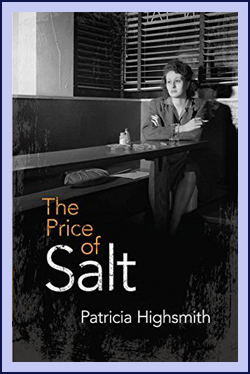
Book Review - Patricia Highsmith's The Price of Salt

The Price of Salt by Patricia Highsmith
Published by: Dover Publications
Publication Date: 1952
Format: Kindle, 260 Pages
Rating: ★★
To Buy (different edition than one reviewed)

Therese Belivet moved to New York in the hopes of being a set designer. But waiting and hoping and making models doesn't pay the bills so she is working at Frankenberg's department store during the holiday season. She's in the toy section selling dolls and is oppressed by the noise of the toy train by the elevators, the din of the customers, and the general chaos that working in retail entails. Her life is a grind, a depressing mix of cafeteria meals and hoping her boyfriend Richard comes through with a job opportunity for her in the theater after Christmas. All this changes when she sees Carol. Carol Aird comes into Frankenberg's to buy a doll for her daughter. The doll is to be sent to Carol's home in New Jersey and the address is emblazoned on Therese's heart. She doesn't know what possesses her but after Carol leaves she rushes to send her a card. Carol calls the store, intrigued by being sent a card from an employee of Frankenberg's. She wonders if this is common practice but learns that it, and the girl who sent it, are not in the least common. Carol is going through a divorce and is separated from her daughter Rindy for the holiday season so she takes in Therese like a stray. They drive around together, sit for hours doing nothing, listening to music, having dinners out, even getting a Christmas tree for which Therese makes all the decorations. They are fast friends. As Therese muses, "It would be almost like love, what she felt for Carol, except that Carol was a woman." But women can love. And that's one of the reasons that Carol is being kept away from Rindy. The divorce isn't going well because of something that happened in her past with her friend Abby. But what Therese feels, Abby could never have felt. As Carol and Therese take to the open road the future is wide open but their past is closing in.

The Price of Salt is a classic of lesbian fiction and it's easy to see why; two women fall in love and are given a chance at a happily ever after. This was something unheard of in literature of the time as it defied all tropes of the genre. Which makes it an important book even if it's a very flawed book. The problem is that both characters are enigmas. They are ciphers. Neither really shows themself to the other fully. We have full insight into Therese's fractured and half finished thoughts as the story is from her point of view but Carol is a conundrum. Yes, I know that they are two people dancing around a taboo subject and it isn't until their trip that they take the risk to finally put their feelings into words and actions, but this makes most of the book an almost excruciating read. It isn't just a "will they won't they" situation it's a Waiting for Godot level situation. And if you're not in the mood for that level of interminable fatalism, well, then this book might not be for you. For the most part it wasn't for me until it was. Because buried among all the things not done and said all of a sudden there's this heart of gold. Yes, I'm saying The Price of Salt should have been a road trip novella. Therese and Carol finally being a couple, just touring the country, oddly skipping Wisconsin on the way from Rockford to Minneapolis, I mean, who seriously goes via Iowa, is a delight. They take pictures and do things normal couples do, they talk, they love, and we learn more about them in these few chapters than in the whole rest of the book. Plus Highsmith, with her accomplished crime fiction background, has this delicious foreboding building. Could they be being followed? Has Carol's husband given her enough rope to hang herself? All the while there's that gun in Carol's suitcase and you can't help but wonder, will it be used? Could Highsmith be going for a dark ending for our lovers? Because literature of the day demands it. When she taps the breaks, that's when you realize what a genius she is. Just not a genius at editing.

Wednesday, June 7, 2023

Book Review - E.M. Forster's Maurice

Maurice by E.M. Forster
Published by: Book-of-the-Month Club
Publication Date: 1971
Format: Hardcover, 319 Pages
Rating: ★
To Buy (different edition than one reviewed)

Maurice Hall leads an unexceptional life. He is neither brilliant nor dense. He is comfortably middle of the road. But ever since his teacher took him aside one day when he was fourteen to tell him about the facts of life, due to Maurice's father being dead, Maurice has known he was different. He felt removed from marriage as being life's goal. He spent years lost in the fog of puberty and adolescence to one day find a hand reaching out of the mist to him making everything clear. That hand belonged to Clive Durham, and Maurice thought that Clive would be the love of his life. Because that is how Maurice is different, he has always been attracted to men, but never known the truth of himself till Clive. They were together throughout their years at Cambridge, Clive introducing him to the world of the Greeks. In fact Clive and Maurice spend several happy years together until one day Clive says that after his recent illness he is no longer attracted to men and now wants to marry and settle down with the woman of his dreams. Maurice doesn't know how to handle this new information. How does going to Rome turn you heterosexual? He is at sea and can only see two ways out, he shall either kill himself or cure himself. Perhaps hypnotism is the answer? A doctor whom he visits says he has a fifty percent success rate. Though it's clear that Maurice can not cure who he is. Yet little does he realize that perhaps Clive wasn't the love of his life. Perhaps life can go on without Clive. Biting the bullet and visiting Clive and his new wife at the ancestral pile, Penge, Maurice meets an insolent young under-gamekeeper, Alec Scudder, who answers Maurice's cry of need in the night. But does Alec spell ruin or redemption for Maurice? Either way, it spells the end of the comfortable suburban life he has been living till now. Because who knows if homosexual relationships, true human nature, will ever be accepted in England.

Maurice was written right before the outbreak of WWI yet was never published during Forster's lifetime. A select group of friends read it and passed it around between them but Forster didn't seem to think that it was worth it to publish the book during his lifetime. This is of course due to the public perception of homosexuality combined with his book having a happy ending. It would have been obscene libel and might have gone the way of Lady Chatterley's Lover. But there's a part of me that really wishes he had published it. To have an established author release a book that was a homosexual love story might have shaken up the society of the time and deservedly so. It shows two different, yet loving, homosexual relationships between consenting adults. I can't help but wonder if Maurice was published earlier, if more authors of the time showed that this is just human nature, that maybe, just maybe, acceptance would be more prolific. And perhaps it wouldn't have taken until 1967 to decriminalise homosexual acts in private between consenting adults. The publication of Maurice being delayed made it an odd duck. It felt like it's time had already been and gone, missing the boat completely. Not to mention that the execution is lackluster with Maurice almost being a caricature. And yet it was so refreshing to find characters who just accepted who they were. Clive Durham never denied that he preferred men. Never. From his youngest yearnings he was honest with himself and his honesty let Maurice realize his own truth, that he too had always been only attracted to men. But was Forster really advocating for being openly in love? Maurice tells Alec that two against the world can do anything. Well, to me, that means to live in defiance of society, to take on the world. To Maurice it means to retire from society and hide in the greenwood like actual fairies. WHAT!?! I thought two against the world can do anything? So true love is acceptable only by complete removal from the society that is trying to conform them? The choice offered here isn't really a choice. You can make yourself an outcast, and let society win, or conform with society and let society win. Don't you get it? Love wins!

Friday, May 19, 2023

Book Review - Jacey Bedford's Rowankind

Rowankind by Jacey Bedford
Published by: DAW
Publication Date: November 27th, 2018
Format: Paperback, 473 Pages
Rating: ★★★★★
To Buy

When freed many of the rowankind took the Fae's offer to return to their homeland, Iaru. Yet there are those that stayed behind in Britain. They have made lives for themselves and have no desire to return to a homeland that they've never known. The humans though don't feel safe. They have treated the rowankind worse than slaves for hundreds of years and now those slaves have the power to fight back. And they are. In retaliation the humans are killing the rowankind. Reports of mass executions happening all over the country have reached the ears of the Fae and they want to take revenge. But Ross and Corwen beg the Fae council to let them attempt a diplomatic approach first before razing all of Britain. A major problem though is in educating the Fae that the world has changed. They have cloistered themselves in Iaru for so long they don't understand that being King isn't as powerful as it once was. The King has to answer to Parliament and they have to answer to the people. This will not be an easy fix and yet the Fae expect it to be. They expect Ross and Corwen to just walk up to the King and get him to make his subjects behave. In order to stop more bloodshed the couple are willing to attempt the impossible. And it really looks like it shall be impossible, George III isn't well, and the reason shocks Ross when she discovers it, the King has magic. Magic he isn't using. Much like Corwen's brother denying his wolf half, the King is denying his magic and it's making him very ill. Yet once contact is made Ross really hopes that they can reach some sort of agreement. But the Fae think they are taking too long and start demonstrating what they are capable of. If the populace was scared of a few rowankind with not much magic how are they going to feel about the Fae turning their beer into water and bringing about a blight to their crops? If everyone would just behave and trust each other for one minute perhaps everything will work out and Ross and Corwen can have their happy ending. Perhaps.

Rowankind doesn't really bring anything new to the table with regard to this trilogy but it does satisfactorily tie up all the loose ends. And there are many, from rescuing missing men to reinstating Gentleman Jim on his island. And there is also much politicking. Because the merging of two worlds, with magical citizens living in a nonmagical world, needs policies. There need to be laws to protect their rights and their bodies from harm. And it's a sad day when fictional Fae end up having more rights than many people do today. But that's just the world we live, and proves once again why I want to live in books and in particular this series. But while the politics do take center stage along with several notable politicians of the day, that's not all this book is about. We get one last piratical adventure, another shooting of London Bridge, a final Walsingham showdown, some more family drama, and lots of happily ever afters. Because this is fantasy and that means the good prevail, the bad fail, and everyone gets to sail off into the sunset. Plus there's just this wonderful message of the healing powers of love and that love is love. Ross is able to find love again even though she thought she never would after the death of her husband Will. Her brother David finds love with a rowankind servant Annie. Her brother-in-law is able to tame his beast due to the love of his partner Roland. Her Aunt Rosie reunites with her lost love Leo. Even the servants get in on the love with her maid Poppy marrying Yeardley. And, now that I think about it, this whole series is about finding your family, those who you love with your whole heart and soul. You don't have to be related by blood, I mean look what Ross had to do to her brother.... It's about finding your tribe. Be they pirates or pixies, when you find your people the world is so much better because they are there for you in good times and in bad and most importantly, they will fight for you and even help you burying the bodies. So here's a shout-out to all my family, I love you like I love books, and you know how much that is.

Saturday, April 1, 2023

Regency Magic

Last year I read a lot of Regency themed books for my Regency Romp. Which made me actually question whether doing Regency Magic might have been a tad too much too soon. Yes, it's been four years since I last did Regency Magic and this subgenre is such a favorite of mine that I am a little baffled I didn't squeeze it in somewhere. And yes, I do totally organize my blog around the "what do I feel like reading" versus "what is popular" which means I have a legitimate excuse to indulge in something Austenesque with a side of magic. But somehow I just didn't. And then the question of should I even be doing it now kept repeating in my head on a loop. But then two things happened, I started craving anything set in the Regency and I picked up C.C. Aune's The Ill-Kept Oath. The cravings were obviously caused by my withdrawal after reading so many Regency set books last year and The Ill-Kept Oath was one of those books you read and it's just sheer perfection. You want to inhale it all and yet you never want it to end and I felt myself falling in love with Regency Magic all over again. And then I picked up Jacey Bedford's Rowankind series and the same thing happened again! I wasn't just falling in love with a subgenre all over again I was falling in love with reading all over again! Therefore I am beyond delighted to spend the next two months with C.C. Aune and Jacey Bedford, as well as the much loved Stephanie Burgis, and the new to me H.G. Parry. I can't wait for you to read their books! Join me on this journey, read along with me, keep an eye out for an Instagram giveaway or two, and if we ever meet in person, excuse me for yelling at you to pick up The Ill-Kept Oath by describing it as Jane Austen with trolls. And yes, that did happen. More than once.

Wednesday, April 6, 2022

Book Review - Eloisa James's My American Duchess

My American Duchess by Eloisa James 
Published by: Avon
Publication Date: January 26th, 2015
Format: Paperback, 402 Pages
Rating: ★★★★
To Buy

Perhaps Merry Pelford doesn't know what love is. Here she is questioning her betrothal to Cedric just minutes after accepting him. And Cedric's proposal is literally one she cannot break. She's told herself as much. After all, here she is, an American in England, because she has gained a reputation for breaking her promise back in Boston. In fairness, only one of her ex-fiances sued her and that was because he was obviously after her money and had borrowed against his expectations. Developing the nickname Mary Mary Quite Contrary left a bad taste in her mouth so her aunt and uncle bundled her off to the homeland of Merry's mother to make a match. That match is Cedric, not the enigmatic stranger she has just met on the balcony whom she is immediately drawn to. Cedric is her one true love. Cedric, Cedric, Cedric. If she says it enough maybe she'll believe it? But in a cruel twist of fate the man on the balcony is Cedric's slightly older brother and twin, the Duke of Trent. If he was anyone else perhaps there could have been a chance, but to jilt one brother for another? Even without her reputation Merry couldn't bring herself to do such a thing. But Trent is determined that his brother and Merry will not make it to the alter. He knew instantly that Merry was the woman he was to spend the rest of his life with. She is everything he never knew he needed. Therefore he starts a campaign against his brother. But Merry can not believe what Trent is telling her about Cedric. OK, so the engagement ring was actually a family heirloom that was intended for the next duchess, that could be an easy mistake. Be he's the brother of a duke, he has to have deep pockets, unlike her second fiancee, and as for his drinking? Merry doesn't believe that Cedric could possibly be a drunk, she would have seen the signs. Trent is just bitter. Or is Merry blinding herself to the truth because she is determined to go through with her marriage to Cedric? Because she is willfully blinding herself to the attraction she feels for Trent. Can she live a life of denial if it means she has a clear conscious? And will Trent let her?

My American Duchess works because of good characterization and humor in spit of it's flaws. Merry is a wonderful heroine because while she is actively on the marriage market marriage isn't the only thing that drives her. She is a fully rounded character with a mind and interests of her own. Often in romance the heroine might be a bit too much like Princess Imani Izzi in Coming to America. She likes whatever you like. Here Merry doesn't just have long lasting and loving attachments to the people and animals in her life, but she has a passion for landscape architecture. Of course she just refers to it as designing gardens, but seriously, she's a landscape architect who works with the land instead of doing a Frederick Law Olmsted and reforming it to be his Arcadia. She also takes great and delicious interest in the growing and eating of pineapple. But her flaw is her American exceptionalism. It's more acceptable when the heroine has direct connections to the founding of America and is proud of her fledgling country and how it differs from England, but it still left a bad taste in my mouth. The problem with American exceptionalism is that by thinking we're the best at everything we've eventually become this country where we're always great and number one and anyone who doubts our greatness should be vilified. It's just too easy to see how we went from Merry to the insurrection and that makes me cringe. I also don't really see why Merry has such a problem with her jilting men. I agree with Trent who didn't care how many people she had jilted, she "would be considered an excellent prospect whether [she] had discarded three or thirty fiances." Because marriage is forever you have to make sure you've got it right. You have to make sure that person is the one. Which of course leads to Trent and Merry denying that love should enter into the equation and that marriage should be built on friendship and passion. OK, but isn't that the basis of love? And the continual denial from Trent that this is love drove me a bit batty. But then again he marries a woman who didn't realize he was her fiances twin. Were they not identical? Or did Trent look that different because of his brawny physique?

Wednesday, June 2, 2021

Season 17 - Fortunes of War (1987-1988)

As a person with an obsessive disorder once I find a film I love I will just watch it over and over again. This was very bad on VHS tapes when I was young. I would literally wear them out. I even once wore out a DVD set... At the beginning of high school the film being obsessed over was Dead Again. Doomed lovers reincarnated to not only get their happily ever after but to get revenge for their deaths? Oh yes please! What I loved most about it was the fact that Kenneth Branagh and Emma Thompson weren't just lovers in the film but their love was real! I became a little obsessed with their relationship and would watch anything they were in together, with especial love for Peter's Friends and Much Ado About Nothing. In our house we had a book on the history of Masterpiece Theatre and there was a picture in it from Fortunes of War. Seeing as this was the miniseries they met on and where they fell in love, to me, this was the beginning of their love story and therefore it was very important that I watch it. At the time you couldn't rent the miniseries so I had to content myself with drawing the picture in the book. I remember that I was convinced the only way to get Emma's hat right was with watercolor pencils. Let's just say I'm still not the best with this medium and when I was a teenager I was worse. I kind of ruined the picture and moved on to obsessing over the movie The Tall Guy, Emma Thompson, Jeff Goldblum, pure genius. By the time I finally got to watch Fortunes of War Kenneth and Emma's marriage had imploded, and she had thankfully found love again in the arms of Willougby and as I thought at the time, Kenneth could go fuck himself. In fact I kind of still feel that way but begrudgingly admit he occasionally has talent. So it was bittersweet seeing this miniseries that meant so much to me long before I had seen it. In fact, in my mind, they aren't the stars of this miniseries. Yes, I know, I know, it says they are, but Ronald Pickup as Prince Yakimov stole the show. He had a little bit of an Edward Gorey vibe with his long fur coat, and I just adore him. And when he met his tragic end in Greece, not only did I learn about the atrocities the Nazis perpetrated on the Greek, but I also felt like I had lost a friend. RIP Prince Yakimov. But thankfully Ronald Pickup was still making movies and television shows until his death at the age of 80 this year.

Wednesday, May 22, 2019

Book Book of 2012 - Mary Robinette Kowal's Glamour in Glass

Glamour in Glass by Mary Robinette Kowal
Published by: Tor
Publication Date: April 10th, 2012
Format: Hardcover, 336 Pages
Rating: ★★★★★
To Buy

Jane and Vincent have become quite the powerful couple. Working side by side they have elevated Vincent's art, their art, to a new level. The Vincents are the toast of London, with the Prince Regent throwing a dinner in their honor in recognition of the magnificent grotto they have created for his opulent New Year's festivities. Yet being a woman Jane is confined to societal expectations, and the lack of recognition that goes with it. Even newspapers articles praising the work done for the Prince Regent omit her entirely. Jane doesn't want to be easily pushed aside after dinner when the men sit and talk and the women "retire." Jane has no desire to retire! She wants to be next to Vincent discussing magic and politics and all the things that matter in the world, not shut up in some parlor til the men deign to come to them! These after dinner traditions make her realize more then anything how lucky she is to have found Vincent, who views her as his equal.

The question of how to follow up their success leads them to consider a different path. They have some freedom at the moment and they never did have a honeymoon... With the continent recently open for travel with the exile of Napoleon, Vincent suggests a visit to his fellow glamourist, M. Chastain in Belgium. Not only has M. Chastain created a school for glamourists, but he has created a new technique that Vincent longs to see for himself. To travel with her husband and be surrounded by others able to work their craft and to perhaps learn more than she was able to learn on her own is a dream come true to Jane. Though the journey there is not without peril. The continent is not as safe as they had hoped. Troops are rallying for Napoleon and it is rumored that he shall escape Elba and make an attempt on reclaiming his throne.

Being surrounded by glamour is inspirational to Jane and she stumbles upon an idea while playing with M. Chastain's daughter on the steps inside the house. What if you could capture a glamour in glass, thus making it portable? In particular, what if they tried it with Vincent's Sphere Obscurcie, which makes a person invisible, but only in a fixed location. The Vincents don't see this revelation as anything that could be used as a tactical benefit in armed combat, but others do. This discovery could mean defeat or victory at the hands of Napoleon. A discovery the Bonapartists would gladly kill for. Though the return of Napoleon isn't the only hitch that has been thrown into Jane's world. She has discovered she has a condition that will not allow her to work glamour. She is with child. Will Vincent still love her if they are no loner able to work side by side and she where to become a more traditional wife? As she quickly sees, Vincent is already keeping secrets from her and not confiding as much as he used to now that she is no longer with him at all times. Yet, when Vincent is threatened, Jane might be the only one able to save him.

The declaration of my adoration of Glamour in Glass that started the first review I wrote of this book years back now hasn't changed. As I return to this series I am even more enamored of the world Mary Robinette Kowal has created. Each installment in this series just finds me more and more enthralled. Instead of just continuing on the trajectory she created in Shades of Milk and Honey, making more Austenesque books, Mary Robinette instead delves deeper into the time period creating a richer tapestry then Jane Austen ever did. While the mix of magic and the Regency world was what captured me initially, Mary Robinette has added in a level of French history that I am always drawn to, IE, the despotic wacko, Napoleon. How could you not love magic and deceit and Napoleonic spies? Napoleon and his hundred days, sigh. It is literally in my blood to be drawn to his time period. My great great great however many greats need to be there, relative was a high muckety-muck for Napoleon, François Joseph Lefebvre, the Duc de Danzig. Family legend always had it that he had actually abandoned Napoleon during the hundred days, turns out, that wasn't quite the case... but, well, would you like to say you rallied to him? At least François's portrait is still at Versailles...

But the history is just a richness and plot contrivance that aids the deeper themes of the book; that of love and passion. As Vincent has shown to Jane, the most wonderful, the most true art is seated in our passions. The true artist thrives on their emotions and is driven by them. This passion makes us artists capable of things we didn't even think we could do, and I'm not just saying pulling a week of all-nighters sewing beads on a David Bowie puppet, though I have done that. Glamour in Glass pointedly shows how much our passions are able to push us beyond what we thought we could endure and achieve. Being driven by their passions leads to Jane and Vincent's new discoveries and new techniques, such as literally incising glamour into glass to create a portable invisibility field. But the heart of the matter is in their connection, their passion for each other. Because of this Jane is able to save her husband's life, quite literally. She is driven to create an elaborate and ultimately successful rescue attempt for Vincent all by herself because her ingenuity and drive is powered by her passion.

It is this love and passion that is so achingly perfect. When I think of what true love means, the marriage of true minds, it is the love embodied by Jane and Vincent. Jane is chaffed by the restrictions of her sex, she is a modern and amazingly capable woman who is not of her time. Vincent sees this and loves this in her. They are a modern couple who defy the expectations and mores of the time they live in. Vincent is even willing to buck the Prince Regent so that Jane can partake in after-dinner conversation instead of retiring to her designated seat in the parlor with the other women. They rely on and support each other in a way that makes the heart ache to have something so precious. Their love is so strong that they aren't shoved into the stereotypical romance tropes where the damsel in distress is rescued by the knight on a white steed in shining armor. Their love allows Jane to be the rescuer.

It is this love and passion that is what will last of their legacy. Because what interests me about their chosen art form is it's transient nature. A Glamoural is almost performance art. It is pulled from the ether and will one day return. It is fixed, it cannot move, and is meant to be an adornment that can easily be changed, almost as easy as redecorating. I can't help but think of the three months that Vincent and Jane spent creating the grotto for the Prince Regent's ball. It is a one night spectacle. Created for a single event and then it will be torn asunder. Gone in a flash to be replaced by the next sensation. The thing that always drew me to sculpt and build and paint was that after you were done you had something physically left over. Some tangible proof of your exertions. But then I started doing theatre, and in theatre you build something, you sweat and toil and in the end, after the run, you tear it all down. This was so hard for me to accept. To willingly destroy what you had made because the time limit was done. So while I ponder the inevitability and the end of all things, including this series, at least the love of Jane and Vincent lives on in Mary's "Histories". Their love is one for the ages.

Friday, January 18, 2019

Book Review 2018 #4 - Tasha Alexander's The Adventuress

The Adventuress by Tasha Alexander
Published by: Minotaur Books
Publication Date: October 13th, 2015
Format: Hardcover, 304 Pages
Rating: ★★★★★
To Buy

Jeremy, the Duke of Bainbridge, has dedicated his life to achieving the title of the most useless man in England. He wants to live a life of semi-debauchery and avoid all the society mothers trying to snare him for their daughters. He knows he will have to wed eventually, his younger brother Jack would never forgive him if he inherited the Dukedom due to Jeremy's licentious lifestyle. But Jeremy claims his dear friend Lady Emily holds his heart, and since she is happily married, his finding connubial bliss is never going to happen. Emily sees his infatuation as nothing more than hyperbole and is proven right when Jeremy falls victim to the wiles of an American buccaneer. Amity Wells is the dream woman, she might even be more debauched than Jeremy! She knows what he needs even before he does. So what if she's a little loud, a little beyond the pale, she's the girl for Jeremy. A girl who Emily realizes she will never be friends with within minutes of meeting her. Yet Jeremy is Emily's oldest and dearest friend and for him she will make an effort. She will stick her courage to the sticking place and celebrate his engagement in the extravagant manner to which Amity is accustomed.

Amity plans a grandiose engagement party on the French Riviera with her parents footing the bill. There are excursions everyday, on land and on sea, nightly walks along La Croisette, delicious dinners, and sumptuous breakfasts. Amity even prides herself on organizing a lads night for Jeremy and his friends at the local casino where there will be dancers direct from Paris. Though that particular festivity ends differently than anyone expected, with Jeremy's friend, Chauncey Neville, dead in Jeremy's suite of an apparent suicide. Emily isn't convinced this dear, sweet man would have ended his life in such a fashion. Yet Emily's husband Colin tells her that with suicide it's not like their murder investigations, they aren't neatly wrapped up, there will always be questions which they will never know the answers to. Emily isn't sure. Even if Colin doesn't want to investigate she feels it necessary to start a discreet investigation. This will at least distract her for the forced joviality of those remaining after Mr. Neville's funeral and Amity's brother Augustus who puts her on edge. But soon weird things start to happen to discredit Emily. Could she be getting close to a truth someone wants hidden? Or does Amity just want her out of the way?

Years and years ago I became obsessed with this miniseries I kept stumbling upon on one of the higher cable channels in the middle of the night. I had no idea what it was called because I would always find it after the opening credits and would usually fall asleep before the end credits rolled. Remember, this was the nineties. Not everyone had computers they could access and find the answers they sought in an instant. As for my trusty TV Guide, well... it didn't list the higher channels in some sick game it liked to play with me where it loved to leave me in ignorance. And yes, I fully believe it was sentient and thought this was funny. Therefore I spent years in ignorance clutching to the few facts I knew. The miniseries starred Carla Gugino, the star of the Thanksgiving Pauly Shore classic Son in Law, and that the house from the Brideshead Revisited miniseries was in it. It turns out I was watching the 1995 adaptation of Edith Wharton's unfinished novel The Buccaneers. The story is about four eligible and wealthy young American girls who go to England to marry into the aristocracy. If I had known these women were called buccaneers perhaps I would have figured out the title earlier. But as it was, all I knew is I wanted to be one, despite not being the daughter of a robber barren. I could become British through an advantageous marriage! And yes, this dream is still with me.

My obsession with these young buccaneers is what enthralled me with Tasha's The Adventuress. I was getting to read a murder mystery with a buccaneer at the center, Amity Wells! Dream come true! Like Emily, there was something I instantly disliked about Amity, but at the same time I was drawn to her. The little chapters spaced between Emily's narrative showed a different side to Amity. Could Emily be an unreliable narrator in this instance? Could Amity really want to befriend Emily? Amity being so "American" as the Victorian Brits would put it left an interesting impression in my mind. She's very layered, making her a far more worthy adversary for Emily than some of her past cases gave her. This is a girl who has a secret, yet at the same time her desire for freedom and to get out from under her parents makes her almost reckless in the way she's willing to morph herself into Jeremy's perfect mate. This made me think of her as a kind of Victorian mean girl. She's outside the pack, but also setting the rules. It's an interesting dichotomy. I couldn't help thinking of her as Emma Roberts from American Horror Story or Scream Queens. She comes into any situation and can be either the ringleader or the victim depending on how she decides to play it. But underneath there's iron. She's getting her way and just playing her part to get it.

Though Amity's most interesting purpose within the story is not how she affects Emily as a person with all her Americanness, but how just her presence will forever change Emily's relationship with Jeremy. Even if Emily doesn't believe for an instant that Jeremy is hopelessly in love with her and is convinced he's using it as an excuse to avoid marriage, losing his constant attention and devotion that she is constantly plied with is a blow. She views that she is losing the Jeremy that she's always known. He's not flirting with her, he's not as attentive, he's not pissing off Colin with comments about how he and Em would make the perfect couple. In other words, his attentions are firmly on his fiance and Emily has to come to the cold hard conclusion that this annoys her. She liked being the center of Jeremy's world. She liked all the attention she was getting. Whenever she was feeling down Jeremy could boost her ego with a few remarks. And throughout the story she views this change as a negative. The fact is that Jeremy has grown up and Emily hasn't. You can see the lie clearly when Emily tells Amity that Emily's relationship with Jeremy will be in flux until it settles into the new pattern of them both being married. We've followed Emily on all her adventures and her behavior to Jeremy has never changed. Luckily for Em things turn out all right for her in the end.

But this change in Emily and Jeremy's relationship brings to the fore one very important question. Does Jeremy really love Emily? Yes, he obviously loves her as his closest and dearest friend as she does him, but could Emily be so blind that she's never realized that Jeremy is indeed in love with her? I think she is. What's more, I think Colin knows and is a bit exasperated that Emily, his astute wife who is able to see murder where everyone else sees suicide, can not see behind the flirtatious ways of Jeremy to see his real feelings are a deep and abiding love. I don't just have my observations that I've coupled with Colin's, oh no, for the first time in Amity's storyline we see how Jeremy felt about an incident that happened in A Fatal Waltz: "That kiss. That kiss. Could it be that, at last, he had found someone who could make him forget another kiss, on a cold day in Vienna? A kiss that ought never have happened, but that still consumed him, even after all these years?" He was CONSUMED by his kiss with Emily! CONSUMED! If he hadn't loved her before he obviously has been in love since that day and it makes me pity Jeremy and just want the best for him. To have a love that is never to be? He deserves some happiness. He deserves someone who loves him like Emily loves Colin. Oh, how my heart breaks for him.

And because I don't feel like ending this review on a sad "Poor Jeremy" note I'll end it on the Roman Feast that Amity was planning for the excursion to Nice and the visit to the ruins at Cimiez. Everyone was throwing themselves into this feast that would let them live in the decadent style of a Roman if just for a night. Well, everyone except Colin, who would not be caught dead in a toga, and Emily, who prefers Greece to Rome. There's a part of me that awhile back would have been all for it. I didn't know anything about Roman feasts, except vomitoriums, because obviously growing up kids remember the disgusting stuff. Within the story they mainly talk about the clothes and that eating is done while reclining, something I can never believe is good for the digestion. But I know OH so much more all thanks to Sue Perkins, Giles Coren, and their show, which used to be available on Hulu, The Supersizers. The Supersizers "went" to different time periods and "ate" different decades, and the weird title shift is what happened between season one and two. For the finale of season two they "ate" Ancient Rome. I was fully nauseated by the whole episode. Seeing as a feast might start with such "tasty" dishes as brain and rose petal patina I'm saying right now, you are NEVER getting me to EVER participate in any kind of authentic Roman Feast. You can see why Emily wants to stick to Greek foods!

Wednesday, November 14, 2018

Book Review - Tasha Alexander's The Adventuress

The Adventuress by Tasha Alexander
Published by: Minotaur Books
Publication Date: October 13th, 2015
Format: Hardcover, 304 Pages
Rating: ★★★★★
To Buy

Jeremy, the Duke of Bainbridge, has dedicated his life to achieving the title of the most useless man in England. He wants to live a life of semi-debauchery and avoid all the society mothers trying to snare him for their daughters. He knows he will have to wed eventually, his younger brother Jack would never forgive him if he inherited the Dukedom due to Jeremy's licentious lifestyle. But Jeremy claims his dear friend Lady Emily holds his heart, and since she is happily married, his finding connubial bliss is never going to happen. Emily sees his infatuation as nothing more than hyperbole and is proven right when Jeremy falls victim to the wiles of an American buccaneer. Amity Wells is the dream woman, she might even be more debauched than Jeremy! She knows what he needs even before he does. So what if she's a little loud, a little beyond the pale, she's the girl for Jeremy. A girl who Emily realizes she will never be friends with within minutes of meeting her. Yet Jeremy is Emily's oldest and dearest friend and for him she will make an effort. She will stick her courage to the sticking place and celebrate his engagement in the extravagant manner to which Amity is accustomed.

Amity plans a grandiose engagement party on the French Riviera with her parents footing the bill. There are excursions everyday, on land and on sea, nightly walks along La Croisette, delicious dinners, and sumptuous breakfasts. Amity even prides herself on organizing a lads night for Jeremy and his friends at the local casino where there will be dancers direct from Paris. Though that particular festivity ends differently than anyone expected, with Jeremy's friend, Chauncey Neville, dead in Jeremy's suite of an apparent suicide. Emily isn't convinced this dear, sweet man would have ended his life in such a fashion. Yet Emily's husband Colin tells her that with suicide it's not like their murder investigations, they aren't neatly wrapped up, there will always be questions which they will never know the answers to. Emily isn't sure. Even if Colin doesn't want to investigate she feels it necessary to start a discreet investigation. This will at least distract her for the forced joviality of those remaining after Mr. Neville's funeral and Amity's brother Augustus who puts her on edge. But soon weird things start to happen to discredit Emily. Could she be getting close to a truth someone wants hidden? Or does Amity just want her out of the way?

Years and years ago I became obsessed with this miniseries I kept stumbling upon on one of the higher cable channels in the middle of the night. I had no idea what it was called because I would always find it after the opening credits and would usually fall asleep before the end credits rolled. Remember, this was the nineties. Not everyone had computers they could access and find the answers they sought in an instant. As for my trusty TV Guide, well... it didn't list the higher channels in some sick game it liked to play with me where it loved to leave me in ignorance. And yes, I fully believe it was sentient and thought this was funny. Therefore I spent years in ignorance clutching to the few facts I knew. The miniseries starred Carla Gugino, the star of the Thanksgiving Pauly Shore classic Son in Law, and that the house from the Brideshead Revisited miniseries was in it. It turns out I was watching the 1995 adaptation of Edith Wharton's unfinished novel The Buccaneers. The story is about four eligible and wealthy young American girls who go to England to marry into the aristocracy. If I had known these women were called buccaneers perhaps I would have figured out the title earlier. But as it was, all I knew is I wanted to be one, despite not being the daughter of a robber barren. I could become British through an advantageous marriage! And yes, this dream is still with me.

My obsession with these young buccaneers is what enthralled me with Tasha's The Adventuress. I was getting to read a murder mystery with a buccaneer at the center, Amity Wells! Dream come true! Like Emily, there was something I instantly disliked about Amity, but at the same time I was drawn to her. The little chapters spaced between Emily's narrative showed a different side to Amity. Could Emily be an unreliable narrator in this instance? Could Amity really want to befriend Emily? Amity being so "American" as the Victorian Brits would put it left an interesting impression in my mind. She's very layered, making her a far more worthy adversary for Emily than some of her past cases gave her. This is a girl who has a secret, yet at the same time her desire for freedom and to get out from under her parents makes her almost reckless in the way she's willing to morph herself into Jeremy's perfect mate. This made me think of her as a kind of Victorian mean girl. She's outside the pack, but also setting the rules. It's an interesting dichotomy. I couldn't help thinking of her as Emma Roberts from American Horror Story or Scream Queens. She comes into any situation and can be either the ringleader or the victim depending on how she decides to play it. But underneath there's iron. She's getting her way and just playing her part to get it.

Though Amity's most interesting purpose within the story is not how she affects Emily as a person with all her Americanness, but how just her presence will forever change Emily's relationship with Jeremy. Even if Emily doesn't believe for an instant that Jeremy is hopelessly in love with her and is convinced he's using it as an excuse to avoid marriage, losing his constant attention and devotion that she is constantly plied with is a blow. She views that she is losing the Jeremy that she's always known. He's not flirting with her, he's not as attentive, he's not pissing off Colin with comments about how he and Em would make the perfect couple. In other words, his attentions are firmly on his fiance and Emily has to come to the cold hard conclusion that this annoys her. She liked being the center of Jeremy's world. She liked all the attention she was getting. Whenever she was feeling down Jeremy could boost her ego with a few remarks. And throughout the story she views this change as a negative. The fact is that Jeremy has grown up and Emily hasn't. You can see the lie clearly when Emily tells Amity that Emily's relationship with Jeremy will be in flux until it settles into the new pattern of them both being married. We've followed Emily on all her adventures and her behavior to Jeremy has never changed. Luckily for Em things turn out all right for her in the end.

But this change in Emily and Jeremy's relationship brings to the fore one very important question. Does Jeremy really love Emily? Yes, he obviously loves her as his closest and dearest friend as she does him, but could Emily be so blind that she's never realized that Jeremy is indeed in love with her? I think she is. What's more, I think Colin knows and is a bit exasperated that Emily, his astute wife who is able to see murder where everyone else sees suicide, can not see behind the flirtatious ways of Jeremy to see his real feelings are a deep and abiding love. I don't just have my observations that I've coupled with Colin's, oh no, for the first time in Amity's storyline we see how Jeremy felt about an incident that happened in A Fatal Waltz: "That kiss. That kiss. Could it be that, at last, he had found someone who could make him forget another kiss, on a cold day in Vienna? A kiss that ought never have happened, but that still consumed him, even after all these years?" He was CONSUMED by his kiss with Emily! CONSUMED! If he hadn't loved her before he obviously has been in love since that day and it makes me pity Jeremy and just want the best for him. To have a love that is never to be? He deserves some happiness. He deserves someone who loves him like Emily loves Colin. Oh, how my heart breaks for him.

And because I don't feel like ending this review on a sad "Poor Jeremy" note I'll end it on the Roman Feast that Amity was planning for the excursion to Nice and the visit to the ruins at Cimiez. Everyone was throwing themselves into this feast that would let them live in the decadent style of a Roman if just for a night. Well, everyone except Colin, who would not be caught dead in a toga, and Emily, who prefers Greece to Rome. There's a part of me that awhile back would have been all for it. I didn't know anything about Roman feasts, except vomitoriums, because obviously growing up kids remember the disgusting stuff. Within the story they mainly talk about the clothes and that eating is done while reclining, something I can never believe is good for the digestion. But I know OH so much more all thanks to Sue Perkins, Giles Coren, and their show, which used to be available on Hulu, The Supersizers. The Supersizers "went" to different time periods and "ate" different decades, and the weird title shift is what happened between season one and two. For the finale of season two they "ate" Ancient Rome. I was fully nauseated by the whole episode. Seeing as a feast might start with such "tasty" dishes as brain and rose petal patina I'm saying right now, you are NEVER getting me to EVER participate in any kind of authentic Roman Feast. You can see why Emily wants to stick to Greek foods!

Wednesday, January 24, 2018

Book Review 2017 #3 - Natasha Pulley's The Bedlam Stacks

The Bedlam Stacks by Natasha Pulley
Published by: Bloomsbury USA
Publication Date: August 1st, 2017
Format: Hardcover, 352 Pages
Rating: ★★★★★ 
To Buy

Merrick Tremayne worries he may be going insane. Yes, prolonged removal from society for recuperation on his family estate in Cornwall doesn't help, but he has precedence; his mother went insane at about his age and is locked up in an asylum. A very nice asylum, but an asylum nonetheless. She claims she saw a stone statue move and Merrick is sure that he has just seen the same thing. Therefore the arrival of his old comrade in arms, Sir Clements Markham from the East India Company with his wife Minna is a welcome diversion. Clem wants Merrick to go with him to Peru and smuggle out some cinchona cuttings because India is in desperate need of quinine, which is made from the bark of the cinchona trees, and the Company is sick of paying the Peruvian monopoly. Merrick is uncertain, before his injury he wouldn't have questioned his ability to pull off this heist, but now? Yet Clem is insistent that the expedition needs Merrick. Their destination is New Bethlehem, lovingly christened Bedlam. The Tremayne family has a connection to that town going back generations. Merrick's grandfather lived there for awhile learning to speak Quechua. Therefore if their cover as "mapmakers" is exposed Merrick's connection might save their lives. Merrick accepts. Mainly because if he is going insane he might as well go out with one last great adventure. With their guide, Raphael, who is the local priest in Bedlam, Merrick learns that what is commonly accepted by the world at large isn't necessarily so once you get off the beaten track. There is danger in the woods, statues that are revered, and a mystery surrounding Raphael... how could this young man have known Merrick's grandfather for a start?

I love magical realism. I love seeing the world we know and love with that little something extra. That spark of magic that makes everything just that much more marvelous. Most people think of magical realism in a modern setting yet, when you think about it, my most favorite subgenre of all, Regency Magic, is magical realism but set in an historical setting. Because I love nothing more than magical historical fiction. Seriously, I can't think of a combination of all the disparate things I love coming together perfectly than in this motley blend. Which is why I love The Bedlam Stacks. Sure, it's set some twenty-two to thirty-nine years after the Regency, depending on whether you believe the Regency ended when Queen Victoria took the throne or before, but it has all those wonderful elements that I love about Regency Magic. There's the real, human need for quinine, but there's also the deeper human need for fables and folk tales and how they come to be. This gives The Bedlam Stacks a mythical quality. There's what is real and what people believe to be real. And Sir Clements Markham's 1859 journey for cinchona actually happened. It happened entirely different, but the core, the basic framework is there. Which is why the magic is so easily grafted on. It's believable that in this foreign country you could wander into a land that time had forgot. Because magic is just something we don't understand. As I remember Philippa Gregory saying in a talk once about writing The White Queen, she wrote the witchcraft as witchcraft because that is how it appeared to the people of the time. This merging of the magical and the historical results in a fairy tale that would be worthy of Doctor Who. Early Doctor Who. Because there's your learning moment and then there's your adventure.

But then there's the Steampunk element. As you probably have guessed over the years by my reading choices and some of my sartorial choices at conventions I have fully embraced Steampunk in many aspects of my life. And there is this element here. Though I would go further and analyze this more, because I think most people are basing this label on the cover coupled with Merrick's insistence that the statues in Bedlam are clockwork. Needless to say covers are designed to sell and Merrick is very much mistaken. Yet I do believe that categorizing The Bedlam Stacks on the outer fringes of Steampunk isn't wrong. The reason I believe this is because of the lamps. Yes, the lamp on the cover is one of them. Sure, they have clockwork in them, but it's not the clockwork in my mind that makes them Steampunk. What makes them Steampunk is that they are utilizing technology and knowledge available to them and creating something new and functional. Much like the fantastical creations in Steampunk based on steam power being the only option these lamps use clock gears to constantly stir up the pollen of the trees in the woods that give off light. The Bedlamites have made something that is completely unique to their region, trees with lighted pollen and a tendency to go boom, and found a way to make it work for them. Throughout the Stacks, there are just little things here and there that show the ingenuity of these people, but there is no greater example than in these lights. I also very much want one for myself.

While the Steampunk elements might be a fascinating aspect of this book it's not why I am so in love with it. What got me was the human element. The connection that each and every character has to the other. Clem and Merrick, who have a strained friendship, in fact prior to his injury Merrick didn't even think they would consider each other friends. Seeing them put through their paces and how their comradely nature erodes is a feeling anyone who has traveled with friends will relate to, and they didn't even have the ability to have the whole music/no music while driving argument. The business nature of Clem versus the more exploratory nature of Merrick allows Merrick to forge connections in Bedlam with the locals. He becomes a part of their community. And as the community of Bedlam is made up of all injured or disfigured people Merrick's leg injury doesn't seem like such a burden anymore. He is considered more fit than the majority of the residents. This, more than sitting in Cornwall with his brother, does more to help him recover than anything else. Yet it's his constantly evolving friendship with Raphael that is the cornerstone, the bedrock, the ONE THING, that this book is about. Two men, from totally different cultures and times, coming together to be friends. The layers of Raphael's reluctance that are broken down and through over time, that let Merrick see who he truly is, that's almost the most magical aspect of The Bedlam Stacks. Though I do have this caveat, their relationship is ambiguous to whether or not it evolves into romantic feelings. Some people are all for this, some people are not. I have no problem with this and do agree that what they felt for each other was love, but I'm uncertain if I think or want it to be romantic in nature. At the end this reveal seems a little forced. They love each other and I don't think it needs definition.

Throughout the whole story, magical and human, I have come to one conclusion, I would die of altitude sickness. I had kind of thought this in passing before but now I have 100% certainty. I would die. This started years ago when watching An Idiot Abroad with Karl Pilkington when he made it three-quarters of the way to Machu Picchu and gave up requesting a Sir David Attenborough-esque voice-over. I'm pretty sure this would be me. Is the journey worth the reward? Worth the pain? Well The Bedlam Stacks made me think 100% no. As Natasha Pulley said, she had no idea the horror of altitude sickness and now her research made sense once she experienced it first had. The inability to think, like you're living in a fog. The headaches, the nausea, the incapacitation, all of it! Weird asides like Sir Clements Markham being unconcerned his team were being followed, because he didn't have the ability to care or worry! Yet the nail in my coffin was the whole nosebleeds issue. As in you get them all the time up there where the air is clear. Here's the thing. I have a lifelong fear of nosebleeds. Why you might ask? Well, I used to have them daily. Also horrifically. Once I had a nosebleed while in Milwaukee when I was little that lasted the entire trip, two full days. I just laid on my uncle's living room floor thinking everything in his house is white what will he do if I get some blood spattered about... he went ballistic when he thought I broke his toy robot, which I didn't by-the-way. Once in grade school I got a nosebleed at recess that soaked my entire sweatshirt before I could get to the nurse's office. This all culminated in my having to have my nose cauterized in 2002. Therefore to willingly go somewhere where this could happen? Sorry I'm out. Ah books, showing us places we could never go to. Now that's magic.

Wednesday, December 27, 2017

The Blue Castle by L.M. Montgomery

The Blue Castle by L.M. Montgomery
Published by: Sourcebooks Fire
Publication Date: 1926
Format: Paperback, 4256 Pages
To Buy

"Okay, so this doesn’t really count as research, per se. The Blue Castle is the story of downtrodden Valency Stirling, the awkward cousin and perpetual poor relation, who finally kicks over the traces and blossoms into her own person, horrifying her family and delighting readers.

Yes, yes, all very well, but what, you may ask, does a novel set in rural Canada have to do with a murder suicide in Gilded Age New York? (Aside from Anne of Green Gables’s feelings about puffed sleeves.)

Here’s the answer: there are two female narrators in The English Wife: Georgie, an actress, and Janie Van Duyvil, younger sister of the murdered man. My little sister always gives me comments on the early chapters of my books. This time, she took one look at those Janie chapters and said, “You do realize that Janie is Valency Stirling, right?” Actually, I hadn’t realized. But, as always, my sister was right. (She has a habit of being right about these things.) Janie Van Duyvil and Valency Stirling are kindred spirits, quirky characters who have been cowed into conformity by overbearing mothers, both of whom are freed by the catalyst of a traumatic event: in Valency’s case, thinking she has only months to live; in Janie’s case, the death of her brother, disappearance of her sister-in-law, and savaging of her family’s reputation. So that’s why The Blue Castle is on this list. Also because it’s one of my favorite books of all time and everyone should read it, right away." - Lauren Willig

The official patter:
"An unforgettable story of courage and romance. Will Valancy Stirling ever escape her strict family and find true love?

All her life, Valancy Stirling lived on a quiet little street in an ugly little house and never dared to contradict her domineering mother and her unforgiving aunt. Then she gets a letter―and decides that very day things need to change. For the first time in her life, she does exactly what she wants to and says exactly what she feels.

At first her family thinks she's gone around the bend. But soon Valancy discovers more surprises and adventure than she ever thought possible. She also finds her one true love and the real-life version of the Blue Castle that she was sure only existed in her dreams..."

Friday, October 6, 2017

Book Review - Philip Pullman's The Collectors

The Collectors by Philip Pullman
Published by: Alfred A. Knopf
Publication Date: September 22nd, 2015
Format: Kindle, 24 Pages
Rating: ★★★
To Buy

On a winter's night at Oxford College Horley sits in the Senior Common Room with his guest Grinstead. As the room gets colder and the hour gets late the other occupants slowly leave while the two talk about Horley's recent purchase of a painting and it's link to another piece of art, a rather terrifying bronze monkey. The painting Horley bought because it was a rather arresting portrait of a young women with an enigmatic air whose expression seems to always be changing. The dealer he bought it from had already made the sale so the story that came with it appears to be genuine. The painting has never been in one owner's hands for long. But wherever it goes the bronze monkey is soon to follow, though occasionally it is the monkey that arrives first and the painting shows up later. These two objects have some connection that cannot be broken as the provenance of the two pieces has undoubtedly shown. As it so happens the monkey has just arrived in Horley's possession as payment for a debt just after he purchased the painting. He hasn't even opened the packing case but the fact of it's arrival proves the story to be genuine. At this point Grinstead almost demands of his host that the time has come for Horley to show him these two pieces. They return to Horley's rooms where things take a turn. Grinstead has not been entirely honest with Horley and the story that was told wasn't new to him. These two pieces have a storied past steeped in mysteries from a distant world. And their subjects? They might just be pleased at the fate of these two men.

The Collectors never registered on my radar when it was first released in 2014 because it was an audiobook and while I am a fan of books in all forms there's something about audiobooks that I just tune out. Therefore my recent discovery that it was released as a short story for Kindle was a joyous surprise because it took me back to the beginning of Lyra's story in The Golden Compass and reconnected me to what I loved best, Lyra's life at Oxford before her journeys began. If there's one image seared in my brain from His Dark Materials it's Lyra sneaking into the Retiring Room at Jordan College. That musty and fusty domain of the male teachers that holds so much interest to the young girl and also catapults her into her destiny. With Horley and Grinstead I felt I was back in that room hearing about the adventures as the true armchair traveler that I am. I was totally absorbed until the story went a little too Douglas Adams and I felt Dirk Gently wandering about. But issues aside, what Pullman does here is to tap into the zeitgeist of the traditional English ghost story and deliver his own spin on classics like The Turn of the Screw and The Woman in Black. There's not just the mystery surrounding these two pieces of art which is almost timeless, but something akin to an ancient Egyptian curse. Something about these kind of tales that fascinate people down through the generations. Why else would people still talk about the curse of Tutankhamun?

This story taps into something primal with this idea of worlds touching and bleeding into each other and through this we get another way to look at ghosts. When I was little I had an imaginary friend. Years later I started to wonder if he was actually imaginary. I remember when we moved across the street I told my parents that Robbie couldn't come over anymore. Later I learned that the previous owner of our old house had hanged himself in the garage, right near where I saw Robbie. What if Robbie was a ghost? Or, here, what if he was someone from another world who slipped through and played with me until one day he couldn't. Maybe it was his ghostly tether or maybe it was his doorway into this world. Whatever it was this story showed me another way to look at the world. Yet this little glimpse into the fluidity of worlds was nothing for what I felt for the connection the two pieces of artwork had for each other. The painting was of Lyra's mother, Mrs. Coulter, before her marriage, and the bronze was of her daemon. While within Pullman's stories these two are morally ambiguous characters leaning towards being unrepentantly evil their connection even after death is so touching to me. That their link was so strong that inanimate objects that are basically their totems or avatars must always be together shows the power of love. They had each other and would always return to each other. So while yes, this is a ghost story, true ghost stories always, deep down, highlight something more, something human, and here, it's the power of love.

Older Posts Home
