Showing posts with label HEA. Show all posts

Friday, January 5, 2024

Book Review 2023 #8 - Jacey Bedford's Rowankind

Rowankind by Jacey Bedford
Published by: DAW
Publication Date: November 27th, 2018
Format: Paperback, 473 Pages
Rating: ★★★★★
To Buy

When freed many of the rowankind took the Fae's offer to return to their homeland, Iaru. Yet there are those that stayed behind in Britain. They have made lives for themselves and have no desire to return to a homeland that they've never known. The humans though don't feel safe. They have treated the rowankind worse than slaves for hundreds of years and now those slaves have the power to fight back. And they are. In retaliation the humans are killing the rowankind. Reports of mass executions happening all over the country have reached the ears of the Fae and they want to take revenge. But Ross and Corwen beg the Fae council to let them attempt a diplomatic approach first before razing all of Britain. A major problem though is in educating the Fae that the world has changed. They have cloistered themselves in Iaru for so long they don't understand that being King isn't as powerful as it once was. The King has to answer to Parliament and they have to answer to the people. This will not be an easy fix and yet the Fae expect it to be. They expect Ross and Corwen to just walk up to the King and get him to make his subjects behave. In order to stop more bloodshed the couple are willing to attempt the impossible. And it really looks like it shall be impossible, George III isn't well, and the reason shocks Ross when she discovers it, the King has magic. Magic he isn't using. Much like Corwen's brother denying his wolf half, the King is denying his magic and it's making him very ill. Yet once contact is made Ross really hopes that they can reach some sort of agreement. But the Fae think they are taking too long and start demonstrating what they are capable of. If the populace was scared of a few rowankind with not much magic how are they going to feel about the Fae turning their beer into water and bringing about a blight to their crops? If everyone would just behave and trust each other for one minute perhaps everything will work out and Ross and Corwen can have their happy ending. Perhaps.

Rowankind doesn't really bring anything new to the table with regard to this trilogy but it does satisfactorily tie up all the loose ends. And there are many, from rescuing missing men to reinstating Gentleman Jim on his island. And there is also much politicking. Because the merging of two worlds, with magical citizens living in a nonmagical world, needs policies. There need to be laws to protect their rights and their bodies from harm. And it's a sad day when fictional Fae end up having more rights than many people do today. But that's just the world we live, and proves once again why I want to live in books and in particular this series. But while the politics do take center stage along with several notable politicians of the day, that's not all this book is about. We get one last piratical adventure, another shooting of London Bridge, a final Walsingham showdown, some more family drama, and lots of happily ever afters. Because this is fantasy and that means the good prevail, the bad fail, and everyone gets to sail off into the sunset. Plus there's just this wonderful message of the healing powers of love and that love is love. Ross is able to find love again even though she thought she never would after the death of her husband Will. Her brother David finds love with a rowankind servant Annie. Her brother-in-law is able to tame his beast due to the love of his partner Roland. Her Aunt Rosie reunites with her lost love Leo. Even the servants get in on the love with her maid Poppy marrying Yeardley. And, now that I think about it, this whole series is about finding your family, those who you love with your whole heart and soul. You don't have to be related by blood, I mean look what Ross had to do to her brother.... It's about finding your tribe. Be they pirates or pixies, when you find your people the world is so much better because they are there for you in good times and in bad and most importantly, they will fight for you and even help you burying the bodies. So here's a shout-out to all my family, I love you like I love books, and you know how much that is.

Wednesday, December 6, 2023

Good Omens

Any fan of Good Omens or it's two authors will know the turbulent history of trying to get an adaptation of it made. Years and years of trouble and strife all for it to finally come together only because of Terry's death. His death hit me hard, it was one of the only times I've cried for an author and not because of something they've written. And Neil promised Terry that Good Omens would happen. Almost two year's after Terry's death it was announced that Neil himself was adapting the book to be a six part miniseries for Amazon that would be released in 2019. Later that year Michael Sheen and David Tennant (listed alphabetically using David's stage name) joined as the two leads. The show is jammed with the cream of the crop of British guest stars, so much so some people didn't notice a few recognizable Americans snuck in there as well. The show, like the book, is uneven. And don't get me started on France McDormand's narration as God. Never has someone so talented phoned in their performance so epicly. The show would be almost 100% better if they just edited her out. A lesson they took to heart in season two. Yet for me, and for most fans, the heart of the show is the relationship between Aziraphale and Crowley. Season one's best episode is "Hard Times" and all it is is their relationship through the ages. And it is priceless. Because the friendship and love isn't just between the two characters but between the two actors. Michael and David have become the best of friends, so much so that during lockdown they created and starred in the award winning Staged, which is a fictionalized look at their lives. Therefore the second season of Good Omens had high expectations, because now EVERYONE knew that not only where the leads best friends but they shipped their characters. This show is unapologetically gay and fan service to the max, but that's why there is a second season, because of the fans. Season two works better than season one because it's on a smaller, more intimate scale. The main cast is just a handful of characters and it's all about finding love. Which makes all the Jane Austen references so perfect, even if she was secretly a criminal and to Crowley's shock, an author. But the show still has pacing problems. We spent way too much time with Job, but thankfully Aziraphale having the meat sweats distracted me a bit there, and I could have used even more Jon Hamm. Seriously, I hated his character in season one, but an amnesiac angel let him lean into his comedic abilities which he should seriously do more often. Has everyone seen A Young Doctor's Notebook? Because if not you should get on that right away. And for some reason, no matter how much I do love her, Miranda Richardson just didn't work. But all my problems fell away with the final two episodes. The whole show is about how people in power don't want you to ask questions. They don't want you to think that something they are against is a possibility, so an angel and a demon falling in love? It's the greatest protest you could stage. And stage it they did. So damn beautifully. That HEA was well earned. Sadly it wasn't for Aziraphale and Crowley. Which means if we don't get a season three someone will be hurt. It will probably be me.

Friday, June 16, 2023

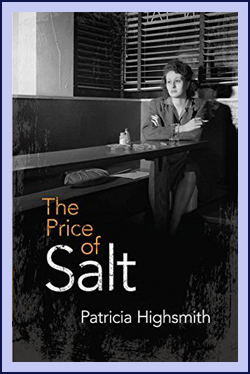
Book Review - Patricia Highsmith's The Price of Salt

The Price of Salt by Patricia Highsmith
Published by: Dover Publications
Publication Date: 1952
Format: Kindle, 260 Pages
Rating: ★★
To Buy (different edition than one reviewed)

Therese Belivet moved to New York in the hopes of being a set designer. But waiting and hoping and making models doesn't pay the bills so she is working at Frankenberg's department store during the holiday season. She's in the toy section selling dolls and is oppressed by the noise of the toy train by the elevators, the din of the customers, and the general chaos that working in retail entails. Her life is a grind, a depressing mix of cafeteria meals and hoping her boyfriend Richard comes through with a job opportunity for her in the theater after Christmas. All this changes when she sees Carol. Carol Aird comes into Frankenberg's to buy a doll for her daughter. The doll is to be sent to Carol's home in New Jersey and the address is emblazoned on Therese's heart. She doesn't know what possesses her but after Carol leaves she rushes to send her a card. Carol calls the store, intrigued by being sent a card from an employee of Frankenberg's. She wonders if this is common practice but learns that it, and the girl who sent it, are not in the least common. Carol is going through a divorce and is separated from her daughter Rindy for the holiday season so she takes in Therese like a stray. They drive around together, sit for hours doing nothing, listening to music, having dinners out, even getting a Christmas tree for which Therese makes all the decorations. They are fast friends. As Therese muses, "It would be almost like love, what she felt for Carol, except that Carol was a woman." But women can love. And that's one of the reasons that Carol is being kept away from Rindy. The divorce isn't going well because of something that happened in her past with her friend Abby. But what Therese feels, Abby could never have felt. As Carol and Therese take to the open road the future is wide open but their past is closing in.

The Price of Salt is a classic of lesbian fiction and it's easy to see why; two women fall in love and are given a chance at a happily ever after. This was something unheard of in literature of the time as it defied all tropes of the genre. Which makes it an important book even if it's a very flawed book. The problem is that both characters are enigmas. They are ciphers. Neither really shows themself to the other fully. We have full insight into Therese's fractured and half finished thoughts as the story is from her point of view but Carol is a conundrum. Yes, I know that they are two people dancing around a taboo subject and it isn't until their trip that they take the risk to finally put their feelings into words and actions, but this makes most of the book an almost excruciating read. It isn't just a "will they won't they" situation it's a Waiting for Godot level situation. And if you're not in the mood for that level of interminable fatalism, well, then this book might not be for you. For the most part it wasn't for me until it was. Because buried among all the things not done and said all of a sudden there's this heart of gold. Yes, I'm saying The Price of Salt should have been a road trip novella. Therese and Carol finally being a couple, just touring the country, oddly skipping Wisconsin on the way from Rockford to Minneapolis, I mean, who seriously goes via Iowa, is a delight. They take pictures and do things normal couples do, they talk, they love, and we learn more about them in these few chapters than in the whole rest of the book. Plus Highsmith, with her accomplished crime fiction background, has this delicious foreboding building. Could they be being followed? Has Carol's husband given her enough rope to hang herself? All the while there's that gun in Carol's suitcase and you can't help but wonder, will it be used? Could Highsmith be going for a dark ending for our lovers? Because literature of the day demands it. When she taps the breaks, that's when you realize what a genius she is. Just not a genius at editing.

Friday, May 19, 2023

Book Review - Jacey Bedford's Rowankind

Rowankind by Jacey Bedford
Published by: DAW
Publication Date: November 27th, 2018
Format: Paperback, 473 Pages
Rating: ★★★★★
To Buy

When freed many of the rowankind took the Fae's offer to return to their homeland, Iaru. Yet there are those that stayed behind in Britain. They have made lives for themselves and have no desire to return to a homeland that they've never known. The humans though don't feel safe. They have treated the rowankind worse than slaves for hundreds of years and now those slaves have the power to fight back. And they are. In retaliation the humans are killing the rowankind. Reports of mass executions happening all over the country have reached the ears of the Fae and they want to take revenge. But Ross and Corwen beg the Fae council to let them attempt a diplomatic approach first before razing all of Britain. A major problem though is in educating the Fae that the world has changed. They have cloistered themselves in Iaru for so long they don't understand that being King isn't as powerful as it once was. The King has to answer to Parliament and they have to answer to the people. This will not be an easy fix and yet the Fae expect it to be. They expect Ross and Corwen to just walk up to the King and get him to make his subjects behave. In order to stop more bloodshed the couple are willing to attempt the impossible. And it really looks like it shall be impossible, George III isn't well, and the reason shocks Ross when she discovers it, the King has magic. Magic he isn't using. Much like Corwen's brother denying his wolf half, the King is denying his magic and it's making him very ill. Yet once contact is made Ross really hopes that they can reach some sort of agreement. But the Fae think they are taking too long and start demonstrating what they are capable of. If the populace was scared of a few rowankind with not much magic how are they going to feel about the Fae turning their beer into water and bringing about a blight to their crops? If everyone would just behave and trust each other for one minute perhaps everything will work out and Ross and Corwen can have their happy ending. Perhaps.

Rowankind doesn't really bring anything new to the table with regard to this trilogy but it does satisfactorily tie up all the loose ends. And there are many, from rescuing missing men to reinstating Gentleman Jim on his island. And there is also much politicking. Because the merging of two worlds, with magical citizens living in a nonmagical world, needs policies. There need to be laws to protect their rights and their bodies from harm. And it's a sad day when fictional Fae end up having more rights than many people do today. But that's just the world we live, and proves once again why I want to live in books and in particular this series. But while the politics do take center stage along with several notable politicians of the day, that's not all this book is about. We get one last piratical adventure, another shooting of London Bridge, a final Walsingham showdown, some more family drama, and lots of happily ever afters. Because this is fantasy and that means the good prevail, the bad fail, and everyone gets to sail off into the sunset. Plus there's just this wonderful message of the healing powers of love and that love is love. Ross is able to find love again even though she thought she never would after the death of her husband Will. Her brother David finds love with a rowankind servant Annie. Her brother-in-law is able to tame his beast due to the love of his partner Roland. Her Aunt Rosie reunites with her lost love Leo. Even the servants get in on the love with her maid Poppy marrying Yeardley. And, now that I think about it, this whole series is about finding your family, those who you love with your whole heart and soul. You don't have to be related by blood, I mean look what Ross had to do to her brother.... It's about finding your tribe. Be they pirates or pixies, when you find your people the world is so much better because they are there for you in good times and in bad and most importantly, they will fight for you and even help you burying the bodies. So here's a shout-out to all my family, I love you like I love books, and you know how much that is.

Friday, April 28, 2023

Book Review - Stephanie Burgis's Spellcloaked

Spellcloaked by Stephanie Burgis
Published by: Five Fathoms Press
Publication Date: February 3rd 2020
Format: Kindle, 18 Pages
Rating: ★★★★★
To Buy

As a young woman Honoria Fennell was an ambassador to the elves. The atrocities she witnessed when she was at their court have haunted her all the days of her life, as has the love she found there, a married elf, Sylvana, who, if the affair was discovered, would have faced the brutality of her husband. That secret is what actually brought about her fall from the Boudiccate. Not many people know what happened at Thornfell College of Magic, only that since that time Honoria has sequestered herself in Cosgrave Manor deep in the elven dales. She has sent the staff away, as for her husband? He left of his own free will. Theirs was, after all, only a marriage of convenience. She is disgraced and alone. Her ambitions of protecting Angland from the tyranny of the elven court is no more. But at least Sylvana is safe. Or at least she hopes so. Honoria can't be sure her blackmailer didn't enact her threats before she was no longer able to. And then a figure steps out of the dales, a figure that asks piercing questions. A figure that has the ability to pierce her heart.

Because of her iron backbone and unwavering stances on the Boudiccate, Lady Honoria Cosgrave has been the antagonist of the previous volumes of the Harwood Spellbook. Therefore it's an interesting conceit to take a rather unlikable character, strip her down, all the way, take away the wealth, the privilege, the position, and make her not just relatable but worthy of her happily ever after. You can understand where she's coming from but what I find truly interesting is that Honoria had a dream, she wanted to protect her people and Sylvana, but she forced herself to work within the system. That is why I think she took such a strong dislike to Cassandra Harwood. Cassandra didn't play by the rules and in Honoria's world that just isn't how it is done. Yet times change, attitudes change, circumstances change, and Honoria realizes that "she had never allowed herself to dream hard enough." That right there is where this story got me. Make your dreams big. Make your love possible. Change the world! We all know if could use some help.

Wednesday, April 19, 2023

Book Review - Stephanie Burgis's Snowspelled

Snowspelled by Stephanie Burgis
Published by: Five Fathoms Press
Publication Date: September 4th, 2017
Format: Paperback, 168 Pages
Rating: ★★★
To Buy

Cassandra Harwood had everything. She was the only female magician in Angland. She was betrothed to Rajaram Wrexham, the best magician in Angland, after herself that is. But things weren't going to plan. Letting her have an education was all well and good, but giving her a job? No, that wasn't the done thing. What was all that work for if she's not allowed to do something? So she felt the need to prove herself as she'd been forced to time and time again and things did not go well. She over-extended herself. Her old life is no more. No magic and no Wrexham. Two months ago she felt she had to drive him away to save them both. Though she's the only one who believes this. Her sister-in-law Amy is convinced that Cassandra and Wrexham just need a chance to reconnect and what better opportunity than at a week-long house party in the elven dales? Cosgrave Manor will be filled to bursting with bickering magicians and ruthless lady politicians as the Boudiccate prepares for their Winter Solstice Ceremony to reaffirm the human's peace treaty with the elves. There will be more than enough alcoves to compromise Wrexham in if Cassandra would just admit how much she misses him. What could be more romantic than being snowbound with the love of your life? More importantly it will get Cassandra out of the house where she's become a recluse and out of the rut she's worked herself into that's half pity half self flagellation. But things don't go according to plan. The weather is abysmal, snow so thick it's almost unnatural, and when they arrive at their destination their hostess, Lady Honoria Cosgrave, is worried about her young cousin's party. Miss Fennell and Miss Banks should have arrived by now but are missing. Cassandra agrees to help in the search, which was her first mistake. Her second was walking on a troll. Her third was accidentally making a binding promise to an elf-lord. So now she has to figure out who is behind the unnatural weather or forfeit her future to the elves. And all this just when she'd finally found something to live for again, and Wrexham is only part of that future.

Snowspelled wasn't the book I was expecting. When I read "trapped in a snowbound house party" I got certain ideas in my head. Ideas that are much more common in locked-room mysteries. So I'm not here damning with faint praise, I'm here going, this will be a book I will be glad to re-read with my expectations in check. Expectations that aren't typical of my usual holiday fare. I seriously read too many murder mysteries around the holidays. I wanted more country house party less protective heat bubbles with people wandering about in bespelled snow. Seriously, they were outside way too much for being "snowbound." But once I got past my own expectations I found myself falling in love with a wonderful story about finding your path after your old path was taken away from you forever. Oh and evil elves. I seriously love evil elves. Haven't we all had dreams that have come shattering down? We've worked and worked for years and then, just like Cassandra, there's that over-extension and the horrible burst of pain and disbelief and crushing reality. This heroine's journey is atypical and therefore actually made it all the more relatable. Because not everyone gets all their dreams. We have to settle, we have to search, we have to find a new path. One that works with what we are capable of doing. This book is so much more hopeful than traditional fairy tale stories because there it's all laid out until the HEA. Here there's no guarantees. And I have to admit, a fully powered and cocky Cassandra would not have been a good look. I don't think I would have liked her. A humbled Cassandra is relatable. She's able to find a HEA with how her life has turned out. It might not have been how she expected it in the least, but the managing of expectations is a powerful lesson. Find your HEA in your own way. In a way that you can handle. Don't let anyone tell you you aren't worth it no matter how many setbacks you've faced. Everyone deserves happiness.

Friday, March 11, 2022

Book Review - Sarah MacLean's Nine Rules to Break When Romancing a Rake

Nine Rules to Break When Romancing a Rake by Sarah MacLean
Published by: Avon
Publication Date: March 30th, 2010
Format: Paperback, 397 Pages
Rating: ★★★★
To Buy

Lady Calpurnia Hartwell was bound for spinster seating from her very first season. Sure she had the dowry. But that only attracted a certain type of gentlemen. And besides saddling her with an absurdly Shakespearean name her parents also made her believe in love matches. Oh, to be loved. Like her sister is. It's been a decade since Callie's first season an her sister has made a love match before the season is even underway. Callie should be happy. Instead she is sad and soon to be drunk. She's been on the shelf for so long even her brother is encouraging her to not be such a stickler for the rules of society. Therefore Callie does what comes naturally to her, she makes a list. Lists are sensible. Lists are good. Lists are what women on the shelf make when they've reached the end of their rope. She lists nine things that would shock polite society. Sure, some of them might easily ruin her, but isn't it time to live a little? Isn't it time to shoot a gun, attend a duel, dance every dance, and be passionately kissed. She decides that she will tackle the kiss first. Only her inebriated mind could make her believe this is a good idea. At a ball during her first season she fell irrevocably in love with the Marquess of Ralston, Gabriel St. John. He spent a few minutes talking to her before moving on to an assignation in a hedge maze. Those few minutes were enough for her to fall in love with a man who was already making a name for himself as a rake. Seeing him and his paramour for the first time in life Callie was jealous of another person. Therefore if she's to experience her first kiss she wants it to be him. It doesn't matter if it will ruin her for all others because she is sure there will never be any others. She is rather scandalized when she is taken to his bedroom. But she has come this far, she will not turn back. When Ralston realizes that it is not his current mistress but Lady Calpurnia Hartwell who has entered his room he decides to take the upper hand. He will give her the kiss she desires but she in turn must help his sister, an illegitimate Italian, come out in society. Callie's approval will give Juliana legitimacy. Callie agrees. But that kiss changes everything. For both of them.

Nine Rules to Break When Romancing a Rake is based on the clever conceit that Callie has written a list of nine things that she wishes to do were propriety not an issue. The conceit is clever because the list acts as an outline. Callie's HEA cannot happen until everything is completed, including a duel. So it's a nice way to pace out the narrative. Plus they don't happen in a specific order so it's a little like roulette, which rule will she break next? Though the problem with Callie's list is that literally every time she draws a line through an item she's drugged by Ralston's kisses. I mean, this is a romance so you expect the sexy time, but does the sexy time have to be so repetitive? Each item means that the sexy time has arrived, and each time it's basically the same with them going a little further until Callie is well and thoroughly compromised. The drugging kisses, the laving of some part of her anatomy with word usage that reminds me more of a cat, the nipple play, all of which seems meant to prove that Ralston is really into satisfying his partner, which means he can't be entirely a reprobate right? I'm just saying that they needed a little variety in their sex life... At least they were both very enthusiastic I guess. But the sexy time for me isn't what this book is about, it's about Callie coming into her own. Like Callie I feel like I have spent so much of my life being "their" version of me that I sometimes don't know who I really am. And by "their" I mean the whole world at large, for Callie it's the ton, for me it's largely family. And don't get me started on when people talk to you with "why are you so..." Maybe I wasn't that way until you thrust your expectations onto me? Maybe I should make a list? What also hit unexpectedly hard was Callie talking about being put on the shelf. How she was so high up there and so alone. It wasn't just the fact lack of coupledom that made this hit the mark but Covid. We have all collectively been on the shelf for two years. We aren't going to public houses or fencing clubs of heaths for duels, we're home on a high shelf hiding out from the rest of the world. I think when this pandemic is over we all need to take a leaf out of Callie's book and make ourselves a list and find out who we really are. Rake an added bonus.

Friday, October 9, 2020

Sanditon

OK, I admit it, I was hesitant at first to watch Sanditon. Why you ask? Well, that answer is twofold. Firstly, I hadn't read Jane Austen's partial manuscript in years and wanted to brush up on that and other of her unfinished writing. Secondly, well, the reviews from other Janeites was bad. I usually don't listen to the Janeites, I've often disagreed with these fanatics, and in fact been treated rather harshly by them, so I don't know why I was listening to them being shocked by sex in Austen, but there it is. Yet here's the thing I say to them; "Oh NO, sex in Austen! It's not like Willoughby knocked up a fifteen year old, oh wait..." So there. Game, set, and match. Andrew Davies for the win! It's not that I'm all for sexing up Austen, I'm for the reasonable depiction of the time period, and people had sex! This adaptation was like Austen mixed with Gaskell and Dickens but with the filming sensibilities of Gentleman Jack. Sanditon was fun and diverting, and so what if it was about a town instead of just one family, this just gave it more of a Cranford vibe. There was more flow of narrative, characters weaving in and out of each other's lives at this seaside town trying to make it versus set pieces. I felt like there was real struggle and strife. In fact I thought to myself, it had a bit of the real world horrors mixed with the frenzied fun of Austen's juvenalia. Sanditon is what the roundly praised by very much disliked by me adaptation of Austen's Love and Friendship was supposed to be. Also, while some characters, in particular our male lead, are supposed to evoke parallels to other Austen characters, ahem Darcy, it was the other more complex characters I really appreciated. In fact Esther Denham is now my new favorite Austen heroine. She's dirt poor, manipulated and manipulating, yet somehow you root for her and her redemptive arc gave me the HEA you'd expect for the leads, except they were expecting a second season and didn't get one. So oddly we have yet another unfinished Sanditon that somehow still manages to be satisfying.

Friday, November 3, 2017

Movie Review - The Circle

The Circle
Based on the book by Dave Eggers
Starring: Emma Watson, Ellar Coltrane, Glenne Headly, Bill Paxton, Karen Gillan, Nate Corddry, Tom Hanks, John Boyega, Amie McCarthy Winn, Eve Gordon, Patton Oswalt, Smith Cho, Amir Talai, Elvy Yost, Ellen Wong, Poorna Jagannathan, Judy Reyes and Beck
Release Date: April 28th, 2017
Rating: ★★
To Buy

Mae's life isn't going well, her car breaking down and forcing her to call her ex Mercer to fix it is just the latest indignity. In fact her parents talk more about Mercer and all the help he's given around the house what with Mae's father having MS than they actually talk about Mae. But her luck is about to change. Her friend Annie has gotten her an interview at the groundbreaking tech company The Circle. Mae gets a job in Customer Experience, and it may not be the job to fulfill her fear of wasted potential, but it's where everyone starts at The Circle. Yet her start is rockier than most. She's not participating as much as the organization would like. She's not reaching out instead she's focusing inwards and escaping in a kayak whenever she can. Late one night after visiting her parents she snaps and takes a kayak out on the bay which she's "borrowed" from her regular rental place after they've closed. Ironically it's tech from The Circle that catches her malfeasance but also saves her life. She is brought before two of the three founders, Eamon Bailey and Tom Stenton who decide to not punish her but use her as an example. Make her the face of a new initiative. Mae is going transparent. Everything she does, every move she makes, can be watched by millions of people worldwide. Because sharing is caring and knowledge not shared is a crime. Yet as Mae is scaling to new heights in the company her friend Annie is spiraling downwards. Mae doesn't know the end game of The Circle or how transparency is another method of control blindly loving her fame. As she gets in deeper she will be forced to make hard decisions and witness horrors that could change everything. It's up to her to stop The Circle, but will she?

"They're Watching You!" With those simple, musical, almost whispered words while waiting for Tom Hiddleston in Kong: Skull Island in a darkened theater I was instantly sold on The Circle. Of course previews are designed specifically to get asses in seats so despite my love of the preview I waited for reviews and in the meantime picked up the book. For years I knew who Dave Eggers is, more for his founding of McSweeney's, the west coast's answer to The New Yorker, than for his book A Heartbreaking Work of Staggering Genius, but I'd never actually read his work. Ironically the book gave me more hope for the movie, until the abysmal reviews came in. I mean, 16% "fresh" on Rotten Tomatoes is one of the worst scores I've seen in recent years, but on the bright side I hear the film will do well at The Razzies. So there's always a silver lining. Going into this movie with low, in fact almost no expectations was interesting. Yes, I was still frustrated when they got something so right only to follow it up with such a colossal misinterpretation of the text, but those were things I was able to laugh off. Sometimes knowing you're watching a dud gives you freedom to enjoy it for what it is. That's not to say I didn't have major issues, I still have criticisms aplenty, they're just from a more zen place. A place where Emma Watson seemingly single-handedly destroyed a film with an otherwise near-perfect cast. But it can't all be blamed on her, oh wait, it can, because all the changes, the taking a dark satire and spinning it into a thriller, all of that seemed in service of making the character of Mae more in line with Watson's values than as she was written. Because Watson is someone who would never drink the Kool-Aid. Do the people who made this film know about Jonestown?  

So let's go into Emma Watson's Razzie worthy performance. I really can't think of anyone more miscast than Watson as Mae. Mae is ambitious, manipulative, sexual, clever, and instead here she is atonal, flat, passionless, sexless. Look at how they clothe her! She's wearing all these sweaters that fully cover her body so that not an inch of skin is visible. For years now I've had friends who hate Watson's acting. I've always been indifferent to her. She's not how I see Hermione, but then the movies aren't how I see the world of Harry Potter at all. She has a funny cameo in This Is the End, but The Bling Ring was so boring I have tried to excise it from my mind, as for Beauty and the Beast, we are not going there. But I do respect her and I do follow what she does, especially with regards to not just her stance on feminism but on reading as well. So the fact that she plays Mae as someone with no charisma, someone who literally NO ONE would follow isn't just baffling to me, it takes the punch out of the whole movie. I don't know if I can accurately state how bad she is. The lines she delivers feel as if she's reading them off cue cards and is being forced to do so and is therefore coming off as harassed and with just the whiff of pissed off teenager being forced to say hi to company. Was there even a director? Because ANY sensible person in charge should have been like, "Hey Emma, can we get some emoting or acting here? You are an actress right?" Mae is stripped bare, but not literally because God forbid Emma shows some skin, and made boring. When Annie tells Mae she's perfect, I had the biggest laugh. Annie, that's the speed talking! 

Yet the biggest changes that were wrought happen in the movie's climax. When Mae does a presentation on how Circle technology can be used to find anyone on earth things spiral out of control and her ex Mercer dies. This is true in both the movie and the book. Only in the book, a dark dystopian comedy, Mae is the instigator, she's egging the Circlers on. She's releasing drones like flying monkeys and that's the moment in the book when you realize that Mae is one of them. But here, oh no, the sexless Emma Watson couldn't be seen as causing someone's death. So instead she's pushing against hunting down Mercer. She's hemming and hawing and Tom Hanks as Eamon Bailey steps out and drives Mercer literally to his death. Um, WTF is this? Bailey is the papa bear of The Circle, if anything Patton Oswalt should have been behind this brutal manslaughter. This moment is the moment, for me, that the book gelled and also the moment when I realized Holllywood just didn't get it. James Ponsoldt, a director and writer whom I've never heard of aside from his David Foster Wallace movie which I'm now probably never going to watch, just didn't get it. The Circle isn't about a near miss, a disaster avoided, this is about a technological Utopia being thrust on us with forced adaption to this secretly totalitarian regime, not something with a happily ever after. And again, I don't know if this was to preserve the "nice" imagine that Watson has built up or because they thought the ending was too bleak. Here's the thing, the bleak ending is more real. The reason the book drew me in is because at the end Mae wasn't the savior, she was Judas!

Though Ty turns out to be the character most changed. In fact, I'm surprised they actually got John Boyega at all with how minimal the role is. In the book "Ty" is a mysterious stranger who Mae is drawn to and has relations with only to eventually find out he is one of the three founders of the company. Yes, I do admit that drawing out that reveal, even in the book, pushes credulity, but to go the opposite way and have him just as exposition and then a deus ex machina is a waste of his talents. While I wasn't all on the Boyega train to begin with I've seen him enough now to know that he is criminally wasted here. He actually has no point other than to fill the plot holes. Plus, can we talk about that hasty ending? You're not going to watch this film, trust me, you're not, so here are some spoilers, in fact all the spoilers. Mae turns against the company and in a lecture she's giving during the talk, thanks to Ty, all the "secret" correspondence of the other two founders is leaked. In the book this is actually what Ty WANTS Mae to do but as I've said before, she goes deliciously Judas and that's the end of Ty. Instead the data destroys the founders yet somehow The Circle survives and Mae's out kayaking... about the only thing they got right is Mae and that stupid kayak. I just don't get it. I mean, just why!?! This book was a bestseller and then you go and do all these tweaks and twists and add a HEA and you think you're going to get a blockbuster movie? That's not how things work. Create a good adaptation OR a good reinterpretation. Don't give us muck. Audiences don't like it, as Rotten Tomatoes has clearly shown.

But the most nonsensical thing to me is something that probably I and only other graphic designers would notice, and that's The Circle's logo. The Circle's logo as seen on the right hand of the image above is ubiquitous in the film and is just plain boring and derivative. Like Apple redoes The Criterion Collection's logo. You might be wondering why this would bother me so much, and the answer is Jessica Hische. Jessica Hische is an amazing designer noted for her typography skills. Seriously, check her out and you'll realize you've been loving her stuff for years without even knowing it. As she said about The Circle on her website: "After working with Dave Eggers on Hologram for the King I was pumped to be brought on board to design his new book, The Circle. It was especially fun to design this cover, as I’ve spent the last two years living in San Francisco surrounded by the tech industry (my husband works for Facebook) and the story is set in an influential social media company. I also had to design a logo for the fictitious company, The Circle, and was inspired by the interweaving connectivity of social media sites and also knots that once tight are difficult to untie." The logo she designed is perfection. I don't know if Eggers' description or her design came first but it captures what the book is about 100%. But should I be surprised that a movie would trash the work of a talented designer and start over with something bland and unoriginal when that is what they did with the whole narrative? I guess not. But I can still grumble about it.

Wednesday, February 15, 2017

Book Review - Agatha Christie's Murder is Easy

Murder is Easy by Agatha Christie
Published by: HarperCollins Publishers
Publication Date: June 5th, 1939
Format: Hardcover, 223 Pages
Rating: ★★★
To Buy (different edition than one reviewed)

Luke Fitzwilliam has returned to England from police duty in the Mayang Straits. He's been away from England for years and his return is a mixed bag. He won a packet on the Derby but his train left without him when he was checking the results. Catching the next train up to London he meets Lavinia Pinkerton, an elderly lady who reminds him of his Aunt. Luke humors her and listens to her reasons about going up to London. She believes there is a serial killer in her small town who now has their sights set on the nice Dr. Humbleby and she is determined to tell Scotland Yard all about it because the other deaths were nasty people but Dr. Humbleby is a different kettle of fish. Luke thinks she's an old dear who's a little batty, but when he later reads of her sudden death as well as the death of Dr. Humbleby he remembers her talking about how murder is really quite easy and there's a look in the eyes of the killer. He decides it's only right to investigate. With the help of his friend who happens to have a cousin down in Wychwood under Ashe Luke poses as a writer researching a book on witchcraft and superstitious beliefs that still survive in small communities. Luke hopes this will let him talk about the recent deaths in the town, totaling six when he arrives in the village. But will there be more deaths? And is Luke putting himself in danger by investigating in the first place?

I started this year by reading a murder mystery by one of Christie's contemporaries oddly enough published in the same year as Murder is Easy. Going from No Wind of Blame by Georgette Heyer to Murder is Easy by Agatha Christie the shift is so dramatic it's patently obvious why Christie is the bestselling author of all time and the "Queen of Crime." Instead of waiting hundreds of pages for a crime to actually be committed, Christie starts with a high body count right out of the gate. She builds the suspense while building her characters, instead of focusing on one or the other and therefore sacrificing quality. Heyer spun things out to excruciating lengths and in the end created a book that was unsatisfying more than anything else. If you're going to do a murder mystery, you kind of need both of those elements. My most favorite mysteries are the ones that follow in the vein of Christie; high body counts with quirky characters and a fun enough journey with plenty of red herrings that the narrative is a cohesive whole. Perhaps that's why I love Midsomer Murders so much, if any show followed Christie on body count alone, it would be Midsomer Murders. Also, this isn't to say Christie is infallible... she does trip up and get stuck in her own devices sometimes, Endless Night anyone? But Murder is Easy is thankfully a classic Christie.

Though, for me, there is rarely a book that is flawless. I mean, there are people out there that actually think for something to be perfect there has to be one flaw for them to pick at. I'm not one of those people, though it might occasionally seem so to others. But Murder is Easy did have a big flaw in it's leading man. Yes, let's talk about Luke Fitzwilliam. Luke is... well Luke must not have been very good at his job out east. Or, if he was good at it, it was with a kind of straightforward bluster that can, occasionally, make a decent cop. Why I've come to this conclusion is that he has no natural ability for subterfuge. He's "supposed" to be in Wychwood under Ashe as an author researching a book... does he ever really commit to this cover? No. About five minutes in he's already telling his friend's cousin who is putting him up, Bridget Conway, the real reason he's there. Um, couldn't she be a suspect? Or is she just too pretty? All his questions to the townsfolk are obviously about the recent spat of deaths, he doesn't once really try to talk about superstition and witchcraft. Which is a shame. Because I was kind of looking forward to a witchy element to this book, especially as Christie set the stage with the town's history for supernatural activity, but then she never followed through. The murders took precedent over Luke's cover and, well, I just was annoyed.

But Luke's inability to dissemble isn't nearly as bad as the forced romance between him and Bridget Conway. Christie does seem to have a need to not only solve the crime but to match off a couple by the end of her books. Like catching the criminal isn't enough. For a true happy ending there must be a marriage to boot. It could be a product of her times, this was released in 1939, but still, think of all the romantic partnerships of crime solvers there are... in fact, could we trace this all back to Christie? OK, that's getting off course, but if she's the reason we have everyone from Nick and Nora to Caskett... I think I'll give her a slid. On most. Not on Luke and Bridget. Because seriously, there is NO chemistry between them. None. In a play or a movie you can understand a lack of chemistry, the leads just weren't able to connect. In a book, there's NO reason for this. The author controls everything and there's no moment where you look at Luke and Bridget and go, "yes, they were meant to be." Luke sees a pretty girl and just decides to fall for her. She, for no apparent reason, is willing to give up a comfortable life with a wealthy man just to what? Marry a poor man who is more in love with the idea of her than her? Seriously. They do not a couple make. But Christie needed the supposed connection for the reveal of the killer... so maybe if she had just worked backwards from that a little more convincingly?

Yet it's Christie's ability to throw so many red herrings at us that we feel as if we're at a fish market that makes her books transcend character issues. She is able to believable posit, through Luke's investigation, so many murder suspects that you're never quite sure. Yes, I am one of those people who try to solve the crime as I'm reading, but if it's a good enough ride I can be swept away and buy into the plausibility of any single person being the killer. What I particularly liked was Luke was continually making up lists with reasons why each person was guilty or innocent. Yet his lists often omitted things, or didn't quite convey what I felt was uncovered in interrogations that we got to be privy too. Therefore we are able to see beyond Luke's narrow mind and see that the suspect pool is far bigger. This allows for Christie to go wild with her red herrings. In fact, just simple turns of phrase, assumptions about how people talk, all these play into the eventual reveal. In fact, it wasn't until minutes before the reveal that I had the aha moment. Where I could fully see her intricate web and who was really at the center pulling all the threads. I used to have this wonderful t-shirt that was for Mystery! by Edward Gorey that had a tree with clues, suspects, and the red herrings being the only items in color. I loved that shirt and I think that shirt captures the feeling of reading Murder is Easy. It's all there, it's all perfect, you just have to wait for Christie to pull back the curtain. Because she really is the master at this game.

Friday, September 2, 2016

Book Review - Fall of Poppies

Fall of Poppies by Jessica Brockmole, Hazel Gaynor, Evangeline Holland, Kate Kerrigan, Jennifer Robson, Marci Jefferson, Heather Webb, Beatriz Williams, and Lauren Willig
Published by: William Morrow Paperbacks
Publication Date: March 1st, 2016
Format: Paperback, 368 Pages
Rating: ★★★
To Buy

The cat stands, stretches, and meows to be let out. Simple, ordinary things that punctuate the hour, the day, a year, a life. - Hazel Gaynor, "Hush"

Life changed the day war was declared, but it changed again on November 11th, 1918, when the war stopped. The problem was in four years of fighting, of death, of destruction, the world could never go back to the way it was. Atrocities were perpetrated with lasting ramifications. Bodies forever disfigured from the brutality of battle. The earth and it's people, forever scarred. To survive women and men did things they want to leave in the shadows, in the dark garrets of Paris, and in the blood soaked trenches of France. With war over for the first time in a long time hope is once again possible. A future can be contemplated, planned, dreamed of. Children will have a future. Love will have a chance to take root. From a hospital in Belgium to an artists studio in Paris, from the coffee fields of Kenya to the riotous streets of Dublin, the war hasn't just changed the world, but forever shaped the course of these peoples stories told by these different authors. The armistice has come and their voices will now be heard.

I have many short story collections and anthologies just laying about neglected. I feel really bad about this because years ago when I read Nick Hornby's selection of monologues, Speaking with the Angel, I found some amazing new voices in fiction whose books I then read and loved. But since then I've been very bad. I keep buying these books because there's one author I love and just have to read their story, so I get the book, I read the story, and then the book is relegated to my neglected, deprived, and languishing shelf. And yes, I do have such a shelf, peopled by many short story anthologies that feature Charlaine Harris and a lot of Dickens. What compounds the problem is that if I've waited too long all the author's stories spread throughout all these books get republished in their own book, like Charlaine Harris's A Touch of Dead of Patricia Briggs's Shifting Shadows, which ironically is also on this shelf. Therefore I kind of felt it my duty that while I picked this book up for Lauren Willig, I knew the other authors names and felt that it was time to read something they'd written and actually finish a book by multiple authors.

While I feel somewhat biased saying Lauren's story, "The Record Set Right," was my favorite, I have a feeling this was more to do with the fact I'd read it out of context as a kindle release prior to reading it amongst the rest of the tales. Therefore it felt like I was revisiting an old friend. But there are quite a few authors I feel will be new friends, and a few I might be reluctant to read, but none I will outright avoid. In fact I think many of these stories will work better taken out of context, because read all together the sameness of some of the writing techniques used makes them blend together into a confusing jumble. Fall of Poppies is definitely a book I'd encourage to read leisurely, a story every few days, to not only get the full impact of the narrative, but to clear your palate of the previous story. Because otherwise the structure of how so many of the first person narratives are weighted to the front of the book combined with all the HEAs and female narrators, it makes them all blend together into a jumpling mass where they all feel like they're telling the same story with the same trite ending.

Now I'm not a hater of first person narration like some people I know, in fact some dear friends I know, but it's hard to get first person right. The key is a very strong voice for the character. "The Daughter of Belgium" had a very timid narrator, followed directly by Lauren's strong narrator, there was a weird disconnect. You've been living in one characters head and you've suddenly switched to another's and it's jarring. It's like you're seeing first hand what it would be like to live in someone's head who has a multiple personality disorder, and in this instance Lauren's character Camilla is the dominate personality, while Marci Jefferson's unnamed narrator, in the vein of Du Maurier's Rebecca, is the submissive personality. In fact, so submissive she has no name! While as the book progresses there is only one more story written in first person, Jessica Brockmole's "Something Worth Landing For." So why did this book feel the need to have two of these stories back-to-back? The book starts out on such a wrong footing that it takes awhile to recover and actually become enjoyable.

Then there's the gimmicky nature of every story having Armistice Day as it's focal point. Yes, the description of the book should have tipped me off with it's themes of "renewal" and "hope." But you can build your story before or after this event, yet SO MANY chose to have Armistice Day as THE DAY the story was set. It made any story with a little time before the bells pealing away at 11AM on the eleventh novel and far more interesting. Yes, to an extent it's interesting to see how nine different authors tackle the inclusion of Armistice Day in their story, but please, think outside the box. Make it a jumping off point. Not EVERYTHING has to happen on that day. True love doesn't have to magically be found in the last minutes of the war. As for love at first sight? Every time it happened I kept thinking, what happens when they get home? What happens when the scales fall from their eyes and they really get to know this person they picked at random for their HEA? Some of the stories seriously need that something more.

Which is why those with this "otherness" really stand out. Those that are set apart just jump off the page. When a male narrator shows up it's like manna from heaven! But the ones that stood out most where those that looked at the diversity of people fighting in the war and where they were fighting. The story that stood out head and shoulders above the rest for me was "The Photograph" by Kate Kerrigan. I mean, I can seriously see this as an independent Irish film starring Saoirse Ronan and Harry Lloyd. See, I've already cast it, just make it now! What makes this story so unique is that it's set in Ireland. What's more it's about soldiers who were sent to quell the Irish Rebellion and their fight for freedom. With the greater Great War, there was a clear villain with Germany, here it's Britain against Ireland and the justifications for fighting are murkier. The Irish deserve and eventually win their independence, but those English soilders fighting them are just doing their job. It's just dumb luck they weren't sent to France, like many Irish soldiers were. Also, when Armistace happens, it's not an end to the hostilities in Ireland, it's just the beginning. This one story brings all the rest into context. It's "otherness" shows all the stories in a clearer more brillant light and elevates the whole book. So when am I getting my movie adaptation?

Wednesday, August 31, 2016

Book Review - Marissa Meyer's Winter

Winter by Marissa Meyer
Published by: Feiwel and Friends
Publication Date: November 10th, 2015
Format: Hardcover, 832 Pages
Rating: ★★★
To Buy

Kidnapping Kai on his wedding day was basically a declaration of war against Queen Levana. But Kai needed to know the whole truth about Levana, and more importantly, about Cinder; that she is Princess Selene, the true ruler of Luna. The rebels, Cinder, Iko, Cress, Thorne, and Wolf, need to get to Luna to broadcast Cinder's identity, foment a rebellion, and rescue Scarlet. After their plan is formed they return Kai to his now decimated palace where he declares his continued allegiance to the alliance with Luna and his desire to still marry Levana. The wedding is rescheduled for ten days later. In Artemesia, the capital of Luna. Just as they had planned. They are going to use Kai's ship as a Trojan Horse and sneak right into the capital. Levana had thought of this outcome and was prepared, but so had Cinder and her friends, enough distractions and they have escaped Levana's grasp once more. Winter has also escaped Levana's grasp, with the help of her guard Jacin and Scarlet, her death was faked and they were able to escape the capital. The two groups meet at Wolf's mother's house in the outer sectors. Maha Kesley offers them shelter, but they know any illusion of safety won't be long lived.

They are now not just outlaws but have an entire moon's worth of soldiers actively hunting them. As rebellion begins to take hold Cinder and Wolf are captured by Levana. But with Winter using her natural charisma to enlist help for Cinder out in the outer sectors there is still hope. What's more, by putting Cinder on trial Levana made a major mistake. Cinder was able to capture Levana's true face. Using her cybernetics Cinder was able to document not just Levana's biggest secret but the travesty of her own trial. Escaping from certain death once again the rebels marshal their forces and plot their final assault. They need to attack the palace head on with their forces from the other sectors, forces that Levana has tried to kill by releasing the letumosis virus. If Levana thinks that victory will be that easy, she is sadly mistaken. Using stealth and forces within the palace as well as those without Levana just might be defeated. But in the end it will come down to just Levana and Cinder in a room. One will be victorious and the other will be dead. Can Cinder get her happily ever after for herself and her friends or was it all just a glamour?

The Lunar Chronicles for me has been a ride of smooth freshly paved concrete and Illinois highways that peter out into dirt roads. There was the perfection that was Cress and the low point of Scarlet. But through it all it has been an overall enjoyable ride. The end of the journey was just a little bumpier than I would have liked. Winter was overlong and many chapters felt like the wheels where just spinning and there was no forward momentum. I'm not saying I wasn't satisfied by the ending, everyone ended up exactly where they should, it was just rough getting there. There was just too much toing and froing. They're in the palace, they're out of the palace, they're captured, they're free, they're in danger, they're safe. Over and over and over again. Exactly how many times do you have to break into a palace only to have to break out again only to have to break in again in one book? Many many times if Winter is the benchmark and with many different subsets of characters. There's literally only so much stalling I can take, which is exactly what every setback felt like. Stalling. It's like Meyer didn't want the end to happen too quickly so she threw in so many obstacles it was almost laughable. This ending was a long time coming. At times it felt like it wasn't going to come at all.

Also, while I admit that everyone ended up where they should, perhaps there should have been some repercussions? Yes, yes, I know this is a retelling of a Fairy Tale so a Fairy Tale HEA is expected, but wouldn't there have been more weight to the story if not everyone got an HEA? In particular I'm thinking about Wolf and his non-transformation transformation. When Wolf and Cinder are captured Wolf is forcibly turned back into one of the Queen's Guards. But more than that he's not just reprogrammed, he's remade into an even more wolfy mutant wolf solider. Snout elongated, mouth widened, my grandmother what big teeth you have, the whole Big Bad Wolf makeover. All that bio-engineering to make him not the Wolf Scarlet and the rest of them knew and loved. It is stressed over and over again that Wolf has been changed so dramatically that he is no longer who he was but just one look at Scarlet and it's all fine!?! It's like all that extensive surgery actually didn't change his appearance much at all. Say what!?! Pages and pages about how he's different and then it's all fixed with a kiss. This is the most Fairy Tale aspect of the entire book and I think that if some reality had been brought to bear just in this one instance the book would have been elevated. Wolf and Scarlet die for the cause? That makes much more sense.

But overall there were a lot of things that just didn't make sense as this series drew to a close. Not just the repetitive nature of the story or the fact that EVERY SINGLE PERSON gets an HEA, but there's The Hunger Games aspect. What I have loved about The Lunar Chronicles is that it took stories that were well known and loved and gave them an entirely new spin. Cinderella is a cyborg but also a space princess! How much more out of the box and original is that? And then when we meet all the wealthy residents of Artemesia they're just extras from The Hunger Games who happened to also be residents of The Capital, in that series and this. Um, what!?! This really just threw me for a loop. I've always touted this series as inventive and original and then in the entire structure of Luna it became a rip-off of another dystopian series. Instead of districts we have sectors, many devoted to the same purposes as those in The Hunger Games. Oh, and the Capital residents, glamours and gaudy clothing and wild looks aplenty. I seriously thought that Caesar Flickerman was going to do a play-by-play of Levana and Kai's wedding. And what baffled me most of all? This wasn't the Luna that we saw in Fairest! This is an entirely new and entirely derivative Luna! WTH people! I just couldn't get beyond this and I still can't. Why, just why!?!

And in the end, the saddest thing of all was that my predictions for the character Winter came true. When Scarlet came out I bemoaned the fact that with all the new characters being added in each volume that by the time we got to Winter's story she would be entirely sidelined. And she was. And this just makes me pissed. Why? Because this book is overly long and filled with all this unnecessary padding and somewhere, deep down in its heart, is this amazing story that is only Winter's. The way Meyer has updated the story of Snow White is exquisite, from the fake death in the menagerie to Levana handing her the apple dosed with the letumosis virus, each and every aspect of this book that is only Winter's story is perfection. There's an elegance and a sadness to her story that captures the bittersweet nature of looking back on Fairy Tales when you think you've outgrown them. The way she doesn't use her power because it's against her core beliefs but is making her insane, the natural charisma that makes the Lunar people drawn to her. I just wanted a book about Winter. No one else. She deserved her own story. She has spent her life in the shadows, tortured by Levana, the least she deserved was not to have the new Queen, Cinder, do the same thing. But such is life. No one, not even fictional characters I have come to love, get what they deserve.

Friday, July 15, 2016

Book Review - Wesley Stace's Misfortune

Misfortune by Wesley Stace
Published by: Back Bay Books
Publication Date: January 1st, 2005
Format: Paperback, 560 Pages
Rating: ★★
To Buy

A young baby boy is being thrown out with the trash. Unwanted and alone a chance of fate has him picked up by the richest Lord in the land, Lord Loveall. Lord Loveall has been mourning all his life for his dear departed sister and when he sees this baby he assumes it to be a female and a chance to have his sister back. But Lord Loveall can't just miraculously have an heir, a quick marriage is arranged with his sister's old governess, Anonyma, who has stayed on as resident librarian at Love Hall to catalog the works of her icon, the poetess Mary Day. Anonyma agrees to raising "Rose" female because Mary Day had some interesting theories on gender and Anonyma sees a chance to put her heroine's thoughts into action. An experiment if you will. For many years the couple are able to keep up this farce, until one day the world crashes down on them in the form of puberty and Rose can no longer hide who he is.

Rose flees in the middle of the night without a trace, unable to face what he is or his feelings for his best friend. He takes to the continent and eventually ends up where all those pilgrims seeking answers often end up, the Levant. Rose's journey won't be an easy one, through awkward sexual awakenings, near death fever dreams, and chance encounters, Rose begins to embrace the odd life that he has been given in this strange world and the companions in his journey who truly love him. Though while he has been traveling, trying to put himself back together, things aren't going so well at home, where Rose's absence is duly noted. The familial vultures have swooped in to claim what they have always lusted after, Love Hall. A scandal would be so unbecoming so Anonyma withdraws into the works of Mary Day... what does she have now that Rose has fled? It will be up to Rose to save the day, once he saves himself.

Misfortune is a Dickensian tale with at LGBTQ mindset. Full of interesting incestuous characters I felt that it never quite lived up to it's full potential due to the shifting narrative that, in the end, opted for a shorter, sleeker story with annoying time jumps, instead of becoming a book of true Dickensian girth. Now I'm not saying that I wanted every detail on Rose's debauched journey to Turkey, but covering such an expanse of time as a fever dream seemed indulgent of the author. In fact, that might be the crux of my problem, the modern sensibilities thrust into this Victorian age by Stace's whim alienates me from the story. Stace says in an interview in the back of the book that he didn't want to be drawn into the trappings of the time period, a carriage is a carriage, not a barouche, not a gig. By having Misfortune be a modern book set in the past he seems to be wanting to make the book more of a post modern statement piece than a quality read.

By breaking convention he is writing a book that will appeal more to those who have never read Dickens or historical fiction while leaving those of us who love 19th century literature and period pieces cold. Coupled with the fact that he pulls a complete Dickensian HEA that was obvious from page one, his tendency to use some literary tropes and abandon others just goes to show that he was gratifying himself instead of his audience, plus exactly HOW was Rose to inherit... she being a she? Many such little questions bothered me throughout. Though my biggest problem with the book that has nothing to do with Stace might just be a side effect of this lack of interest in the historical details. This problem being that the cover illustration shows clothes incorrect to 1820. Yes, I know I should let this go, but the thing is, I remember the day I picked up this book on a table in Barnes and Noble and it was those lovely Regency clothes that sold me on it...

Yet in the end it's not covers nor conceits that are the root of my issues, Rose is what's problematical to me. Firstly, the sheer self-centered delusions indulged by her parents scares the shit out of me. That two adults could contrive to raise a boy as a girl is just wrong to me. I know in this day and age there are a lot of people who talk about wanting to raise their children gender neutral so that they can come into their sexuality on their own. Personally, I think this is bullshit. It takes awhile for children to become aware of things, just look to Rose for an example, and by at least not setting down for them the basics, well, you are going to get one f'd up kid, again, look to Rose. Children need to understand the world around them in order to find their place, wherever that may be. By taking away Rose's knowledge of the world around her with regard to her body, that's just so many levels of wrong. At least her father Geoffroy has some excuse, obviously being insane, but Anonyma, the cold amd calculated way she sees changing her child's sex as an experiment just makes me want to slap her so hard. While yes, this does lead to some amusing situations, in the end, I felt such sorrow and pity for Rose that at times the book became hard to read.

The collusion to keep this lie up just fills me with rage. Personally, the fact that they were able to pull it off for so long makes me a little awestruck. I personally don't see how they did it. I liked that they mentioned that all paintings with genitals shown were hidden, because that was a problem I really had. How, in an English Country House, with the great artwork that is usually in said houses, were they able to keep Rose in the dark? The secluded environment helped, but still, how? Recent studies have shown that people in the 19th century weren't so repressed sexually as we like to imagine. Yes the book has Anonyma lecturing a young Rose on what is private and what is public, and never stripping or lifting of skirts... but still... how? Rose was raised with two other children and they never once lifted a skirt or whipped it out of their pants? That is giving those kids some amazing, I would say unbelievable, restraint. Were they sewn into their clothes? Because that's the only way I see this happening, otherwise, I just don't buy it. I can't buy it. There's too much suspension of disbelief needed here and that just doesn't work for me.

And yet... if we take a step back and look at the larger picture, not those hanging at Love Hall, forcing Rose into a female role is almost equivalent to forcing any child into any role. While yes, as I've said, I do thing it's important to show kids how the world works but I also think it's important that once they grasp the basics that they be allowed to be who they are. However they want to identity themselves, dress themselves, whatever, it is important to be who you are no matter what society thrusts on you. It is your right to choose your own identity and that is the final message we are left with from Rose. He has this unique upbringing, then the upheaval and identity crisis, but in the end he finds out who he truly is. So in one regard, though I had many issues with the book, I'd kind of like to make any bigot I can find read it because the sorrow and pity that you feel for Rose as he finds himself, that might be the first step to understanding those who don't fit the binary world. So yes, issues with the book, but not issues with the message? I know, it can be as confusing as Rose's situation at times, but sometimes even a book that I just don't engage with can connect and resonate on a deeper level with regard to certain issues. Sure, this book is flawed, but so are all of us. 

Wednesday, March 23, 2016

Book Review - Marissa Doyle's Betraying Season

Betraying Season (Leland Sisters Book 2) by Marissa Doyle
Published by: Henry Holt and Co
Publication Date: September 29th, 2009
Format: Hardcover, 330 Pages
Rating: ★★★★★
To Buy (different edition than one reviewed)

Penelope feels that she not only let her twin sister down but her heroine Queen Victoria as well. Sure, she was there when Victoria was saved, but the special commendation belongs to her twin Persy and Persy alone. Pen feels like a fraud. And that is why she's in Ireland. It wasn't just that she felt like a third wheel at home with her sister in a constant state of connubial bliss with her new husband. It's that Pen has neglected her magical studies and now is the time to fix this shortfall. If she had tried harder before perhaps she could have actually helped Persy when she needed her help and deserved the commendation bestowed on her by Victoria. So Pen has followed her governess Ally to Ireland and Ally's new home in Cork with her husband. Only Ally is experiencing a common result of getting married and her horrific morning sickness, which seems to last all day, has led to Ally's father-in-law, Doctor Carrighar, taking over Pen's education. Despite how much she wants to better herself, being locked up all day studying, at times with four male students of Doctor Carrighar's who don't appreciate the presence of a female, can be tiring.

But Cork isn't London and Pen convinces Ally to let her run errands. Alone. When she's out one day she fatefully and almost fatally runs into Lady Keating. Lady Keating takes Pen under her wing and soon becomes the female role model Pen is so desperately missing with Ally being laid up and Persy a country away. It doesn't hurt that Lady Keating's son, Niall, isn't hard on the eyes. But then again, Niall is rumored to be the illegitimate son of Queen Victoria's uncle, the Duke of Cumberland. The Duke might not be liked, but he does have the looks, the looks of Niall. The Duke is also at the heart of a plan being concocted by Lady Keating, who just happens to be a sorceress. Due to unforeseen circumstances Lady Keating's plan to get ride of Queen Victoria and install the Duke on the throne has a hitch. She needs a third witch, preferably family, to help invoke the power of the Triple Goddess to get her spell to work. To this end Lady Keating orders Niall to court Pen, whose magical abilities she has recognized. But when does duty to his mother become true love for Penelope? With secrets upon secrets and broken allegiances can anyone get a happy ending? And more importantly, can Pen earn the commendation Queen Victoria gave her?

In Marissa Doyle's first book in this series, Bewitching Season, I felt such a strong connection to Persy and her bookish ways that I quite honestly didn't think I would be able to connect to Pen. Through the filter of Persy's story Pen seemed the epitome of the girly girl of the time, more concerned with couture and a debutante's lifestyle than education and books. Cutting Pen off from her delightful family, and in particular her little brother Charles, seemed a sure way to get me to tune out. Of course I was totally wrong. Pen didn't so much change throughout her sister's adventure as had her eyes opened and Betraying Season is the result of this new knowledge. Yes, I could say that it's because the sisters did a "Parent Trap" and switched situations, with Pen becoming the bookish one, but that isn't it at all. What it is is that we get to see Pen's struggle as she tries to change, as she tries to do better, to be better, and this is a struggle which we can all relate to. And her change isn't overnight, while she does buckle down and commit to studying, she still longs for and misses society and the season she gave up to improve herself. This is what works so well, we constantly see Pen struggling to balance this new life of the mind with her old life of leisure that Lady Keating seems to initially represent; and it's in this struggle that we finally relate to Pen.

The love story is also of a different ilk. Persy quite literally fell for the boy next door in Lochinvar. Their romance was sweet and destined and full of misunderstandings, but was always a given. We, as the readers, weren't there on this journey from the beginning, we came in once it was already set in stone. Bewitching Season was more about the consummation than the journey. Which is where Pen and Niall come in. We get to follow their budding romance every step of the way, from initial attraction to happily ever after. There's a different kind of magic finding someone when you least expect it and connecting and building a bond and overcoming obstacles. By seeing their entire romance unfold we can never be certain that the HEA is guaranteed. There's more fluidity to the outcome by not having it so fated as Persy and Lochinvar were. Plus, there's wonderful misunderstandings that crop up because these two people haven't known each other their whole life. I think this is best exemplified by Niall's hair-brained scheme to "save" Pen from his mother's machinations. The entire time you're thinking, why didn't Niall just tell Pen what was going on? But that's the fun of this book. They're new to each other so they will misstep, and sometimes those missteps are hilarious in their absurdity.

As for Lady Keating being the big bad... I kind of seriously adored her. Persy was facing a foe who was all about his power hungry machinations, whereas Lady Keating is actually far more complex. She's not just evil, but she's definitely not good. She seriously wants what is best for her son, but doesn't bother to ask him. She assumes that her desires for power and fame are aligned with her sons. But Niall isn't that way inclined. In this way I view her as a very Norma Bates character, because she's trying to do what's best for her son but in the only way she knows how. And of course that way is entirely the wrong way to do it. But underneath this veneer she has created she's far more complex than you'd think. She is obviously a woman who is looking for someone to connect to. She doesn't care about her husband or her daughter, because one was a convenience, the other wasn't skilled enough in magic to provide any interest. She "loves" Niall because he is a link to the one person she did connect with, the Duke of Cumberland. But it is in her relationship with Pen that we see all her different layers. She obviously has longed for someone magical to connect with and one wonders, if she had had this in her life earlier, would she be the villain? I honestly don't think she would be, and that human side is what makes her so deliciously complicated.

What I really sunk my teeth into here was the expansion of the magical system that Marissa Doyle had previously set up. Ireland has an entirely different feel, magically speaking, and this contrast helps Pen become as adept as her sister, but in a unique way. There are many methods of teaching these varying magics, and I think it really shows how people, even twins, learn differently and connect to subjects in distinctive ways. This "Other" magic very much ties into the very fiber of what it is to be Irish and their myths and legends. The Fairy realm, the Triple Goddess, all of it ties into what makes Ireland so distinctive. I can't help but think of the Irish Fest I used to attend every summer in Milwaukee. Even though it was many many miles away from the homeland, there was a magic to the storytelling and the music and the community. There's just something inherent to the culture of Ireland that encourages this belief in the possibility of magic and Marissa Doyle has tapped into it in this volume. She has made magic even more believable and that's why I, and perhaps even Pen, were able to make this connection that we didn't think was possible.

The magic just doesn't stop at enchantments, but goes further into the bestiary, the "creatures" of Ireland and the magical world. Adding magical creatures into a series that previously had no mention of them is a tricky thing. The main problem that us readers face is the suspension of disbelief. This suspension is often hampered by making the creatures too comical. A funny creature doesn't lend itself to credulity, most of the time. Yet once again Marissa Doyle comes out on top. She introduces the creatures, in particular Corkwobble the clurichaun, which for some reason my spell check actually recognizes as a form of leprechaun, in a very matter of fact way. And this is what makes it work. My paternal grandmother was 100% Irish, though not born there, and she talked about ghosts and creatures, in particular Pookas, as totally existing. I grew up believing in these creatures and nothing will ever shake my belief because when a little old lady sits you down and says it's just the way of the world and sure, you'll see ghosts, there's something so matter of fact that you just accept it. And that is what this book does, it's the way of the world for Pen and Pen just goes with it. And what better way to have an adventure then to be at Pen's side?
Wednesday, February 3, 2016

Book Review - Trisha Ashley's A Winter's Tale

A Winter's Tale by Trish Ashley
Published by: Avon
Publication Date: November 17th, 2008
Format: Paperback, 405 Pages
Rating: ★★★
To Buy (different edition than one reviewed)

Sophy Winter spent her formative years living in her family's stately home, Winter's End, until she was one day whisked away by her hippie mother without a backward glance. Her life then took on an itinerant feel, never really settling down until she got married and got pregnant. The pregnancy scared the husband off and she made do as a single mother working in great estates like the one she grew up in. Her daughter is now all grown up and teaching in Japan and Sophy is at loose ends, having lost her job and her home in a matter of minutes. That's when the miracle happens; she inherits Winter's End. A cousin she never knew about, Jack, has come to tell her of her good fortune and to offer to buy the house from her. He explains that Winter's End isn't in the best of shape, her grandfather funneled all the money into the restoration of the gardens at the expense of the house. Therefore Jack's solution would solve Sophy's money problems and sooth the wounds inflicted on Jack when he found out he only inherited the title. It's win win. But when Sophy arrives home she realizes she could never sell Winter's End, even to family. She doesn't care how desperately she needs to find money for it's upkeep or how upset Jack will be or how cantankerous the gardener Seth is, she only knows that she will find a way to do what is in the best interest of the house. Her home.

Several people over the years have recommended A Winter's Tale to me knowing of my love of grand English estates and chick lit. So the book had made it's way onto my shelves and languished, until this past December when it sounded like just the right read for a cold Christmas day. The thing is, there's not much Christmas in it... yes, Christmas is there, but it's almost an afterthought, the book actually getting it's title from Shakespeare not from being all yule. Yet for my love of country estates this was perfect. It's not so much a fairy tale as other books I've read go, though it would be a dream come true to inherit such a house, it's more a realistic fairy tale if that makes sense. We are given insight into the nuts and bolts of the day to day struggles to keep a grand house running. Basically the more down and dirty reality of owning Downton Abbey. Keeping the staff happy, keeping the house repaired, finding money to keep the restoration of the garden underway. Finding a happy balance between wants and needs. Prioritizing that which must get done. And cleaning. Seriously, the amount of cleaning a place like this takes, well, if you hadn't thought about it before in your fantasies about becoming on heiress, you will now. And not that that's a bad thing. In fact reading all about this minutiae, it gives you a stronger connection to this way of life than if you were to the manor born.
The minutiae is where this book lives. In the purchase of special beeswax for banisters and brushes for paintings. There's a languid feel that makes this book the perfect bedtime read. You slip into bed and you sink into the story that lulls you into a safe world of hard work with wonderful rewards. The pacing for most of the book continues on in this vein. Hundreds of pages of day by day tasks to have it abruptly changed. As Christmas nears the pace is picked up, soon we aren't spending languid days seeing the house brought back to life slowly, we're zooming along until it's later the next year at the happily ever after is thrust upon us. This is where the book kind of lost me. It's weird when the pace is abandoned in favor of some new narrative style. The book lost some of it's charm by changing tempo. I didn't feel as connected to these characters I had spent so much time forging a bond with. I felt like the bond was severed and I was left on the outside looking in as everything came together, but without me. Yes, if Trisha Ashley had continued the narrative style throughout A Winter's Tale might have been a doorstop of a book, but as I've said before and I'll say again, I don't care how long or how short a book is, it should be exactly as long as it takes to tell the story and do it justice. This book needs a little of the justice that came Jack's way.

Speaking of Jack. He is the major thorn in my side in this book. He is sleazy and scheming yet everyone thinks he's God's gift and why not let Jack have the house? He couldn't possibly do something underhanded, insert ominous music here. I give credit to Sophy that she stays the course, but there is too much of her waffling. Too many times she questions herself and doesn't stand up to Jack. So while Jack is the villain of the piece, with his dirty deals and his desperate ways, the main problem I have is that he illuminates the flaws of our heroine. Sophy is so strong of will and motivated by hard work I find it hard to believe that she'd buy any line coming out of Jack's mouth, no matter how seductive and silken. I mean, how can she be so naive? She just lost her job and her home because of a scheming relative of her employer and here she is in a similar situation and yet she's all, oh Jack, you're so pretty, you could never love frumpy me with my frizzy hair. Gaw. Just no. I know it's a staple of chick lit to have the to go to be true bad boy and the brooding good boy with the befuddled heroine in the middle not knowing what to do, but seriously? Sophy is so much stronger than the average Bridget Jones that I am baffled that she didn't call shenanigans sooner.

What sets this book apart from the run of the mill chick lit or Downtonesque book is the olde thyme stuff, IE Shakespeare! I admit about a few pages in I should have gotten that the title was from Shakespeare, given all the references in the text, but sometimes I'm not quite on the ball and as I mentioned before I seriously thought this was a Christmas book. This Shakespearean element also elevates the book to a kind of historical fiction chick lit fusion that is fun for fans of both genres. But the downside is that I think you'd have to be somewhat to fairly knowledgeable about Shakespeare and his life to get the personal references peppered throughout the story. The extracts from Alys Blezzard's journal are purposefully very cryptic and written for those with knowledge of the Bard. Therefore this book can be read on two levels, the plain old chick lit HEA, and the fusion level. Personally, if I was only reading it on the chick lit level without my knowledge of Shakespeare, I'm not sure I would have been as drawn into the book. It's the mystery woven throughout about Alys being dark of complexion, that connects with Shakespeare's sonnets to "The Dark Lady." The Shakespeare angle adds so much that without it I just don't know if it would work.

Yet that "Dark Lady" Alys is still a questionable addition to the book in my mind. Not her connection with Shakespeare, nothing like that. It's her "other" qualities. IE, the magic of it all. By bringing in a paranormal aspect I think it might be stretching the narrative's credulity to it's breaking point. The Shakespeare secret, the history of the family and the house, that's all well and good, but the magic? I could see it if there were just ghosts and Alys having been condemned as a witch, because well, any smart woman was a witch back then, but that magic... That tangible real magic that gives Sophy insight and visions. It's just a step too far. It's almost like this book so wanted to be everything that it threw in everything and the kitchen sink and sometimes enough is enough. Sometimes being descended from Shakespeare is a big enough twist. Sometimes getting your HEA is enough. And sometimes just saving your family estate is enough. There doesn't need to be "real" magic too. Because isn't everything else magical enough? Apparently not according to Trisha Ashley. But then again, some people just don't know where to draw the line, like Sophy with her "relationship" with Jack.

Tuesday, January 19, 2016

Book Review - Karen White, Beatriz Williams, and Lauren Willig's The Forgotten Room

The Forgotten Room by Karen White, Beatriz Williams, and Lauren Willig
ARC Provided by the Publisher
Published by: NAL
Publication Date: January 19th, 2016
Format: Hardcover, 384 Pages
Rating: ★★★
To Buy

Olive is a maid in the opulent Pratt Mansion on the upper east side. She wasn't raised to be a maid, far from it, her father was a famous architect and had ambitions of grandeur for his family. Ambitions that ended when the Pratt's refused to pay for his work on the mansion and he ended his life. Olive has infiltrated the household to clear her father's name, little thinking that she might find something other then vengeance inside those four walls her father built. Almost thirty years later Olive's daughter Lucy hears her mother's deathbed utterance of the name Harry and has become convinced, in part due to her overbearing grandmother, that the Harry her mother spoke of was Harry Pratt. Could she be related to that once great family? She takes a job in the city working for the firm that handles the Pratt estate and gets a room at Stornaway House, a respectable boarding house for young women that was once the Pratt Mansion.

Though Lucy isn't the only one looking into the Pratts. John Ravenel, the son of the famous painter Augustus Ravenel, is trying to find a connection between the Pratts and his father. Lucy's life is caught up in the secrets of the past and present but can her heart endure the discoveries? More then twenty years have passed and World War II is raging, Stornaway House is now a hospital and they have a very competent female doctor on staff, Kate Schuyler, the daughter of Lucy. On a stormy night they receive a new patient, Captain Ravenel. The only room available is a disused and forgotten room at the top of the once great mansion that Kate has been sleeping in. Up in this secret aerie will Kate and her Captain connect the dots and reconcile the past and the present to make a future for themselves?

Books with multiple authors that aren't anthologies or short story collections are an interesting breed apart. You often get husbands and wives writing together, sometimes under a combined pseudonym, A.A. Aguirre is Anne Aguirre and her husband Andres, Ilona Andrews is Ilona Gordon and Andrew Gordon, something I didn't know until I met them. Even two good friends writing together happens, look at Margaret Stohl and Kami Garcia. The key to these writing partnerships is that they have a bond that goes beyond the writing to an understanding of each other so they can form a cohesive narrative. There are even ways to work around cohesion, this being a more epistolary approach where each author takes a character and is their voice, much as Patricia C. Wrede and Caroline Stevermer did with their Sorcery and Cecelia series. But to have more then two authors is a rarity.

To have three authors each tackling a different time period but working together to mesh their writing styles so that it feels like a cohesive whole seems in the abstract like an insurmountable task. Even when marketing this book Lauren commented on how the PR department had a hard time conveying that that they "were three authors writing a single novel... rather than an anthology." Yet when you start to read the book all your doubts leave. Aside from the minor exception that Kate's section is written in the first person the book feels like a cohesive whole, not like loosely strung together stories. I haven't read any other books by Karen White or Beatriz Williams, I signed on initially just for Lauren, but seeing how they worked together I'm excited to see what they all do next.

Even though the three writers created this cohesive story I still found myself liking certain characters more than others. I mean, it's nearly impossible not to pick favorite characters in a book, but when all those characters are in a certain section and you have to read two other sections to get back to them, it's hard not to be occasionally frustrated. What was must frustrating to me though is how the narrative is constructed so that only one of the three women gets the happily ever after. Seeing my favorite character NOT get her HEA, that got on my nerves, even if I figured it was inevitable. But seeing my least favorite character, Kate, get the HEA? Oh, yeah. I'm not a happy woman. So much of the love stories seemed to hinge on the star-crossed lovers motif that when the women used common sense and logic to settle down I was frustrated.

Olive and Lucy both seem resigned to their fates that they couldn't be with the ones they loved. Seriously, all I could think of was the 30 Rock episodes with Michael Sheen where he meets Tina Fey's character and he thinks that she is his settling soulmate. That the "universe wants us to settle for one another... fate is telling us this is the best we're ever going to get. We're each other's settling soulmates." Not the one true love, the one that you settle for. This is so depressing to me. There's this connection between the women of this family and the Ravenel men that passes down the line, they are inevitability drawn to each other like magnets yet it takes them three generations to get it right? Disgruntled sigh. But who I feel the worst for is the poor schmoes that Olive and Lucy marry. These two men ADORE these women, they are the loves of their lives and the women know this and settle and become bitter. Those men deserved women who loved them as much as they loved!

As for all these women searching out the truth and connecting with these Ravenel men, it makes you realize the importance of asking questions before it's too late. Family secrets build and fester and this shows what happens when you wait too long; you don't get the truth. Or you don't get the whole truth. The fact of the matter is we never think to ask questions of our parents or our grandparents when there's time. Why does the ancestry bug bite people in their 50s and 60s? If we could jump start this a little earlier than perhaps we could learn more, get the answers, even get answers to questions we never thought to ask! This is how we lose our ancestral identity, through laxity. Yes this book takes place in a different time, in fact several different times, when openness wasn't the order of the day. But still, there is silence because people were willing to accept it as the status quo. We need to be willing to ask the hard questions of our parents before it's too late, learn of their life and loves, and even their frustrations and sins. A few too many deathbed utterances could easily be replaced with truth. But then, from a fictional standpoint, where's the mystery?

Another product of the times is the pervasive sexual harassment within this story. In fact at times it's so prevalent you feel drawn out of the story. Yes, I know it's not historically inaccurate, it's a sad truth, but making it such a theme takes something away from the book. It leaves an uncomfortable aftertaste in your mouth. If it was important to the narrative I would understand it's presence, but it just seems to be used as a signifier of the times. The worst is Kate's fellow Doctor, Dr. Greeley. He is a worm. A slimy, slippery, creep. I just don't understand why with him. Not the why he behaves the way he does, but why Kate lets him. Yes, she's a female in a male dominated profession. Yes, he could make life uncomfortable for her. But no, that doesn't mean she should acquiesce to dinner dates and gropings in cupboards. In fact her unwillingness to stick up to this creep is probably the number one reason I like her least of the female trio. She has the ability to stand up to him, she just won't. And that's the problem with sexual harassment. Too many women not willing to raise their voices up. Kate is a woman ahead of her times, not a product of her times, and she accepts something that is unacceptable. Ugh. No.

But among all the characters there's one character that I just couldn't connect with, and that's the Pratt mansion. Because the mansion is just as much a character as any of those of flesh and bone. I just didn't buy the building as an actual location. It doesn't work. There seems to be no real handle on the building. The structure seems to shift and morph. In fact this would be the only time where the three authors I think are most obvious, because it seems they all have slightly different interpretations of this one place and they don't quite jive. I think they needed a real life counterpart to actually walk around in to get the architecture right. For the longest time I thought Lucy was actually rooming in "the forgotten room" only to be shocked in her last section to find out she was living in the servants quarters the floor below. In fact "the forgotten room" seems to be able to be accessed several different ways, at one point the stairs go all the way there, later there's only the secret stairs in a hidden cupboard. Also, was this room even really forgotten? It's seems to have fairly regular usage, and therefore the moniker of "forgotten" seems to be just desperate to add mystique. The reason I'm harping on about this is because a story needs to be grounded. This house was to be that. Instead it's like building your story on shifting sand. It works for awhile, but sometimes something is lost to the sea.

Older Posts Home