Showing posts with label Lesbian. Show all posts

Friday, March 1, 2024

Book Review - Malinda Lo's Last Night at the Telegraph Club

Last Night at the Telegraph Club by Malinda Lo
Published by: Dutton Books for Young Readers
Publication Date: January 19th, 2021
Format: Kindle, 415 Pages
Rating: ★★★★
To Buy (different edition than one reviewed)

Lily Hu knows she's different than other girls. It's not just that she's smarter and likes math it's that, unlike her best friend Shirley, she really doesn't have any interest in boys. Lily can use her parents' strictures as the reason why she doesn't date, but the real reason is she doesn't want to. Boys don't stir anything in her like they do Shirley. But then, one day helping out at Shirley's parents restaurant, Lily sees an ad in the paper that stirs something in her. It's for Tommy Andrews, a male impersonator at the Telegraph Club. She furtively rips the ad out and it becomes a talisman for her. A dangerous talisman. One day it slips out of it's hiding spot and her fellow classmate Kathleen Miller picks it up. Kathleen and Lily are the only two girls in the advanced math class, both with dreams in the heavens, and it turns out they have more in common than Lily thought as Kathleen says that she has been to see Tommy at the Telegraph Club. Her friend Jean took her and Kath will take Lily if she wishes. It is Lily's greatest wish to go, but the experience is more unnerving than she thought it would be. It's not lying to her parents and risking their safety, or even being in a bar with so many women free to be themselves, it's the fact that the Tommy of her imagination was a matinee idol yet the real Tommy is flesh and blood and female. How she's feeling inside is no longer hypothetical, it has shape and form, and that form is looking more and more like Kath. But there are consequences to Lily's actions, Shirley has warned her about Kathleen and in particular Kathleen's friend Jean who was thrown out of school when she was found with another girl in the band room. When she first heard the story Lily couldn't understand what could drive someone to do something so risky. Now she's endangering herself every minute with her thoughts and actions. But love, true love, is worth all the consequences.

When Last Night at the Telegraph Club was released to such acclaim, topping best of lists left and right, I thought it sounded like a rich historical fiction novel about the LGBTQ experience in 1950s San Francisco. And it is that, don't get me wrong, I just didn't think it would be so YA. And Last Night at the Telegraph Club is epicly YA in all the good and bad ways. YA, even YA done right, has a certain cringe factor, you're looking back at your teen years and you feel all the feels all over again. The sweats breaking out when you see your crush, the itch on your skin as they draw near, the horrible replay of how your tongue fumbled to form coherent words around them. It's all here. Even the horrible betrayal of a former best friend. Everyone's teenage years seem to distill down to the same level of hormonal tension and Malinda Lo has captured that universality for good and for ill. But she has also captured the deeper identity struggle that happens when you realize you're not like everyone else. I was also forcefully reminded of a situation I was in in college. One of my friends started dating a guy. She was Vietnamese and he was white. She knew her parents wouldn't approve so one day when they were on a date she told her mother she was with me. I was not informed that I was her alibi and called her house. Her cover was blown and thereafter she created a fake girl who she was hanging out with when she was really with her boyfriend. I commented that it was lucky she wasn't gay because otherwise her mom would be suspicious of this new girl friend. Her response was that "that wouldn't happen." Reading Lily's mom say there "are no homosexuals in this family" brought that moment back to me after twenty years. To have someone who you love so much deny who you are, I just don't get how anyone could be so cruel. Love is love. I'm just lucky enough to have been raised in a family that believes this.

Wednesday, June 21, 2023

Book Review - Malinda Lo's Last Night at the Telegraph Club

Last Night at the Telegraph Club by Malinda Lo
Published by: Dutton Books for Young Readers
Publication Date: January 19th, 2021
Format: Kindle, 415 Pages
Rating: ★★★★
To Buy (different edition than one reviewed)

Lily Hu knows she's different than other girls. It's not just that she's smarter and likes math it's that, unlike her best friend Shirley, she really doesn't have any interest in boys. Lily can use her parents' strictures as the reason why she doesn't date, but the real reason is she doesn't want to. Boys don't stir anything in her like they do Shirley. But then, one day helping out at Shirley's parents restaurant, Lily sees an ad in the paper that stirs something in her. It's for Tommy Andrews, a male impersonator at the Telegraph Club. She furtively rips the ad out and it becomes a talisman for her. A dangerous talisman. One day it slips out of it's hiding spot and her fellow classmate Kathleen Miller picks it up. Kathleen and Lily are the only two girls in the advanced math class, both with dreams in the heavens, and it turns out they have more in common than Lily thought as Kathleen says that she has been to see Tommy at the Telegraph Club. Her friend Jean took her and Kath will take Lily if she wishes. It is Lily's greatest wish to go, but the experience is more unnerving than she thought it would be. It's not lying to her parents and risking their safety, or even being in a bar with so many women free to be themselves, it's the fact that the Tommy of her imagination was a matinee idol yet the real Tommy is flesh and blood and female. How she's feeling inside is no longer hypothetical, it has shape and form, and that form is looking more and more like Kath. But there are consequences to Lily's actions, Shirley has warned her about Kathleen and in particular Kathleen's friend Jean who was thrown out of school when she was found with another girl in the band room. When she first heard the story Lily couldn't understand what could drive someone to do something so risky. Now she's endangering herself every minute with her thoughts and actions. But love, true love, is worth all the consequences.

When Last Night at the Telegraph Club was released to such acclaim, topping best of lists left and right, I thought it sounded like a rich historical fiction novel about the LGBTQ experience in 1950s San Francisco. And it is that, don't get me wrong, I just didn't think it would be so YA. And Last Night at the Telegraph Club is epicly YA in all the good and bad ways. YA, even YA done right, has a certain cringe factor, you're looking back at your teen years and you feel all the feels all over again. The sweats breaking out when you see your crush, the itch on your skin as they draw near, the horrible replay of how your tongue fumbled to form coherent words around them. It's all here. Even the horrible betrayal of a former best friend. Everyone's teenage years seem to distill down to the same level of hormonal tension and Malinda Lo has captured that universality for good and for ill. But she has also captured the deeper identity struggle that happens when you realize you're not like everyone else. I was also forcefully reminded of a situation I was in in college. One of my friends started dating a guy. She was Vietnamese and he was white. She knew her parents wouldn't approve so one day when they were on a date she told her mother she was with me. I was not informed that I was her alibi and called her house. Her cover was blown and thereafter she created a fake girl who she was hanging out with when she was really with her boyfriend. I commented that it was lucky she wasn't gay because otherwise her mom would be suspicious of this new girl friend. Her response was that "that wouldn't happen." Reading Lily's mom say there "are no homosexuals in this family" brought that moment back to me after twenty years. To have someone who you love so much deny who you are, I just don't get how anyone could be so cruel. Love is love. I'm just lucky enough to have been raised in a family that believes this.

Friday, June 16, 2023

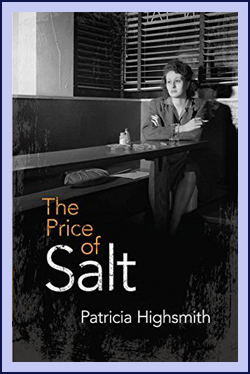
Book Review - Patricia Highsmith's The Price of Salt

The Price of Salt by Patricia Highsmith
Published by: Dover Publications
Publication Date: 1952
Format: Kindle, 260 Pages
Rating: ★★
To Buy (different edition than one reviewed)

Therese Belivet moved to New York in the hopes of being a set designer. But waiting and hoping and making models doesn't pay the bills so she is working at Frankenberg's department store during the holiday season. She's in the toy section selling dolls and is oppressed by the noise of the toy train by the elevators, the din of the customers, and the general chaos that working in retail entails. Her life is a grind, a depressing mix of cafeteria meals and hoping her boyfriend Richard comes through with a job opportunity for her in the theater after Christmas. All this changes when she sees Carol. Carol Aird comes into Frankenberg's to buy a doll for her daughter. The doll is to be sent to Carol's home in New Jersey and the address is emblazoned on Therese's heart. She doesn't know what possesses her but after Carol leaves she rushes to send her a card. Carol calls the store, intrigued by being sent a card from an employee of Frankenberg's. She wonders if this is common practice but learns that it, and the girl who sent it, are not in the least common. Carol is going through a divorce and is separated from her daughter Rindy for the holiday season so she takes in Therese like a stray. They drive around together, sit for hours doing nothing, listening to music, having dinners out, even getting a Christmas tree for which Therese makes all the decorations. They are fast friends. As Therese muses, "It would be almost like love, what she felt for Carol, except that Carol was a woman." But women can love. And that's one of the reasons that Carol is being kept away from Rindy. The divorce isn't going well because of something that happened in her past with her friend Abby. But what Therese feels, Abby could never have felt. As Carol and Therese take to the open road the future is wide open but their past is closing in.

The Price of Salt is a classic of lesbian fiction and it's easy to see why; two women fall in love and are given a chance at a happily ever after. This was something unheard of in literature of the time as it defied all tropes of the genre. Which makes it an important book even if it's a very flawed book. The problem is that both characters are enigmas. They are ciphers. Neither really shows themself to the other fully. We have full insight into Therese's fractured and half finished thoughts as the story is from her point of view but Carol is a conundrum. Yes, I know that they are two people dancing around a taboo subject and it isn't until their trip that they take the risk to finally put their feelings into words and actions, but this makes most of the book an almost excruciating read. It isn't just a "will they won't they" situation it's a Waiting for Godot level situation. And if you're not in the mood for that level of interminable fatalism, well, then this book might not be for you. For the most part it wasn't for me until it was. Because buried among all the things not done and said all of a sudden there's this heart of gold. Yes, I'm saying The Price of Salt should have been a road trip novella. Therese and Carol finally being a couple, just touring the country, oddly skipping Wisconsin on the way from Rockford to Minneapolis, I mean, who seriously goes via Iowa, is a delight. They take pictures and do things normal couples do, they talk, they love, and we learn more about them in these few chapters than in the whole rest of the book. Plus Highsmith, with her accomplished crime fiction background, has this delicious foreboding building. Could they be being followed? Has Carol's husband given her enough rope to hang herself? All the while there's that gun in Carol's suitcase and you can't help but wonder, will it be used? Could Highsmith be going for a dark ending for our lovers? Because literature of the day demands it. When she taps the breaks, that's when you realize what a genius she is. Just not a genius at editing.

Wednesday, June 14, 2023

Book Review - C.L. Polk's Even Though I Knew the End

Even Though I Knew the End by C.L. Polk
Published by: Tordotcom
Publication Date: November 8th, 2022
Format: Hardcover, 144 Pages
Rating: ★★★★
To Buy

Helen Brandt would do anything for those she loves. She literally gave her soul and lost the life she knew to save her brother. Now her time is up. Ten years for a life doesn't seem like too bad a deal until those ten years are up. She never knew she'd forge a new life in Chicago as a private detective and part-time diviner. She never knew Edith would walk into her life and make every second precious. And as Helen sets about doing a job for Marlowe at twice her usual fee she can't help but think she'd rather be home with Edith. Though Marlowe is the perfect client, always knows what she wants, always knows how to intrigue Helen, always pays on time though heaven knows where her money comes from, as she is always living in the lap of luxury at the Palmer House hotel. And she has one hell of a job for Helen. The photos and augury in the alleyway keeping her away from Edith was just to wet Helen's appetite. The girl murdered there, Kelly McIntyre, is just the latest victim of the murderer dubbed the White City Vampire and Marlowe wants that killer brought to her. But Helen's time left on Earth is short so she turns down the job. Which is when Marlowe throws a wrench in Helen's carefully orchestrated death; what if she could get Helen her soul back? All Helen has to do is uncover the killer and she can live out her long life with Edith. The deal seems too good to be true. Which it probably is. But it's not like Helen has anything left to lose except a lifetime with Edith. But Marlowe did warn her it would be dangerous, and soon the divine and the damned are after her as she becomes the target of the White City Vampire. How could they know she's on the case? What's more the Brotherhood who excommunicated her for bringing back her brother are on the case too. If only she had an ace up her sleeve... But sadly she doesn't, but Edith might...

If I had to choose between noir and fantasy, I'll be honest, I'd most likely choose fantasy. And yet noir and fantasy merge together beautifully. I often try to think about what makes certain genres mesh together well, certain time periods just beg to have that little something more. They're usually times of great change and upheaval when you can see the cracks in the world and out of those cracks comes something magical, something different. The forties are one such time. World War II changed everything and it makes sense that along with the evil that was stirred up, so were other forces both demonic and angelic. And with the heavenly hosts I couldn't help think about how much I love the television show Lucifer. While the main framing device is the devil does a procedural, the show did so much more, especially during the noir episode "It Never Ends Well for the Chicken." This episode showed these two genres perfectly blending together and I never thought I would see that again, and then I picked up Even Though I Knew the End. I adore this world that C.L. Polk has created. There's this wonderful merging of noir and a unique magical system that is somehow, at it's bones, just so Chicago. As someone who has spent a fair amount of my life visiting Chicago they perfectly captured that sense of place. I was in a place I loved but in an era that my grandparents would have known. And don't get me started on the crime scene photography with magic aspect, that was a bullseye. This is so unique and original but at the same time it was reminiscent of things I'd forgotten I'd loved, from Who Framed Roger Rabbit to The Exorcist to H.H. Holmes, immortalized in Erik Larson's The Devil in the White City. And while this book is wonderful and perfect and complete, I want more stories set in this world! A world that is made all the more perfect by Helen and Edith's love. Helen really would do anything for those she loves and that just about breaks my heart.

Friday, June 2, 2023

Book Review - Sarah Waters's Fingersmith

Fingersmith by Sarah Waters
Published by: Riverhead
Publication Date: October 1st, 2002
Format: Paperback, 548 Pages
Rating: ★★★
To Buy (different edition than one reviewed)

Sue Trinder has grown up in Lant Street. She has never left this slummy Borough of London and has never wanted to. She has lived her entire life in the care of Mrs. Sucksby, who makes her living farming babies. But Sue was the only baby that ever mattered to Mrs. Sucksby. They live with Mr. Ibbs, who makes his living in the roundabout manner of taking in dubious goods through the back door and sending it out the front in a slightly different "legitimate" form. The rest of the household is made up of Mr. Ibbs's invalid sister and John Vroom, a man with a love for dog skins, and his simple girl Dainty. This is Sue's world and they are as dear to her as family. One day an acquaintance, known to all as Gentleman, arrives with a plan to make all their fortunes using Sue. Mrs. Sucksby has always told Sue that she would be the making of them all and now Sue has her chance. Gentleman has been posing as an artist, a Mr. Rivers, for a Mr. Lilly, who lives out west in the Thames Valley. Mr. Lilly has a niece, Maud. Maud is where their fortune will be found. Gentleman has been seducing this isolated girl in hopes of getting at her fortune through marrying her but has hit a brick wall; Maud's maid. Maud's maid was their chaperon and has taken ill and now Maud isn't allowed in the presence of Gentleman. Gentleman has decided to fix that. By installing not only a new chaperon, but one that will help him pursue his interests with Maud. With Sue on the inside it is a win win situation. They will compromise Maud, throw her in an insane asylum, and split her vast fortune and live like toffs. What could possibly go wrong? In a world where there are plots within plots, games within games, and you don't know who's playing who, there are a lot of ways this could play out...and perhaps it won't be to everyone's liking.

Fingersmith is an amazing book if you were to redact the final two-thirds of the book. There's only so many times you can see the same events through the eyes of different characters before you start to tune out. But this is a very Victorian trope, like Wilkie Collins's The Woman in White, it overstays it's welcome by several sections. Yet while The Woman in White might have overstayed it's welcome it was always moving forward not dwelling on the same events over and over again. Though this book can't be discounted just for falling prey to the tropes Waters is emulating. She does an amazing job of capturing the seamy side of Victorian London. Sometimes you're reading about other times and think, now that would be a nice place to visit. Not here, not this world. And I think that's what makes the world of the book so real. You feel as if this is probably the most accurate depiction you've ever read of this time period. It's filthy and dirty, it's creaking corset stays on a large woman who never washes herself and the secrets she hides within her bodice. Maud's penchant for gloves, though not of her own doing, at least is some kind of barrier to the grotesques that are discussed. But even they are tainted. The only bright spot is the friendship and love that develops between Sue and Maud. Fingersmith is perhaps most famous because it continues in Waters tradition of depicting lesbianism in different eras. Sapphic love has been around as long as there have been humans, yet it wouldn't have been openly discussed in Victorian times, despite it existing. Here Waters is breaking down another door, going all out with what would be a taboo subject and making it believable and compelling. For all the repetition and all the tropes she falls victim to in her writing of this story there is the other side of the coin. All that she does right. A more accurate depiction of the times, relationships that are real, making us readers see that this world of times gone by was just as real as the "now." Because more than anything, that is what this book does, make Victorian England real.

Thursday, June 1, 2023

Pride

I have so many ideas for theme months that only a fraction of them make it to fruition. That being said I feel that there are some that are so important that no matter what I have to do them; and that's how it is with Pride. I've been wanting to do this for so long and looking at the world today, at all the hate against the LGBTQIA+ community, I knew that this June, no matter what, I would celebrate pride with inclusive books; books that a lot of people would like you to not read. So with more bans and more just bullshit I wanted you all to know that I am an ally. Love is love and I love you and we all love books. So let's celebrate Pride together, and you know, if people start getting us down, throw a riot or two, because it's no longer the time for hollow gestures, it's the time for action.

Friday, September 9, 2022

Gentleman Jack

Three years ago Anne Lister strode onto the screen and became the darling of relevant period drama. Suranne Jones as Lister with a nod and a wink spoke right to the audience letting us into the secrets of Lister's life. And what a life! From 1791 to 1840 Anne Lister detailed the minutiae of her life in secret diaries that were found behind a wall panel in her home, Shibden Hall. What's more stunning is that they were written in a code that, when cracked, showed their importance because Lister was unapologetically a lover of women. She wrote about her seduction techniques and love affairs, as well as information about coal and canals. Lister's marriage to Ann Walker, which concludes the first season of Gentleman Jack, is viewed as the first lesbian marriage in Britain. There's a plaque and everything. You'd think that such a life as Lister's, with all her work and travel and love affairs, would have been adapted years early, and actually it was almost a decade previously, but The Secret Diaries of Miss Anne Lister staring Maxine Peake just seemed to be missing something, and oddly not Gemma Jones who reprises her role of Aunt Lister here. And I can't really put my finger on the failure either other than perhaps the world was just waiting with baited breath for the perfection that is Gentleman Jack. This show is an amazing headlong plunge into the life of a woman who loved life. Suranne Jones as Anne Lister is more alive than anyone I have ever seen. Her personality is larger than life, you can see how Ann Walker fell under her spell and how Mariana Lawton can not live without her. But in Ann Walker we see the heart of the show, her vulnerability, her humanity, and how Anne Lister wants to protect her. This is a complicated love story as well as a celebration of a woman who lived her life as she wanted, not willing to conform to societies expectations of her. What's more this show has a stacked cast, Timothy West, Peter Davison, Rupert Vansittart, Gemma Whelan, and so many more. But I think a king, a doctor, an in-law of Mr. Bingley's, and a Greyjoy are pretty big names indeed! But the second season seems to lack focus. Yes, love, work, politics, they were all an important part of Lister's life, but here they're all mashed together with no rhyme or reason. And as for how they handle the politics, blues versus yellows, they do know us Americans don't know what that means right? I wanted Gemma Whelan to give one of her perplexed stares into the camera just for me. But maybe, just maybe, they didn't want to spell it out because Lister was actually a conservative, AKA a blue. And as for how they handled Mariana this season, hold me back. There is NO EVIDENCE that there was an affair after the marriage. And Mariana comes across as such a manipulative bitch. But I give them credit for showing Lister warts and all, especially in how she treated her sister. Sometimes you can't like her, but you have to root for her, because it's wrong that Miss Lister and Miss Walker are the only two people in the world who are rooting for their relationship to succeed.

Friday, April 27, 2018

Book Review - Heather Rose Jones's Mother of Souls

Mother of Souls (Alpennia Book 3) by Heather Rose Jones
Published by: Bella Books
Publication Date: November 29th, 2016
Format: Kindle, 240 Pages
Rating: ★★★★
To Buy

Luzie Valorin grew up in a family of musicians. When she married she thought she had put that life behind her but the untimely death of her husband forced Luzie to make some difficult choices. She could have run off to the bosom of her family in the countryside but instead she turned her home into a boarding house for theatrical souls. Though opening her house to strangers didn't make ends meet as she had hoped and she supplements her income by teaching piano lessons and doing copy work for her father's old friend, the great classical composer Fizeir. All this just to honor the memory of her dead husband and send their two boys to his old school. The only joy in her life is in composing. She writes little musical pieces to help her students. Whether it's for more confidence or to showcase their current abilities, it brings her joy. She even got up the courage to show Fizeir her work, but he broke her a little when he said he didn't think much of it. But he is willfully "blind" to Luzie's talents as she will painfully learn. She doesn't have just talent, she has the ability to create magic from her compositions. And to think, Luzie would have never known if Serafina hadn't come into her life. If a room in her house hadn't become available and Serafina wasn't in need of a roof over her head. Serafina changed everything.

Serafina Talarico is the daughter of Ethiopian exiles who settled in Rome. Her life was happy until the death of her mother. So many things changed, but what forced her into the arms of Paolo was her interfering sister-in-law who wasn't just domineering, but didn't want any Ethiopian taint in her life. Paolo seemed the perfect choice of husband, he was going to teach Serafina about the mysteries she could see but couldn't perform. Soon his displeasure with his wife's inabilities leads him to spend much time abroad while Serafina takes comfort in the arms of his cousin. Though everything changes for Serafina when she stumbles on the notes of Margerit Sovitre and sees a kindred soul. Throwing caution to the wind she journeys to Alpennia and joins Margerit's inner circle hoping to achieve a mystery that will capture the happiness she experienced in her mother's presence as a child. But she knows Margerit's hospitality can only last so long with Serafina's continued frustration at being unable to perform the simplest of miracles. Therefore she takes a room at Luzie Valorin's boarding house and is shocked to find that the composer is unaware the she is creating magic with her compositions. Serafina encourages Luzie's composing and leaps at the opportunity to help shape an opera whose magic might effect more then these two lonely hearts who've found each other.

Mother of Souls is the first book in Heather Rose Jones's Alpennian series that I feel achieved it's full potential. With each book building off the previous volume everything started to click into place over time and here with the larger cast of characters there was a better balance than just the two previous couples featured. The narrative no longer felt constricted by only four viewpoints and there was a wonderful blending of talents and interests, from music to printing, mysteries to sorcery, religion to godlessness, Alpennia to the rest of the world, here we have a Bloomsbury set for Alpennia. We have artists and free thinkers, a family, a tribe is being created. All these women who felt like they fit into society like a square peg in a round hole come together in salons and aren't crushed under foot by the patriarchy. Seeing as this series is Ruritanian lesbian romance a lot of inference can be made about educated women and their sapphic ways and at times it strains credulity and feels a little stereotypical especially given the previous two installments, but to these niggling criticisms I say that one, it's romance, and two there's Luzie. I should say Luzie and Serafina because I really like how their relationship forms and eventually ends. They are a different kind of heroine. Both have been married, both have been thrust into a new world that they aren't sure will accept them, but both have amazing resilience, and both end up in a place you wouldn't expect them to. That I think was the best part of Mother of Souls, the unexpected.

Yet among all these characters there is a strong theme of female empowerment running rife. This book is a rallying cry, as is the opera Luzie writes about the female philosopher Tanfrit who is only remembered through her connection to the male philosopher Gaudericus! Women have been told to be quiet for far too long! Men are always keeping us down and taking credit for what we do and when that can't work just erasing us from history. I literally can not think of a woman who won't identify with Luzie's relationship with the composer Fizeir. Here is a man that needs her and his need leads him to purposefully insult her work which he obviously thinks is worthy because he passes it off as his own all while she hero worships him. Who hasn't been taken advantage of by a man in power in one way or another? To be told you are "less than" just so that they can keep you in line and keep themselves on the top of the heap. At times I was just filled with rage for Luzie and her situation. She has real talent and has been kept down by the male status quo. While things are still far from equal I really don't know what I would have done if I had been raised in a time when women and their education were frowned upon. To not be allowed to read and learn? I shudder at the thought. Which is why Margerit's founding of the female academy named after Tanfrit is such a wonderful counterpoint to Luzie's journey. Here is a place where women and education is prized and that makes me immensely happy.

What also makes me immensely happy is the expanding of what is considered "magic" in the Alpennian world. The first book Daughter of Mystery dealt with thaumaturgy and The Mystic Marriage dealt with alchemy. These are both "sciences" that were practiced in medieval times. Yet the thaumaturgy we see here is very specifically on the religious mysteries end of the spectrum and the need for devotion to God. Which is why the introduction of alchemy in the second book was cunning in that it can be learned by non-believers and was paving the way to a new magical system. We were slowly moving away from God and looking for a "word other than miracles." In fact it's very clear with all that is happening that "[t]here was more magic in the world than could be encompassed in Margerit's theology." I nearly cried for joy that Margerit was dinged a little. I am such a strong non-believer that I rebelled at a world where only the prayers of certain people were answered and this was what "magic" was. I am not joking that I DID cheer when Margerit's partner Barbara said "[s]ometimes I think we need a different word than 'miracle.'" Sing it sister! Non-religious magic is here to stay! And how is it here to stay? In Luzi'e music. Yes, you could argue that originally music was a strong part of religious devotion, but I'm not going there because I finally have magic unencumbered by the church! Music, to me, has always been magical. Theater even more so. Therefore combining the two is a rare form of magic. Just look how much Hamilton changed our world and it's easy to see that in this world, as in ours, music and performance can change anything.

Though I wouldn't be me if I didn't have something that annoyed me to no end. So Antuniet Chazillen, one of our two heroines from The Mystic Marriage is now a royally appointed alchemist and one of our Alpennian Bloomsbury set. She actually has REAL power. Power that I feel could be used dubiously, but that's an issue I had with the previous volume, not this one. Antuniet also is obsessed with her family's legacy and therefore despite having the Vicomtesse de Cherdillac as her life partner she is determined to have a child. She plans to go about this in the regular fashion, think of it as a 1800s sperm bank because she's so not the type to marry some man just to have a child, leaving Jeanne in the process. But she's so obsessed with her reputation, and here I scratch my head because come on, she lives with a woman and is doing magic, that she decides to fool everyone as to how she became with child. She decides to claim that she created a homunculus because it's the second great act of alchemy and she is THAT GOOD! Excuse me!?! WTF!?! This is so counter intuitive. Antuinet is actually an alchemist and she is resorting to the tricks of charlatans? My mind boggles. I have a real problem with people who have abilities, doesn't matter what kind, artistic, whatever, who resort to "alternative methods" to achieve what they want. Because it isn't fair! It's like plagiarism, you are getting credit for something you didn't do. Nope, nope, nope. Plus, just as an aside, wouldn't people see the baby and be like, nope, not what a homunculus is supposed to look like? No? Just me. As always. But then again... "When a mystery works with nature and not against it, it's hard to distinguish truth from fraud."

Friday, March 24, 2017

Book Review - Shirley Jackson's The Haunting of Hill House

The Haunting of Hill House by Shirley Jackson
Published by: Penguin
Publication Date: 1962
Format: Hardcover, 235 Pages
Rating: ★★★★
To Buy

None of the villagers go to Hill House. No one will hear you scream, in the dark, in the night. Dr. Montague views the house as the ideal location for his research of supernatural phenomena. The house's history coupled with the right participants should yield him the results he's looking for. Yet he only heard back from a few people selected as the perfect candidates for his summer long program, for sensitivity combined with previous supernatural encounters. In the end he gets the shy and awkward Eleanor who has spent much of her life caring for her recently deceased mother. She doesn't even remember the incident for which Dr. Montague recruited her she just views Hill House as her first real adventure and a way to get out from under the stifling life she's living on a cot at her sister's. Theo was chosen because of her apparent psychic abilities. Then there's Luke. Luke is the heir to Hill House. He doesn't have abilities or haunting experiences, he just needs to get out of his troubling patterns and his grandmother thinks locking him away at Hill House as a guarantee against Dr. Montague's lease is a lovely idea.

After each of the participants successfully battle their way past the suspicious caretaker, Mr. Dudley, and get explained the rigorous rules as regards the meals and cleaning up by his wife the group settles in. It does not take long for weird knocks to happen at doors in the night as well as severe temperature drops. The doors don't like to remain open, if this is Mrs. Dudley, or the house, they can't figure it out even with the aid of large doorstops. Very shortly they instigate a rule that no one is to wander alone, especially at night. Yet what is actually happening, if they where to write it down as per Dr. Montague's research guidelines, they wouldn't or couldn't be able to put it into words. Strange writings, noises, voices, drafts, and above all four very different personalities clashing, not counting the possible personalities of the house's former occupants. Is any of this real? Or are they hallucinating? Or should they all leave the house as fast as they can and never look back?

The Haunting of Hill House is the standard to which modern ghost stories are held. Even Stephen King has been known on more than one occasion to extol the virtues of this book. When I first read this book I couldn't help wondering why. But as more time passed I realized The Haunting of Hill House had left an impression on me and that I had perhaps judged it based on what I thought it should be versus what it was. Going back to the book I was once again drawn into Jackson's writing. She is able to depict places and characters so well that you feel you are inhabiting them. I also was able to pinpoint my dissatisfaction from my first reading. It's the ending. While I'm fine with open ended ambiguity it's that it was rushed. The book has a very languorous pace from Eleanor's daydreaming drive to Hill House through the daily routine the four occupants adapt, living like they are on holiday. And then Doctor Montague's wife arrives. This is when the story falls apart and just rushes headlong like Nell through the halls of the house until she goes straight into a tree. While this could have been Jackson's plan, having Mrs. Montague be the final push to Nell's death, instead it just feels like Jackson used Mrs. Montague to end the story in an abrupt if timely fashion.

Another reason I was initially dissatisfied was that there really isn't a plot per se. The book goes for impressions over tangibility. Any time anything vaguely spooky happens it's just glossed over or made light of when day breaks. The big scene where Theo and Nell are running from something, that's it, they ran, cut to the next morning where it will never be mentioned again. Yet over time this lack of substance works it's way into you building suspense and paranoia. This book is a slow burn, you might not feel the effects for a long time. Jackson is literally playing with our minds and the more you're willing to go back to the text the more the story works. A cumulative horror that becomes a compulsion that gripes you every fall. Because of all the things that Jackson doesn't say and doesn't spell out this allows The Haunting of Hill House to be interpreted a thousand different ways. Even the ending can be debated. As Nell slams her car into the tree so that she can forever stay at Hill House we aren't even certain of her death. All that we know is she longed for death, either because she was already suicidal or because she was driven there by supernatural means. Nell is the key here, because it's through her we are told the story and this might just be the biggest corker of an unreliable narrator ever.

Nell is interesting, but you can't really get a read on her. You know what it's like to be inside her mind, but it quickly becomes clear that this won't help you figure out what's happening, you just have to give in and let go. Her mind jumps and contradicts and doesn't make any kind of sense. Yet she is a sympathetic character. You're not sure if she's crazy but you become complicit in Nell's actions during the drive to Hill House. As she travels to her destination she sees glimpses of houses in different towns and wonders, what would her life be like there? What would happen if she decided this town was her final destination and it was her new home? Who hasn't while out walking or driving looked at a house or through an illuminated window at night and wondered what would their life be like if that was their house. Who would they be in a different setting? And that's how we become one with Nell. Whatever happens from that moment forward, whatever fantasy she spins about her and Theodora, whatever she see or hears, we are fully invested. We give in and let go with her and love the ride aboard the crazy train.

In fact, this analysis of Nell leads into the idea that Nell is in fact the haunting... but as I've said before you can interpret this book so many different ways that I find saying Nell is the haunting is wrong. I don't think the encounters the four occupants of Hill House come up against are manifestations of Nell. I think the house is it's own entity. It isn't just a building, it's a home, with personality, and once you have personality it is one quick step to being a person, a character in your own right. Therefore I fully believe that the house is haunted and it's not Nell. Well, it's not Nell at first. Because I think Nell is sensitive and is tuned into the house and as time goes on they are becoming one, which would be why she'd kill herself to never leave it. This is very obvious once Mrs. Montague arrives. Before this time the banging on the doors and the noises were unnatural phenomena that the house was creating, but once the good doctor's wife arrives Nell is the one banging on the doors. I think this is because the house is now using her for what it had to do by itself before. Nell has become an extension of the house and therefore helps with the haunting. It's no wonder she doesn't want to leave when this is the only place she's ever felt welcome.

In fact going back to this book I've realized that there's only one real problem with the different interpretations, and that's the lesbianism. I'm not against this at all and think that Nell and Theodora would make a lovely couple and they balance each other so well, what I see as problematic is Jackson's vehement denials that The Haunting of Hill House has anything to do with sex and in particular lesbianism. She didn't see sex as entering into her story at all. But so much of her story goes against what she later stated. Theodora is obviously a woman of the world while Nell is the virginal character who just doesn't understand, an innocent nature that the house can corrupt. Yet there's a connection between them long before there's a connection between Nell and the house. Also the fact that Jackson never comes out and says that Theodora's partner whom she left behind is male or female, though female is strongly implied, then why write this? Why have this omission if you didn't want the book to be read this way? If she was so against this interpretation just a few clarifications could have solved it. But then she wanted to leave her readers mystified and perhaps, despite her denials, this was just another mystery she enjoyed dangling in front of her audience. She was a master manipulator after all.

Friday, March 10, 2017

Book Review - Arthur Phillips's Angelica

Angelica by Arthur Phillips
Published by: Penguin Books
Publication Date: April 3rd, 2007
Format: Paperback, 331 Pages
Rating: ★
To Buy (different edition than one reviewed)

The Barton household is about to be violently upset. Whether it's of a supernatural nature or a more prosaic nature is dependent on who you are listening to. The simple facts are these. Constance Barton and her husband Joseph had a hard time having a child. Two painful miscarriages and finally Angelica was born. In an attempt to thwart her husband's sexual advantages Angelica has been living in their bedroom for four years. Constance couldn't handle more disappointments and Angelica is enough for her. Angelica is her everything. But things are changing and Joseph finally imposes his will, which is a rare occurrence, and Angelica is removed to her nursery and the master bedroom is once more home to the martial bed. That is when the trouble starts. Constance views it as a haunting. There are smells and spectres and while Joseph points out that it could all be due to her high strung nature, she is convinced something more is at play; and is Angelica playing along? Could the child actually be scared or is she feeding off her mother's emotions? When Joseph claims his martial rights with Constance the spectre takes on physical form and something must be done. The maid Nora has heard of a spiritualist who specializes in cleansing houses, Anne Montague, a failed actress who is supplementing her income via overwrought housewives. But Anne sees something in the Barton household to change her mind about her "calling" and helps Constance. As for Joseph, he is easily taken care of... and as for Angelica? It turns out this is her story in more ways than one.    

If you're looking for a book strewn with contradictory stories and lack of resolution, than this here is the book for you! If instead you're looking for a psychological thriller that has supernatural elements, then I'd suggest you walk away. Or at the very least only read Constance's viewpoint, because the only thing going for this book was, aside from Phillips's ability to capture the language of the time period heavily reminiscent of Lewis Carroll, the first section with it's paranormal activities. Because this book isn't about the supernatural it's about unreliable narrators and the fallibility of memory and how each and every person sees the world differently. Which is all fine and good, it's just not the book I thought I was signing up to read and therefore I was a very dissatisfied reader. But more on my complete dissatisfaction later, with spoilers aplenty, so you've been warned. The problem with having four distinct perspectives is that they will never agree, add to this that Angelica is technically the vehicle for the other three narrators, and it's a jumbled mess. Yes, it's interesting to see the different interpretations of the same events, but overall it needed some grounding. There needed to be some character that you could connect to over the others, someone needed to be a little more believable so that you could take that away as what you believe is the truth. Instead, by not having this element the inconclusive ending makes for dissatisfied reading.

Seeing the story in order from the POVs of Constance, Anne, Joseph, and finally Angelica, who we've really been hearing from all along because this is her therapy session, Phillips seemed to want to discount the previous POV. Yes, everyone sees the world in their own unique way, but he seems determined to lessen the book in each section by paving over what came before and making it unbelievable. Therefore instead of being able to pick apart the POVs and find some thread of truth, we have each subsequent narrator totally disproving what came before. With Constance it's a ghost, but then Anne comes along and it's not a ghost it's sexual abuse, though she still lets Constance think it's a ghost. Then along comes Joseph and it's not sexual abuse it's that women be crazy yo. As for Angelica... she confirms nor denies any of these stories. So all is plausible. Say what!?! All is true and nothing is true? I know you can mimic the writing of Carroll, but please, no. Phillips you are no Carroll when it comes to nonsense and riddles. Unreliable narrators are really popular at the moment from Gone Girl to The Girl on the Train, heck this book technically has the ever popular "girl" in the title with Angelica's name, but these books succeed, and I really can't believe I'm saying there's something successful in Gone Girl, but they succeed because you get closure, not some supposedly deep yet ultimately aggravating non-ending.   

But then again, this is a book that basically writes itself off in the end. In fact, rarely have I hated a book so much in it's last few sentences that I grew to despise it and wanted to throw it more than anything."Flames, on the side of my face, breathing-breathl- heaving breaths. Heaving breaths... Heathing..." So let's break down that ending. At the conclusion of the book Angelica, the gimmicky narrator/manipulative bitch we've been hearing from tells her therapist to just ignore everything she's said, he will never understand her and he should just bring on the next "pretty hysteric." Now I've had long talks with one of my friends over this abrupt ending, seeing as we read this book for book club. Her conclusion, in as simplified a manner as I can make it, is that Angelica realizes that the therapist will never understand her, a complex modern woman, and the slight is to the therapist. Whereas I think it's the exact opposite. I think it's the author not bothering to understand women but just flipping them off at the end. They're women, they aren't worth figuring out because this wasn't Angelica's story it was Joseph's story all along. And why do I think this? Because Phillips, while writing so much about women here can't help that he is a male and as evidenced strongly in Joseph's section all his sympathies are with the male of the species so he's just writing from his entitled white male POV. Yeah, so let's throw this book out a window shall we?  

Going back to Joseph's section, not only does it discount everything that Constance and Anne have said, it makes Joseph this tragic figure who isn't understood at work or at home and he just has no friends and blah blah blah blah. I'm sorry your wife doesn't want to sleep with you, could it be because there is no birth control and she doesn't want to almost die having a stillborn child again? Every aspect of Constance's life is put under the microscope, every thing she does, says, feels, is up for debate, whereas Joseph, well, it's just poor Joseph don't pick on him, he's having a bad day, so let's let him be. Why not scrutinize Joseph? Put him under the harsh lights he uses in experimenting on animals, a job that is noble and not at all amoral! The true theme of this book isn't about memory and differing POVs, in Joseph's section we see Phillips's true motive, everything comes down to "poor men." Because obviously, like the recent Portlandia sketch, men have been pushed aside and marginalized too long. All women want from them is to trick them into marriage so they can have babies. Yeah, that's right. This very modern and topical view that women are out there to trick men into baby making is thrust into this Victorian period piece. I just kept thinking, yes, things are cyclical and men could have felt that way then, but more I kept thinking, is the author's girlfriend trying to get him to put a ring on it and a bun in the oven?

So as you can imagine by this point, I'd sworn off the book. Whatever good had happened with Constance and Anne, all was washed away by the modern hypocrisy just screaming at me from these pages that made up Joseph's section. Was there hope that Angelica could redeem the book? As you've read already. No. There wasn't. In fact Angelica's section is so slight it barely deserves a mention, except for one point; Constance and Anne hooking up. This is an issue I have with many male authors, they think that women will just randomly be lesbians if it suits the needs of the men. George R. R. Martin might be the worst, but can't they get that people are born who they are and that's that? You can see why Constance and Anne might be drawn to each other, Constance hasn't fared well at the hands of men, especially in regard to reproduction, and Anne is a wonderful protector and provider. But like the male entitlement that just oozed off the pages earlier, this just seems to be another nail in the coffin of women as manipulators. They got the child they wanted, killed Joseph, and now can live happily ever after. Or you could look at it as Constance doesn't like Joseph or his attentions so therefore she must be gay. In other words, everything in this book is seen through male entitlement glasses, I wouldn't say they're rose colored, they're more shit colored, because what makes you think that it's OK to think like this? Women are people too. I know many men are trying to change this, and reading a book that thinks that way... it just enrages me.

Friday, December 2, 2016

TV Movie Review - Daphne

Daphne
Starring: Geraldine Somerville, Andrew Havill, Christopher Malcolm, Elizabeth McGovern, Nicholas Murchie, Malcolm Sinclair, and Janet McTeer
Release Date: May 12th, 2007
Rating: ★
To Buy

There was a time when two women were Daphne Du Maurier's life entire. Ellen Doubleday was the wife of Daphne's American Publisher, Nelson Doubleday, and Gertrude Lawrence was an actress with whom Daphne sated her unrequited love of Ellen. The news of the death of Gertrude leads to Daphne baring her soul in writing to Ellen, because Ellen was the beginning. They met on a transatlantic crossing. Daphne was coming to America to stay with the Doubledays to defend herself in court against accusations of plagiarism stemming from her most famous book, Rebecca. Ellen wafted into her cabin with her arms laden with presents and from that moment on the trial was nothing but a nuisance to Daphne who liked to do nothing better than bask in the presence of Ellen. Ellen is aware of Daphne's growing infatuation and confides to her that she doesn't judge her, she just can't love her in the way she desires. Daphne returns to England and does what she does best, control her emotions in her work. She writes a play, September Tide, wherein the character of the mother-in-law is Ellen and Daphne's avatar is the son-in-law. In a twist of fate the mother-in-law is played by Gertrude Lawrence, whom Daphne met at a party of Ellen's. Soon Gertrude and Daphne begin an affair, much as Gertrude and Daphne's father Gerald did years earlier. Yet Gertrude isn't Ellen and Ellen will forever be between them.

When I first read Rebecca I knew that it would forever be one of my favorite books. So much so that I actually stole my mom's copy from her collection of Franklin Mysteries despite being only about thirteen and not getting the full impact of the book. One of the first things I remember reading when looking into the life of the author of this classic was that this female writer shared a lover with her father. Right there I knew there was a story that needed telling. It might be a weird story, it might be a disturbing story, but the more I read about Daphne's relationship with her father, the famous actor Gerald Du Maurier, the more I needed to know. And I needed to know this from someone who wasn't Daphne. Daphne had a habit of censoring herself. Just read her autobiography, Myself When Young, and you'll see what I'm saying. She just tells her story in a very flat and conventional way. Her life could have been the life of any of her contemporaries. There was no plumbing of her depths, no hints of what she was so artfully and carefully concealing. Therefore when I first read about Daphne in some catalog I got in the mail I was excited to see that there was a film out there finally dealing with the complexity of Daphne Du Maurier. Her sexuality, her relationships, everything she tried to keep hidden. I wanted in. I wanted to know her better.

Perhaps I had too many expectations of a short movie made for television. Because all I got was surface. There was no complexity. If anything Daphne conflates and condenses until there's almost no story to tell. I can't help but think of the adaptations of Sarah Waters's work, who is herself a big fan of Du Maurier, there risks were taken, here... here is a movie that won't offend the sensibilities of the after church crowd gathering around to watch PBS. Because nothing is explained, nothing really happens. Daphne is a confusing mess of repressed emotions and stilted acting. It felt of another time. As in it felt like a movie made post Hayes Code, but only just. The film stock and direction made Daphne look and feel like a BBC adaptation from the early 70s. But not a good one like Upstairs, Downstairs, one of those ones you saw once and never wanted to see again and have since expunged from your memory. In fact I would go so far as to say that this isn't so much acted as a "historical dramatization" akin to the historical reenactments on the History Channel that are interposed between interviews with scholars. Only those are better acted.
In fact, if Daphne had gone all American Horror Story: Roanoke on us perhaps this would have worked. There is just SO MUCH that is glossed over and omitted, and this coming from someone who has only a passing knowledge, that this movie NEEDED those scholars interjecting and explaining what is happening in Daphne's life and mindset in order to grasp what is going on. Someone who is not at all familiar with Du Maurier would be totally at sea. For example the plagiarism lawsuit was just brushed aside for long awkward glances at Ellen Doubleday. Whereas the countless claims and sole lawsuit against Du Maurier for plagiarizing Rebecca could have alone made an interesting movie, instead of a few quick snapshots that brought her into the orbit of Ellen. Sure a successful book will bring the kooks out of the woodwork, but there is a possibility that Rebecca wasn't all Du Maurier's making... see, I'm already hooked right there, now I want that movie as well! But this movie was never about clarity. Daphne's complex relationship to her father is basically reduced to a not very witty line delivered by Noel Coward.

This here is the fatal flaw. Here is a movie about Daphne Du Maurier that never once goes into the depths of her psyche. Never once goes into the whole creepy control her father tried to exert over her with his countless laments that he wished Daphne had been a boy or the whole THEY SHARED A LOVER. Here she's portrayed as butch, the word "lesbian" literally shan't be uttered, if there has to be a mention of her proclivities, just call it "Venetian" as the unexplained ergot of her family demands. This simplification discounts so much of how Du Maurier viewed herself. Most likely due to the roles her father made her fit she isn't able to be simply called bisexual. She quite literally had a split within her, I'm not saying a split personality, but it could almost be called such. She viewed her creative drive as masculine and home life as feminine. Her creative drive was tied into her passion and therefore her romances with both Ellen and Geraldine, why else does she keep referring to herself as a young boy? And yes, that is never explained within Daphne. These issues needed to be handled with care and insight, not just dressing her up in plus fours and having her walk around the countryside!


This movie was such a missed opportunity that it just, ugh. I just don't want to think about what it could have been. But the true horror is that this movie was brilliantly cast. I mean seriously, you have some of the TOP actresses in British Drama and the directing and writing reduced them to this? Cora Crawley! That doyenne of Downton! Lily Potter! Harry Potter's freakin' mother reduced to this! But what really drives me batty is Janet McTeer. I've always admired her, from bumping people off on Marple to getting the sorcery going in The White Queen to taking on that most famous of mothers, Mrs. Dashwood, she's always been good. But this past February I got to see a broadcast of the National Theatre's live production of Les Liaisons Dangereuses which she stared in with Dominic West and holy shit people, if she doesn't win every award available to her for this it is a crime against humanity. The depth, the complexity, the humanity. I was moved more by that production and her acting than anything else in recent years. To know that this movie had access to that talent and then didn't utilize it? It is yet another crime against humanity.

Wednesday, July 20, 2016

Book Review - Sarah Waters' Fingersmith

Fingersmith by Sarah Waters
Published by: Riverhead
Publication Date: October 1st, 2002
Format: Paperback, 548 Pages
Rating: ★★★
To Buy

Sue Trinder has grown up in Lant Street. She has never left this slummy Borough of London, and has never wanted to. She has lived her entire life in the care of Mrs. Sucksby, who makes her living farming babies. But Sue was the only baby that ever mattered to Mrs. Sucksby. They live with Mr. Ibbs, who makes his living in the roundabout manner of taking in dubious goods through the back door and sending it out the front in a slightly different "legitimate" form. The rest of the household is made up of Mr. Ibbs' invalid sister and John Vroom, a man with a love for dog skins, and his simple girl Dainty. This is Sue's world entire. And they are as dear to her as family. One day an acquaintance, known to all as Gentleman, arrives with a plan to make all their fortunes using Sue. Mrs. Sucksby has always told Sue that she would be the making of them all and now Sue has her chance.

Gentleman has been posing as an artist, a Mr. Rivers, for a Mr. Lilly, who lives out west in the Thames Valley. Mr. Lilly has a niece, Maud. Maud is where their fortune will be found. Gentleman has been seducing this isolated girl in hopes of getting at her fortune through marrying her but has hit a brick wall. Maud's maid, who was their chaperon, has taken ill and now Maud isn't allowed in the presence of Gentleman. Gentleman has decided to fix that. By installing not only a new chaperon, but one that will help him pursue his interests with Maud. With Sue on the inside it is a win win situation. They will compromise Maud, throw her in an insane asylum, and split her vast fortune and live like toffs. What could possibly go wrong? In a world where there are plots within plots, games within games, and you don't know who's playing who, there are a lot of ways this could play out... and perhaps it won't be to everyone's liking.

Fingersmith is an amazing book if you were to redact the final two-thirds of the book. Divided into three parts the second and third parts are repetitive. Waters showed us in that first-third what she was capable of, and if it had ended there this could have been a true classic. But instead she chose another course. Yet I wonder if this drawing out of the narrative wasn't purposeful. Yes, she could have had a tauter more compact story, but that would defeat the Victorian aspect. I think being overly long and taking the narrative straight into "I don't care land" is a staple of true Victorian writing, or Victorian-esque in this case. Like Wilkie Collins's The Woman in White, which Fingersmith strongly emulates, it overstays it's welcome by several sections. Looking back onto the other Waters book I've read, The Little Stranger, I realize now that that book really did have the perfect ending. You weren't sure what happened and it ended a bit mysteriously. If Waters had done that with this book, ending on a cliffhanger and being all mysterious, I would have been blown away and ranked it up there with some of the finest short fiction with the likes of Shirley Jackson. Instead she went the route of Wilkie Collins, and you can't really blame her for that.

Yet I can blame her for the repetitive nature of the storytelling. The Woman in White might have overstayed it's welcome but it was always moving forward. By having two different narrators with Sue and Maud, we see the exact same events at least twice. With the second section with Maud narrating I was almost skipping pages going, OK, I've already read this all from Sue's point of view, let's get to the part where we left off with Sue so that I get to the forward progression of the narration. Though once we move forward, back to Sue, we go back to the ending of part one! We have learned so much from Maud that it is painful to then have to live through Sue's excruciatingly slow journey to see Sue learn all that we already know. One step forward, two steps back. That cliffhanger to end part one... it will blow you away. Yet it is soon nullified and made pointless by all the other twists and turns and cliffhangers that come after it. The impact is lost in the dragging narrative. It got to the point where it was like watching M. Night Shyamalan's The Village, I kept not only waiting for the next not really shocking twist, but I got good at predicting what it would be, and in the end you really didn't care. So, by all means, read this book, just don't read past part one.

Though this book can't be discounted just for falling prey to the tropes Waters is emulating. She does an amazing job of capturing the seamy side of Victorian London. Sometimes you're reading about other times and think, now that would be a nice place to visit. Not here, not this world. And I think that's what makes the world of the book so real. You feel as if this is probably the most accurate depiction you've ever read of this time period. It's filthy and dirty, it's creaking corset stays on a large woman who never washes herself and the secrets she hides within her bodice. Maud's penchant for gloves, though not of her own doing, at least is some kind of barrier to the grotesques that are discussed. But even they are tainted. Yet it's the unrelenting depravity and filth combined with characters who you don't just dislike, but who have nothing good or nice ever happen to them that wears you down in the end. Sure a little history of Victorian pornography is well and good, but after awhile, you say enough is enough. This book grinds you down, and in the end, you are relieved that it is done.

The secret of Mr. Lilly and his pornography collection builds on this seamy underbelly that Waters has exposed. The Victorian London she is depicting isn't the one we really see in the literature of the day. While Victorians were far more into sex, sensationalism, and penny dreadfuls than popular authors of the day were willing to depict, it is still a little taboo. Over time the image that has arisen in popular culture is of the Victorians being a very prudish lot. They never talked about sex and didn't even know quite how one went about it, like the old Pete and Dud sketch where children are conceived through sitting on warm chairs and the eating of good meals. The last few years at the steampunk convention I go to I have attended a panel on the "Forbidden Image." Which is a "selection of erotic images from the Victorian era and classical images known to the Victorians ... but forbidden by polite society!" The images, ones that would no doubt be in Mr. Lilly's collection, show that these things did indeed exist. Any new technology soon goes to sex, just look at the internet. So is it any wonder that as soon as there was photography there was pornography? Fingersmith doesn't just depict Victorian England as we know it, but as it actually was.

Which leads to Sue and Maud. This book is perhaps most famous because it continues in Waters tradition of depicting lesbianism in different eras. Sapphic love has been around as long as there have been humans, but outside of pornography, it wouldn't have been openly discussed in Victorian times, despite it existing. Here Waters is breaking down another door, going all out with what would be a taboo subject and making it believable and compelling. For all the repetition and all the tropes she falls victim to in her writing of Fingersmith, there is the other side of the coin. All that she does right. A more accurate depiction of the times, relationships that are real, making us readers see that this world of times gone by was just as real as the "now." I also defy anyone to not find Sue and Maud's sex scene quite steamy. With their bodies connecting it makes us feel for them, and no, not in THAT way. It's a scene that makes them both so vibrant and alive that even if you hadn't found some connection to the characters, this one moment will make them real for you. Because more than anything, that is what this book does, make Victorian England real. 

Friday, April 15, 2016

Book Review - Heather Rose Jones's The Mystic Marriage

The Mystic Marriage (Alpennia Book 2) by Heather Rose Jones
Published by: Bella Books
Publication Date: April 28th, 2015
Format: Paperback, 264 Pages
Rating: ★★★
To Buy

Antuniet Chazillen has been living in self-imposed exile from Alpennia. She longs to go back to Rotenek but that isn't an option. Even if she were to return no one would take her in. Ever since her brother was executed for treason and her mother committed suicide anyone bearing the name Chazillen has been ostracized. The driving force in her life now is to show the world that not everyone bearing the name Chazillen is worthless. To this end she has devised a plan with a rare alchemical text she found in Prague. If she can master the book's recipes to create precious gems of power she could present them to Alpennia's ruler, Princess Annek, and prove she can be of use to the crown and regain her standing. But wanting and doing are two very different things. Not only is her work hindered by a lack of funds, but she is being chased across Europe by someone who will stop at nothing to get their hands on the text she found. After she is discovered in Heidelberg she realizes that she must return to Alpennia earlier than she had planned in order to live long enough to restore the tattered shreds of her honor.

Jeanne, the Vicomtesse de Cherdillac, is a social butterfly. Flitting from party to party and lover to lover. Yet lately the petulance of these young women who rotate through her bedroom isn't as entertaining as it once was. And then one night Antuniet appears at her door. They knew each other peripherally years ago before Antuniet's hasty departure. It intrigues Jeanne that of all the people Antuniet knew in Rotenek she chose her. But Antuinet's only other option was her cousin and Jeanne's former lover Barbara, and somehow going to Barbara would have been too much for her pride to bear, and Antuinet has always been proud. In fact all the bedraggled Antuniet asks of Jeanne is help in securing a patron so she can continue her alchemical work. Jeanne tries her best but finding money for a dubious trade for a disgraced outcast tries even her formidable skills. But Jeanne won't abandon Antuniet, she will stick by her as she mends her flirtatious ways and develops a tendre for the alchemist. Though returning to Rotenek didn't dissuade Antuniet's malevolent shadow. Soon enough the protective Barbara and her lover Margerit, the crown's thaumaturge, come to Antuniet's aid as well. But Antuinet and her heart are vulnerable. Will she be able to repair her reputation and find love, or is it all too late?

Sometimes book series don't start out as series. The author writes a tale and for some reason or other the characters won't leave after the denouement. Whether it's their inability to leave the author's subconscious as they keep chatting away or rabid fans salivating for more, sometimes a stand-alone morphs into a series. It feels like this is what happened here. The first book set in Alpennia by Heather Rose Jones, Daughter of Mystery, focused on Anuniet's cousin Barbara and her lover Margerit. They had their story and got their happily ever after. There was an ending and it felt final. Yet here they are again getting into new adventures and new scrapes. You're probably wondering why I'm pointing this out. I should be happy at their return not dwelling on the whys. But I'm dwelling. I find this book's setup problematic. The thing is, if you are going to write a series in such a way that each volume has the secondary characters stepping forward into the limelight, the previous volume's characters need to know enough to take a step back. They aren't the focus anymore. Only someone forgot to give Barbara and Margerit this message. It makes sense that they would appear, Barbara and Margerit's actions in the previous volume having had such an effect on our two new heroines. But did they have to take up at least half of the narrative? I felt that this gave short shrift to Antuniet and Jeanne. It was THEIR time to shine, and they felt secondary.

I think this problem comes down to the fact that this book is stuck in the middle, and sorry, not sorry, for getting that song in your head. And by middle I'm referring to it's length. It could easily go either way. To go shorter, really pare down and omit Barbara and Margerit almost completely. This would give you a shorter, sweeter story. Yet I am not included in this direction. The Mystic Marriage has such court politics and machinations it's like a Ruritanian Game of Thrones. So make it like Game of Thrones! Make it a thousand plus pages! Don't just have four characters POVs have more. Have Anna, the little alchemical assistant have her say! Have Barbara's little country cousin have a chapter or two. Make this book the doorstop book to end all doorstop books. Make it the epic it wants to be! I just feel like there's so much I'm missing in this world, the details of a dress, the architecture of an alchemist's laboratory. So much is hinted at but then never developed further. I talked about this with Daughter of Mystery and how the writing felt elliptical. Here I was happy to see more time spent on the smaller details, such as the refining of the precious gems, but seriously, I craved even more. It's rare for me to say make a book longer, and editors today seem to only want books short and sweet, but The Mystic Marriage needs to expand to reach it's full potential. It needs to be fired a little longer.

What really helped me to connect to The Mystic Marriage more so than the previous volume was I felt the arcane elements were easier to understand. Thaumaturgy and the working of miracles still feels a little beyond my keen. I don't quite fully understand the process and I felt that the mysteries were left lacking definition and therefore left me a little cold. Fluctus this and fluctus that... it would help to understand a little better what fluctus even was in my humble opinion. But alchemy. I'm on far stronger ground here. Whereas we can question if miracles and magic ever really did happen, alchemy DID. I'm not saying it worked, but I'm saying that it was studied and was an accepted "science" of the time. Even if your only exposure to alchemy is the Philosopher's Stone in Harry Potter or the more detailed chemical marriages in Deborah Harkness's All Souls Trilogy, you have a grounding in it so that you are more easily able to understand what Antuniet is up to than what Margerit was. What I found particularly interesting from my point of view was the crossover of the alchemical practices and how it relates to things such as metalwork. I haven't done metalwork in many years but crucibles, flux, fire, all that I used is here used in similar yet different ways and I found that fascinating.

But it wasn't just the alchemical work itself that intrigued me, but the outcome. Antuniet was making stones, well gems really, that would have influence over people. So my first thought was, if this is the actual case with alchemy people have every right to fear it! Before I'd only ever heard of the Philosopher's Stone, which was used to increase your life, and turning lead into gold. But the work that Antuniet does is basically used to control people. Say what!?! Alchemy is basically rohypnol! Antuniet even worries that one of her stones set in a ring is responsible for Jeanne's feelings towards her. If Antuniet is worried about this how can she, in good conscience, give this power to the crown so that they can basically control their ministers? I can see the benefit for helping people with health issues, but to actually CONTROL THEM!?! I really have issues with this concept. It's taking away free will. It's like in the Buffy the Vampire Slayer season six episode "Dead Things" when The Trio use a Cerebral Dampener to make any woman their willing sex slave. It's not just wrong it's a violation of basic human rights. While you could say at least Annek's counsel "knows" the rings do something, I don't think she told them the whole truth... This just brings up a LOT of the more negative connotations of what "magic" can do. Is it even right that Antuniet made these influencing gems?

Which brings me around to the whole alchemy not really be respectable. Well, if you're controlling everyone's free will I'm not surprised alchemy has a dubious reputation! Of course it's hinted at that most alchemists are charlatans, but still, if Antuniet's morals were a little more lax, dear god! What I'm getting at is that question I wondered in the previous volume as to the acceptability of magic and witch hunts. I really like that Heather Rose Jones came back to this because I felt this was something that needed addressing. So yes, witch hunts do happen! Evil magicians are run out of town. The only reason "mysteries" and thaumaturgy are acceptable is because they have the cloak of religion giving it respectability. Which has an interesting counterpoint in the relationships of Antuniet and Jeanne, and Margerit and Barbara. Margerit and Barbara are accepted as a couple because of their eccentricity and status, whereas Antuniet and Jeanne raise eyebrows because Antuniet used to be respectable and one of the society that is now looking at them askance. Just like the veneer of religion covers a multitude of sins, so does the right combination of eccentricity coupled with title and wealth. The lower down the social ladder, the less acceptable it is to be an "other." You could in fact say that Jeanne and Antuniet face their own witch hunt with the lesbian backlash. The marriage of the mystical and mundane controversies just goes to show all the levels this book is working on. But don't worry, luckily love conquers all as long as you are willing to fight the good fight. Love wins.

Older Posts Home