

Season 52 - Around the World in 80 Days (2022)













































 The Atlas Paradox by Olivie Blake
Published by: Tor Books
Publication Date: October 25th, 2022
Format: Kindle, 397 Pages
Rating: ★★
To Buy
Knowledge is carnage, you can't have it without sacrifice. They were meant to kill one of their own. So obviously it was going to be Callum. He's too dangerous and too annoying. The problem is, the sacrifice had to actually mean something, which meant that Tristan was to do the deed. And he just couldn't. Callum really meant something to him. Which didn't fit in with Atlas Blakely's plans. Callum was chosen from the very beginning to die. He was the sacrifice. But instead Libby died. So the library got it's pound of flesh and the six became five. Though they're all having trouble trusting each other what with the fallout from the murder plot. Old alliances were destroyed and new alliances were forged. And Atlas's plans imploded all because of Libby's ex Ezra Fowler. Ezra, unbeknownst to Libby, can travel in time and is technically a lot older than her. He was one of the six candidates chosen the year Atlas was an initiate. They were the best of friends and to this day he is Atlas's confidant. They thought the same and shared the same goals, to take down the society from within and replace it with an organization that would allow access to all. To let the knowledge be widely distributed not hoarded away. Once they learned that one of their number would have to die the two of them formulated their plan. They would fake Ezra's death and he would jump forward in time while Atlas worked from the inside. Only without a sacrifice there were unintended consequences. Everyone in their year died. Except Atlas and Ezra. Ezra was safely in the future and Atlas pleased the library by becoming it's caretaker and therefore it let him live. The flaw in their plan soon became obvious. Atlas grew over the intervening years and changed what he wished to do. Whereas Ezra was still the Ezra that was first approached by the Alexandrian Society. When Ezra realizes that Atlas no longer cares about access and wants to undo the past, something Ezra knows is impossible, he fakes Libby's death and secrets her away in 1989. He does not want the Society to destroy the world, which is very much something that could happen if Atlas gets his way. But Ezra doesn't count on Libby's tenacity and her friends' obsession with finding her. Nico would know in his bones if she were dead, they are two halves of a whole. He never fell for her "death" and has been determined to find her. And, eventually, they do. She's been busy in the past. The only problem is to bring her home would come at the loss of many lives. Can Libby live with herself if she does what she needs to do? Can the world survive if they reunite and listen to Atlas? And will the library claim it's pound of flesh now that they are all still alive in the present?
So, after reading the first volume I kind of thought that there is no way this series is going to turn out to be as divisive as I kept hearing. I will fully admit I was wrong. The decline in quality between The Atlas Six and The Atlas Paradox is almost incomprehensible. What had some structure now is nothing more than fanfics colliding at the speed of light, here's some Outlander, here's some Dark Materials, here's some Dark Phoenix. Oh, and just for fun, here's some pretentious preaching reminiscent of the worst parts of Sophie's World. And yet, it might have worked. Maybe. Possibly. I'm trying to not trash fanfic or fanfic adjacent here because if you're a good writer you can make that work. You just have to have the right characters and the right plot and not you know almost four pages of nothing. Here's the thing. I truly believe this in my heart of hearts and it's my personal headcanon. When Tor was negotiating the rights to publish this series it was originally written as a duology. But Tor went, hey Olivie Blake, we're only buying trilogies at the moment and she promptly said, I can do that! And what followed is four hundred pages where nothing happens. OK, that's a little unfair. There's angst and philosophy and moral dilemmas but that's just the air of ennui this series exudes. For actual plot points Libby gets back to the present. Oh and Ezra tries to kill the remaining five of the six, but that's so half-hearted that I don't know why I'm mentioning it. So the entire plot is get Libby back to the present. That could have been handled into a single chapter. Maybe, possibly two. In other words, it could have happened at the end of The Atlas Six or, if you wanted to maintain the cliffhanger, at the beginning of The Atlas Complex. The Atlas Paradox does not need to exist. Wait, is that the paradox of the book? No. It couldn't be. That would be too clever and I won't give the author that much credit. Though lovers of this book, the two of you out there, will say that we needed this book so we could have Libby Rhodes's corruption arc. She had to go all evil villain. AKA Dark Phoenix. And, I'm sorry. But no. It was stupid. She chose herself and her potential over countless lives. She could have stayed in the past, but it was her potential in the future, at that point in time with those people that was more important than the lives lost. She blew up a nuclear power plant to get home. She's a bitchier Oppenheimer, destroyer of worlds. And ironically she's going into the future to destroy worlds as well with Altas's plan. But then again, this book is all about people choosing ignorance over knowledge and the six are the most ignorant of all.
 Emily Wilde's Encyclopaedia of Faeries by Heather Fawcett
Published by: Del Rey Books
Publication Date: January 10th, 2023
Format: Hardcover, 336 Pages
Rating: ★★★★
To Buy
Cambridge professor, Emily Wilde, PhD, MPhil, BSc, Dde, untenured, is hoping to change this status with her research trip to Hrafnsvik, Ljosland, the most isolated of Scandinavian countries, an island situated off the Norwegian coastline brushing the arctic circle. Emily is the foremost dryadologist in her field, but being a prickly woman inept at small talk has limited her advancement within the remorseless academic hierarchy. She knows better than most, she's been ensconced there since she was fifteen. When Emily's Grandfather, an amateur folklorist, died when she was a child his library became her best friend. Most children love faeries for their magic, but not Emily. To her the Folk were another world with their own rules and customs, and to a child who felt ill-suited to the human realm the lure was irresistible. And it's in the stories you unlock the secrets of the Folk. There are held the deepest truths. Because the Folk cannot be understood, living in accordance to whims and fancies that are little more than a series of contradictions with jealously guarded traditions that are erratically followed. They can be cataloged but true understanding is impossible. And that is exactly what Emily plans to do to achieve tenure. She is writing an encyclopedia. Her encyclopedia with be a pinnacle of faerie scholarship, though it is still incomplete and in manuscript form. A heavy thing presently totally some five hundred pages not including the appendices. It will be extensive, alphabetized, cross-referenced, and paired with illustrations as well as a phonetic guide. She is in Ljosland to learn about their Hidden Ones. They will be the feather in her cap and form the final entry to her life's work. She arrives with her dog Shadow and soon turns the village against her. Luckily, or not, depending on your point of view, her colleague Wendell Bambleby has decided to follow her in her hunt with his servants, commonly referred to as students, in tow. He has a reason for being there. He's been under a cloud of suspicion since it turned out his Schwarzwald study was faked. The incident has tarnished his reputation and therefore his ability to get funding and someone as unassailable as Emily could launder his reputation. They could coauthor a paper and do a joint presentation at the upcoming International Conference of Dryadology and Experimental Folklore in Paris. This would limit her time in Hrafnsvik and cede some of the credit to Bambleby. But it is acceptable. The only problem is Bambleby embeds himself into the lives of these villagers. They are suffering at the hands of the Folk. Five people have been taken in the last four years and a rather horrific changeling is in residence. And Emily feels the need to help. Though it might be far more dangerous to herself than she ever could have imagined and reveals Bambleby's secret to the world.
For quite some time now, in other words, the two years since this book has been in print, people have been telling me how much I needed to read it. And, I have to begrudgingly admit, that they were right. I don't like to admit I'm ever wrong if you were wondering, which I think is something Emily and I might agree on. Emily might be a bit too prickly for me at times and her empathy can wax and wane depending on her scholarly goals, but the book is a delicious blend of Amelia Peabody and The Mummy, obviously the 1999 classic staring Brendan Fraser and Rachel Weisz, with a huge helping of Philip Pullman's His Dark Materials. Yet at the same time wonderfully unique while capturing a bygone era were academic research and journaling were in high regard. Sigh, for the academic life of a bygone era. Though it's the concept of home and homeland that weaves through this book that connected to me and made my heart ache. Homeland both ancestral and personal. On my mother's side I am fully Norwegian. You get all my family together and not only is it obvious we're related, but we're all blonde hair and blue eyes and about as tall as you can make us. The Scandinavian ideal. So I really connected with the people of Hrafnsvik. Yes, Ljosland doesn't exist and is an amalgam of Norway and Iceland, but it felt like my ancestral home. Here though I have to drop a note in for those people who say that this book insults Norwegians by being more Icelandic than Norwegian by saying that firstly, this is fictional, and secondly, the cross-pollination of myths, legends, and even names plays into Emily's theory that the Folk are far more in contact with each other than most academics think and just because this island is off the coast of Norway it is not Norwegian. Though you can't help thinking of Scandinavian cultures and Norway in particular with their fairy tales, folk tales, and fables. Oh, and the trolls. There are A LOT of trolls according to Norwegians. But when it comes time for a book to be written about fairies they're almost always set in England. It was wonderfully refreshing to see the less represented cultural creations takes center stage. And one of those creations has a big secret I'm about to spill, so if you don't want to know what Bambleby's secret is, turn away now. So Bambleby is Folk. In fact he's a dispossessed king. While he puts on a show of a lackadaisical cad he's really just someone horribly homesick. And I know exactly how he feels, mourning for a home you may never return to. I felt his pain because it is mine. While home is where your family is and he and Emily find a home in Hrafnsvik, it's also the homes that they can't return to, that I can't return to or have never been to that made this book resonate with me.
Published by: Disney-Hyperion
Publication Date: September 12th, 2017
Format: Paperback, 448 Pages
Rating: ★★★
To Buy
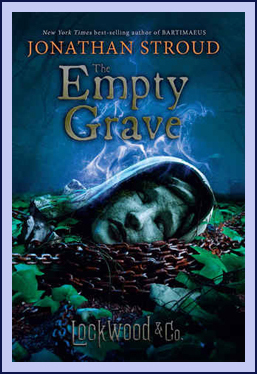
Their enemies are closing in. But if there's one thing that George believes deep in his soul it's that knowledge is power. They cannot go into their final confrontation without knowing all the facts. And that's why they are breaking into the Fittes Mausoleum, where the legendary Marissa Fittes is buried. Because if the skull is right, the woman they know as Marissa Fittes's granddaughter, Penelope, is actually Marissa herself. Which makes it highly suspect that she only "discovered" The Problem. And if everything was above board the Fittes Mausoleum wouldn't have been booby-trapped now would it? Lockwood and Co. which bafflingly now includes Quill Kipps finds the Mausoleum occupied, but not by Marissa. It seems the skull was right. Now that they know they are dealing with Marissa they can make their plans accordingly. Plans that now include vengeance from Julius Winkman, just sprung from jail. Their only viable move is to lure all their enemies to Portland Row and then work a miracle. But seeing as Lucy is the first person since Marissa Fittes who can talk to Type Three ghosts, they know they have the power, they just need the nerve. As their enemies descend on their home, destroying their beloved headquarters, they retreat to the room where Lockwood's sister met her end. Just like Rotwell was doing down at the research center in Aldbury Castle they make an opening to the Other Side. They have gone where they can not be followed. Their plan is to cross through the bleak and desolate landscape and gain entry into the Fittes building and end Marissa's reign of terror. The Problem will be removed. But crossing through this liminal space isn't easy. Every step is laborious, the protection they have can only last so long, and Quill was injured, but oddly he seems to be doing the best of all of them, which is when they realize how serious this is. Not all of them might make it out alive. But they have to try. They are the only hope for this to end once and for all.
This is it! The big final showdown! This is for all the stakes people! And maybe, in the end, that's what let me down most, because I didn't feel like there were that many stakes. I have always disliked stories that have no stakes. Look to the Gothic classics The Woman in Black or The Turn of the Screw, both of these stories use a framing device that takes place after the events of the book so we know that Arthur Kipps (last name probably not coincidental) and the unnamed governess survive. Throughout The Empty Grave Lucy is dropping hints about the future. She'll become a preeminent figure in studying the Other Side, which is great for her, not so great for creating any kind of tension. But we have hopes with Quill, he's badly injured and the only way that he is doing better than everyone else on the Other Side is that he is dying. But guess what? He doesn't die. I'm not saying I wanted him to die, but him somehow pulling through after doing a total hero move and joining Lockwood and Co. and risking everything to right his wrongs, well, he should have died is all I'm saying. Sometimes the best thing a character can do is die. I know that might sound harsh but it's the truth. A prime example is L.A. Confidential, Bud White should have died. He should have gone out in a blaze of glory. But no, he's a battered man in the back of a car. I'm even one of those rare people who think Thomas Magnum should have died because it was more satisfying than the ending we got. But it is what it is. At least Stroud was willing to let the villains die. And while this book is kind of just a headlong rush of tying up all the loose ends I did enjoy the vibe in shares with Philip Pullman's His Dark Materials trilogy. Firstly we have windows into other worlds that are used for escape, one uses powerful sources the other uses Æsahættr. Secondly we have a laborious journey through the land of the dead. And I know at the time I thought up more but I think those two are enough justification for the comparison. But I do love that while The Empty Grave has this similar vibe it's also totally it's own thing. Though I kind of would like a further glimpse into the future... Just a little more for Lucy... Is that too much to ask? I mean Philip Pullman is doing it...
 Back in 2017 when Philip Pullman released Volume One of The Book of Dust, La Belle Sauvage, I did a deep dive into the world of His Dark Materials, re-reading all the classics and hunting down all the short stories I had missed. I even went so far as the re-watch the much maligned film. It was nowhere near as bad as I remembered, but nowhere near what these beloved books deserved, especially that sanitized ending. Therefore I was looking forward to this series with bated breath. Obviously it had to be better! On the one hand they had the time to fully explore the world, on the other hand, television series don't get the budgets of blockbusters, especially when there had been a previous and costly prior attempt. Still, the casting made my heart jump, Ruth Wilson!?! Ruth 'Alice' Wilson as Mrs. Coulter!?! That right there was enough. They could mess up everything else but I was spared the most complicated character being given to someone not up to the challenge. While this adaptation as a whole wasn't perfect, I think it was as close to perfect as we're ever going to get. The three main points of contention are the expansion of the roles of the adults, the daemon problem, and the introduction of plot points from The Subtle Knife. Well, more Ruth Wilson just made me happy and made me finally understand Mrs. Coulter, and this was done to deepen the world as well as to get around how many hours child actors can work. The daemon problem, well, yes, I understand that there is a problem, but I think it was the explanation versus the execution. Daemons needed to be better explained as our other halves versus more camera time, because I don't think we will ever get to a point where we'll have realistic CGI animals. The final issue I will fight you tooth and claw over. The Subtle Knife has plot points that take place concurrently with The Golden Compass, so one, it made sense to include them in season one because then we don't have half a season with no Lyra, and two, the big reveal of Lord Boreal and Sir Charles Latrom being the same person doesn't work in television! You'd go, hey, that's the same actor in five seconds. So it was a logical change. Plus, it made me more invested in Will from the start. What I do find entertaining though is that not one review mentioned the one major gripe I had, which was there just wasn't enough snow!
 The Subtle Knife by Philip Pullman
Published by: Alfred A. Knopf
Publication Date: July 22nd, 1997
Format: Paperback, 352 Pages
Rating: ★★★★★
To Buy (different edition than one reviewed)
Lyra followed her father across the bridge in the sky and lost him. There was a fog. A dense, impenetrable fog and she has found herself in a world with no one. The town she is in is deserted until one day Will shows up. Will is from an Oxford different than her own. His father was a great explorer and his mother is mentally ill. Will has been caring for his mother all his life since the disappearance of his father. Only now he and his mother are in danger. Men have broken into their house and are searching for something that his father left behind. He secrets his mother away and when he goes home to retrieve that which is sought he accidentally kills one of the intruders. On the run he sees a window into another world and climbs through and meets Lyra. They decide to join forces as the only outsiders in this weird little world they've found themselves in, which isn't empty after all. The town is run by gangs of children because the adults fled due to Spectres, dangerous beings that are invisible to children but destroy adults. The two kids go back and forth between Will's Oxford and Cittàgazze. Lyra is trying to learn about Dust and Will is trying to find his father. Lyra soon learns, thanks to nudges from the alethiometer, that perhaps her questions will be answered by helping Will find his father. Because as it turns out, his father might have played an important role in Lyra's life so far, as he one day found a window into another world like his son did and walked through, never looking back. But how are these windows even formed? Will will learn the hard way about the Subtle Knife, but it also means that in spite of the danger to him he can always go home.
If you're expecting The Subtle Knife to be a straightforward sequel to The Golden Compass you're in for a bit of a surprise. Yes, it is a continuation of Lyra's story, but perhaps not as anyone growing up reading the Harry Potter books would foresee. Harry Potter is always front and center, but here, Lyra takes a backseat. The spitfire we've grown to love has been drastically changed because of her father's betrayal and therefore it is up to the new character of Will to fill the void. While you could say that it's all about the balancing of these two characters, of male and female, I think the shifting of focus off Lyra might be more in the vein of another famous writer who dealt with church indoctrination, C.S. Lewis. The Chronicles of Narnia pick up and drop the various Penvensies like they're going out of fashion, and while Pullman never deserts any of our beloved characters, they all have their specific heft depending on the book. And The Subtle Knife belongs to Will, and to a lesser but more emotionally charged way to Lee Scorsby the Texas aeronaut. This kind of results with the reader feeling a little alienated. We've fallen in love with this world and now we're back at square one. Even weirder, we're back in our own world. We have to rebuild our love of this expanding universe while our heroine is in shock. Because Lyra's absenting herself from steering the book makes sense when you think of the very real situation she is in. She's in shock from the death of her best friend Roger. She doesn't know what to do, she's just pinballing around looking for something, someone to rally around and she finds Will and makes him her new cause. Lyra is actively promoting Will while stifling her and Pan's voice.
This change up just adds to the fact that this book is suffering from typical "middle book" problems. Everyone has heard of middle child syndrome, but I think more people need to be aware of the problems inherent in middle books. Ah, the issues facing the bridging book of a trilogy... you need to make it interesting enough that people will wait with baited breath for the final volume, yet you must give them a story that holds up on it's own, while also having a satisfying ending. If you want a master class in a successful middle book look to J.R.R. Tolkien's The Two Towers or Laini Taylor's Days of Blood and Starlight or Galen Beckett's The House on Durrow Street. I could go on because when a middle book gets it right it just stays in your mind as being the exception to the rule. While The Subtle Knife does "technically" hold up on it's own, it's not due to any overarching story, it's due to little moments that take your breath away. Imagery that is unforgettable, while Pullman struggles with setting up all the pieces that will be needed for the epic conclusion. Lee Scorsby's last stand in that rocky gulch will just rip your heart out and put it back in all gritty and pained. The witches swirling through the sky, like the unforgettable illustrations of Adrienne Adams's A Woggle of Witches. The dangerous yet somehow ingenious heist of the alethiometer from the odious Sir Charles Latrom. These moments stick with you. I remembered these moments in all the years since I first read The Subtle Knife, but as for anything else like plot? It had slipped out of my head because of all those middle book issues... and worst of all Pullman decided to end the book on a major cliffhanger... sigh. You know, minor cliffhangers can be just if not more satisfying. They also don't alienate your readers.
While there are those who grow to love Will as much as Lyra, I have to say that I've always been on the fence about him. Yes, he has struggled, yes he has survived against the odds, and yes, he has a soft spot for cats, yet there was always something that I couldn't quite put my finger on. Until now. Will's mother is mentally ill. This isn't the problem, the problem is the way in which Philip Pullman describes Will's thoughts in regards to his mother. I don't know if Pullman is trying to show that Will is young and naive or if Pullman himself just doesn't get mental illness. And yes, there are people out there that try as they might just aren't able to comprehend what mental illness is in any form, from having it to dealing with someone who has it. Will is very straightforward about knowing that his mother's problems come from within, that there's something wrong. She obviously has OCD as well as other more serious problems yet when Will hears about the Spectres he starts to fantasize that somehow in his world, this world, that perhaps they are what cause mental illness. While yes, a child does dream of there being some external force that can be removed and their parent returned to normal, the actual belief wouldn't be there. Having spent a childhood growing up seeing those with problems and having OCD myself Will would never be this naive. What's more he describes what his mother does as just things she does, he never once focuses on the underlying compulsion. It's like a flip got switched in her and she does these things without any logic. But the truth is for the person suffering there is a logic, a drive. They might not want to do it, they might be fighting against it every step of the way, but Pullman just doesn't get this across. Mental illness becomes just another problem Will deals with instead of the horror it really is. Pullman trivializes it for his character's backstory.
I guess the reason the way Pullman handles mental illness annoys me is because he's dealing with such weighty issues, reconciling religion and science and yet he got something so wrong that can I trust his analysis of anything? This weird give and take between religion and science is one we have fought of centuries and which is sadly still being fought as Creationism is being taught again in many schools. Yet in Lyra's world experimental theology is what physics is in our world, indicating that there science and religion are more entwined and accepting of each other. As the series continues you see that yes, it is the battle between free thought and that of indoctrination but it's not so clear cut as The Magisterium would want you to think. And yes, this book is taking many ideas and bringing them together for you to think about, especially the fall of man as Milton depicted it in Paradise Lost, but to me, at this point in the series, it almost feels as if Pullman isn't sure what his side is. Both sides have committed atrocities in his narrative, yet we have yet to learn what is the truth. Because this is fiction, while we might speculate day and night and a book that leads to a good discussion is the friend of all book lovers and book clubs everywhere, we still need to know where Pullman's opinion lies. Did God create the universe or did science? This needs to be stated. Clearly. And it wasn't here. Here we suffer once again from middle book issues and have to wait. Sometimes I just want to find authors and shake them. As I write this I'm about a third of the way through The Amber Spyglass and the truth has been revealed and with that revelation I wonder why he waited. Yes, he's created a big set piece with it, so it would have made this book a little longer. But some of the building blocks were in place and a touch more foreshadowing might have made this book a more satisfying read.
But life isn't about satisfaction most of the time. Life is about just living day to day wondering about the mysteries of the universe that if we think too long on we'll be right there with Will's mom. Yet in the end I keep coming back to the more supernatural elements of this story, the fantastical, the prophetic. The witches. The witches have a prophecy that Lyra will be the end of fate by initiating the second fall of man. Here's the thing though, how is there really fate in this "world" that Pullman has built. Prophecies are all nice and good but he's clearly shown us that the multiple worlds theory is at play here and that each and every decision creates a different universe that has splintered off. Therefore everything is possible and everything IS happening at the same time. In a multiverse where everything is possible how exactly does prophecy come into play? Is it just for this ONE Lyra and this ONE Will? If something happened to them could Lord Asriel or Mrs. Coulter or the church go to another universe and nudge that other Lyra or Will into line with what they want? I get that this is a multiverse changing war that's on the horizon, but if everything is possible at all times yet you need a certain chain of events to happen how do you do this? It's almost too hard to reconcile these opposing ideas. So Lyra will end fate. What does that mean? I mean, really, how is fate possible in these books? It could be possible if the worlds were self contained. But travel between them is possible, so then what? Again, middle book issues! It's like he just threw everything at this book and figured he'd work it all out in the end. The problem I have is can he actually work it all out?
 Once Upon a Time in the North by Philip Pullman
Published by: Alfred A. Knopf
Publication Date: April 8th, 2008
Format: Hardcover, 104 Pages
Rating: ★★★★
To Buy (different edition than one reviewed)
Lee Scoresby has set his balloon north in the hopes of finding some work. He's recently become an aeronaut, having won the balloon on a hand of poker. Though teaching himself has been a little hairy, something his hare daemon Hester would agree with, what with the balloon coming with only half a copy of The Elements of Aerial Navigation. One day he will find an intact copy of that valuable guide, until then as he lands in Novy Odense his number one goal is to line his pockets, which are perilously empty. And in a town built on every kind of oil imaginable not to have enough for a drop to fix his pistol feels downright shameful to Lee, so he sets out in search of some job leads. Stowing his balloon he walks to the nearest bar to look for employment and to wet his whistle and realizes he's walked into a town in the midst of an upheaval. There's to be an election that week for mayor and the incumbent looks to lose to the ex-senator Poliakov who's taken a strong anti-bear stance. Poliakov is a cunning man who is working with the powerful Larsen Manganese mining company which has supposedly just struck it rich in Novy Odense. All this Lee learns from a rather chatty poet, Sigurdsson, who happens to make his money as a journalist. While all these political machinations should be of some concern to Lee he's more interested in a distressed sea captain in the bar. Lee's interest in this man will put him in the center of all Novy Odense's problems and unit him with a powerful ally, the armoured bear, Iorek Byrnison.
While I picked up Once Upon a Time in the North when it first came out almost a decade ago I couldn't bring myself to read it because at the time this slim volume was THE END. This would be it from Philip Pullman with regard to his magnum opus, His Dark Materials. There were rumors and whispers that there would eventually be more but until the announcement this spring I just couldn't bring myself to read this story about when Lee and Iorek first met. I couldn't take the heartbreak that their story was over even if this was just the beginning chronologically. But what's odd is I'm really glad I waited. The book isn't just a great read, it's so relevant now that it is shocking. I mean it couldn't be more timely and it made me wonder, does Philip Pullman actually have an alethiometer? To so accurately depict the political climate almost a decade in advance is spooky. There's an election with Russians causing havoc, there's a charismatic leader whose entire platform is the removal of illegal immigrants taking jobs from the community in order to secure his win while really he's there to aid big business and the military industrial complex and line his pockets all the while having thugs working for him behind the scenes with his own personal army and the press in his pocket. I mean, seriously!?! Russians! Poliakov/Trump! Bears/Mexicans! Novy Odense Courier and Telegraph/Breitbart! It's spookily accurate. But what this does is rise the book from not just a story with bears and balloons into a fable for our time. Fairy Tales are there to teach people lessons, and I think the lessons shown here are ones that need to be taken to heart so we never end up in this situation again.
Yet the book wasn't all relevant to today, after all Lee Scoresby is a cowboy and a Texan through and through so Once Upon a Time in the North also deals lovingly with all the wonderful western tropes we've come to love to this very day. There's a reason Westworld would work in the real world as well as on the screen. Lee has a soft spot for the ladies yet he's honorable, giving advice to lonely women while not tarnishing their virtue. He's a crack shot, when his gun actually works. He has a weakness for gambling, but luckily with Hester by his side she'll keep him on the straight and narrow. He does what is right even if it gets him into a whole heap of trouble. Plus, there's something about a cowboy in a situation that is so beyond his ken that calls to me. Like Ethan Chandler on Penny Dreadful, he's without a home and in a foreign land and falling into a dangerous adventure but his moral compass will steer him right. There is also a villain from Lee's past! Poliakov has one Mr. Morton in his pay, an assassin from America whom Lee had a previous run-in with, though he knew him by the name of McConville. They had a set-to in Dakota Country that had elements of Deadwood and more than a dash of Pinkerton justice gone wrong. Like Dashiell Hammet's Red Harvest, there's a trail of bodies in this man's wake, friends of Lee, and Lee isn't about to let him get away this time. With the politics and the vengeance I feel that this book actually can stand on it's own. In fact, I think that not only can anyone read it, but that this would be a good starting point for anyone considering reading Philip Pullman's work. Yes, there are some spoilers, but the microcosm of characters is so rich that I would recommend Once Upon a Time in the North to anyone. Even those skeptical of fantasy.
 Lyra's Oxford by Philip Pullman
Published by: Alfred A. Knopf
Publication Date: October 28th, 2003
Format: Hardcover, 64 Pages
Rating: ★★★★
To Buy
Lyra is in her favorite place in the world, high on the rooftops of Jordan College. It's been a few years since her journey with Will and she's settled into the academic life at St. Sophia's College and she's diligently studying when there's a ruckus among the birds. Pantalaimon and her quickly see the cause, the birds are attacking a witch's daemon. They rescue the daemon and sneak him back to their room to find out what's going on. The daemon, Ragi, was sent to Lyra to ask for help. His witch, Yelena Pazhets, has a wasting disease that is ravaging the witches and is rare in that it doesn't effect their daemons. There is a cure available from an alchemist in Jericho and Ragi needs Lyra's help to find this Sebastian Makepeace. Lyra agrees to help him later after her school commitments are done. That night as they sneak through the streets of Oxford her and Pan start to question Ragi's story. There's something about it that seems off. Yet Lyra isn't faint of heart. If they ARE walking into a trap then at least they will soon know the whole story. That story is dark and involves the love of a witch and the death of a son in the cause that Lord Asriel championed. Will Lyra have to pay for the sins of the father or will she be able to pull off an improbable victory once again?
Lyra's Oxford wasn't written just to wallow in the nostalgia of seeing a beloved character again. This isn't like every returning television series out there that is more of the same, it's like the uniqueness of the return of Twin Peaks. Yes, there's nostalgia, but this is an entirely new story, a new chapter, and while Lyra isn't dealing with tulpas she has dark forces to face and daemons to overcome. There are repercussions from what she and Will did, but more so just from the fact that her father wagged a war and people died because of his beliefs and not everyone is happy about that. Lord Asriel is dead and so can not face justice, therefore Lyra must pay. I think this book is what sparked the hope in Philip Pullman's readers that Lyra's story wasn't over because here, with this vengeful witch, we see that the fallout from the war against the Authority is still just beginning. As a reader my appetite was whetted for more. This taste just wasn't enough! What else happened? What else came after? I don't just want to see this more confident Lyra with this more settled Pan, I want to see the Magisterium fall, I want to see what happened to everyone. And like David Lynch, Pullman is a genius in that here he gives us just a little taste and then, with La Belle Sauvage, he goes back, further than his previous start and shows us the story we knew in an entirely new light. We don't necessarily get what we want or what we expected but what we needed.
And the one thing we needed to see here was a bit of Lyra not only coming into her own but coming home. Oxford and Jordan College have always been where Lyra belonged, yet when she takes off with Mrs. Coulter and later embarks on her epic journey with Will she doesn't look back. Yet it's the stories of her life in Oxford that pacify the harpies. It's her stories that give the ghosts in the land of the dead hope again. Therefore Lyra being in Oxford was a must. Yet there's all these questions, foremost of which is, after all her adventures would Oxford still feel like home? At the end of The Amber Spyglass we get a little hint that Lyra's going to settle back into life and find a purpose with Hannah Relf of St. Sophia's College who is an expect in the alethiometer but it's so much better to see that firsthand. And here we see a confident and studious Lyra, and that makes my heart glad. But what I really love about this little book is that it's not just that Lyra belongs in Oxford it's that Oxford knows this and protects and takes care of her. Those birds that were attacking the witch's daemon? They were trying to protect Lyra! Again and again this book gives us big and small signs that not only did the city of Oxford welcome Lyra back with open arms but that their number one goal is to protect her. Oxford really is Lyra's and I hope that with the coming books I get to visit it again and again in the years to come.
 The Amber Spyglass by Philip Pullman
Published by: Alfred A. Knopf
Publication Date: October 10th, 2000
Format: Hardcover, 518 Pages
Rating: ★★★
To Buy (different edition than one reviewed)
The final war with the Authority has come. The sides have been drawn. Ignorance and control or knowledge and freedom. That which was known as God was really just taking credit for creating that which was in existence long before him. Now his second in command is power hungry and wants absolute control over all worlds. A modern inquisition, which Lord Asriel will fight until his dying breath. Yet it's the breath of his daughter that is needed. She needs to live. She needs to fulfill the prophecy that she will put an end to death and become the new Eve. This might prove rather tricky as the Magisterium has sent a priest to kill her and her own mother is currently holding her captive in a drug-induced sleep in a Himalayan cave. It is up to Will, Lyra's staunch friend, to pull himself together after seeing the father he spent his life searching for killed in front of him by a witch and then have a pair of angels appear to direct the bearer of the subtle knife to Lord Asriel. But Will is up to the challenge and along the way to Lyra meets one of her old allies, the armoured bear, Iorek Byrnison, who has fled the arctic as the opening between worlds Lord Asriel has created has destroyed his icy fortress of Svalbard. They find Lyra in the nick of time, taking her out from under the hands of the Magisterium and Lord Asriel. While Lyra was drugged she dreamt of her friend Roger in the land of the dead and upon waking knows what she and Will must do. If his knife can open a window into any world, surly that includes the land of the dead. They will journey there with two new companions, the Gallivespian, the Chevalier Tialys and the Lady Salmakia who ride upon dragonfly steeds, and speak to Roger. Will might even get a chance to talk to his father. After that? Well, who knows how their journey will effect the war... but effect it it will, especially once they are reunited with their friend Mary.
Well, the "end" is here. I say "end" in quotes because as we know now it's not really the end but back in 2000 it was that. The big battle, the Authority toppled, the end and the beginning all in one. Pullman could have concentrated on the war, made an unsubstantial confection of explosions worthy of the big screen sometime in the summer months with angels fighting angels but instead he decided to focus on his characters. Lyra and Will take center stage, as well as new favorites, and instead of a grinding depiction of war we're given something bigger. A journey of self discovery and redemption and hope while the war just happens to be going on off to the side. Am I the only one to say "thank god" only to realize that Lord Asriel would totally disapprove that I, as a thinking person, am giving thanks to an organization that thrives on ignorance and he made a holy war to topple? While The Golden Compass is Lyra's story and The Subtle Knife is Will's story, The Amber Spyglass is about their journey towards not just growing up, but the knowledge of what it is to love. They are the Adam and Eve of this story and as such they must taste the fruit of knowledge offered up by Mary and basically reboot the world. The problem in this though is the vagueness that Pullman uses when describing their love. I can't tell if it's because he's trying to write around it because this was intended for a younger audience, but is their love more than love? Are they sneaking off into the savanna for some hanky panky? He's embracing the ellipses, more than once I might add, and after this long of a journey with these characters I NEED to know if just the knowledge of love was enough to bring about the second fall or if Lyra and Will actually had sex.
As for those we know had sex... let's look to Lyra's parents, Lord Asriel and Mrs. Coulter, I'm sorry, she's too scary to ever to refer to her casually by her first name. SO much of this series is dealing with parental issues. A lot of that is to do with the fact that as we grow up we have our parents to look to as to what we will become and this either is something we embrace or something we buck. But there's no getting around the fact that Lyra's parents are horrible parents and this is the crux of the series. Lyra is drawn into their world and their war. She is at times a pawn but usually THE major player in all of it. But her parents aren't static, they change over time until they make the ultimate sacrifice for Lyra and one is believable and the other isn't plausible in the least. Lord Asriel's journey and his faith in Lyra make sense. He saw her grow up, pretending to be her uncle, and he is willing to die to protect Lyra because he knows that his daughter will end the war he has wagged. His sacrifice at the end makes sense. He dies taking down the angel in power while also giving Lyra time to escape and fulfill her destiny. But Mrs. Coulter. I just don't get her. When she shows up in Oxford and swoops Lyra away to be a part of her world it's almost like Lyra is a doll she's picked up to dress and play with. Yes, she does save her from intercision at Bolvanger, and she saves her again from the church to hide her away in a dank cave in the Himalayas, but why? She claims it's because her grinchian heart has grown three sizes because of her daughter, but I don't buy it. They say every mother has this overriding instinct to protect their child and lavish it with love, but that's not true. Just look at the world around us, just look at this story. I don't buy that Mrs. Coulter would sacrifice herself for Lyra. For her own purposes, yes, but for her daughter? No way.
Yet I don't have as many issues with Mrs. Coulter as I have with the Mulefa. Those loving elephant faced, diamond skeletoned people whom Mary spends all her narrative with freak me out. But to be fair, it's not in their nature, it's in their wheels. Father Gomez the killer priest was so right when he said that their use of wheels was evil, and yes, I know I'm agreeing with an evil assassin, but seriously, wheels! Yes, I know, technically it's ingenious evolution, but the truth is me and wheeled creatures have a dark history, one which makes me hate them all. Are there things that you saw as a child that just ingrained themselves so deeply in you that they make up a substantial part of your nightmares and neuroses? Not the standard teeth falling out nightmare that so many of us suffer, but a hate of zombies from seeing a certain movie too young. Or a fear of elevators because of what the hell was in outer space when Charlie and Willy Wonka stepped out of the glass elevator (and yes, I cop to this one). Well, when I was very young I stumbled on the comic adaptation of Return to Oz. If you haven't seen Return to Oz, well, firstly you should, but secondly, it's a really dark re-imagining of Oz and the second and third books in the series by L. Frank Baum. There's shock treatment and a lady with removable heads. So while the shock treatment just gave me interesting knowledge, and the lady with removable heads made me slightly freaked, there was one part of the movie that terrified me: The Wheelers. Forget flying monkeys, these minions of the witch Mombi are "people" with wheels for hands and hatred in their hearts and they will hunt you down. Therefore I can not condone these Mulefa, they are in essence that world's Wheelers! BEWARE THE WHEELERS!
OK, no more Wheeler talk, it's near Halloween, this movie is bound to be airing and the nightmares will return. Let's discuss a pet peeve of mine; quotes at the start of chapters, or even at the start of a book. I know for a lot of authors that they have a special meaning, that perhaps this certain line that they have included inspired them or sheds meaning on their writing or captures the essence of whatever is to come like some cryptic clue, but can I just ask all you writers out there to stop. If it's a clue or whatever it's annoying because after reading the chapter you have to go back and re-read it and see if you got it and if you didn't you just end up feeling really stupid. But most of the time, it just comes off as pretentious: "Yes, I have a Shakespeare quote because I've read all Shakespeare and know more than you, ha ha." "What, this obscure poet, you've never heard of them? How can you even live with yourself?" "Don't you just feel that this line wouldn't get it's meaning fully across without the weird spelling of the words and all that is implied by it's antiquity." So IF you're one of these authors, just know, THIS is what's going through my head and makes me hate you just a little bit. Or, if I'm honest, quite a lot occasionally. Here though, besides making me hate Pullman a little, because yes, I can see these quotes at the beginning of each chapter do reflect the world he's created and inspired him so I can't completely hate them though I reserve the full right to hate the tiny ass font they were set in, I can hate them for a logical reason... These quotes are all from authors from our world. Yeah, I agree, quotes from another world would be weird, but then again it might work. Why might it work? Because it wouldn't be grounding The Amber Spyglass so completely in Will's world. Like 10 pages in the whole book take place in that world yet each and every quote comes from there? Bad move Pullman. Bad move. You are tearing down the worlds you built and I don't even know if you realize it.
Though for all my nitpicking what I think Pullman got SO right is the new definition of the Kingdom of Heaven. Lyra and Will are told that each world has to build their own Heaven, which means that it's about cherishing and caring for the world and it's people because you're building the Kingdom with each act, with each thing you put back into the world. Which makes Will and Lyra's final separation into their own worlds make sense. Yes, it may pain them, but they are each such extraordinary people that think of what they can accomplish and build in each of their worlds? Their journey and their sacrifice create a new start, a new chance to fix the problems they see all around that have been caused by three hundred years of damage from the subtle knife and millennia of damage from the Authority. It's not just the humanitarian nature of this that so resonates with me, it's that when I think of heaven I don't think of some weird ethereal place I think of the world around me. Hence, if there is a heaven it would be here on earth. The best thing we could be given is a chance to live again, which is why reincarnation makes sense to me. Though within this I still have to question where Mary stands. She's an ex-nun who doesn't believe in God anymore and hence has turned to physics. Yet while the events around her show that "God" was really just taking credit for something he didn't do and that now his second in command is going power crazy, I think some part of Mary should have gone, "Oh wow, there really was a God and angels and etc etc." Yet she's still firmly entrenched in her new beliefs and despite there being correlations she just doesn't see that both things can be true. But then again she was friends with people who had wheels!!!
 The Subtle Knife by Philip Pullman
Published by: Alfred A. Knopf
Publication Date: July 22nd, 1997
Format: Hardcover, 326 Pages
Rating: ★★★★
To Buy (different edition than one reviewed)
Lyra followed her father across the bridge in the sky and lost him. There was a fog. A dense, impenetrable fog and she has found herself in a world with no one. The town she is in is deserted until one day Will shows up. Will is from an Oxford different than her own. His father was a great explorer and his mother is mentally ill. Will has been caring for his mother all his life since the disappearance of his father. Only now he and his mother are in danger. Men have broken into their house and are searching for something that his father left behind. He secrets his mother away and when he goes home to retrieve that which is sought he accidentally kills one of the intruders. On the run he sees a window into another world and climbs through and meets Lyra. They decide to join forces as the only outsiders in this weird little world they've found themselves in, which isn't empty after all. The town is run by gangs of children because the adults fled due to Spectres, dangerous beings that are invisible to children but destroy adults. The two kids go back and forth between Will's Oxford and Cittàgazze. Lyra is trying to learn about Dust and Will is trying to find his father. Lyra soon learns, thanks to nudges from the alethiometer, that perhaps her questions will be answered by helping Will find his father. Because as it turns out, his father might have played an important role in Lyra's life so far, as he one day found a window into another world like his son did and walked through, never looking back. But how are these windows even formed? Will will learn the hard way about the Subtle Knife, but it also means that in spite of the danger to him he can always go home.
If you're expecting The Subtle Knife to be a straightforward sequel to The Golden Compass you're in for a bit of a surprise. Yes, it is a continuation of Lyra's story, but perhaps not as anyone growing up reading the Harry Potter books would foresee. Harry Potter is always front and center, but here, Lyra takes a backseat. The spitfire we've grown to love has been drastically changed because of her father's betrayal and therefore it is up to the new character of Will to fill the void. While you could say that it's all about the balancing of these two characters, of male and female, I think the shifting of focus off Lyra might be more in the vein of another famous writer who dealt with church indoctrination, C.S. Lewis. The Chronicles of Narnia pick up and drop the various Penvensies like they're going out of fashion, and while Pullman never deserts any of our beloved characters, they all have their specific heft depending on the book. And The Subtle Knife belongs to Will, and to a lesser but more emotionally charged way to Lee Scorsby the Texas aeronaut. This kind of results with the reader feeling a little alienated. We've fallen in love with this world and now we're back at square one. Even weirder, we're back in our own world. We have to rebuild our love of this expanding universe while our heroine is in shock. Because Lyra's absenting herself from steering the book makes sense when you think of the very real situation she is in. She's in shock from the death of her best friend Roger. She doesn't know what to do, she's just pinballing around looking for something, someone to rally around and she finds Will and makes him her new cause. Lyra is actively promoting Will while stifling her and Pan's voice.
This change up just adds to the fact that this book is suffering from typical "middle book" problems. Everyone has heard of middle child syndrome, but I think more people need to be aware of the problems inherent in middle books. Ah, the issues facing the bridging book of a trilogy... you need to make it interesting enough that people will wait with baited breath for the final volume, yet you must give them a story that holds up on it's own, while also having a satisfying ending. If you want a master class in a successful middle book look to J.R.R. Tolkien's The Two Towers or Laini Taylor's Days of Blood and Starlight or Galen Beckett's The House on Durrow Street. I could go on because when a middle book gets it right it just stays in your mind as being the exception to the rule. While The Subtle Knife does "technically" hold up on it's own, it's not due to any overarching story, it's due to little moments that take your breath away. Imagery that is unforgettable, while Pullman struggles with setting up all the pieces that will be needed for the epic conclusion. Lee Scorsby's last stand in that rocky gulch will just rip your heart out and put it back in all gritty and pained. The witches swirling through the sky, like the unforgettable illustrations of Adrienne Adams's A Woggle of Witches. The dangerous yet somehow ingenious heist of the alethiometer from the odious Sir Charles Latrom. These moments stick with you. I remembered these moments in all the years since I first read The Subtle Knife, but as for anything else like plot? It had slipped out of my head because of all those middle book issues... and worst of all Pullman decided to end the book on a major cliffhanger... sigh. You know, minor cliffhangers can be just if not more satisfying. They also don't alienate your readers.
While there are those who grow to love Will as much as Lyra, I have to say that I've always been on the fence about him. Yes, he has struggled, yes he has survived against the odds, and yes, he has a soft spot for cats, yet there was always something that I couldn't quite put my finger on. Until now. Will's mother is mentally ill. This isn't the problem, the problem is the way in which Philip Pullman describes Will's thoughts in regards to his mother. I don't know if Pullman is trying to show that Will is young and naive or if Pullman himself just doesn't get mental illness. And yes, there are people out there that try as they might just aren't able to comprehend what mental illness is in any form, from having it to dealing with someone who has it. Will is very straightforward about knowing that his mother's problems come from within, that there's something wrong. She obviously has OCD as well as other more serious problems yet when Will hears about the Spectres he starts to fantasize that somehow in his world, this world, that perhaps they are what cause mental illness. While yes, a child does dream of there being some external force that can be removed and their parent returned to normal, the actual belief wouldn't be there. Having spent a childhood growing up seeing those with problems and having OCD myself Will would never be this naive. What's more he describes what his mother does as just things she does, he never once focuses on the underlying compulsion. It's like a flip got switched in her and she does these things without any logic. But the truth is for the person suffering there is a logic, a drive. They might not want to do it, they might be fighting against it every step of the way, but Pullman just doesn't get this across. Mental illness becomes just another problem Will deals with instead of the horror it really is. Pullman trivializes it for his character's backstory.
I guess the reason the way Pullman handles mental illness annoys me is because he's dealing with such weighty issues, reconciling religion and science and yet he got something so wrong that can I trust his analysis of anything? This weird give and take between religion and science is one we have fought of centuries and which is sadly still being fought as Creationism is being taught again in many schools. Yet in Lyra's world experimental theology is what physics is in our world, indicating that there science and religion are more entwined and accepting of each other. As the series continues you see that yes, it is the battle between free thought and that of indoctrination but it's not so clear cut as The Magisterium would want you to think. And yes, this book is taking many ideas and bringing them together for you to think about, especially the fall of man as Milton depicted it in Paradise Lost, but to me, at this point in the series, it almost feels as if Pullman isn't sure what his side is. Both sides have committed atrocities in his narrative, yet we have yet to learn what is the truth. Because this is fiction, while we might speculate day and night and a book that leads to a good discussion is the friend of all book lovers and book clubs everywhere, we still need to know where Pullman's opinion lies. Did God create the universe or did science? This needs to be stated. Clearly. And it wasn't here. Here we suffer once again from middle book issues and have to wait. Sometimes I just want to find authors and shake them. As I write this I'm about a third of the way through The Amber Spyglass and the truth has been revealed and with that revelation I wonder why he waited. Yes, he's created a big set piece with it, so it would have made this book a little longer. But some of the building blocks were in place and a touch more foreshadowing might have made this book a more satisfying read.
But life isn't about satisfaction most of the time. Life is about just living day to day wondering about the mysteries of the universe that if we think too long on we'll be right there with Will's mom. Yet in the end I keep coming back to the more supernatural elements of this story, the fantastical, the prophetic. The witches. The witches have a prophecy that Lyra will be the end of fate by initiating the second fall of man. Here's the thing though, how is there really fate in this "world" that Pullman has built. Prophecies are all nice and good but he's clearly shown us that the multiple worlds theory is at play here and that each and every decision creates a different universe that has splintered off. Therefore everything is possible and everything IS happening at the same time. In a multiverse where everything is possible how exactly does prophecy come into play? Is it just for this ONE Lyra and this ONE Will? If something happened to them could Lord Asriel or Mrs. Coulter or the church go to another universe and nudge that other Lyra or Will into line with what they want? I get that this is a multiverse changing war that's on the horizon, but if everything is possible at all times yet you need a certain chain of events to happen how do you do this? It's almost too hard to reconcile these opposing ideas. So Lyra will end fate. What does that mean? I mean, really, how is fate possible in these books? It could be possible if the worlds were self contained. But travel between them is possible, so then what? Again, middle book issues! It's like he just threw everything at this book and figured he'd work it all out in the end. The problem I have is can he actually work it all out? I seriously don't remember from when I first read this series!
 The Book of Dust Vol. 1: La Belle Sauvage by Philip Pullman
Published by: Knopf Books for Young Readers
Publication Date: October 17th, 2017
Format: Hardcover, 464 Pages
To Buy
The official patter:
"Renowned storyteller Philip Pullman returns to the parallel world of Lyra Belacqua and His Dark Materials for a thrilling and epic adventure in which daemons, alethiometers, and the Magisterium all play a part.
The Book of Dust will be a work in three parts, like His Dark Materials (The Golden Compass, The Subtle Knife, The Amber Spyglass). The book is set ten years before The Golden Compass and centers on the much-loved character Lyra and her daemon Pantalaimon.
Philip Pullman offers these tantalizing details: “I’ve always wanted to tell the story of how Lyra came to be living at Jordan College, and in thinking about it, I discovered a long story that began when she was a baby and will end when she’s grown up. This volume and the next will cover two parts of Lyra’s life: starting at the beginning of her story and returning to her twenty years later. As for the third and final part, my lips are sealed.
“So, second: is it a prequel? Is it a sequel? It’s neither. In fact, The Book of Dust is . . . an ‘equel.' It doesn’t stand before or after His Dark Materials, but beside it. It’s a different story, but there are settings that readers of His Dark Materials will recognize, and characters they’ve met before. Also, of course, there are some characters who are new to us, including an ordinary boy (a boy we have glimpsed in an earlier part of Lyra’s story, if we were paying attention) who, with Lyra, is caught up in a terrifying adventure that takes him into a new world.
“Third: why return to Lyra’s world? Dust. Questions about that mysterious and troubling substance were already causing strife ten years before His Dark Materials, and at the center of The Book of Dust is the struggle between a despotic and totalitarian organization, which wants to stifle speculation and inquiry, and those who believe thought and speech should be free. The idea of Dust suffused His Dark Materials. Little by little through that story the idea of what Dust was became clearer and clearer, but I always wanted to return to it and discover more.”
The books of the His Dark Materials trilogy were showered with praise, and the Cincinnati Enquirer proclaimed, “Pullman has created the last great fantasy masterpiece of the twentieth century.” With The Book of Dust, Philip Pullman embarks on an equally grand adventure, sure to be hailed as the first great fantasy masterpiece of the twenty-first century."
What it's all about people. What it's all about.
 Harry Potter: A Journey Through A History of Magic
Published by: Arthur A. Levine Books
Publication Date: October 17th, 2017
Format: Paperback, 144 Pages
To Buy
The official patter:
"As the British Library unveils a very special new exhibition in the UK, Harry Potter: A History of Magic, readers everywhere are invited on an enchanting journey through the Hogwarts curriculum, from Care of Magical Creatures and Herbology to Defense Against the Dark Arts, Astronomy, and more in this book uncovering thousands of years of magical history.
Prepare to be amazed by artifacts released from the archives of the British Library, unseen sketches and manuscript pages from J.K. Rowling, and incredible illustrations from artist Jim Kay.
Discover the truth behind the origins of the Philosopher’s Stone, monstrous dragons, and troublesome trolls; examine real-life wands and find out what actually makes a mandrake scream; pore over remarkable pages from da Vinci’s notebook; and discover the oldest atlas of the night sky.
Carefully curated by the British Library and full of extraordinary treasures from all over the world, this is an unforgettable journey exploring the history of the magic at the heart of the Harry Potter stories."
Anything that makes Harry Potter more real, am I right?
 House of Shadows by Nichola Cornick
Published by: Graydon House
Publication Date: October 17th, 2017
Format: Paperback, 464 Pages
To Buy
The official patter:
"The wooded hills of Oxfordshire conceal the remains of the aptly named Ashdown House—a wasted pile of cinders and regret. Once home to the daughter of a king, Ashdown and its secrets will unite three women across four centuries in a tangle of intrigue, deceit and destiny...
In the winter of 1662, Elizabeth Stuart, the Winter Queen, is on her deathbed. She entrusts an ancient pearl, rumored to have magic power, to her faithful cavalier William Craven for safekeeping. In his grief, William orders the construction of Ashdown Estate in her memory and places the pearl at its center.
One hundred and fifty years later, notorious courtesan Lavinia Flyte hears the maids at Ashdown House whisper of a hidden treasure, and bears witness as her protector Lord Evershot—desperate to find it—burns the building to the ground.
Now, a battered mirror and the diary of a Regency courtesan are the only clues Holly Ansell has to finding her brother, who has gone missing researching the mystery of Elizabeth Stuart and her alleged affair with Lord Craven. As she retraces his footsteps, Holly's quest will soon reveal the truth about Lavinia and compel her to confront the stunning revelation about the legacy of the Winter Queen."
Yeah, I love house books. English house books are even better!
 Seven Days of Us by Francesca Hornak
Published by: Berkley
Publication Date: October 17th, 2017
Format: Hardcover, 368 Pages
To Buy
The official patter:
"A warm, wry, sharply observed debut novel about what happens when a family is forced to spend a week together in quarantine over the holidays...
It’s Christmas, and for the first time in years the entire Birch family will be under one roof. Even Emma and Andrew’s elder daughter—who is usually off saving the world—will be joining them at Weyfield Hall, their aging country estate. But Olivia, a doctor, is only coming home because she has to. Having just returned from treating an epidemic abroad, she’s been told she must stay in quarantine for a week…and so too should her family.
For the next seven days, the Birches are locked down, cut off from the rest of humanity—and even decent Wi-Fi—and forced into each other’s orbits. Younger, unabashedly frivolous daughter Phoebe is fixated on her upcoming wedding, while Olivia deals with the culture shock of being immersed in first-world problems.
As Andrew sequesters himself in his study writing scathing restaurant reviews and remembering his glory days as a war correspondent, Emma hides a secret that will turn the whole family upside down.
In close proximity, not much can stay hidden for long, and as revelations and long-held tensions come to light, nothing is more shocking than the unexpected guest who’s about to arrive..."
One for Christmas, which despite being October is still fast approaching...
 Cooking Price-Wise by Vincent Price
Published by: Calla Editions
Publication Date: October 17th, 2017
Format: Hardcover, 208 Pages
To Buy
The official patter:
"Best known as a star of stage and screen, Vincent Price was also a noted gourmet whose enthusiastic promotion of home cooking included several cookbooks and a television show, Cooking Price-Wise. This charming book of Price's favorite recipes is based on the Thames Television series he hosted in the 1970s, which showcased timeless international cuisine. Scores of easy-to-make dishes from around the world include soups, breads, main courses, sidedishes, and desserts that can be made from ingredients readily available in supermarkets and food shops. Fascinating food-related historical tidbits add extra zest to the newly typeset recipes and numerous color and black-and-white photographs that enhance this handsome collectible edition.
This special expanded edition of Cooking Price-Wise stands as a true family affair, featuring new contributions from the author's children, including a Preface by his daughter, Victoria, and a Foreword by his son, V.B. An extensive bonus section, "The Culinary Legacy of the Price Family," includes baking recipes from Vincent's grandfather, the inventor of baking powder; journal entries from the author's eye-opening trip to Europe as a 17-year-old; and a selection of family favorites from Victoria Price's childhood. Plus, Victoria also provides a wealth of insights into the Price Culinary Legacy."
Seriously, HOW DID I NOT KNOW OF THIS BOOK!?! Also, extra points if it's cost efficient, LOL!
 The Collectors by Philip Pullman
Published by: Alfred A. Knopf
Publication Date: September 22nd, 2015
Format: Kindle, 24 Pages
Rating: ★★★
To Buy
On a winter's night at Oxford College Horley sits in the Senior
Common Room with his guest Grinstead. As the room gets colder and the
hour gets late the other occupants slowly leave while the two talk about
Horley's recent purchase of a painting and it's link to another piece
of art, a rather terrifying bronze monkey. The painting Horley bought
because it was a rather arresting portrait of a young women with an
enigmatic air whose expression seems to always be changing. The dealer
he bought it from had already made the sale so the story that came with
it appears to be genuine. The painting has never been in one owner's
hands for long. But wherever it goes the bronze monkey is soon to
follow, though occasionally it is the monkey that arrives first and the
painting shows up later. These two objects have some connection that
cannot be broken as the provenance of the two pieces has undoubtedly
shown. As it so happens the monkey has just arrived in Horley's
possession as payment for a debt just after he purchased the painting. He hasn't even opened the packing case
but the fact of it's arrival proves the story to be genuine. At this
point Grinstead almost demands of his host that the time has come for
Horley to show him these two pieces. They return to Horley's rooms where
things take a turn. Grinstead has not been entirely honest with Horley and the story that was told wasn't new to him. These two pieces have a storied past steeped in mysteries from a distant world. And their subjects? They might just be pleased at the fate of these two men.
The Collectors never registered on my radar when it was first released in 2014 because it was an audiobook and while I am a fan of books in all forms there's something about audiobooks that I just tune out. Therefore my recent discovery that it was released as a short story for Kindle was a joyous surprise because it took me back to the beginning of Lyra's story in The Golden Compass and reconnected me to what I loved best, Lyra's life at Oxford before her journeys began. If there's one image seared in my brain from His Dark Materials it's Lyra sneaking into the Retiring Room at Jordan College. That musty and fusty domain of the male teachers that holds so much interest to the young girl and also catapults her into her destiny. With Horley and Grinstead I felt I was back in that room hearing about the adventures as the true armchair traveler that I am. I was totally absorbed until the story went a little too Douglas Adams and I felt Dirk Gently wandering about. But issues aside, what Pullman does here is to tap into the zeitgeist of the traditional English ghost story and deliver his own spin on classics like The Turn of the Screw and The Woman in Black. There's not just the mystery surrounding these two pieces of art which is almost timeless, but something akin to an ancient Egyptian curse. Something about these kind of tales that fascinate people down through the generations. Why else would people still talk about the curse of Tutankhamun?
This story taps into something primal with this idea of worlds touching and bleeding into each other and through this we get another way to look at ghosts. When I was little I had an imaginary friend. Years later I started to wonder if he was actually imaginary. I remember when we moved across the street I told my parents that Robbie couldn't come over anymore. Later I learned that the previous owner of our old house had hanged himself in the garage, right near where I saw Robbie. What if Robbie was a ghost? Or, here, what if he was someone from another world who slipped through and played with me until one day he couldn't. Maybe it was his ghostly tether or maybe it was his doorway into this world. Whatever it was this story showed me another way to look at the world. Yet this little glimpse into the fluidity of worlds was nothing for what I felt for the connection the two pieces of artwork had for each other. The painting was of Lyra's mother, Mrs. Coulter, before her marriage, and the bronze was of her daemon. While within Pullman's stories these two are morally ambiguous characters leaning towards being unrepentantly evil their connection even after death is so touching to me. That their link was so strong that inanimate objects that are basically their totems or avatars must always be together shows the power of love. They had each other and would always return to each other. So while yes, this is a ghost story, true ghost stories always, deep down, highlight something more, something human, and here, it's the power of love.
Once Upon a Time in the North by Philip Pullman
Published by: Alfred A. Knopf
Publication Date: April 8th, 2008
Format: Hardcover, 104 Pages
Rating: ★★★★
To Buy (different edition than one reviewed)
Lee Scoresby has set his balloon north in the hopes of finding some work. He's recently become an aeronaut, having won the balloon on a hand of poker. Though teaching himself has been a little hairy, something his hare daemon Hester would agree with, what with the balloon coming with only half a copy of The Elements of Aerial Navigation. One day he will find an intact copy of that valuable guide, until then as he lands in Novy Odense his number one goal is to line his pockets, which are perilously empty. And in a town built on every kind of oil imaginable not to have enough for a drop to fix his pistol feels downright shameful to Lee, so he sets out in search of some job leads. Stowing his balloon he walks to the nearest bar to look for employment and to wet his whistle and realizes he's walked into a town in the midst of an upheaval. There's to be an election that week for mayor and the incumbent looks to lose to the ex-senator Poliakov who's taken a strong anti-bear stance. Poliakov is a cunning man who is working with the powerful Larsen Manganese mining company which has supposedly just struck it rich in Novy Odense. All this Lee learns from a rather chatty poet, Sigurdsson, who happens to make his money as a journalist. While all these political machinations should be of some concern to Lee he's more interested in a distressed sea captain in the bar. Lee's interest in this man will put him in the center of all Novy Odense's problems and unit him with a powerful ally, the armoured bear, Iorek Byrnison.
While I picked up Once Upon a Time in the North when it first came out almost a decade ago I couldn't bring myself to read it because at the time this slim volume was THE END. This would be it from Philip Pullman with regard to his magnum opus, His Dark Materials. There were rumors and whispers that there would eventually be more but until the announcement this spring I just couldn't bring myself to read this story about when Lee and Iorek first met. I couldn't take the heartbreak that their story was over even if this was just the beginning chronologically. But what's odd is I'm really glad I waited. The book isn't just a great read, it's so relevant now that it is shocking. I mean it couldn't be more timely and it made me wonder, does Philip Pullman actually have an alethiometer? To so accurately depict the political climate almost a decade in advance is spooky. There's an election with Russians causing havoc, there's a charismatic leader whose entire platform is the removal of illegal immigrants taking jobs from the community in order to secure his win while really he's there to aid big business and the military industrial complex and line his pockets all the while having thugs working for him behind the scenes with his own personal army and the press in his pocket. I mean, seriously!?! Russians! Poliakov/Trump! Bears/Mexicans! Novy Odense Courier and Telegraph/Breitbart! It's spookily accurate. But what this does is rise the book from not just a story with bears and balloons into a fable for our time. Fairy Tales are there to teach people lessons, and I think the lessons shown here are ones that need to be taken to heart so we never end up in this situation again.
Yet the book wasn't all relevant to today, after all Lee Scoresby is a cowboy and a Texan through and through so Once Upon a Time in the North also deals lovingly with all the wonderful western tropes we've come to love to this very day. There's a reason Westworld would work in the real world as well as on the screen. Lee has a soft spot for the ladies yet he's honorable, giving advice to lonely women while not tarnishing their virtue. He's a crack shot, when his gun actually works. He has a weakness for gambling, but luckily with Hester by his side she'll keep him on the straight and narrow. He does what is right even if it gets him into a whole heap of trouble. Plus, there's something about a cowboy in a situation that is so beyond his ken that calls to me. Like Ethan Chandler on Penny Dreadful, he's without a home and in a foreign land and falling into a dangerous adventure but his moral compass will steer him right. There is also a villain from Lee's past! Poliakov has one Mr. Morton in his pay, an assassin from America whom Lee had a previous run-in with, though he knew him by the name of McConville. They had a set-to in Dakota Country that had elements of Deadwood and more than a dash of Pinkerton justice gone wrong. Like Dashiell Hammet's Red Harvest, there's a trail of bodies in this man's wake, friends of Lee, and Lee isn't about to let him get away this time. With the politics and the vengeance I feel that this book actually can stand on it's own. In fact, I think that not only can anyone read it, but that this would be a good starting point for anyone considering reading Philip Pullman's work. Yes, there are some spoilers, but the microcosm of characters is so rich that I would recommend Once Upon a Time in the North to anyone. Even those skeptical of fantasy.
 Daughter of Smoke and Bone (Daughter of Smoke and Bone Book 1) by Laini Taylor
Published by: Little Brown
Publication Date: September 27th, 2011
Format: Hardcover, 432 Pages
Rating: ★★★
To Buy
"Once upon a time, an angel and a devil fell in love. It did not end well."
Karou might be just as she seems, a gifted art student in Prague. Yet the fantastical beasts that she fills her sketchbooks with aren't a figment of her imagination. They are her family. And like most family, they sometimes have favors to ask of her that take her away from the normal life she is trying to live. A life that is about to end. All over the world black hand prints are appearing on doors, burned into the wood by winged strangers. One day it is the door Karou takes to visit her family. She is cut off from them, she doesn't know if they are alive or dead. What will she do if she is cut off from all that she knows?
Yet what of the winged strangers? One of them, Akiva, sees Karou and cannot believe his eyes. She looks just like his lost love. But she is dead and gone. Their love was forbidden. Two star crossed lovers on different sides of an otherworldly war. There can not be a connection between the two women. Yet Akiva's heart is telling him differently. Could Karou be his lost love? Could she love him again in this new life once she knows the whole truth?
If someone had said to me that I would become enamoured with a book series about "devils" and "angels" I would have laughed. Angels to me have never seemed the stuff of literature, more the stuff of Sunday School. Yet there are angels out there that have fascinated me... Loki and Bartleby in Dogma, Balthamos and Baruch in Philip Pullman's His Dark Materials series for example. So, add to this many of my friends clamouring that I must read this book now, which increased a hundred fold once the second book came out, I caved and fell in love with this world.
What I adored was the world building. The seamless twining of reality and fantasy. Prague was the perfect choice in it's character to couple it with an imaginary land. The history and the Gothic feel of the city make it totally believable that you might accidentally stumble upon a chimera walking down a twisty back alley. Or a winged creature might descend from the skies and accost you. There's a part of me that wishes I had been raised in that little office of Brimstone's where wishes were made, literally. Add to Taylor's creatures and continents this elaborate currency of wishes and their effectiveness, and it's so alive and real that I really thought I might be able to barter some teeth for a scuppy or a shing to give myself really cool colored hair like Karou...
Though, I did have a hard time after becoming so invested in Karou's life as it revolved around Prague, that when we are pulled out of that life and into her previous life as Madrigal I was so jarred that I didn't really take to her previous life. Having already read the second book, I know that there is a merging of the two halves of herself that takes place that then makes everything make sense, but at this point in Daughter of Smoke and Bone was when my love for it wavered. I needed to know the full history of Akiva and Karou's previous life when she was Madrigal, but at the same time, this fearless warrior that was Madrigal, was so different from Karou, that my heart hardened a little towards her. Madrigal is what Karou would have been/was in a different world. A "person" I just didn't take to. Thankfully this was rectified in the second book, which is one of the most amazing books I have read in a long time.


