Showing posts with label The Turn of the Screw. Show all posts

Friday, September 15, 2023

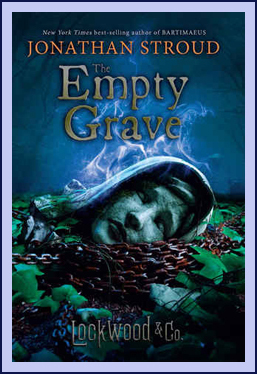
Book Review - Jonathan Stroud's The Empty Grave

The Empty Grave by Jonathan Stroud
Published by: Disney-Hyperion
Publication Date: September 12th, 2017
Format: Paperback, 448 Pages
Rating: ★★★
To Buy

Their enemies are closing in. But if there's one thing that George believes deep in his soul it's that knowledge is power. They cannot go into their final confrontation without knowing all the facts. And that's why they are breaking into the Fittes Mausoleum, where the legendary Marissa Fittes is buried. Because if the skull is right, the woman they know as Marissa Fittes's granddaughter, Penelope, is actually Marissa herself. Which makes it highly suspect that she only "discovered" The Problem. And if everything was above board the Fittes Mausoleum wouldn't have been booby-trapped now would it? Lockwood and Co. which bafflingly now includes Quill Kipps finds the Mausoleum occupied, but not by Marissa. It seems the skull was right. Now that they know they are dealing with Marissa they can make their plans accordingly. Plans that now include vengeance from Julius Winkman, just sprung from jail. Their only viable move is to lure all their enemies to Portland Row and then work a miracle. But seeing as Lucy is the first person since Marissa Fittes who can talk to Type Three ghosts, they know they have the power, they just need the nerve. As their enemies descend on their home, destroying their beloved headquarters, they retreat to the room where Lockwood's sister met her end. Just like Rotwell was doing down at the research center in Aldbury Castle they make an opening to the Other Side. They have gone where they can not be followed. Their plan is to cross through the bleak and desolate landscape and gain entry into the Fittes building and end Marissa's reign of terror. The Problem will be removed. But crossing through this liminal space isn't easy. Every step is laborious, the protection they have can only last so long, and Quill was injured, but oddly he seems to be doing the best of all of them, which is when they realize how serious this is. Not all of them might make it out alive. But they have to try. They are the only hope for this to end once and for all.

This is it! The big final showdown! This is for all the stakes people! And maybe, in the end, that's what let me down most, because I didn't feel like there were that many stakes. I have always disliked stories that have no stakes. Look to the Gothic classics The Woman in Black or The Turn of the Screw, both of these stories use a framing device that takes place after the events of the book so we know that Arthur Kipps (last name probably not coincidental) and the unnamed governess survive. Throughout The Empty Grave Lucy is dropping hints about the future. She'll become a preeminent figure in studying the Other Side, which is great for her, not so great for creating any kind of tension. But we have hopes with Quill, he's badly injured and the only way that he is doing better than everyone else on the Other Side is that he is dying. But guess what? He doesn't die. I'm not saying I wanted him to die, but him somehow pulling through after doing a total hero move and joining Lockwood and Co. and risking everything to right his wrongs, well, he should have died is all I'm saying. Sometimes the best thing a character can do is die. I know that might sound harsh but it's the truth. A prime example is L.A. Confidential, Bud White should have died. He should have gone out in a blaze of glory. But no, he's a battered man in the back of a car. I'm even one of those rare people who think Thomas Magnum should have died because it was more satisfying than the ending we got. But it is what it is. At least Stroud was willing to let the villains die. And while this book is kind of just a headlong rush of tying up all the loose ends I did enjoy the vibe in shares with Philip Pullman's His Dark Materials trilogy. Firstly we have windows into other worlds that are used for escape, one uses powerful sources the other uses Æsahættr. Secondly we have a laborious journey through the land of the dead. And I know at the time I thought up more but I think those two are enough justification for the comparison. But I do love that while The Empty Grave has this similar vibe it's also totally it's own thing. Though I kind of would like a further glimpse into the future... Just a little more for Lucy... Is that too much to ask? I mean Philip Pullman is doing it...

Wednesday, March 22, 2023

Book Review - David Mitchell's Slade House

Slade House by David Mitchell
Published by: Random House
Publication Date: October 27th, 2015
Format: Hardcover, 238 Pages
Rating: ★★
To Buy

There is a door. It's small and unassuming. Most people never see it because most of the time it isn't there. But every nine years on the last Saturday of October it's there for the chosen one. Near The Fox and Hounds Pub, Slade Alley is easy to miss. If you don't look carefully you could end up going out the other side wondering how you could have missed the entrance. But through that small door is a beautiful garden leading up to a house. A house that is far too nice for the working class neighborhood the alley is a part of. But then again, you'd never find the house in that neighborhood. It's in a little bubble all it's own, an orison. In 1979 Nathan Bishop is the chosen one. His mother, a pianist, has been asked to perform at Slade House for Lady Norah Grayer. Lady Grayer asked that Nathan be brought along. He spends the day in the garden playing with a boy his age, Jonah. But as they chase each other around the house things begin to shift and change. Nathan is worried that the Valium he snuck from his mother was bad. But it's not the Valium, it's the house. It has lured him in and Norah and Jonah won't let go. Nathan Bishop and his mother are never seen again. Nine years later in 1988 Detective Inspector Gordon Edmonds is looking into the disappearance of Nathan Bishop and his mother because new evidence has surfaced. On the day they disappeared they asked directions from a Fred Pink. Immediately after stepping out of Slade Alley Fred Pink was hit by a car and has spent the intervening years in a coma. When he was catching up on the news that he missed he recognized the Bishops and immediately went to the police. Gordon Edmonds finds Slade House and the beautiful widow Chloe Chetwynd. She uses her feminine wiles to seduce Gordon Edmonds. He is never seen again. In 1997 a group of paranormal investigators made up of college students, one of whom is Fred Pink's nephew, goes missing never to be seen again. In 2006 the sister of one of the missing college student interviews Fred Pink. She to disappears. Like dominoes, each disappearance leads to another and another, stretching back and forward until someone is able to pop the bubble.

Years ago I bought Slade House giddy for a good haunted house story not knowing that it tied heavily into David Mitchell's other book, The Bone Clocks. But then again, all his books tie in. Yet I still thought I should probably do my homework and read The Bone Clocks first. So I put off reading Slade House, and I put off reading it. Then two things happened around the same time, a friend of mine said this book could easily be read as a standalone and I found a copy of The Bone Clocks on the sales table at Barnes and Noble. Thanks for sending me mixed messages universe! So I was basically back at square one. Looking for a good spooky read leading up to Halloween I said fuck it and picked up Slade House and I really wish that I had waited. Typical me would have read The Bone Clocks first. Typical me would have been right. This feels almost like it's the CliffsNotes version of the meticulous worldbuilding that Mitchell has done. There is a literal infodump in the forth chapter that while yes, it makes everything clear, feels too shoehorned in. This information about apertures and orisons and lacunas and psychovoltage feel like they belong to another story. And really, they do. And that is this book's fatal flaw. Yes, you may be given everything you need to know, but it feels shallow. The ending is a literal Deus ex machina where a character from his other books who is from the other feuding immortal faction shows up and puts an end to Norah and Jonah. How is that fair to the readers of this book? It feels not just like Mitchell is cheating the readers of a satisfying ending but is also admonishing them for not doing their homework. I should have known this wasn't likely a book for me because of the comparisons the The Turn of the Screw. My main problem with that story is there is no jeopardy. You know the governess survives. The same could be said here. There is no driving force because every narrator dies so your investment in the characters will never pay off so you quickly learn to disassociate from all of them. And this isn't even going into my issues about how Mitchell handles each decade and the derogatory language he uses. Sure, it's era appropriate, but much like everything to do with this book I could have done without.

Friday, December 10, 2021

Book Review - Ruth Ware's The Turn of the Key

The Turn of the Key by Ruth Ware
Published by: Gallery/Scout Press
Publication Date: August 6th, 2019
Format: Hardcover, 352 Pages
Rating: ★★★
To Buy

Rowan is in prison. Yes, she's the nanny who had the worst thing that could possibly happen happen. The police won't listen. No one will listen. Her fate has already been decided due to a few bad decisions on her part. She thinks if she could just get her story completely told to one person that person would understand and help her. Because no one gets what it was like at Heatherbrae House. The lack of sleep, the feeling of going mad, constantly being pushed beyond her limits. She was thrown into the deep end and she sank. She might be a flawed human being, but she is no murderer! It all seemed like a dream until it became a nightmare. The job in the middle of nowhere, the ridiculous salary, the perfectly behaved children, the chance to get away from her current job at Little Nippers, and the house. Oh, Rowan would have given anything to live there and to be a part of that family, and in the end she did. She should have known it was too good to be true. But the impeccable references got her in the door and she did the best job of selling herself she ever had and somehow she achieved the impossible, her dream job. But the interview gave her a glimpse into a nonexistent world. The smart house with it's omniscient technology might sound appealing, but it's just a means of control. Of forcing the modern and the old to coexist in a way they shouldn't. Also the remodeling of the house was just a means to scrub the past away. But that past is buried deep, like the roots of the plants in the poison garden out back. A garden conceived by a man who lost his daughter due to the very poisons he cultivated. Then there's Jack. He's the handy man. And he is very handy. Maybe too handy. He's always there when Rowan needs him but she doesn't question this until it might be too late. She should have questioned everything. She should have done better. She should have come clean sooner. Maybe then things would have turned out differently. Or maybe she was always supposed to be the catalyst for this tragedy, just a ticking time bomb waiting to explode.

I have issues with The Turn of the Screw. Many, many issues. While many people have written copiously on all the plurality of meanings in The Turn of the Screw I could probably write a dissertation on why I hate it. There'd even be footnotes! But I think spending all my time dwelling on something I dislike wouldn't be the most beneficial to my health, though as I've said before, it's easier to write about something you hate than something you love. You can pinpoint with unerring accuracy everything that gets under your skin while that which makes your heart sing is almost impossible to describe. At this point you're wondering, well, then why did she pick up a retelling of The Turn of the Screw if she hates it so much? The answer is simple, I can see that this story has potential written by anyone other than Henry James and therefore I wanted to see where Ruth Ware would take it. The answer is a lot further and more futuristic than Henry James! Aside from the fact that she uses the built in horror tropes of a smart home perfectly, a home I would never live in because even my phone stopped reading my fingerprint, the bones of this version make it the best version of The Turn of the Screw I have yet read. Notice I am not mentioning The Haunting of Bly Manor, because that was watched, and that is now the pinnacle of perfection all retellings of The Turn of the Screw should be aiming for. What this retelling did so well is make us actually care about the characters and the family dynamic. Plus, with double the number of children, it's like Russian roulette, at least one of them is going down, and you can't be sure which one! So not only did I care if these characters lived or died, the fact that they were all in jeopardy made me turn the pages at breakneck speed. I was totally invested in a story that I thought would be just a mild diversion. Because of this I really started to over-analyze everything. There are weird little errors throughout the book. Rowan purposefully picks up an iPad when leaving the kitchen to watch the children but then ends up using her phone instead. The dog beds move from the weird servants pantry to the kitchen. There are all these little things that add up and I wonder, was it purposeful to highlight the fact that Rowan is an unreliable narrator? Or accidental? If accidental, this is the first time a lack in editing has paid off.

Friday, September 17, 2021

The Haunting of Bly Manor

After seeing the amazing interpretation of Shirley Jackson's The Haunting of Hill House that Mike Flanagan pulled off I was beyond excited for The Haunting of Bly Manor. And this was only approximately 79% to do with Rahul Kohli being cast. OK, it was probably closer to 100% because I am not a fan of The Turn of the Screw like I am with The Haunting of Hill House, but that's why this adaptation is so perfect, it made me like The Turn of the Screw and the other stories by Henry James that were incorporated. This miniseries turned a bleak tale of possible madness into a love story. And not just a single love story either! There are many couples to ship here. In fact this show might have healed and broken my heart simultaneously. If someone were to say to me "it's you, it's me, it's us" I would probably break down sobbing right this second. Yet this phrase which comes to mean so much about the power of love started out menacing. That's what's amazing here. The way the story unfolds. What was one thing becomes another and another and everything you think you knew keeps changing. This is a miniseries that could easily be rewatched the second you finish it just to fill in the gaps you might have missed. The one thing I found odd when reading reviews of what people have dubbed the second season of Mike Flanagan's "Haunting" series is that so many people took exception to the penultimate episode shot in black and white, "The Romance of Certain Old Clothes." This episode set centuries earlier explains how Bly Manor came to be the haunted place it is with Mike Flanagan's wife, Kate Siegel, Theo from The Haunting of Hill House, taking center stage. This episode is lyrical and perfectly paced. There are phrases that come back to me again and again while thinking about this show. "She would sleep, she would wake, she would walk." And while yes, this could be a way to explain all our lives during quarantine and it's repetitive nature, it also taps into the broken record aspect of a haunting. How ghosts are just reliving the same moments over and over again which is why the penultimate episode is crucial! This show is time loops and the supernatural and true love all mashed up together and all I have to say is more!

Wednesday, April 21, 2021

Season 29 - The Turn of the Screw (1999-2000)

One night back in undergrad two of my friends and I decided to go rent a movie. Remember video stores? Full of all those wonderful films yet somehow kind of grubby. We were walking from Rivendell (no really, my friend Matt lived in a big purple housing co-op named Rivendell) to the local video store a few blocks away. On the way there we found over $20 in cash on the ground that some drunk college student had obviously dropped. So dinner and a movie was on said drunk college student who was probably pissed in more ways than one when they found out. Four Star Video was known for it's rather indie pics. You could find basically anything there that was offbeat. After much toing and froing we decided on the Ethan Hawke/Kyle MacLachlan version of Hamlet and The Turn of the Screw, because Colin Firth. I'm not sure how far we got into Hamlet before it was ejected, but could have been twenty minutes could have been a thousand years. And that, my friends, is why you always rent two movies when you go out in case one is an absolute stinking pile of shit. Well, we didn't fair that well with The Turn of the Screw either. None of us had actually read the story, so we were all unprepared for the whole evil wins ending. What's more, and in fact more to the point of why it failed to meet our expectations is that Colin Firth was in the first five minutes and then never seen again. That's false advertising that is putting his name first! And yes, after this debacle my friends said I should pay them for having to sit through videos dubbed my choices... but they were free! And more importantly we did put it to a vote! But looking back, while The Turn of the Screw isn't my favorite ghost story out there this is the best direct adaptation there is, because at least they didn't throw in a weird insane asylum/murder conviction plotline like the 2009 version with Michelle Dockery did. So if you're looking for a faithful adaptation of The Turn of the Screw you can't go wrong with Jodhi May and Pam Ferris who are superb actors, but if you're looking for the best adaptation out there check out The Haunting of Bly Manor instead.       

Friday, March 9, 2018

Book Review - Mike Mignola and Christopher Golden's Baltimore, or, The Steadfast Tin Soldier and the Vampire

Baltimore, or, The Steadfast Tin Soldier and the Vampire by Mike Mignola and Christopher Golden
Published by: Spectra
Publication Date: August 28th, 2007
Format: Hardcover, 304 Pages
Rating: ★★★★★
To Buy

Captain Henry Baltimore leds a night attack in the Ardennes that will forever change the world. As his entire battalion is cut down he survives the initial onslaught but is left to die with a leg wound. Out of the night sky comes large bat-like creatures, carrion eaters to feast on the dead. But there's something not right about them. One sees Baltimore and decides that he will be his feast. Lashing out Baltimore injures the creature but in return the creature destroys his leg. Later in hospital, a man appears beside his bed, and Baltimore knows he's one and the same with the creature on that battlefield. This "man" tells Baltimore that he knows not what he has done and the world will pay for the injury Baltimore inflicted on him. After this incident there are three people that Baltimore confides this story to, his three friends; Captain Demetrius Aischros, Thomas Childress, and Dr. Lemuel Rose. They know not of each other until one night when Baltimore asks them to meet him in a pub whose air of decrepitude and despair matches that of the rest of the world since the plague took hold and the Great War became of no consequence in the face of this new threat.

There they sit, waiting for Baltimore. In the interim they tell their stories because it is obvious that in order to have believed Baltimore's story, without hesitation, they too must have had some experience of this supernatural evil that walks the earth. Dr. Rose, besides treating Baltimore, also treated a man who believed he was responsible for the death of all the men he was stationed with. Dr. Rose couldn't believe this to be the case, but after a night in the woods keeping watch, believing Baltimore later was a given. Captain Aischros helped escort Baltimore home after he was invalided out of the war, if he wasn't convinced by what he saw on Baltimore's island home he was by an experience years earlier. Aischros recounts a tale from his youth when he was walking the coast of Italy and came upon the town of Cicagne, famed for their puppet shows, and barely escaped with his life. Childress is the last to tell his tale, having grown up with Baltimore on Trevelyan Island, he knew Baltimore all his life, but it was an incident while working for his own father's company in Chile that opened his eyes. They talk and wait hours, the pub becoming oppressive. They aren't sure if Baltimore is going to show, but they feel the final battle with the monster from that day in the Ardennes is at hand.

If you are a fan of good art and good storytelling then the only explanation for not knowing who Mike Mignola and Christopher Golden are would be that you've spent the last few decades under a rock. While I knew of them individually, in fact meeting Christopher Golden at a Buffy the Vampire Slayer Convention in upstate New York and fangirling over his videogame script, it was in a roundabout way that I learned about Baltimore, or, The Steadfast Tin Soldier and the Vampire. Before I started this blog I was very cunning in getting press passes for events. In February of 2007 I was supposed to go to the New York Comic Con with a friend of mine but the train from Chicago to New York was snowbound and the trip was cancelled because I wouldn't be able to make it in time. I insisted that my friend go and meet Christopher Golden knowing she would love him as much as me and it so happened that he was signing posters for a new collaboration with Mike Mignola. I still have the signed poster on my office wall next to my computer. Beautifully enlarged drawings from Baltimore, or, The Steadfast Tin Soldier and the Vampire of the church in Reveka and the church interior at Cicagne, and a weeping angel that would forever slightly freak me out after the Doctor Who episode "Blink" aired later that year. THIS I knew was a book written and illustrated just for me.

What is interesting about these two authors collaborating is that both are very familiar with vampires. Mike Mignola worked on the inadvertently hilariously awesome Bram Stoker's Dracula as well as Blade II, and the Angel comics. Whereas Christopher Golden, besides writing the scripts for both Buffy the Vampire Slayer Video Games also wrote comics and books for Buffy the Vampire Slayer and Angel. So their individual and combined vampire street cred could hardly be surpassed. But what struck me so much about this book was that it wasn't just a way to shoehorn vampires into the first world war, a time when these opportunistic creatures could flourish, instead it was almost a reinvention of the vampire for a new generation. They were carrion eaters awoken by the violence of men further spurred onto creating a destructive plague by violence against one of their own, The Red King. They lived in a symbiotic relationship with man, feeding off their dead and dying. Rarely are vampires shown as creatures there to keep the balance, keep the scales from tipping. The Red King in fact lays all the vengeful ills that have befallen mankind on Baltimore lashing out to save himself on that battlefield. It's almost as if the plague is a result of hurt pride, making the vampires pitiable more than anything else.

This spin of the morals of the vampires isn't the only way that this book stands head and shoulders above the rest. The main attraction for me was that this book reeked of Victorian Christmas ghost stories. The three men thrown together around a fire while the bleakness of the day bares down on them and they tell their terrifying stories couldn't have been more Dickensian if Dickens had written it himself. I literally couldn't contain my joy as I read this book into the late hours with chills going down my spin thinking that finally someone had written my own personal The Turn of the Screw, but with vampires and the Great War and totally not a lame premise! Seeing as I read so many stories with vampires predictability of plot and worldbuilding becomes problematic. You either have it modern, which can work, though I often like it without the tweaks to our world, or you can go all Bram Stoker. It's like there's an either or switch and you're not allowed in that middle ground. But that middle ground is where the best stories can be found. Think of one of the best episodes of Angel ever, "Are You Now or Have You Ever Been." It was set during the height of McCarthyism and was approached in a whole new way. It wasn't Victorian stodginess and it wasn't new and hip. Much like here, we have a new spin that is quite fascinating and is able to harken back to the origin story while still keeping the feeling of another era.

This ability of the authors to not only capture but understand the era they are writing about and tweaking just made me giddy. Let's look at the basics. The Great War resulted in the 1918 Influenza Pandemic which actually killed more people than the war itself. So World War I is forever linked to a horrible plague, The Spanish Flu. But what Golden and Mignola do here is to cleverly expand on this. What if the flu had been worse? What if this plague was supernatural in origin? What if it wasn't just supernatural but was a vampire with a severe grudge for getting his face a little scarred? The truth is, they have taken real events and taken a believable extrapolation of events to their worst possible outcome. I know I shouldn't be so happy about a vampire plague descending on the world, but they just wrote it so well. They made a compelling alternate history. If you want to extrapolate further you could even take this into World War II. Now you're probably thinking I'm talking crazy, but think about it. World War II was inevitable as soon as we placed such hard sanctions on the Germans. We created our own worst enemy and we made Germany want another war. Here Baltimore by lashing out at The Red King to save himself creates the plague. Sometimes in trying to protect we make matters far worse and the ramifications impossible to foresee. Plague, World War II, you see?

With all that this book has going for it, the feeling of Poe, the more relevant yet completely original vampire, the Dickensian Christmas, I wonder if perhaps the drawings weren't a step to far. Yes, I don't think it would be a true collaboration without the drawings, but I don't really think there needed to be so many. More judiciously used illustrations better positioned would have worked better in my opinion perhaps with some red as a spot color. Yes, this seems counter intuitive with me picking up the book in the first place because of the illustrations, but they just don't really work for me. I felt they were unnecessary. My main problem was that these images were forcing us to view the story in a certain way and that's not right. Words evoke images in the reader's imagination and it's the work of these readers to create the scene in their heads. To people the world of the book as we see fit. But here we are meant to view the language in a proscribed manner. Thus making the book closer to the graphic novel end of the spectrum. Don't get me wrong, I love graphic novels, they just use a different part of the brain, one where image is primary and text is secondary, and if we're lucky they merge into a cohesive whole. Instead here Mignola's illustration would draw me out of the text and make me think aloud that that isn't how I saw it and also realize that if you've seen one skull or one peaked rooftop you've probably seen them all. I am interested to see how they transitioned this book into a series of comics... perhaps that will be the proper outlet for the drawings. Whereas the story? The story is something you shouldn't miss. Just never mind that skull or that one or that other one.

Friday, October 6, 2017

Book Review - Philip Pullman's The Collectors

The Collectors by Philip Pullman
Published by: Alfred A. Knopf
Publication Date: September 22nd, 2015
Format: Kindle, 24 Pages
Rating: ★★★
To Buy

On a winter's night at Oxford College Horley sits in the Senior Common Room with his guest Grinstead. As the room gets colder and the hour gets late the other occupants slowly leave while the two talk about Horley's recent purchase of a painting and it's link to another piece of art, a rather terrifying bronze monkey. The painting Horley bought because it was a rather arresting portrait of a young women with an enigmatic air whose expression seems to always be changing. The dealer he bought it from had already made the sale so the story that came with it appears to be genuine. The painting has never been in one owner's hands for long. But wherever it goes the bronze monkey is soon to follow, though occasionally it is the monkey that arrives first and the painting shows up later. These two objects have some connection that cannot be broken as the provenance of the two pieces has undoubtedly shown. As it so happens the monkey has just arrived in Horley's possession as payment for a debt just after he purchased the painting. He hasn't even opened the packing case but the fact of it's arrival proves the story to be genuine. At this point Grinstead almost demands of his host that the time has come for Horley to show him these two pieces. They return to Horley's rooms where things take a turn. Grinstead has not been entirely honest with Horley and the story that was told wasn't new to him. These two pieces have a storied past steeped in mysteries from a distant world. And their subjects? They might just be pleased at the fate of these two men.

The Collectors never registered on my radar when it was first released in 2014 because it was an audiobook and while I am a fan of books in all forms there's something about audiobooks that I just tune out. Therefore my recent discovery that it was released as a short story for Kindle was a joyous surprise because it took me back to the beginning of Lyra's story in The Golden Compass and reconnected me to what I loved best, Lyra's life at Oxford before her journeys began. If there's one image seared in my brain from His Dark Materials it's Lyra sneaking into the Retiring Room at Jordan College. That musty and fusty domain of the male teachers that holds so much interest to the young girl and also catapults her into her destiny. With Horley and Grinstead I felt I was back in that room hearing about the adventures as the true armchair traveler that I am. I was totally absorbed until the story went a little too Douglas Adams and I felt Dirk Gently wandering about. But issues aside, what Pullman does here is to tap into the zeitgeist of the traditional English ghost story and deliver his own spin on classics like The Turn of the Screw and The Woman in Black. There's not just the mystery surrounding these two pieces of art which is almost timeless, but something akin to an ancient Egyptian curse. Something about these kind of tales that fascinate people down through the generations. Why else would people still talk about the curse of Tutankhamun?

This story taps into something primal with this idea of worlds touching and bleeding into each other and through this we get another way to look at ghosts. When I was little I had an imaginary friend. Years later I started to wonder if he was actually imaginary. I remember when we moved across the street I told my parents that Robbie couldn't come over anymore. Later I learned that the previous owner of our old house had hanged himself in the garage, right near where I saw Robbie. What if Robbie was a ghost? Or, here, what if he was someone from another world who slipped through and played with me until one day he couldn't. Maybe it was his ghostly tether or maybe it was his doorway into this world. Whatever it was this story showed me another way to look at the world. Yet this little glimpse into the fluidity of worlds was nothing for what I felt for the connection the two pieces of artwork had for each other. The painting was of Lyra's mother, Mrs. Coulter, before her marriage, and the bronze was of her daemon. While within Pullman's stories these two are morally ambiguous characters leaning towards being unrepentantly evil their connection even after death is so touching to me. That their link was so strong that inanimate objects that are basically their totems or avatars must always be together shows the power of love. They had each other and would always return to each other. So while yes, this is a ghost story, true ghost stories always, deep down, highlight something more, something human, and here, it's the power of love.

Wednesday, March 15, 2017

Book Review - Susan Hill's The Woman in Black

The Woman in Black by Susan Hill
Published by: Vintage
Publication Date: 1983
Format: Paperback, 164 Pages
Rating: ★★
To Buy

Arthur Kipps could easily contribute to his family's tradition of ghost stories on Christmas Eve... only his ghost story is so dark and so disturbing he dare not utter it. After the holidays he decides he will commit it to paper so that it is recorded, exorcised from his life. A life that was destroyed by him going to Crythin Gifford to deal with the estate of Mrs. Alice Drablow. As a young solicitor he was excited at the opportunity this job gave him to prove his worth. He planned to spend a few days sorting out the elderly widow's papers and return to London and his fiance. Though the townspeople seemed reluctant to endorse his staying out at Eel Marsh House by himself. Arthur thought it was because of the Nine Lives Causeway which would cut him off from the mainland during high tide... but the seclusion wasn't the only reason. The main reason is a woman in black Arthur saw at Mrs. Drablow's funeral. A woman whose appearance presages something which the villagers dare not discuss. Despite vocal opposition Arthur ensconces himself at Eel Marsh House and is subjected to many supernatural apparitions, terrifying noises coming from the causeway, as well as many revelations. He learns who the woman in black is and what she wants, and what she will take from him... though, even in death, it looks like she will forever be unsatisfied.

I remember when the Daniel Radcliffe adaptation of this book arrived in cinemas, everyone who saw it kept insisting that it didn't capture the book. How The Woman in Black was a classic of Gothic storytelling and the stage adaptation was brilliant, but how I should avoid the movie and just go to the source. Of course I did both. I picked up the book at Barnes and Noble and then I eventually got around to watching the movie. Oddly for me I actually decided to watch the movie first and was unimpressed and confused. The sequel, The Woman in Black: Angel of Death, which had almost nothing to do with the book or the adaptation, might actually be my favorite among the three. As for the book, I don't know if it's because people were building it up to me or if it's just that horror films and other Gothic stories have gone so far beyond what Hill did here in the early eighties that it fell flat. The worst person though in building up this story is Hill herself. She set herself up for a fall with all the allusions to this story being too terrifying for Christmas Eve, and that it really shouldn't be uttered. I'm sorry, but if your narrator is telling a story about his past right there almost all jeopardy is gone. He's alive at the end. He survives into old age. He's never in real danger, so why is this story so scary if he makes it out alive?

But Hill keeps insisting on the danger... and with each insistence, with each demurral from daring to tell the tale she comes across as smug and overly pleased with herself. Oh Arthur was so damaged he never recovered... yet here he is with his new family surrounded by love and light at Christmas! So Hill thinks she's SO clever trying to break all the tropes? Others have broken the tropes and FAR better. She thinks the beauty of nature and the surrounding country makes it not your typical ghost story? I think that Mary Shelley kind of blasted apart the setting trope with her Gothic classic. Breaking with genre locals and connecting with nature... sorry to say but a pretty place doesn't a book make. The question of who is really the baby's mother? Um, yeah, it's not like this is anything original. Especially in Gothic literature! As for the townsfolk who don't trust outsiders and close ranks? Seriously, you think this was groundbreaking? In fact, this is also to everyone who recommended this book to me. Seriously? And no, you're not allowed to use the excuse that she did it first, because 1983 isn't that long ago and many many people did it better first. I just couldn't shake this feeling of Hill thinking she was superior throughout the book and this continually alienated me.

The narrative just didn't sit right with me. But then again this could all be Arthur's fault. Arthur isn't a good lead. Skipping over his dramatics about even wanting to tell his story, let's just go with him being a whiny little pretentious bitch. He views this job as a real feather in his cap. Oh, he'll just do this job so well that he'll get a huge promotion enabling him to marry his fiance sooner and well, his boss will just love him and never want to let him go, just throwing money at him for simply doing his job. I could say that this was Hill showing the naivety of youth that will be jaded by experience... but the fact is I wanted to smack him so bad that I couldn't relate to him on any level. Plus he's like manic depressive or something, split personality perhaps? Because during the days at Eel Marsh House nothing bothers him, he's all rainbows and puppies and oh, that noise was nothing, look at the beautiful view out these glorious windows, and the night falls and he's running around like a chicken with his head cut off screaming about the noises on the causeway. Maybe Jekyll and Hyde is a more apt way of describing Arthur. Yes, things can get scary at night, in the dark, but having him so blithely swan through the day talking about how lovely everything is? He's in serious denial and needs help. But it's not coming from me.

What does "help" Arthur is that lovely trope of the fever that puts him abed. Suffered by any overactive man who just collapses from strain. I kind of wonder if this is a trope that women writers use to just poke fun at men who have been claiming that women are weaker and prone to fainting... because whenever I've seen this trope used so heavy-handedly it's always been from the pen of a female author. Like they're saying, "we'll show you a wilted flower!" Which amuses me to no end. But then again Conan Doyle even used this trope in a Sherlock Holmes story... so maybe it was really a thing. And I have to say, if this is a real thing, how can I get in on this action? Because I'd seriously like a month off to just lay in bed and read. Because I don't want to take it to the extreme of delirium, but just a slight wasting problem that needed bed rest. Can you seriously, in this day and age, imagine someone saying that they are convalescing for the foreseeable future do to nerves? Everything is so diagnosable now this isn't something that can be believable in novels written in present times about the past. We know better now and so this trope too must pass.

The Woman in Black was actually in a perilous position. Until the last few pages it was about to receive the dreaded one star rating and then it surprisingly redeemed itself, just a little. If you don't know the motives of the woman in black, Mrs. Drablow's sister, now is the time to get a fever and take to your bed. OK, so I assume now if you're still reading you either already know or don't care to be spoiled that the woman in blacks appearance heralds the death of a child, which is why the villagers never wanted to talk about it, because it might be their child next. So Arthur figures this all out we and think he's getting his happily ever after, he gets married, has a child, but turns out, things aren't so resolved. Because the woman in black, she is a ghost that is unrepentantly evil. She is not able to be "put to rest" or "exorcised" and THIS is the selling point of the book. There is no happy resolution. Arthur loses his wife and child to the woman in black because she is pure evil. This is rare in ghost stories, I can only think of a few, usually Japanese in base, where there is no tidy resolution, evil wins. Yes, you could say that Henry James did this with The Turn of the Screw, but he didn't do it effectively. Here there is no doubt that evil wins. And I like that. It's spelled out cleanly and clearly, like the vengeful ghost in The Ring. So if you stick with it, there's this lovely light at the end of the tunnel. Sure it's actually a train, but it brings you some satisfaction.

Wednesday, February 1, 2017

Book Review - Mary Shelley's Frankenstein

Frankenstein by Mary Shelley
Published by: A Public Domain Book
Publication Date: 1818
Format: Kindle, 148 Pages
Rating: ★★
To Buy

Victor Frankenstein has had a perfect life surrounded by love and plenty. His curious mind was supplied with everything he could desire focusing his studies on outdated theories of the natural world. When he ventures to university in Ingolstadt he realizes that his opinions are outmoded and he devotes himself to the study of the modern theories and practices of natural philosophy and chemistry. Victor's studies lead him to a discovery that he could create life from death. He succeeds at playing God but instantly regrets his experiments and falls gravely ill while his creation sets out into the world, alone. The consequences of his actions take Victor's life of love and joy and transforms it into a nightmare of his own making. His inability to take responsibility for what he has done and atone with the smallest sliver of empathy will destroy his world. Yet Victor sees the destruction of his world as a sacrifice that must be made to save the rest of the world.

Everyone knows some version of Frankenstein. That's the thing though, it's a "version" of Frankenstein. I'm not naive in that I knew I wasn't going to be reading a book about a green monster with bolts in his neck while someone screamed "He's Alive!" Yet there was a part of me that worried that I would be bored and disinterested to the point that I wouldn't want to finish the book because I had heard the story so many times before. I truly hadn't heard the story though. Frankenstein is this story that no adaptation has ever gotten right (putting Mary Shelley before the title didn't help you Kenneth Branagh). Though on my first reading of the book I was blinded by the appendixes. The historical context of the story's creation, the tie-ins to philosophy, all these other aspects were so fascinating that I fell in love with the book without actually judging the book on it's own merit, because re-reading it I was bored and disinterested, belatedly proving my concerns. Victor is such a reprehensible character that without that something more, more backstory, more context, you just want to punch his smug little face.

One of the interesting things to come of Frankenstein is the odd quirk that the majority of the people think Frankenstein is the monster, not the creator. Personally I think this is a Freudian Slip that acknowledges the truth, the real monster. Because while the creature eventually does become a monster because of Victor's actions, in truth Victor is the monster. Just look at the evidence? He creates life and abandons it. When the life reaches out to him he "helps" only to give his creation false hope. Also, a thing that niggled at me, if Victor's real horror at creating a mate for his creation was that they would populate the earth with their abominations, well, he was "making" her so he could have just removed the baby making parts. Getting back on track, Victor, knowing of the danger the creature brings to his family he just goes home and waits while carnage rains down on him. The creature is lashing out at the world because all he wants is love. Is that a monster? No a monster is someone who is amoral, lacks empathy, doesn't care about the consequences of their actions, and has an ego that easily has delusions of being a god. IE, Victor. 

While I love so many different kinds and genres of books there are some books that just blow you away and your mind slowly melts out your ear. Then you re-read that book and start to seriously question your own judgment. Was this the book that I loved? Was this the book I was lauding and throwing laurels at and telling everyone I'd ever known to go and read it? The interweaving of philosophy and science, arts and literature, the book's subtitle, even the origins of the story easily make this book's categorization as a classic almost a forgone conclusion because it's the perfect book for a college student to take apart and write several essays on. The sheer richness of the text though is never bogged down though in being indecipherable or overly written (yes, I'm looking at you Henry "Turn of the Screw" James). I think it would surprise the average reader that despite being written almost two hundred years ago this is an easy read, even if some of the concepts delve into the greatest questions that have plagued mankind. Again, making it an approachable classic. It's rare that a book can be easy to read yet robust enough to withstand much research and scrutiny.

"Last time I saw you
We had just split in two.
You were looking at me.
I was looking at you.
You had a way so familiar,
But I could not recognize,
Cause you had blood on your face;
I had blood in my eyes.
But I could swear by your expression
That the pain down in your soul
Was the same as the one down in mine.
That's the pain,
Cuts a straight line
Down through the heart;
We called it love."

In his lyrics for "The Origins of Love" from Hedwig and the Angry Inch, which incidentally is heavily influenced by Frankenstein, Stephen Task retells Aristophanes' myth of primal man from the Symposium which Shelley's husband translated as "The Banquet of Plato" and which Shelley incorporated into her novel. The lyrics are able to poetically express all the concepts that Shelley took from Aristophanes' story and incorporated into Frankenstein. The duality of Victor and the creature being halves of the same whole is again and again brought to the reader's consciousness. They are one whole person that has been separated quite literally by a bolt of lighting into a being of love (the creature) and a being of rationality and science (Victor). They need each other, which the creature sees but Victor is unable to accept. This doppelganger aspect was taken even further in The National Theatre's production of Frankenstein back in 2011 when Benedict Cumberbatch and Jonny Lee Miller would alternate nights as to who was Victor and who was the creature, further highlighting this aspect of the work.

These opposing natures, which in one person would form a whole, sets up all the struggling forces in the book. Conflict abounds with man versus monster, god versus science, man versus nature. The last thing I want to touch on is this last aspect of nature, as in the material world, not as in humankind. Up until Shelley Gothic had a very specific look, ie moldy old castles in remote areas; which is probably why so many adaptations of her books has reverted to this trope. But Shelley is able to do what you might think impossible, she is able to create the small and cloistered environment that is shut off from society while still in the glory of nature. The lightning stuck peaks of the alps, the glory of God's creation of ice and snow. These scenes of bleak beauty that bring home all that Victor was flying in the face of when he decided to make a man. Every aspect of this book brings home to me how amazing Mary Shelley was. She was wicked smart and broke the mold for her time, so while I have developed issues with Frankenstein, I think it IS a classic if just for her.

Thursday, January 5, 2017

Book Review 2016 #9 - Mike Mignola and Christopher Golden's Baltimore, or, The Steadfast Tin Soldier and the Vampire

Baltimore, or, The Steadfast Tin Soldier and the Vampire by Mike Mignola and Christopher Golden
Published by: Spectra
Publication Date: August 28th, 2007
Format: Hardcover, 304 Pages
Rating: ★★★★★
To Buy

Captain Henry Baltimore led a night attack in the Ardennes that would forever change the world. As his entire battalion is cut down he survives the initial onslaught but is left to die with a leg wound. Out of the night sky comes large bat-like creatures, carrion eaters to feast on the dead. But there's something not right about them. One sees Baltimore and decides that he will be his feast. Lashing out Baltimore injures the creature but in return the creature destroys his leg. Later in hospital, a man appears beside his bed, and Baltimore knows he's one and the same to the creature on that battlefield. This "man" tells Baltimore that he knows not what he has done and the world will pay for the injury Baltimore inflicted on him. After this incident there are three people that Baltimore confides this story to, his three friends; Captain Demetrius Aischros, Thomas Childress, and Dr. Lemuel Rose. They know not of each other until one night when Baltimore asks them to meet him in a pub whose air of decrepitude and despair matches that of the rest of the world since the plague took hold and the Great War became of no consequence in the face of this new threat.

There they sit, waiting for Baltimore. In the interim they tell their stories because it is obvious that in order to have believed Baltimore's story, without hesitation, they too must have had some experience of this supernatural evil that walks the earth. Dr. Rose, besides treating Baltimore, also treated a man who believed he was responsible for the death of all the men he was stationed with. Dr. Rose couldn't believe this to be the case, but after a night in the woods keeping watch, believing Baltimore later was a given. Captain Aischros helped escort Baltimore home after he was invalided out of the war, if he wasn't convinced by what he saw on Baltimore's island home he was by an experience years earlier. Aischros recounts a tale from his youth when he was walking the coast of Italy and came upon the town of Cicagne, famed for their puppet shows, and barely escaped with his life. Childress is the last to tell his tale, having grown up with Baltimore on Trevelyan Island, he knew Baltimore all his life, but it was an incident while working for his own father's company in Chile that opened his eyes. They talk and wait hours, the pub becoming oppressive. They aren't sure if Baltimore is going to show, but they feel the final battle with the monster from that day in the Ardennes is at hand.

If you are a fan of good art and good storytelling then the only explanation for not knowing who Mike Mignola and Christopher Golden are would be that you've spent the last few decades under a rock. While I knew of them individually, in fact meeting Christopher Golden at a Buffy the Vampire Slayer Convention in upstate New York and fangirling over his videogame script, it was in a roundabout way that I learned about Baltimore, or, The Steadfast Tin Soldier and the Vampire. Before I started this blog I was very cunning in getting press passes for events. In February of 2007 I was supposed to go to the New York Comic Con with a friend of mine but the train from Chicago to New York was snowbound and the trip was cancelled because I wouldn't be able to make it in time. I insisted that my friend go and meet Christopher Golden knowing she would love him as much as me and it so happened that he was signing posters for a new collaboration with Mike Mignola. I still have the signed poster on my office wall next to my computer. Beautifully enlarged drawings from Baltimore, or, The Steadfast Tin Soldier and the Vampire of the church in Reveka and the church interior at Cicagne, and a weeping angel that would forever slightly freak me out after the Doctor Who episode "Blink" aired later that year. THIS I knew was a book written and illustrated just for me.

What is interesting about these two authors collaborating is that both are very familiar with vampires. Mike Mignola worked on the inadvertently hilariously awesome Bram Stoker's Dracula as well as Blade II, and the Angel comics. Whereas Christopher Golden, besides writing the scripts for both Buffy the Vampire Slayer Video Games also wrote comics and books for Buffy the Vampire Slayer and Angel. So their individual and combined vampire street cred could hardly be surpassed. But what struck me so much about this book was that it wasn't just a way to shoehorn vampires into the first world war, a time when these opportunistic creatures could flourish, instead it was almost a reinvention of the vampire for a new generation. They were carrion eaters awoken by the violence of men further spurred onto creating a destructive plague by violence against one of their own, The Red King. They lived in a symbiotic relationship with man, feeding off their dead and dying. Rarely are vampires shown as creatures there to keep the balance, keep the scales from tipping. The Red King in fact lays all the vengeful ills that have befallen mankind on Baltimore lashing out to save himself on that battlefield. It's almost as if the plague is a result of hurt pride, making the vampires pitiable more than anything else.

This spin of the morals of the vampires isn't the only way that this book stands head and shoulders above the rest. The main attraction for me was that this book reeked of Victorian Christmas ghost stories. The three men thrown together around a fire while the bleakness of the day bares down on them and they tell their terrifying stories couldn't have been more Dickensian if Dickens had written it himself. I literally couldn't contain my joy as a read this book into the late hours with chills going down my spin thinking that finally someone had written my own personal The Turn of the Screw, but with vampires and the Great War and totally not a lame premise! Seeing as I read so many stories with vampires predictability of plot and worldbuilding becomes problematic. You either have it modern, which can work, though I often like it without the tweaks to our world, or you can go all Bram Stoker. It's like there's an either or switch and you're not allowed in that middle ground. But that middle ground is where the best stories can be found. Think of one of the best episodes of Angel ever, "Are You Now or Have You Ever Been." It was set during the height of McCarthyism and was approached in a whole new way. It wasn't Victorian stodginess and it wasn't new and hip. Much like here, we have a new spin that is quite fascinating and is able to harken back to the origin story yet while still keeping the feeling of another era.

This ability of the authors to not only capture but understand the era they are writing about and tweaking just made me giddy. Let's look at the basics. The Great War resulted in the 1918 Influenza Pandemic which actually killed more people than the war itself. So World War I is forever linked to a horrible plague, The Spanish Flu. But what Golden and Mignola do here is to cleverly expand on this. What if the flu had been worse? What if this plague was supernatural in origin? What if it wasn't just supernatural but was a vampire with a severe grudge for getting his face a little scarred? The truth is, they have taken real events and made a believable extrapolation of events to their worst possible outcome. I know I shouldn't be so happy about a vampire plague descending on the world, but they just wrote it so well. They made a compelling alternate history. If you want to extrapolate further you could even take this into World War II. Now you're probably thinking I'm talking crazy, but think about it. World War II was inevitable as soon as we placed such hard sanctions on the Germans. We created our own worst enemy and we made Germany want another war. Here Baltimore by lashing out at The Red King to save himself creates the plague. Sometimes in trying to protect we make matters far worse and the ramifications impossible to foresee. Plague, World War II, you see?

With all that this book has going for it, the feeling of Poe, the more relevant yet completely original vampire, the Dickensian Christmas, I wonder if perhaps the drawings weren't a step to far. Yes, I don't think it would be a true collaboration without the drawings, but I don't really think there needed to be so many. More judiciously used illustrations better positioned would have worked better in my opinion perhaps with some red as a spot color. Yes, this seems counter intuitive with me picking up the book in the first place because of the illustrations, but they just don't really work for me. I felt they were unnecessary. My main problem was that these images were forcing us to view the story in a certain way and that's not right. Words evoke images in the reader's imagination and it's the work of these readers to create the scene in their heads. To people the world of the book as we see fit. But here we are meant to view the language in a proscribed manner. Thus making the book closer to the graphic novel end of the spectrum. Don't get me wrong, I love graphic novels, they just use a different part of the brain, one where image is primary and text is secondary, and if we're lucky they merge into a cohesive whole. Instead here Mignola's illustration would draw me out of the text make me think allowed that that isn't how I saw it and also realize that if you've seen one skull or one peaked rooftop you've probably seen them all. I am interested to see how they transitioned this book into a series of comics... perhaps that will be the proper outlet for the drawings. Whereas the story? The story is something you shouldn't miss. Just never mind that skull or that one or that other one.

Friday, September 23, 2016

Book Review - Mike Mignola and Christopher Golden's Baltimore, or, The Steadfast Tin Soldier and the Vampire

Baltimore, or, The Steadfast Tin Soldier and the Vampire by Mike Mignola and Christopher Golden
Published by: Spectra
Publication Date: August 28th, 2007
Format: Hardcover, 304 Pages
Rating: ★★★★★
To Buy

Captain Henry Baltimore led a night attack in the Ardennes that would forever change the world. As his entire battalion is cut down he survives the initial onslaught but is left to die with a leg wound. Out of the night sky comes large bat-like creatures, carrion eaters to feast on the dead. But there's something not right about them. One sees Baltimore and decides that he will be his feast. Lashing out Baltimore injures the creature but in return the creature destroys his leg. Later in hospital, a man appears beside his bed, and Baltimore knows he's one and the same to the creature on that battlefield. This "man" tells Baltimore that he knows not what he has done and the world will pay for the injury Baltimore inflicted on him. After this incident there are three people that Baltimore confides this story to, his three friends; Captain Demetrius Aischros, Thomas Childress, and Dr. Lemuel Rose. They know not of each other until one night when Baltimore asks them to meet him in a pub whose air of decrepitude and despair matches that of the rest of the world since the plague took hold and the Great War became of no consequence in the face of this new threat.

There they sit, waiting for Baltimore. In the interim they tell their stories because it is obvious that in order to have believed Baltimore's story, without hesitation, they too must have had some experience of this supernatural evil that walks the earth. Dr. Rose, besides treating Baltimore, also treated a man who believed he was responsible for the death of all the men he was stationed with. Dr. Rose couldn't believe this to be the case, but after a night in the woods keeping watch, believing Baltimore later was a given. Captain Aischros helped escort Baltimore home after he was invalided out of the war, if he wasn't convinced by what he saw on Baltimore's island home he was by an experience years earlier. Aischros recounts a tale from his youth when he was walking the coast of Italy and came upon the town of Cicagne, famed for their puppet shows, and barely escaped with his life. Childress is the last to tell his tale, having grown up with Baltimore on Trevelyan Island, he knew Baltimore all his life, but it was an incident while working for his own father's company in Chile that opened his eyes. They talk and wait hours, the pub becoming oppressive. They aren't sure if Baltimore is going to show, but they feel the final battle with the monster from that day in the Ardennes is at hand.

If you are a fan of good art and good storytelling then the only explanation for not knowing who Mike Mignola and Christopher Golden are would be that you've spent the last few decades under a rock. While I knew of them individually, in fact meeting Christopher Golden at a Buffy the Vampire Slayer Convention in upstate New York and fangirling over his videogame script, it was in a roundabout way that I learned about Baltimore, or, The Steadfast Tin Soldier and the Vampire. Before I started this blog I was very cunning in getting press passes for events. In February of 2007 I was supposed to go to the New York Comic Con with a friend of mine but the train from Chicago to New York was snowbound and the trip was cancelled because I wouldn't be able to make it in time. I insisted that my friend go and meet Christopher Golden knowing she would love him as much as me and it so happened that he was signing posters for a new collaboration with Mike Mignola. I still have the signed poster on my office wall next to my computer. Beautifully enlarged drawings from Baltimore, or, The Steadfast Tin Soldier and the Vampire of the church in Reveka and the church interior at Cicagne, and a weeping angel that would forever slightly freak me out after the Doctor Who episode "Blink" aired later that year. THIS I knew was a book written and illustrated just for me.

What is interesting about these two authors collaborating is that both are very familiar with vampires. Mike Mignola worked on the inadvertently hilariously awesome Bram Stoker's Dracula as well as Blade II, and the Angel comics. Whereas Christopher Golden, besides writing the scripts for both Buffy the Vampire Slayer Video Games also wrote comics and books for Buffy the Vampire Slayer and Angel. So their individual and combined vampire street cred could hardly be surpassed. But what struck me so much about this book was that it wasn't just a way to shoehorn vampires into the first world war, a time when these opportunistic creatures could flourish, instead it was almost a reinvention of the vampire for a new generation. They were carrion eaters awoken by the violence of men further spurred onto creating a destructive plague by violence against one of their own, The Red King. They lived in a symbiotic relationship with man, feeding off their dead and dying. Rarely are vampires shown as creatures there to keep the balance, keep the scales from tipping. The Red King in fact lays all the vengeful ills that have befallen mankind on Baltimore lashing out to save himself on that battlefield. It's almost as if the plague is a result of hurt pride, making the vampires pitiable more than anything else.

This spin of the morals of the vampires isn't the only way that this book stands head and shoulders above the rest. The main attraction for me was that this book reeked of Victorian Christmas ghost stories. The three men thrown together around a fire while the bleakness of the day bares down on them and they tell their terrifying stories couldn't have been more Dickensian if Dickens had written it himself. I literally couldn't contain my joy as a read this book into the late hours with chills going down my spin thinking that finally someone had written my own personal The Turn of the Screw, but with vampires and the Great War and totally not a lame premise! Seeing as I read so many stories with vampires predictability of plot and worldbuilding becomes problematic. You either have it modern, which can work, though I often like it without the tweaks to our world, or you can go all Bram Stoker. It's like there's an either or switch and you're not allowed in that middle ground. But that middle ground is where the best stories can be found. Think of one of the best episodes of Angel ever, "Are You Now or Have You Ever Been." It was set during the height of McCarthyism and was approached in a whole new way. It wasn't Victorian stodginess and it wasn't new and hip. Much like here, we have a new spin that is quite fascinating and is able to harken back to the origin story yet while still keeping the feeling of another era.

This ability of the authors to not only capture but understand the era they are writing about and tweaking just made me giddy. Let's look at the basics. The Great War resulted in the 1918 Influenza Pandemic which actually killed more people than the war itself. So World War I is forever linked to a horrible plague, The Spanish Flu. But what Golden and Mignola do here is to cleverly expand on this. What if the flu had been worse? What if this plague was supernatural in origin? What if it wasn't just supernatural but was a vampire with a severe grudge for getting his face a little scarred? The truth is, they have taken real events and made a believable extrapolation of events to their worst possible outcome. I know I shouldn't be so happy about a vampire plague descending on the world, but they just wrote it so well. They made a compelling alternate history. If you want to extrapolate further you could even take this into World War II. Now you're probably thinking I'm talking crazy, but think about it. World War II was inevitable as soon as we placed such hard sanctions on the Germans. We created our own worst enemy and we made Germany want another war. Here Baltimore by lashing out at The Red King to save himself creates the plague. Sometimes in trying to protect we make matters far worse and the ramifications impossible to foresee. Plague, World War II, you see?

With all that this book has going for it, the feeling of Poe, the more relevant yet completely original vampire, the Dickensian Christmas, I wonder if perhaps the drawings weren't a step to far. Yes, I don't think it would be a true collaboration without the drawings, but I don't really think there needed to be so many. More judiciously used illustrations better positioned would have worked better in my opinion perhaps with some red as a spot color. Yes, this seems counter intuitive with me picking up the book in the first place because of the illustrations, but they just don't really work for me. I felt they were unnecessary. My main problem was that these images were forcing us to view the story in a certain way and that's not right. Words evoke images in the reader's imagination and it's the work of these readers to create the scene in their heads. To people the world of the book as we see fit. But here we are meant to view the language in a proscribed manner. Thus making the book closer to the graphic novel end of the spectrum. Don't get me wrong, I love graphic novels, they just use a different part of the brain, one where image is primary and text is secondary, and if we're lucky they merge into a cohesive whole. Instead here Mignola's illustration would draw me out of the text make me think allowed that that isn't how I saw it and also realize that if you've seen one skull or one peaked rooftop you've probably seen them all. I am interested to see how they transitioned this book into a series of comics... perhaps that will be the proper outlet for the drawings. Whereas the story? The story is something you shouldn't miss. Just never mind that skull or that one or that other one.

Friday, April 22, 2016

Book Review - Galen Beckett's The Magicians and Mrs. Quent

The Magicians and Mrs. Quent (Mrs. Quent Book 1) by Galen Beckett
Published by: Spectra
Publication Date: July 29th, 2008
Format: Hardcover, 512 Pages
Rating: ★★★★
To Buy (different edition than one reviewed)

The three Lockwell sisters, Ivy, Rose, and Lily are trying to hold onto the threads of their gentile lives. But it is hard when none of them stand a chance of making a good match due to their penury. Meanwhile their home is entailed upon the death of their mother to an odious cousin and their father had an accident years ago that left him basically an invalid. Though the eldest daughter, Ivy, holds out hope. Her father was a great magician and she believes his madness must therefore be rooted in the work that he loved. It only stands to reason that if she were to find the cause then he can be returned to them whole. Once their father is back everything else will work itself out. Yet women can't work magic and Ivy's social circle is very small, so how to meet a magician? Oddly enough her odious cousin will provide an introduction to someone who might just help. Dashton Rafferdy has spent the majority of his life wasting it away at parties and dinners and balls being the wittiest one there, much to his father's dismay. Lord Rafferdy has long told his son that life is more than what Dashton currently makes of it and he is about to learn the startling truth of this statement when he finds out he is a magician.

Thrown together by chance, Ivy and Dashton forge an immediate connection that could solve many problems while creating many others, but the fate that brought them together is a cruel mistress and she soon rends them asunder. Ivy's mother drops dead and what little savings Ivy had set aside are decimated by hidden bills. Living on the sufferance of their cousin who immediately took possession of their house, Ivy's goal is to take a job as a governess in order to save enough to reopen their old home on Durrow Street and relocate her family there. Moving out of Invarnel for Heathcrest Hall Ivy's world is expanded beyond what she has ever known. She thought she was smart and well informed, in fact the perfect person to be a governess, but as she takes up the care of Mr. Quent's two young cousins she realizes that there is so much she never knew. All of Altania is in danger. It isn't just the disparity between classes causing unrest, but highwaymen fomenting revolt involving the darkest of magics. While closer to home Ivy learns of magicians planning the most dangerous of acts. Will Altania be able to survive the very ground beneath their feet rising up? And will they owe their survival to one whom they never would have expected?

When The Magicians and Mrs. Quent came out I had been spending four years trying to find a book as magical as Jonathan Strange and Mr. Norrell. They were fruitless years of toil. One day I walked into my local Borders and they had this new book by the unknown Galen Beckett featured in the science fiction section with a little card underneath handwritten by one of the employees saying it was recommended for fans of Jonathan Strange and Mr. Norrell. Looking at The Magicians and Mrs. Quent I had such hope that I didn't want the standard trade paperback release but I wanted it in hardcover. Luckily the Science Fiction Book Club had a hardcover copy which I ordered and promptly shelved, where it sat for eight years waiting for me to read it. I was worried. Maybe I had built up my hopes too high and nothing could live up to them. Why else would I purposefully go out of my way to track down a specific edition only to leave it untouched for so long? One of the reasons I actually started Regency Magic was to get around to all these books I had bought in the hope that they were a fraction as good as anything written by Susanna Clarke. I have been surprised time and time again by how different all these authors approached the same idea creating such remarkable and varied books. And The Magicians and Mrs. Quent is easily one of the remarkable ones. It's high fantasy worthy of George R. R. Martin combined with the Gothic lure of Jane Eyre and The Turn of the Screw with the manners of Austen and the back alleys of Dickens. I very quickly fell in love.

While no one featured during this year's Regency Magic could beat Beth Deitchman for being the most Austen of the bunch, what with her books being continuations of Austen's own work, but Galen Beckett comes in a close second. The Magicians and Mrs. Quent is like seeing your favorite Austen characters in a new setting with them all interacting despite which book they appear in. I don't know if anyone reading this has watched Dickensian, but the conceit behind it is that instead of each book Dickens wrote existing in it's own individual world all his books were in the same world so therefore all his characters could co-mingle. The series started with Inspector Buckett from Bleak House investigating the murder of Jacob Marley from A Christmas Carol, and it went on from there making merry havoc with Dickens's work but somehow being appealing in that way like setting out your Dickens Village is at Christmas and thinking about how all the stories would overlap. All of Galen Beckett's characters owe a debt of gratitude to the characters that came before. The Lockwell Sisters have more than a dash of the Dashwoods. While their odious cousin owed much to Mr. Collins. As for Dashton Rafferdy, he kind of combines the best of the rakes. And when Rafferdy is hanging out with his best friend Garritt they could easily be a Darcy and Bingley double act, but more flashbacks to their college days what with all the drinking. But while they all have an echo of these previously beloved characters at the same time they are 100% their own.

Looking at other people's reviews one of the things that I notice people took issue with was in this three part book one of the parts switches from third person to first person narration. This was a ballsy move on Galen Beckett's part to shake up the middle of the book. It could either work or it could fail and give the whole work a pretentious vibe like the author was trying to be clever; and yes, I'm looking at you John Scalzi with your Redshirts codas! I of course don't agree with the many, surprise surprise, and perhaps for the first time ever think that this moved paid of entirely. And it paid off for many reasons. Most importantly the second part is when Ivy leaves Invarnel and is a governess at Heathcrest Hall. This section of the book is mimicking both Jane Eyre and The Turn of the Screw, two famous books who used first person narration. Therefore to get the vibe right this section needed to be written in a similar style. Gothic books cry out for that intimate writing and therefore I think it was needed. This also let us forge a stronger connection to Ivy and actually get inside her head. This didn't just help us bond with the book but it helped us have more of a vested interest in the characters by feeling what she felt. But I don't think the full impact of Galen Beckett's choice was felt until Ivy returned to Invarnel and was thrust back into the comedy of manners that is the high society taken straight from the pages of Austen. Before we reveled in these little party scenes but now we see the triviality of it all. These people are entirely unaware of what is at stake and completely blinded to the danger that is coming. By seeing through Ivy's eyes our eyes were opened to the bigger picture and now we can't understand how we ever related to these insipid people who just don't get it.

Another aspect of the book I was surprised people took issue with was the worldbuilding. Personally, I loved it. This is a very different yet parallel world to ours. What I connected to most was the way in which day and night formed this society. The way the planets work in this world is far different from ours, and I'm guessing more than a little irregular which I hope we'll sink our teeth into in the later volumes. Here in our world after the winter equinox we gain a few minutes of sun every day until the summer equinox where we lose a few minutes of sun every day, unless you live at the equator and then it's twelve hours of light and twelve hours of dark everyday, year round. Whenever I think of the shifting of day and night I think of that line I love in the Doctor Who episode "A Christmas Carol" that refers to the winter equinox as being "half-way through the dark." But enough about Doctor Who, in this world night and day are all over the place. Lumenal is the time of daylight while Umbral is the time of night. There are long Lumenals and short and middling, there are long Umbrals of twenty-two hours of darkness. Sometimes you are waking when it's full dark and other times you sleep very little because the light will return so soon. I find it fascinating that instead of sticking to a strict clock of waking up and going to bed at the same time no matter what lightness or darkness the sky possesses that their schedules are far more fluid. Despite the strictures of society they are willing to be more indulgent when it comes to their circadian rhythms and I find this interesting. While I wouldn't want to live in this world of inconstancy and the dire need for an almanac, I like reading about how it effects these characters.

Of course I've written a rather wordy review by this point and have barely mentioned the magic. Seeing as this is Regency Magic perhaps I should get around to it? The magic in this world is clearly divided by the sexes and I could go into talking about what these two halves, the witches and the magicians, have and don't have, but instead I'm going to talk about where the magic resides, because this is what speaks to me. The danger and the magic in Altania comes from the forests and the darkness. The most basic of human fears come from where danger could be found. Stories and folktales sprung out of these innate fears, fears of the forest and the dark. The fact that the magic is found in this world where our fears are born just fascinates me. I took a forestry class years ago in undergrad where I wrote a paper on the depiction of forests in Twin Peaks drawing on myths and legends and how evil was thought to reside there. We have a primal fear of forests and what if it's with very good reason? What if all our worst nightmares were real? What it there really was something in the dark to be scared of? What if the evil that resides in these places is magical and far more dangerous than we could ever expect? Unlike some of the other magical systems that I've read about this one seems somehow more viable to me. It speaks to the idea of what you can achieve if you could only embrace your fears. I can't wait to embrace the next volume of this series to see what happens next and if it will scare me.

Saturday, April 25, 2015

Pink Carnation Spotlight - Michelle Dockery (Laura Grey)

From the moment I first delved into Laura Grey's story in The Orchid Affair there was only one actress in my mind who could bring this character to life. Someone with the looks, the attitude, and the acting chops.

Name: Michelle Dockery

"Dream" Character Casting for the Lauren Willig Miniseries: Laura Grey

First Impression: The first thing I ever saw Michelle in was her second ever screen credit in the adaptation of Terry Pratchett's Hogfather. She literally killed it as Susan, DEATH's granddaughter and a governess, and by it I mean the monsters under the bed disturbing her charges with a poker. Quite literally the definition of stoic and unshakable governess.

Why they'd be the perfect actor for the Lauren Willig Miniseries: Well, aside from the whole governess angle, she has this ability to appear perfectly calm and collected, like she's wearing a mask or armor, but when she starts to soften, you realize all the emotions that mask was hiding. I can't think of anyone who can portray that stoic resolve that melts when she finds love. Plus, she's good with a poker.

Lasting Impression: Seriously, Hogfather people. There was no way it was anything but memorable and awesome, even if Going Postal is still the best Pratchett adaptation out there.

What else you've seen them in: Um Downton Abbey anyone? Most popular British import show to the US ever? Michelle has also been in a few crime shows like Waking the Dead, Heatbeat, and Dalziel and Pascoe, but for those of the Masterpiece Theatre fandom, you've most likely seen her in The Hollow Crown, Anna Karenina, Return to Cranford, or The Turn of the Screw. Only some of those I'd recommend... but at least The Turn of the Screw was a little more inventive then most adaptations and didn't tease you with Colin Firth.

Can't believe it's them: Michelle has a little role in Fingersmith, which isn't the best adaptation of the book, but it was fun to see her first role on screen.

Wish they hadn't: Seriously, this is a hard choice between Red Riding and Return to Cranford. Red Riding was just all around bleak with almost indecipherable accents loosely following events around the Yorkshire Ripper. But I think the crown goes to Return to Cranford, which was just atrocious. All the characters had personality transplants from the first series and the book, and then both Michelle AND Tom Hiddleston were underused, both with ridiculous haircuts to boot, see the picture above.

Bio: Michelle seems to have been made for the stage, starting young and then going to the Guildhall School of Music and Drama in London, getting her first television job the year after she graduated in the adaptation of Sarah Waters's Fingersmith. But she's never fully left the stage, appearing in such wide ranging productions as His Dark Materials, Pygmalion, and Hamlet. She is often on stage for singing as well, being a jazz singer who has performed and collaborated with her Downton Abbey co-star, Elizabeth McGovern and her band, Sadie and the Hotheads. But it's was truly her role as Lady Mary in Downton Abbey that launched her to fame in 2010. At least fame hasn't damped her sense of humor, as you can see in this fabulous Lady Mary spoof, Tough Justice.

Wednesday, October 29, 2014

Book Review - Peter Straub's Mrs. God

Mrs. God by Peter Straub
Published by: Pegasus
Publication Date: February 14th, 2012
Format: Hardcover, 208 Pages
Rating: ★
To Buy

Esswood House is the dream of all literary types. Housing rare manuscripts from some of the literary elite. Henry James, T.S. Eliot, Ford Madox Ford are just some of the luminaries that not only stayed in the house, but left work to the great library. Yet, for researchers, there is a road block to this holy grail. Unlike many country estates in England, this house and it's contents aren't part of The National Trust or even open to the public. Oh no, the Seneschal family not only still reside within it's walls, but are recluses as well. Every year they invite scholars to come and research there, with the coveted Esswood Fellowship. But in all Professor William Standish's life, he has never seen anyone make it to Esswood. Sure, they get the fellowship and are all excited, but then something always happens. A letter appears saying something has arisen, some secret in the candidate's past that invalidates the arrangement.

William Standish has never really thought about applying himself. He's never had a reason. But now, well, now, his standing at his university is in jeopardy, and he needs to be published. He has always had a connection to the work of the minor and virtually unknown poet Isobel Standish. She was the first wife of his grandfather and William has always felt her work deserved a wider audience. Against his wildest imaginings, he is accepted as the Esswood Fellow and waits daily to get the letter saying the offer has been revoked. Yet the letter never comes and he is shortly on a plane to England, leaving behind his very pregnant wife and entering a world of his dreams. Though some dreams quickly become nightmares.

I so wanted to like this short book. Mrs. God has the elements that I so love and long for in my readings, forgotten English Country Houses, literati, ghosts... and yet, this book is the biggest failed attempt to emulate Shirley Jackson that I have ever read. It wanted so much to be of the caliber of The Haunting of Hill House, but Peter Straub is no Shirley Jackson. Firstly their is the crudeness of William Standish. He has dark thoughts and really is a misogynistic bastard. The feelings towards his wife I'm surprised haven't resulted in murder. Not only that but there are constant references to his erections and a rather odd and very disgusting masturbation scene. Also, his eventual breakdown seems not to be because of the unearthly whatever is going on, but because of women all being unfaithful. Yes, because instead of being an adult about things, when women are unfaithful, even if they are pregnant, why not just decapitate them. Say what? I'm dearly hoping that Standish's views on women are nothing more then fiction for Straub, because they are disturbing in the extreme. I kept wishing that at every meal of veal (was it really veal?) and Morel Mushrooms that Standish sat down to that some False Morel's would slip in there and that would be the end of Standish.
Yet this lack of a likable character isn't the only flaw... yes, it is the big flaw, but you can have anti heroes and still have a redeemable book. Though there really was no way to redeem Standish. The lack of any cohesiveness to the "haunting" was a big problem. We see "things" but we get no answers. There are possible immortals that still have aged a bit, witchcraft, aka magick, maybe vampires, maybe little people trapped inside dollhouses, maybe disfigured children that have cold white hard skin, maybe just incest, maybe, maybe, maybe. Yes, ok, there are the great ghost stories, by the likes of Henry James, that have no concrete answers. In The Turn of the Screw was it ghosts or was the governess insane. But see there, it's one or the other... not fifty million possibilities! We have a choice as to what to believe and can create an ending for ourselves. Not be left with the feeling that the author himself obviously had no idea where he was going either so everything will just fall apart, (even his grasp on the English language with the almost incoherent writing the book devolves into), while William Standish feverishly declares that he knows what's going on. Does he really? Because if he does, could he let me in on it... oh wait, he can't... he burned the whole freaking place down and ran off into the woods after some ax murdering, because obviously this is The Shinning now...

Gaw. Give me back my money and my time Straub, you owe me! Also, your graphic designer obviously didn't bother to read the book, because while the cover is suitably Gothic, the house is supposed to be Palladian... so, fail on you Michael Fusco. Shame on you. You give Graphic Designers a bad name!

Older Posts Home