 Behind the Shattered Glass by Tasha Alexander
Published by: Minotaur Books
Publication Date: October 15th, 2013
Format: Hardcover, 272 Pages
Rating: ★★★★★
To Buy
Emily and Colin are rusticating and recuperating at Colin's ancestral home Anglemore Park in Derbyshire after the birth of their twins. Aside from a few staffing issues involving their ward Tom their calm is only strained by the continued presence of Emily's mother, Lady Catherine Bromley, and her opinions on child rearing. After another torturous night en famille the calm is finally shattered when a man staggers through the French doors and drops down dead on the Axminster. Thanks to Lady Bromley's obsession with the aristocracy she quickly identifies the victim as the new Marquess of Montagu, Archibald Scolfield, who just happens to be Emily and Colin's neighbor. Emily rushes to Montagu Manor to deliver the tragic news to Archibald's cousin and Emily's acquaintance Matilda who is holding a party for her now deceased cousin. But could Matilda have had a motive for killing Archibald? She inherited all her grandfather's money but the title and the ancestral seat went to Archibald. Could this have strained their cordial relationship? Once Colin convinces the police to let him handle the investigation he vows they will get to the bottom of this crime.
As Emily and Colin dig into Archibald's life his character isn't as upstanding as one would assume. He had two fiancees, one an American buccaneer, Miss Sturdevant, the other the daughter of the local vicar, Miss Cora Fitzgerald. His rapacious attitude toward women might have been the reason for a scandal at Oxford. He ruined his best friend, Mr. Porter, with plagiarism accusations after they toured the continent together. And as for Matilda, who thought she was next in line for the title, in walks Rodney, the heir apparent, a treasure hunter who might be from the wrong side of the sheets. With everyone having a motive and more than a few of them lying Emily and Colin have their job cut out for them. And while they are trying to come to grips with this horrendous crime they have romance blooming under their own roof as their house guest, Simon Lancaster, Earl Flyte, seems to have fallen for their housemaid Lily. Things are precarious enough with a murderer on the loose but a romance crossing classes might be the final straw for everyone.
Every Anglophile of a certain age can trace the origins of their affliction to PBS airing Upstairs, Downstairs in the 1970s. I myself am a second generation sufferer with my parents indoctrinating me throughout my childhood until the whole series became available on DVD and the binge watching commenced. In fact I'd go so far as to say that Downton Abbey succeeded because it tapped into this need of American Anglophiles to root for the denizens of a grand manor house from both sides of the baize door. Behind the Shattered Glass is a break, pun intended, from Tasha's other Lady Emily books in that her secondary story isn't letters, diaries, or correspondence, but a view behind the baize door. We are seeing Emily and Colin from the POV of the servants. But more than that we are a party to their trials and tribulations, their loves and their animosities, we are finally seeing Cook in the kitchen instead of her sending up a menu. Davis the butler isn't just proffering port he's holding court in his chambers. There is just so much more that happens in houses of this period that for the first time in this series we're getting a complete picture instead of just a view upstairs.
While I have seen a few reviews critical of this installment saying the narrative is constricted I would like to firmly refute that by saying a more focused narrative doesn't mean a more constricted narrative. Just look to Gosford Park! A long weekend, a murder, and all the suspects available to us which is the bedrock of so many British mysteries and is a movie I could watch again and again. And much like Gosford Park, Behind the Shattered Glass shines a light on the issues that arise when those from the two different levels of the house interact. This is a powerful book to read in the #MeToo movement because it deals with many facets of consent. Not just sexual consent, though that is the core of this book not just with Archibald Scolfield's predilections when he is away from home, but the burgeoning relationship between Simon and Lily and how they navigate a relationship when one member is viewed as having all the power. But also consent to access someone's personal space. I know Lady Emily is involved in a dire investigation when she searches the servants rooms, but at the same time, it sat badly with me. She was wielding her power over her servants and not being the enlightened employer, showing that even Emily can occasionally stumble.
Which brings everything back to Colin's argument against aristocracy and why he keeps refusing to accept a title from the Queen. Who is anyone to set themselves up as better than their fellow man? Just because they treat their servants well at Anglemore doesn't mean that these people should be stuck being servants forever. There's almost this idolatry going on at Anglemore where all the servants drank the Kool-Aid and just love their work making everything perfect for their masters. What's more they view them as their betters! Hard, physical labor, and yet they love it because they are given basic humane conditions in which to live? This here is showing how the class system really started to fall apart and how the era of the grand country houses would implode. This era needed to end because it wasn't glorious or wonderful, it was hard work that for some is soul crushing. Just look to kitchen maid Prudence! She is miserable and I think she more accurately depicts what life was truly like downstairs. You are cut off from family and friends and work so that others can just live the idle life. Yes, this might be harsh on Lady Emily and the dream of Downton Abbey, but it's the truth!
Which brings me back to Pru. I literally spent the entire book hating her, because there's always that one servant that you hate, hello Thomas Barrow, meet your new BFF since O'Brien fled the coop, Pru! Though I doubt Thomas would talk to her, a kitchen maid being so far below a footman... But there it is, Pru is our Thomas, we are meant to hate her, yet by the end you see her more fully, more clearly, and pity should be your only feeling. She is what the class system made her. For comparison, whenever someone asks me "why are you angry" I think, hang on, I wasn't angry until you insinuated I was and therefore you made me what you thought of me. Pru has been made to be bitter and spiteful! So going back to those critics who call Behind the Shattered Glass constricted, no, it's not, it's you who have a constricted mind. You are unable to see how Tasha is exploring all these different angles of what it means to be a servant and what it means to be a master and how there's not just a symbiotic relationship there but a duty of care, actually in both directions. To say a book that is grappling with all these rather weighty issues isn't dealing with enough I just think you, whomever you are, need to open your mind.
But in today's America a closed mind is more common than an open one and we women, well, we are facing some scary realities. Our rights are in peril so it's nice to look back on historical context and precedent and think, at least we got from there to here so if we have to keep fighting we can. Also, please, go out and vote next week! Back to the book... it's interesting to see historical precedent which occasionally favors women. Because titles going down the male line is total BS. With Matilda it makes sense that she would want her family's title, not just because she was closest to her grandfather, but because she is for women's suffrage. She's Lady Emily on speed. She's throwing bricks and taking names versus trying to gently persuade. So much of this book is showing that change was needed and change was coming but it needed people like Matilda and Emily and Lily and even Pru for that change to happen. A man isn't always right and a patriarchy isn't always the right way. An episode of Magnum, P.I. I was watching the other day had a bumper sticker that said "The right man for the job is a wo-man." Now, I'm not going all militant feminist here, all I want is equality. Therefore can we hear it for Marchioness Matilda? Even if Queen Victoria wouldn't agree.











































 Can I just start this with a totally random aside? Ewan McGregor could totally be Tom Selleck's doppelganger circa peak Magnum, P.I. fame in this series. That stache, that hair... Damn. It's uncanny. Moving on from my random Thomas Magnum obsession, which is hard to move on from while watching this show... A Gentleman in Moscow... This limited series is a love letter to a bygone era of class and elegance. Count Alexander Ilyich Rostov is sentenced to house arrest by the Bolsheviks. It just so happens that his "home" is the Hotel Metropol Moscow. There the lives of the patrons and workers of the hotel become his entire world. He is living the Eloise dream! The dream I held for many years as a kid. We'd go down to Chicago often and stay at The Drake Hotel. I loved that hotel so much. Everything about it, the lush carpeting, the flower arrangements taller than I was. I wanted to live there and when I found out that people actually did live there, it became a secret dream of mine. A dream that Count Rostov lives. If in an involuntary manner. Though this is set against the backdrop of the Russian Revolution and the elegance and wealth of the upper class was being continually chipped away. So we see him thrown from his palatial rooms with the precious relics of his old life taken from him and banished to the attics. He moves from patron to prisoner to proletarian. All the while trying to find the silver lining in a very bleak world. And sometimes it's up to outside forces to give him the will to go on. Sometimes it's the bees. If there's one country in the world that faced the greatest upheaval in the 20th century it was Russia. This is a paean to that upheaval, that drastic change, through the eyes of someone who had the most to lose and in the end gained the most. Count Rostov, if the revolution hadn't come about, would have lived a life of idolatry and dissipation. Travelling throughout Europe from one luxury hotel to another like Maxim de Winter. And like Maxim he had a tragic death of a woman he loved in his past. Count Rostov would have been more concerned with manners and keeping up appearances than noticing the plight of those around. He knew the waiters and the workers on a superficial level, but his new circumstances give him a depth. He becomes someone to count on, someone who is entrusted with the life of a young girl who becomes his daughter, whom he would willingly give up his life for. He finds a family. But all the while the horrors of the present are banging on the doors of the hotel. Friends disappear. Friends die. The cultural shift becomes more and more dangerous. While this change takes place over decades we can't help but feel a connection to the times becoming more and more dangerous and strong men in power posing a threat. Now is the time for this show because it resonates. We must stand up to the evil, we must make our plans, and we must risk everything for freedom for those we love, even if we will not live to see that day. And while this show has big themes, it's just like a Fabergé egg, small bejeweled perfection that can be held carefully in the hand. As carefully as every human life.
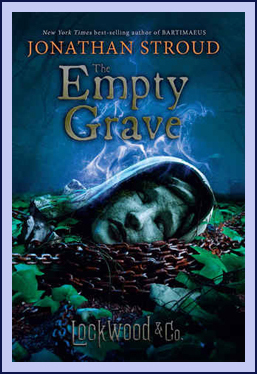 The Empty Grave by Jonathan Stroud


