










Showing posts with label London Calling. Show all posts

Wednesday, January 31, 2024

Book Review 2023 #1 - Ben Aaronovitch's The Hanging Tree

The Hanging Tree by Ben Aaronovitch
Published by: DAW
Publication Date: January 31st, 2017
Format: Paperback, 304 Pages
Rating: ★★★★★
To Buy

Peter owes Lady Ty. When he was trapped under the platform at Oxford Circus she saved his life for a favor. And she has come to cash it in. Her daughter, Olivia McAllister-Thames, was out with her classmates from St. Paul's. The teens had snuck into the posh One Hyde Park where they were partying in a vacant flat when Olivia's classmate, Christina Chorley, overdosed. Christina died on the way to the hospital. Lady Ty wants Olivia kept out of it. She doesn't just want her daughter exonerated, she wants her daughter's name never to be even mentioned in connection to the overdose at One Hyde Park. But that isn't how Peter works, even if he does owe her his life. He was willing to go easy on Olivia, but that became complicated when she admitted to supplying the drugs that killed Christina. And that's when Olivia was arrested and low-lying areas around the Tyburn were in danger of flash flooding. Just because Olivia confessed doesn't mean she actually did it, and Peter is nothing if not thorough, you kind of have to be when you're a magician, so he starts digging. And what he finds is interesting and disturbing. Interesting in that Olivia is obviously covering up for someone, who turns out to be her girlfriend, she just hadn't come out to her mother yet. Disturbing in that Reynard Fossman seems to be involved. Peter and Nightingale have never figured out quite what he is. Is he the spirit of Reynard the Fox? Is he someone who wants people to think that? Or is he just a creepy pedophile who just happens to get in their way? Whatever he is other than a pedophile, because that is confirmed, he seems to have been up to something with Christina Chorley. They were selling stolen magical artifacts. But Reynard didn't realize that his partner had been stupid enough to put them up on eBay. Magical artifacts need to be sold secretly, by word of mouth, because otherwise everything goes tits up. Which is what happens here. The main item of interest is Isaac Newton's Third Principia, rumored to have the secret of eternal life and turning lead into gold. Everyone wants it. The Americans, the Linden-Limmer's, the Folly, and any other practitioner who ever had a classical education. Which means Christina put a big ol' target on her back. Moreso because, if Peter and Nighttingale are correct, the Faceless Man is involved as well. Anyone could have killed her, but one thing is certain, it probably wasn't the pills but magic.

Peter and the crew are back in top form in The Hanging Tree with architectural collateral damage and big developments on the Faceless Man front. Though what I really connected to with this volume was the interwoven narrative of women within the magical community. In the present day we see that the Folly is quite open to female practitioners, with Lesley being taught by Nightingale, before her betrayal, and with plans for Abigail to be taught once she comes of age. But other than the Night Witch, Varvara Sidorovna, most magical women are creatures from the demimonde or Genius Loci. Here we get not just witches, but the history of witches. Lady Helena Linden-Limmer and her daughter Caroline Linden-Limmer might both have had connections to the Faceless Man of their generation. Helena was revolutionary in her medical experimentation and healing, which she only recently started to have qualms about. Whereas her daughter encountered Peter before in his pursuit of the Faceless Man and has one goal in life, to learn how to fly. And she doesn't mean aviation. The two of them come to the Folly for tea and sympathy and in short order they are setting history straight. Because back in the days when Isaac Newton was codifying magic men and women were equals. They were hanging out at disreputable coffee houses and taking on the mysteries of the universe. Together. This Society of the Wise then was able to get a premise on Russell Square and the doors of the Folly were closed to women. Women didn't take this lying down. They continued teaching each other in secret. Magic was passed down through the female line for generations. Magic that men couldn't even contemplate. At one point Peter tries to figure out the forma of a spell Caroline is doing and it's unlike anything he's ever seen. Because women invented, created, worked around all that was standing in their way, and they made their own branch of magic. What I love about this isn't the sad history that is all too common of women being shunned, what I love is that they persisted. They developed their own skillsets because they were pushed aside. I mean, there's a part of me that wants to liken this to "home arts" and wise women and their healing, which I think Aaronovitch is implying, but it's so much more, because domesticity doesn't mean what some people think it means. Just because women have been pigeonholed for so long it doesn't mean they've let these restrictions hold them back. It's like Lesley was always saying to Peter with regard to rebuilding her face, it's not like the Folly knows everything. Just because they are the academic repository of magical knowledge doesn't mean they're the only way. There's more in heaven and earth and all that, especially if you're trying to deny the abilities of half the people on the planet. Let the world of magic expand!

Wednesday, January 17, 2024

Book Review 2023 #5 - Ben Aaronovitch's What Abigail Did That Summer

What Abigail Did That Summer by Ben Aaronovitch
Published by: Subterranean Press
Publication Date: March 16th, 2021
Format: Hardcover, 232 Pages
Rating: ★★★★★
To Buy

Abigail Kamara should not be left to her own devices. She's not like her brother Paul who is terminally ill and needs looking after. She's just very good at getting into trouble. Just ask her cousin, DC Peter Grant. The second Peter's mom started bragging about her son doing magic Abigail demanded that he teach her. In an attempt to fob her off he said she'd need to get a GCSE A level in Latin. More fool him if he thinks she's not going to hold him to that, she's already in Latin club. She used to imagine her life out there, away from home, on some lonely road, but now she knows about magic, now she imagines seeing in the dark and running with foxes. Now she imagines finding a cure for Paul. When not being the bane of her teachers existence she's always on the lookout for the uncanny as a way to pass the time and impress Peter. There have been a recent spate of disappearances around Hampstead Heath and Abigail thinks they're rather sus. The entire nation is gripped by two white girls missing in Herefordshire and yet in London they can't be bothered with children missing on their own manor. This needs to be looked into, especially something Abigail thinks is extra sus, an old classmate of hers she hadn't seen for years invites her to a "happening" on the Heath. She's stood up but she meets Simon, who was also invited by someone he barely knew who also didn't show. At loose ends Simon and Abigail start to hang out. As Abigail comes to the realization that she's stuck with Simon she lets him help with her investigation. One that gets even stranger when it's revealed the the missing kids have all returned home with no memory of where they were. The most important piece of information is where are the kids going, thankfully Abigail has a skulk of talking foxes who have labeled her as a "person of interest" and are willing to help her with her operation; they're very big on the spy speak. And she needs each and every one of them to monitor the perimeter of the Heath. Which is how she gets her big break. The kids are all going into a house. But when Abigail enters, unlike the other kids, the house doesn't want to let her go. This conundrum is up to her to solve, without the help of the Folly, but oddly with the help of Simon's mom. Simon's mom is well connected, the foxes would be impressed.

While this is a standalone novella it is also technically a companion book to Foxglove Summer. Here we see Abigail in a similar situation to what Peter was dealing with in Herefordshire, missing children. While there are probably millions of stories about missing children what's interesting is seeing how one author handles the same subject in two very different ways. One was successful, the other was not. This book is damn near perfection. The bones of the story are a solid haunting of a house. The inside of the house is different pockets of time and it forces those whom it's lured inside to replay moments from it's past. It's not the most original of concepts, even Angel did a similar story in the season three episode "Waiting in the Wings," which I think was predominately written so that Angel and Cordelia could make out thus acting on years of pent up sexual frustration without them actually becoming an item. Yet Ben Aaronovitch writes his story so cleverly, so perfectly, that you feel like it's the first time you've head a haunted house story like it. What's more, the way that Abigail is trying to dissect the pockets of time while being forced to be a participate is fascinating. She actually appreciates these memories she is being shown while at the same time trying to find the source of the haunting. Abigail is just an amazing character with so much depth. What I personally connected to was the melancholy that is at the heart of her life, the fact that one day her brother Paul is going to die. Since the age of five his world has been getting smaller and smaller and I think that's why she pushes herself beyond her comfort zone. She wants to experience everything, even if it's the ghostly memories that a house gives her. Ben Aaronovitch understands the kind of suffering that a family with chronic illness endures. The hope that is almost worse than the bone deep pain of lifelong trauma. He wrote this book at the beginning of the pandemic and I think it influenced the story in an elegiac way. If you doubt me just read the section wherein Abigail is reading Terry Pratchett's Reaper Man to her brother. As she makes passing reference to that book's conclusion, if you know and love that book like I do, your heart will break anew.

Thursday, January 4, 2024

Book Review 2023 #9 - Ben Aaronovitch's The Furthest Station

The Furthest Station by Ben Aaronovitch
Published by: Subterranean Press
Publication Date: June 27th, 2017
Format: Hardcover, 144 Pages
Rating: ★★★★★
To Buy

When you limit a talented person to one specific thing they tend to get really good at it. Peter should have known all along that making a deal with his cousin Abigail was dangerous. She's almost as cunning as the Fae of legend with their bargains. Never agree to teach someone magic if you don't want to by adding a condition that they can easily meet, like getting a GCSE A Level in Latin. Because Abigail is way better than Peter at Latin. Which is very worrying. Though her age means that he and Nightingale have some time until they have to ask her parents for permission to teach her magic. Of course that would require a lot more explanations, but Peter did promise. Until that time comes Abigail is like the Folly's intern and has become the defacto ghost expert. Being unable to practice magic she's really good at finding the uncanny, and ghosts are the most easily observed of phenomena. And at this moment that phenomena is causing trouble on the London Underground. The Metropolitan Line has had a rash of reports. The problem is their witnesses aren't very helpful. Most people who encounter a ghost tend to forget the incident within minutes of it happening. It's like waking up from a dream, try as hard as you might the dream slips away. So the police get 999 calls that when followed up lead to very confused witnesses who don't even remember calling them. Therefore they must catch a ghost interacting with a member of the public and interview the witness immediately. Which doesn't go as well as they hoped. Walking the trains at night when they're in storage does lead to an interesting discovery though, the ghosts don't appear normal. Or should that be disappear. The ghost Peter encounters has an important message it needs to deliver and then it shatters like porcelain. The next ghost he encounters gives him some more information before shattering as well. This leads them into the archives of the Folly and the County Practitioner for Buckinghamshire, George Buckland, who died in 1815. He lived in Chesham and made rose jars, which were a unique form of ghost trap. But most importantly, Chesham happens to be the terminus of the Metropolitan Line. They might have just found out where their ghost commuters are coming from. Now to find out why.

What I love about this series is that you never know where it's going to go and that's rare for me to actually embrace and enjoy. I'm the kind of person who likes to try to figure out where things are going in books, shows, really, anything, that's why I'm addicted to whodunits, because I don't just want to know I want to figure it out before the killer is revealed. I want to be smarter than everyone else. Which is probably a trait I shouldn't encourage. I should know by now that a series ready to randomly drop in jazz vampires and talking foxes is unpredictable to say the least, but this story in particular was a wonderful surprise. You think it's going to be a simple ghost hunting on the Underground story with Peter and Sergeant Jaget Kumar of the British Transport Police, in a similar vein to them working together in Whispers Under Ground, but then it turns out that the ghosts aren't the problem, they're the messengers making them all red herrings. The ghosts have been haunting the Underground in an attempt to save a life. And while, read chronologically and not by publication date, that means we've basically had three cases of kidnappings in a row, I'll forgive Ben Aaronovitch because of those three stories two of them were amazing and this one at least didn't involve children. Plus this case is building on the lore of ghosts. The fact that to most people they disappear like dreams is fascinating. Like the brain can't cope with this information so it just deletes it. So what does that mean about those who retain the memory of seeing ghosts? Are they more observant or just wired differently when it comes to the uncanny? Also the knowledge that ghosts can be caught and that catching them changes them in some manner. I would literally love to read just like Abigail writing a dissertation on her thoughts of ghosts. Because I'm sure that she's going to study those rose jars that remained and figure out a way to recreate them. Which leads us to George Buckland. His wife, who was creole and from New Orleans, taught him how to make rose jars. Which means there are obviously different sets of skills and beliefs depending on where you've learned or practiced your magic. And while I adore the history of magic as codified by the Folly, it's only been around since 1775 which means even George Buckland himself lived in a world without the Folly for awhile. Which makes you wonder about the really old history. I would just love to read a history of the magical systems of Ben Aaronovitch's world. It could be a couple thousand pages and I would devour them all. Or just let me into the Folly and set me loose in those libraries, I want to know everything. I just love this world so much!

Wednesday, January 3, 2024

Book Review 2023 #10 - Daniel O'Malley's Stiletto

Stiletto by Daniel O'Malley
Published by: Back Bay Books
Publication Date: June 14th, 2016
Format: Paperback, 592 Pages
Rating: ★★★★
To Buy

The Wetenschappelijk Broederschap van Natuurkundigen, the Scientific Brotherhood of Scientists, attacked Britain. It was hundreds of years ago but the Checquy hasn't forgotten. Monsters coming out of the mist on the Isle of Wight and nearly destroying them in an unprovoked attack by unknown enemies. The Checquy won. Barely. Then they hunted their enemy down throughout Europe and destroyed them. These "Grafters" who made monsters out of human flesh have been the boogeymen of the Checquy for centuries. So when it turns out that the Grafters weren't eliminated but just really good at hiding and that Rook Thomas has decided that in everyone's best interest the two organizations will merge no one in the Checquy is best pleased. Which is why it's so important the negotiations go well. Graaf Ernst van Suchtlen founded the Broederschap with his cousin who earlier in the year was eliminated by the Chequy after a series of attacks. Therefore the peace is very delicate. Especially as the Broederschap might have a dangerous secret that could endanger themselves and the Checquy. Pawn Felicity Clements has just barely survived an attack that the Checquy doesn't realize was perpetrated by a splinter group from the Broederschap they refer to as the Antagonists. Her crew killed, she is reassigned to the Grafter delegation, in particular Graaf Ernst's heir apparent, Odette Leliefeld. Odette is a surgical genius, what's more, she's the acceptable face of the Broederschap, because she has few implants and therefore isn't threatening to the Checquy. But what Odette doesn't realize is that her very existence is a threat to the Checquy. As her and Felicity come to an arrangement, Odette learns the lesson again and again that to the people she has been raised to fear in their eyes she is the real monster. Even her innocent little brother Alessio is a danger to the Checquy and their way of life. Therefore Odette must do everything in her power to show that she could be a boon to the Checquy. Her skills, the Broederschap technology, all of this would be shared information. She brings so much to the table, but she's worried that all the Chequy see is a monster. She will dance, she will wine and dine, she will find the most absurd hat she can and go to Ascot, she will be the perfect delegate, because she has a feeling that if the talks fail there's no way to go back into hiding, the Checquy won't make the same mistake twice.

The first time I read Stiletto it perplexed me. Daniel O'Malley had created one of the most unique and original new voices in literature with Myfanwy Thomas and in his followup she's relegated to nothing more than a "featured role." She's not even around for the first fifty pages and then just pops up often throwing a wrench in everyone's plans, even if that isn't her intention. Because being stabbed by a guy who exudes crystals isn't really on anyone's agenda. But rereading Stiletto I see that it's a ballsy move that actually pays off. Because this series is "The Checquy Files" it makes sense that we'd get different stories within the organization as it continues, hopefully for many more volumes to come. This story gives us an interesting view of the Checquy through the eyes of Felicity Clements. She's not among the high and mighty, she doesn't aspire to being in the Court, she's a peon whose lifelong goal is to become a Barghest, which is basically an elite commando. She doesn't have problems with the Checquy, she does her job and doesn't complain. Even if she objects to her assignment, which she does. This shows the stratification within the organization and is a clever move because while orders come from on high, it's those lower down who have to deal with the fallout, like the Grafters joining the Checquy. Myfanwy doesn't understand the ramifications of this deal. She doesn't understand the indoctrination of hate for the Grafters. One, because she's not the Myfanwy who grew up hearing the horror stories, and two, because this new Myfanwy takes big swings in the hopes of effecting change, and this is one big swing. And personally, I can see where the peons in the Checquy are coming from. The Grafters skeeve the shit out of me. All that surgery requiring a pharmacopoeia of anti-rejection drugs? I mean just the fact that you need that many drugs so that your body won't scream at you? Hell no. Just so much no. And I know we're supposed to draw a line between "good" Grafters and "bad" Grafters, but how about no Grafters? I'd be fine without them. Though I do find their POV with regards to the Checquy fascinating because they aren't alchemists, they're natural scientists, think Victor Frankenstein, everything they do is rooted in science and they themselves are terrified of the Checquy because there is no scientific explanation for them. Which I find interesting because Peter Grant in the Rivers of London series believes magic is just science we don't understand yet, yet here, there is no scientific explanation. The Checquy is what it is, an unexplainable quick of nature that I just love.

Friday, September 29, 2023

Book Review - Daniel O'Malley's Blitz

Blitz by Daniel O'Malley
Published by: Little, Brown and Company
Publication Date: October 18th, 2022
Format: Hardcover, 688 Pages
Rating: ★★★★
To Buy

Lynette Binns was raised in care and has a deep suspicion of government and bureaucracy. She has created a life for herself and her family. She's a librarian, her husband is a respected cop, her daughter is the light of her life, and her dog, well, he might just be a dog but she loves him. Then one day lightning arcs out of her body destroying her kitchen. The Checquy swoop in. They tell her she has dangerous powers, but they can help her learn to control them. She's not really given an option. She is back in the system and attending school with children on a remote island while her family thinks she's fighting for her life with some rare disease. Well, at least they're right about the whole "fighting for her life part." But surprisingly she learns control, she becomes strong and powerful. She likes the new Lynette, the Delouser. And yes, it's best not to ask about the nickname. Oh, how she wishes it was cooler. She works hard at her new life and just when she thinks everything will work out a report crosses her desk. Someone is killing criminals in London, someone whose signature matches her own. Because whenever she uses her power she leaves behind a double circle. The Checquy have assured her that all powers are unique and that if anyone uses their power for nefarious purposes the policy is to shoot first and ask questions later. Knowing that she has been handed her own death warrant, she goes on the run. If she can find the real killer before the Checquy catch up to her perhaps she has a chance of holding on to her new life, or any life for that matter. Little does she know that her problems are linked to a string of deaths that happened during the Blitz. Bridget Mangan and her two best friends, Usha and Pamela, were on the tail of a Nazis whose plane Pamela downed. If it hadn't been bad enough that Pamela broke the rules, the Checquy is to avoid escalating the war at all costs by using their powers, the fact that there was a surviving witness who could identify them is catastrophic. A surviving witness who happens to have powers. But they can't tell the higher ups. They have to find the powered Nazis while also going about their day to day assignments, and for Bridget that means finding out how certain artifacts have gotten into public hands when they were safely in the Checquy vaults. An assignment that brings her into the orbit of the criminal madame, Tillie Murcutt. The problem with Tillie is she knows more than the public. She knows about powered people. Which means, could it be possible she knows about the Nazis?

Blitz is an odd entry into the Checquy Files because it feels like it's suffering from a split personality disorder. It can't decide if it wants Lynette Binns to be the heroine or Bridget Mangan to be the heroine. Which means it can't decide if it wants to be about the present or the past. Daniel O'Malley's workaround to this problem was to make the book about both of them instead of thinking what would best service the narrative. Which, given his writing style of stacking infodumps like nesting dolls and letting his book run to blunt weapon size, wasn't unexpected. And yes, I can see the appeal of Lynette, an "older" woman joining the Checquy and having to navigate this strange world, and I won't say that Daniel O'Malley wrote this entire book just to get some quality boarding school scenes in, but I think it's pretty obvious that he did. Also, the truth is, Lynette's story does have heart, and a connection to Bridget, it's just that it wasn't enough of a connection to justify her story. Because honestly, the only reason to have a modern section is to include our previous heroines, Myfanwy Thomas and Odette Leliefeld. Which he did. Barely. I think Myfanwy has two lines, Odette a few more. And just getting glimpses of them might actually have been more painful than if they hadn't shown up at all. Which is why this book should have been entirely set during World War II. On the whole I tend to avoid historical fiction or historical fantasy set during World War II because I feel that it's an overused time period. Enough is enough already, there were other wars! But Daniel O'Malley did the impossible, and through unique characters and their highly unique powers, made me actual embrace World War II after many years of avoidance. The more a thought about Blitz I likened it to when Torchwood showed us what it's third iteration was like during the Victorian Era with Alice Guppy and Emily Holroyd. I really enjoyed that dip into the past to see how the organization developed over time. And just like Torchwood, here we know about the present day power structure, so we didn't need Lynette, we just needed Bridget. We just needed a terrifying and delightfully different romp through the Battle of Britain. Because during the War, I might not have had Myfanwy, but I at least had Tillie Murcutt. And Tillie Murcutt is one in a million.

Wednesday, September 27, 2023

Book Review - Ben Aaronovitch's Amongst Our Weapons

Amongst Our Weapons by Ben Aaronovitch
Published by: DAW
Publication Date: April 12th, 2022
Format: Paperback, 304 Pages
Rating: ★★★★★
To Buy

In one of the most secure places in London a man loses his heart by an invisible assailant. The London Silver Vaults rarely has anyone stupid enough to attempt a robbery, and yet that's just what David Moore more tried to do, and failed, when a giant hole appeared where his heart should have been. This case has Falcon written all over it, those "special" cases that the Folly comes in to handle. The victim was looking for a ring that his ex-wife supposedly sold. A ring that he desperately wanted back. A ring that his ex-wife was still in possession of. When Peter Grant and Danni Wickford, who's on the Basic Falcon Management Course, show up at her house to say Althea Moore is channeling Gollum would be an understatement. The ring is unique, it can expand to form an armillary sphere and has writing inside from more languages than they can recognize. Soon though that ring is stolen. When they stumble on another dead body with the same cause of death as David Moore, they start to form a picture of what's going on. Years ago up in Manchester, a man named Preston Carmichael, AKA the second body, ran a prayer group that David Moore was a part of. There were seven members of the group in total, seven rings for the dwarf-lords in their halls of stone. And these rings were magical. They were also misfiled at a local library instead of with the Sons of Weyland, the magical blacksmiths whom Nightingale learned from. Which is how they got into the hands of the public. Obviously something magical happened at one of these meetings and since then the bearers of the rings have become overly attached to them. It is when they are questioning one of the other members of the group that Peter has to fight off what he is quite sure is the Angel of Death. Now is not the time for him to die, Bev is about to give birth to twins any day now and he's not going to leave his daughters fatherless. Plus the Folly hasn't really ever come across "angels." And anyhow what would an angel want with rings? Whatever it is there are obvious religious connotations, it's just figuring them out before another person dies, another person that hopefully isn't Peter, that is going to be tricky.

There are very few authors whose sense of humor is perfectly aligned with mine. Ben Aaronovitch happens to be one such author. I honed my humor at the feet of Monty Python. I watched the entire series and then rewatched it while bootlegging it. I know bits off completely by heart, enough to retroactively know that my friends in eighth grade really biffed up the "Dead Parrot" sketch for our talent show that year. Needless to say I, like many, especially the writers of the film Sliding Doors, have a strong reverence for "The Spanish Inquisition" sketches. So when I saw that the title of the next Rivers of London book was Amongst Our Weapons I instantly hoped beyond hope that it was in reference to said sketch. Needless to say, it was. Aaronovitch hasn't let me down yet. But what's more it's used as a structure for the book as well, creating a flow not seen since Whispers Under Ground. Plus, it's not just a a humorous veneer, though I did snort laugh when DCI Seawoll uttered a certain profanity before declaring he "wasn't expecting them," Aaronovitch has worked the Spanish Inquisition into the plot of the book making the reference so important and tying it into the ever expanding magical world. One of the reasons that "The Spanish Inquisition" sketches resonate with me is because I had eight years of Catholic school. Needless to say eight years made me pretty convinced that there isn't a God and there had to be something else that people got out of going to church. Whether it was a sense of community or safety or patronage, I felt that there was something other than God that had to be why thinking people kept going back. I am not alone in thinking this way, and one person who has spent quite a considerable about of time on it is Professor Harold Postmartin D.Phil, F.R.S. As the Folly's literary liaison he is convinced that mass is actually magic. A form of magic that allows one practitioner, the preacher, to use the gathering of the congregants to work a spell. Thus giving Postmartin some tangible reason as to why the congregants would believe, because they got something out of it despite having no magical ability themselves. And I buy this theory, but the more I learn about this world Aaronovitch has created the more I need to know. The Catholic Church might have their own version of the Folly!?! And there are just so many different magical traditions all over not just Britain, but the world. This series could be hundreds of books and it would never be enough. More!

Friday, September 22, 2023

Book Review - Alexis Hall's Smoke and Ashes

Smoke and Ashes by Alexis Hall
Published by: Carina Press
Publication Date: November 12th, 2020
Format: Kindle, 332 Pages
Rating: ★
To Buy

About three years ago, shit has it been three years? Kate Kane's life went to hell. Technically literally, but that's another story. Her life was saved but in the process it also fell apart. She was betrayed by her girlfriend, Julian Saint-Germain, once again proving you can never trust vampires, and her best friend, Elise, was turned back into a statue. But the worst fate belonged to her ex Nimue, who lost half her face in the battle for the very soul of London and now lies in a coma. Since then Kate's done exactly what you'd expect her to do, drunkenly wallow. Although the thread count of the sheets in the bed she's been wallowing in have gone drastically up since she started banging Tara Vane-Tempest. Posh werewolves really do have a nice life. Although this posh werewolf is even starting to question Kate's life plan. One can't stay in bed forever drunk. Of course when Kate does get out of Tara's bed she often ends up in someone else's... Which she's not sure if Tara is OK with. But Kate's life is a train wreck so what does it matter if she destroys the one kind of good thing in it? Though things are about to change. Not for the better. The werewolves have been attacked. One was skinned. The perpetrator has links to Kate, links she'd rather not think about because the attacker happens to be the vampire that sired Patrick, her intolerable ex who is still listening to "Clair de Lune" on repeat. Her arrival would be problematic enough if she hadn't teamed up with the vampire who almost killed Kate three years previously, Sebastian Douglas, who has allied himself with the Queen of Winter, the King of Shadows. This is a clusterfuck of vengeance coming right for Kate and those few people she still tries to care about even if she's kind of lost touch with them. But Kate knows things are really about to kick off when her prophetic dreams return. The green lady who is and isn't Nimue tells Kate that all that is wrong is because Nim's life is in the balance. She needs to be killed or restored so that London can recover. Of course Kate doesn't want Nim to die, which means she has to find the Holy Grail. Yes, THAT Holy Grail.

How would I describe Smoke and Ashes? A damn stupid interminable vision quest without an actual ending. This volume, and to an extent the previous volume, seem to be prologue to whatever is coming in the final volume, Time and Tide, which is now two years overdue. Not that I actually care. Other than if the final volume was out I could read it and then never look back. Because all that I mildly enjoyed in this series has been slowly stripped away. The narrowing of focus has made this nothing more than bad King Arthur fanfic. And I like King Arthur fanfic, my love of Merlin, both the campy BBC series and the Sam Neill miniseries, should be enough to prove my bona fides. But I can't stand this. This stripping down of characters, this myopic drunken vision quest. If you would have told me I'd react so strongly to the removal of a Pudding Nun and Pygmalion I would have laughed at you. And I would have been so so wrong. And yes, I know Pygmalion was the sculptor, it just has such a nice alliterative ring that I couldn't pass it up. Taking away the most "memorable" characters has been tantamount to suicide. The supposed three years since the events of the previous book has seen Kate become a committed drunken whore. Which proves to me, time and again, that the main problem with this whole series is it's star, Kate Kane. And this volume really let me get to the heart of why I hate here. Kate is an immature ass. Literally. She has no emotional maturity. I mean, this could have something to do with Patrick and her traumatic teens, that somehow her development has been stunted at a time in her life where she wasn't fully formed and instead of dealing with the trauma she has created a persona versus a personality. But this might just be me trying to justify her being drunk in Tara's bed for three years. Because Kate is what an ill-informed teenager would think a PI is, a drunk who bangs the dames. Yes, I guess this could be a valid life choice, but it's so damn depressing and nihilistic. Kate's always assumed she'd die young so she doesn't bother to work on herself, she doesn't actually try, she's willing to stay childish, even needing bedtime stories. She stumbles around when she has to, but really, if you think about all her actions, they are really only reactions. I want to smack her and tell to grow the fuck up. But I really don't think that would help, she knows how to take a punch.

Wednesday, September 20, 2023

Book Review - Ben Aaronovitch's False Value

False Value by Ben Aaronovitch
Published by: Gollancz
Publication Date: February 25th, 2020
Format: Paperback, 404 Pages
Rating: ★★★★
To Buy (different edition than one reviewed)

What do you do when at face value it looks like you're on the outs at your job? You use that to go undercover at a shady tech startup that values secrecy and loyalty above everything else. Or at least values it second to a good Douglas Adams homage. Tech guru Terrence Skinner has left California behind for the grey skies of London. Could it be for personal safety, which is what's bandied about among the employees, or could it have to do with whatever is in Serious Cybernetics Corporation's second building, Bambleweeny? It's rumored that that is where Deep Thought is, because the guy really can't pass up a Douglas Adams joke. But Peter knows that they're up to no good because of a run in he had a month before his first day at SCC. A run in with an American practitioner who was working at the London Library where he is looking into recovering the Mary Engine. The Mary Engine is the supposed creation of Charles Babbage and Ada Lovelace and if the Faceless Man owned it, which Peter knows to be the case, then it has to be seriously magical. Of course the Faceless Man's daughter sold it on eBay resulting in previous catastrophic attempts to retrieve it, so it's reappearance in the hands of Terrence Skinner is worrisome. Which is why Peter is now a Vogon at SCC, that's security to the layman. And Terrence sure needs protection when Peter stops one of Skinner's own employees from stabbing him. The incident leads Peter to be a bit of a celebrity among the staff but more importantly it gets him an in with Skinner. Because the attacker worked in Bambleweeny this allows Peter to get behind that mysterious locked door to discover that Skinner might have created not just Artificial Intelligence but Artificial General Intelligence. Which is where the money really is. This AGI could change everyone's life. And sure, Skinner sounds convincing, but Peter lives in a world where magic exists, and, well, magic is more likely than AGI, which means everything must come back to the Mary Engine. With the help and hindrance of other practitioners Peter starts to formulate a plan. The problem is that this is bigger than he thought and he was really not cut out for undercover work. This could end very badly.

There's one thing no one who's a fan of Aaronovitch will ever doubt, and that's his geek cred, and I'm not even counting that he wrote for Doctor Who. Because if there's one thing true geeks love it's Douglas Adams references from the overt to the obscure and arguing about the singularity. And here Arronovitch has built an entire book around these core beliefs. Because yes, Douglas Adams and The Hitchhiker's Guide to the Galaxy is a religion as is the belief we will all be killed by Cylons. And possible baddie boss aside, who hasn't wanted to work at a company that has Vogons and Magrathea as job titles and locations? But the veneer of Adams isn't where False Value shines, it's in it's handling of Artificial Intelligence, Deep Thought as it were. AI is right at this moment an issue that everyone is dealing with, along with trying to grapple with what this means for us as a species. And I don't think it's a coincidence that both AI and the singularity came into the vernacular in the fifties, AI preceding the idea that AI will destroy us all by only about two years. Yet it's only truly now that the extreme warnings signs those of us raised in the eighties to recognize are blaring klaxons. Skynet people! SKYNET! But the thing is, the question asked daily is, is this true AI? Because most times, especially in fiction, if we're told it's AI there's no way it's AI. It might look like it can pass the Turing Test, but can it really? Because the truth is what the vast majority of people believe is AI, which at this precise moment is "writing" and "creating" and "making art," isn't AI, it's a complex program that has scrapped the entire internet and is plagiarizing the work of others. Others who are losing jobs because of AI. When one of my friends was playing with Midjourney I told her to stop. Immediately. She was helping the program learn while taking away jobs from artists such as myself. Never help the machines to rise up! Aaronovitch has a wonderful character with Peter because he understands all of this yet is skeptical. He knows when people tell you AI you should look for the man or woman behind the curtain. And because of his line of work, it could be a ghost literally in the machine. A very vindictive ghost. But still, it's not AI. But one day it just might be. I mean look how much of a shit show it is when the AI is really just a misnomer. So for now, us humans are the real danger, we were the Cylons all along.

Friday, September 15, 2023

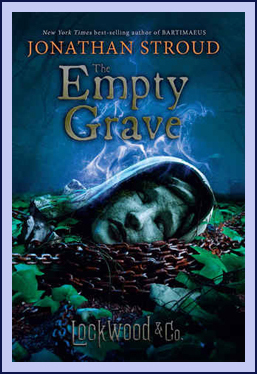
Book Review - Jonathan Stroud's The Empty Grave

The Empty Grave by Jonathan Stroud
Published by: Disney-Hyperion
Publication Date: September 12th, 2017
Format: Paperback, 448 Pages
Rating: ★★★
To Buy

Their enemies are closing in. But if there's one thing that George believes deep in his soul it's that knowledge is power. They cannot go into their final confrontation without knowing all the facts. And that's why they are breaking into the Fittes Mausoleum, where the legendary Marissa Fittes is buried. Because if the skull is right, the woman they know as Marissa Fittes's granddaughter, Penelope, is actually Marissa herself. Which makes it highly suspect that she only "discovered" The Problem. And if everything was above board the Fittes Mausoleum wouldn't have been booby-trapped now would it? Lockwood and Co. which bafflingly now includes Quill Kipps finds the Mausoleum occupied, but not by Marissa. It seems the skull was right. Now that they know they are dealing with Marissa they can make their plans accordingly. Plans that now include vengeance from Julius Winkman, just sprung from jail. Their only viable move is to lure all their enemies to Portland Row and then work a miracle. But seeing as Lucy is the first person since Marissa Fittes who can talk to Type Three ghosts, they know they have the power, they just need the nerve. As their enemies descend on their home, destroying their beloved headquarters, they retreat to the room where Lockwood's sister met her end. Just like Rotwell was doing down at the research center in Aldbury Castle they make an opening to the Other Side. They have gone where they can not be followed. Their plan is to cross through the bleak and desolate landscape and gain entry into the Fittes building and end Marissa's reign of terror. The Problem will be removed. But crossing through this liminal space isn't easy. Every step is laborious, the protection they have can only last so long, and Quill was injured, but oddly he seems to be doing the best of all of them, which is when they realize how serious this is. Not all of them might make it out alive. But they have to try. They are the only hope for this to end once and for all.

This is it! The big final showdown! This is for all the stakes people! And maybe, in the end, that's what let me down most, because I didn't feel like there were that many stakes. I have always disliked stories that have no stakes. Look to the Gothic classics The Woman in Black or The Turn of the Screw, both of these stories use a framing device that takes place after the events of the book so we know that Arthur Kipps (last name probably not coincidental) and the unnamed governess survive. Throughout The Empty Grave Lucy is dropping hints about the future. She'll become a preeminent figure in studying the Other Side, which is great for her, not so great for creating any kind of tension. But we have hopes with Quill, he's badly injured and the only way that he is doing better than everyone else on the Other Side is that he is dying. But guess what? He doesn't die. I'm not saying I wanted him to die, but him somehow pulling through after doing a total hero move and joining Lockwood and Co. and risking everything to right his wrongs, well, he should have died is all I'm saying. Sometimes the best thing a character can do is die. I know that might sound harsh but it's the truth. A prime example is L.A. Confidential, Bud White should have died. He should have gone out in a blaze of glory. But no, he's a battered man in the back of a car. I'm even one of those rare people who think Thomas Magnum should have died because it was more satisfying than the ending we got. But it is what it is. At least Stroud was willing to let the villains die. And while this book is kind of just a headlong rush of tying up all the loose ends I did enjoy the vibe in shares with Philip Pullman's His Dark Materials trilogy. Firstly we have windows into other worlds that are used for escape, one uses powerful sources the other uses Æsahættr. Secondly we have a laborious journey through the land of the dead. And I know at the time I thought up more but I think those two are enough justification for the comparison. But I do love that while The Empty Grave has this similar vibe it's also totally it's own thing. Though I kind of would like a further glimpse into the future... Just a little more for Lucy... Is that too much to ask? I mean Philip Pullman is doing it...

Wednesday, September 13, 2023

Book Review - Ben Aaronovitch's The October Man

The October Man by Ben Aaronovitch
Published by: Subterranean
Publication Date: May 28th, 2019
Format: Hardcover, 216 Pages
Rating: ★★
To Buy

Tobias Winter works in Meckenheim, Germany, under the Director at the Abteilung KDA, the Department for Complex and Unspecific Matters. In other words, he is Germany's answer to Peter Grant, and Peter Grant has a lot to answer for. Tobias has been called to Trier because the death of an unidentified male ticked the right boxes to alert the KDA that they might have a possible supernatural infraction. Kriminalkommissarin Vanessa Sommer, AKA the local fuzz, is on hand to take him to the crime scene. The body was found in a ditch abutting the vineyard of Frau Stracker. It has since been sent off to the KDA's pathologist of choice, Professor Doktor Carmela Weissbachmann, which means that Tobias is to assess the crime scene for vestigia before meeting up with her. Very faintly there's something like wriggling roots but it's not enough to be sure that this case is his. That is until he sees the body. It's covered in fur. But the "fur" is actually fungus. Fungus that Carmela delightfully informs him is unique to grapes. Noble rot is a fungus used to make a sweet wine. And the Stracker winery used to be renowned for it, so says resident wine expert Vanessa Sommer. That can't be a coincidence. Nor can the fact that Tobias gets that same sense of wriggling roots from the corpse, this time with hints of turned soil and half-discordant musical notes. The only lead that Winter and Sommer have is a recent tattoo the man had gotten, which leads them to All Art is Transitory, a tattoo studio where they learn the identity of their victim, one Jörg Koch, and that he came in with a group of friends to have Dionysus tattooed on his arm because of a dare. These friends could be suspects, witnesses, or even potential victims. Soon another body turns up, this time the victim choked on his own vomit, but that was due to an astronomical blood alcohol content. Which means it's imperative they find Koch's friends. The murderer is changing their modus operandi, or are they? Here's hoping they can stop the killer before they escalate again. Because if there's one thing that Tobias Winter has learned in his short time in Trier it's that the town is about wine and Romans, and those two things are inextricably linked so therefore they have to be at the heart of these crimes.

I don't know what the purpose of this book is because so much of it is wading through shit we've heard a million times before but in a better voice until finally we are able to concentrate on the crime. We have to hear Tobias talk down to us like we've never heard what vestigia is. Peter Grant has a way of imparting knowledge in a way that makes you eager to learn, Tobias is no Peter. Tobias is pedantic and just an asshole. I never want to have to read anything in his voice ever again. What I found mildly interesting is the differences that have arisen in how Germany and England categorize and label their magical systems, but these are too few and far between and again, the way it's imparted to us through Tobias is just annoying. I had some hope for the crime, this bizarrely furry situation, but it fell apart because it ended up repeating so many of the tropes of the main series, from baby river goddesses to sequestration, it's just the same thing told in a slightly different way. And not for the better. Plus it went really dark with attempted rape and stalking and Nazis. Oh and don't get me started on the wine. I'm not a drinker. I never want to go to a vineyard or on a winery tour. I want nothing at all to do with the pretension of being a vintner. So to have that be the core of the crime with all this "previously on" swirling around it, it's like I didn't care to get to the center of the Tootsie Pop. I DO NOT CARE ABOUT WINE. I NEVER WILL! Nothing will make me change my stance. Not even one of my favorite authors. Which brings me back to the why of it all. Why does Tobias Winter exist? The only way I can justify his existence in my mind is that he's going to be the next Big Bad. Now on the surface he looks like a normal police officer. He solves the crimes, he gets things done, but in the process we learn some startling things about Germany. Does Nightingale know that the forbidden knowledge that wasn't meant to be kept was kept anyway? That the Nazis research of the Ahnernerbe and the Black Library which was the reason for Ettersberg where almost all was lost still lives? There's a reason it's kept behind a door in the Folly and yet Winter has access to this knowledge. Maybe that's why I hate Tobias Winter so very very much, because I know Nightingale would and I will always side with Nightingale.

Friday, September 8, 2023

Book Review - Jonathan Stroud's The Creeping Shadow

The Creeping Shadow by Jonathan Stroud
Published by: Little, Brown Books for Young Readers
Publication Date: September 13th, 2016
Format: Paperback, 435 Pages
Rating: ★★★★
To Buy

After the events at Aickmere's Department Store Lucy has left Lockwood and Co. She and the skull have gone freelance. Which has it's ups and downs. Her home isn't really a home and she misses 35 Portland Row and Lockwood in particular but she's not about to go crawling back begging for her old job. One day, after a long night, there he is, Anthony Lockwood, at her door. She knew they'd eventually see each other but she didn't think he'd seek her out. He's not asking her to come back just asking for her help. Penelope Fittes has asked the Lockwood and Co. complement to look into the case of Solomon Guppy, otherwise known as the Brixton Cannibal. He killed and ate his victims and it seems his ghost has returned to his old home. The source must be found and destroyed. Lockwood and Co. with Lucy and Quill Kipps in tow successfully find the source but Lockwood is reckless and Lucy is worried. She left in order to protect him and it seems that this has had the opposite effect. Though with the life Lucy leads she doesn't have time to dwell on this revelation as the very next day the skull is stolen from her apartment. There's only one person who knew about the skull other than her friends and that's a worker at the Fittes Furnaces where sources are destroyed. Lucy reaches out to him but it doesn't end well, he's murdered and she's on the run. The only place she can go is Portland Row. After a failed attempt to rescue the skull they decide that perhaps being in London isn't that safe at the moment and they accept a job they had previously turned down. The village of Aldbury Castle is swarming with spirits. What's more, Aldbury Castle is near a research facility run by the Rotwell Agency who it appears has been behind the purchase of artifacts that should have been thrown in the furnace. What they find inside the facility will change the very underpinnings of how society views The Problem. Their problem is staying alive long enough to let the world know.

While this series has always had Lucy at it's heart, with her moving out on her own she becomes even more important. This isn't about Lockwood and Co. anymore, this is about Lucy's relationship to Lockwood and Co. It's an interesting shift. Because partly it's like the first book with Lucy being the outsider, but at the same time we've spent three books with her building a relationship with Anthony and George and we have insider knowledge. It's an interesting liminal space to be in and ties in perfectly with the reveal at the end. Because Fittes and Rotwell, instead of actually fighting The Problem, they have been creating it by using sources to power a portal to the Other Side, which itself is a liminal space between life and death. This grey and lifeless mirror world isn't meant for the living and their intrusion is causing chaos. There is no balance between life and death anymore. The natural order of things has been damaged, perhaps beyond repair. This is the heart of the matter, humans mucking about can make everything worse. And unlike Penelope Fittes, Lucy, Anthony, and George, don't strive for power they strive for survival and normalcy. That's what these kids have all been fighting for, a world in which they can be kids. Though of course I would love to follow them forever and see there adventures as adults, I know there's only one book left to wrap it all up. Which I'm sad and also grateful for. Because while I love this world there are some quirks of Stroud's that really get on my nerves. Yes, I'm back to his body shaming yet again. Here it reaches a new level of unacceptable with the cannibal and his capacious corpse leaving belly streaks on the walls of his home. Firstly, how many people was Solomon Guppy eating? Because it sounds more of the gorging than of the eating to survive variety of killing. But more importantly, just no. I do not want to read about an obese Jeffrey Dahmer thank you very much. Really though, the belly streaks on the wall were the tipping point for me. Just so much no.

Wednesday, September 6, 2023

Book Review - Ben Aaronovitch's Lies Sleeping

Lies Sleeping by Ben Aaronovitch
Published by: Gollancz
Publication Date: November 20th, 2018
Format: Paperback, 406 Pages
Rating: ★★★
To Buy (different edition than one reviewed)

Martin Chorley and his co-conspirator Lesley May will be run to ground and made to pay for all their crimes. Which are numerous. Operations Tinker, Wentworth, Carthorse, Cartwheel, and Marigold were all separate investigations into their crimes, now combined under the aegis of the Folly and Operation Jennifer. The Folly is groaning under the influx of police officers, but Molly seems happy to feed them all, even opening up the dining room. Their only hope of finding Martin Chorley is through his connections to other Little Crocodiles, that Oxford dining club that was more about magic and less about running riot. Which is why Richard Williams is under surveillance. He ticks all the boxes. And soon his heart will tick no more because Chorley is tying up loose ends and as soon as the police approach Richard Williams all hell breaks loose. He doesn't die immediately. But he does die. But they find a clue in his papers. A screenplay for movie set in Roman London called Against the Dark written by Richard Williams and Gabriel Tate from a story by John Chapman. This is right up Chorley's alley. His romantic view of the Dark Ages might just have something to do with his plans, why else would he silence Williams? And Chapman and Tate as it turns out once they hear back from Australia and America. All three people associated with the screenplay being deceased is a dead giveaway that it's integral to Chorley's plans. But the first real lead they get is Richard Williams's interest in bells. He made several visits to the Whitechapel Bell Foundry where they forged a bell for him. He provided them with the materials, some of it nicked from archaeological sites throughout London. The bell draws Peter in and he knows it's magic. This bell is important and could very well be the lure they need. They use the large police presence for Michelle Obama's visit to Whitechapel to make the foundry look unguarded. But Lesley fails to make off with the bell and they all think that despite it's beauty, destroying the bell is a plus because it hobbles Chorley's plans. It won't stop them, he'll just make another bell, but bells take time. And in that time they start to put the pieces together; Roman London, the Temple of Mithras, St. Paul's, The Silmarillion, and last but not least, Mr. Punch. Will this knowledge be enough or will Martin Chorley make myth reality?

Lies Sleeping is the big culmination of, well, basically everything that has come before. The book hits the ground running with all the various MET operations that are folded into one unwieldy operation, Jennifer, that is to deal with all of Martin Chorley's crimes under the remit of the Folly. That means Nightingale is in charge. From the first few pages it feels as if this book is struggling to do too much. I've been reading this series over the last three months so there hasn't been the passage of time that usually occurs between volumes, so, logically, I should know every single little detail, and yet I found myself spending an inordinate about of time on Follypedia. Every police officer that has ever appeared is pulled into this operation. And yeah, apparently I should have remembered who David Carey was but by the time I got to Follypedia I'd forgotten his name. This happened repeatedly. He's very forgettable. So while Aaronovitch does successfully tie together all the loose ends, from Martin Chorley to Lesley May to Mr. Punch to all that stuff I'd rather forget from the comics, I really don't like the comics, it doesn't create a satisfying story. It's just one thing happening after another with what feels like a cast of thousands. The Rivers of London series has always perfectly balanced the character of Peter Grant with the character of London itself. With little moments and asides that feel like lovely character studies. Quiet moments. Here there's no time for those quiet moments. There's no working along with Peter to solve a crime it's just them, and a lot of them, trying to run Chorley to ground. All the characters have become stock figures and the one who suffers the most is Lesley May. I no longer get where she's coming from. Yes, revenge and a return to her life before Mr. Punch has always seemed her motivator, but here, here she has a chance at that and she blows it all up. Yes, Aaronovitch is probably setting her up to be the next Big Bad, but her change seems too out of character. She monologues about her hatred of magical creatures at one point and I couldn't help thinking she's turning into a bit of a bigot but without any reason why. I need the why. But I'll give Aaronovitch the benefit of the doubt, because the ending with Mr. Punch in the very first book felt convoluted and dreamlike, and here Aaronovitch is, seven books later, and he knows he messed up and is trying to set it to right. And as someone who has recently watched all of I, Claudius, I gotta admit he got Roman Britain and the Roman mindset down perfectly, when in doubt kill someone and make them a god.

Friday, September 1, 2023

Book Review - Alexis Hall's Fire and Water

Fire and Water by Alexis Hall
Published by: Carina Press
Publication Date: February 24th, 2020
Format: Kindle, 278 Pages
Rating: ★
To Buy 

Artie King is nothing more than a thug backed up with a granny from hell. OK technically he's a wizard, but he's also a skinhead and a gangster so thug covers all bases. Ten years ago when Kate and Nimue were together they fought him for the soul of the city. Nim won on a technicality, Artie King went to the clink. She's been the Witch Queen of London ever since. Only now Artie King is back and he wants London. Kate owes fealty to Nim but oddly enough that oath isn't what brings her back into the orbit of Artie King. That happens because of a job. The Merchant of Dreams had their shop broken into and a bust of Napoleon was stolen. Sadly Kate has a bad history with that bust. It's the reason her partner is dead and she's running her business with a living statue named Elise. Corin Black is the worst of femme fatales, you actually fall for her routine. Each and every time. You know being around her means certain death and yet you can't help yourself. No one can. Corin was looking for the statue when she and Kate had their first run in. She finally found the bust she was looking for, there were mulitple busts, it's like a story written by Sir Arthur Conan Doyle, but to protect the bust she pawned it to the Merchant of Dreams. Now someone has the bust and the Merchant has hired Kate to find it because it turns out Corin's obsession with the bust was because of what was inside; The Tears of Hypnos, capable of reshaping reality in the right hands. And Kate finds out that Artie King has gotten his hands on them. Or that was the plan until Corin showed up. Now the werewolves have them and it's just a big mess. Because even though Kate has been able to track the movements of the Tears she doesn't physically have them, and that wasn't the deal she made with the Merchant. And the Merchant is someone who understands deals. Intimately. Therefore it's up to Kate to broker a deal with the werewolves to give the tears to Nim so that she can win the battle for the soul of London and defeat Artie King once and for all. Only no matter how simple that may sound, life is never simple for Kate. Because there are kidnappings and side trips to hell and bargains made and vampires. And while she's not looking, the vampires might be Kate's biggest threat and weakness. After all, she is dating the Prince of Cups.

I naively thought that the length of time between the second and third volume might have indicated that the writing would have improved. Because writers do grow and become more polished. Sadly, this was not the case. Thankfully the amount of Twilight references have gone down, but oddly this made things worse. Because I wasn't focusing my rage on Alexis Hall using another author's work as lazy exposition the one-dimensionality of all the characters was even more apparent. If it wasn't for Elise I don't think I could have even gotten through this book. All Kate does is traipse about London in varying levels of injury, not really accomplishing much, but causing havoc in her wake with minimal plot. Or as Kate herself said utilizing "a loose collection of randoms, most of whom I've slept with" for information and help. This results in a sameness to the three volumes I've read making me dread reading the forth. The books weren't well written the first or second time around and the third time isn't the charm. But there is Elise. The Pygmalion of it all. Which, because of the age of the myth, has been used time and time again. I mean, they even did a Buffy the Vampire Slayer episode that dealt exactly with the abandonment issues that Elise is processing. And Alexis Hall is no Jane Espenson. And yet Elise has a certain turn of phrase that makes her memorable. Her fascination for objects and their feelings, like how she wouldn't let Kate get rid of their destroyed car, gives her a depth. The love she has of temperature variations and textures is delightful. As is just the cadence of how she speaks. She has her own patois that it just adorable. And due to the storyline we finally get to learn more about her creation and world and how she wasn't the first or the last creation of Russel, he of "they're not comics they're graphic novels." Elise has "sisters." And they are all at different stages of her development. Beth, the eldest, is more developed and jaded, Alissa is the second youngest and still in the subservient phase, while Lisbeth is newborn. Part of me really wanted to just have them be the stars. And then Alexis Hall granted my wish and I realized I really need to be careful what I wish for because while Elise is interesting, she is more interesting seen through Kate's eyes. When she has control of the narrative somehow she loses her magic. Even her language loses it's luster. I think that was the last straw and the scales fell from my eyes. This series just isn't for me. But I'm willing to be proven wrong.

Wednesday, August 30, 2023

Book Review - Ben Aaronovitch's Tales from the Folly

Tales from the Folly by Ben Aaronovitch
Published by: JABberwocky Literary Agency, Inc.
Publication Date: November 17th, 2020
Format: Paperback, 238 Pages
Rating: ★★★
To Buy

The world surrounding the Folly and it's denizens grows every time Peter and Nightingale investigate a crime or meet a strange new creature or practitioner. Peter has his own share of adventures. There's an old French wizard whose guilt over the death of his master during the last London Olympics has caused him to return to the scene of the crime and attempt suicide by Nightingale. Then there's the domestic disturbance which is much more disturbed than the little old lady's neighbors could ever guess. There's a ghost. But is it the ghost of her supposedly dead husband or something else? Peter doesn't trust her one bit. Also when a bookstore appears to develop a poltergeist it's dangerous when it likes to hang out in the section containing the art books because some of those Taschen books are huge. Plus, what's a man to do when his girl, who happens to be an all powerful goddess, decides to adopt a granny? The answer is agree and do whatever your goddess asks of you. And what would happen if a genius loci wasn't human but just possibly an ape... Also, what happens when you investigate a magical book when your colleague will try to make off with anything mystical for "research purposes" of course. You don't want to alienate the British Library, but you also don't want to endanger their collection. Who knew that Professor Postmartin was known as "Pirate" Postmartin? Then there are the stories that happened before Peter was even born. There was a drug dealer in London in the sixties. He had a love for fashion and in order to cover his loses bought the most beautful fabric and stored it in the basement of a house he and his friends were living in. Only there was a flood from the canal. The room sealed itself tight. There was no way in or out. But then beuatiful fabric threads started to come through the door. Soon there were flowers made of the most amazing silks. Then, one day, when the thugs came to collect their payment in blood, the door opened and there was a baby instead a cocoon of fabric. A baby who would captivate all the men and become their lives work. And babies seem to be the order of the day as two years after Dominic and Victor got married they receive a rather elaborate congratulatory speech from the foxes. But what is it the foxes know that they don't? They're sure to find out when three river goddesses show up the next day.

I'm not really a fan of short stories. They're an art form in and of itself that many authors who write full length novels aren't able to transition to. But Aaronovitch, more than any other writer, has created a large universe for his characters to play in. From the novels to the novellas, the comics to the short stories to the moments, his characters weave in and out of all these different mediums, and if you're not following all the disparate threads, you might find yourself scratching your head. Because he will reference it. It doesn't matter what it is, Abigail talking to a fox or Guleed helping Peter with mould or the River Lugg finally being born again, Aaronovitch will at some point reference it and if you're not au courant you will feel like you've missed a step. Therefore I've read the comics, for my sins, and everything else I can get my hands on. I'm still not sure how I'll ever get my hands on ROBOT100. Povídky, but one day I will. I might have to learn Czech... Therefore it was a forgone conclusion that I would read Tales from the Folly. And occasionally Aaronovitch knocks it out of the park. In particular "Three Rivers, Two Husbands and a Baby" was just perfection. Getting to see Dominic and Victor from Foxglove Summer get their happily ever after with a bit of a twist was wonderful. Plus it neatly tied up the one loose end that Peter and Bev left in Herefordshire. But Aaronovitch displays time and time again the number one reason I dislike short stories, he ends them too abruptly. This is why I like television shows over movies and doorstop books over novellas, I really want to be fully immersed in the world I'm reading about. I want to know everything, not be left feeling dissatisfied. Which is why the short story is an art form. To tell all you want to tell and tell it perfectly in a limited capacity is hard. Looking over my notes from Tales from the Folly for "The Loneliness of the Long-Distance Granny" I wrote "3 Stars, ended abruptly" for "King of Rats" "2 Stars, NO ending!" and "A Rare Book of Cunning Device" as "3 Stars, would have been four but again abrupt ending." The "non-endings" really took their toll. And trust me, it wasn't just these three, there were others. Yet that isn't the only problem here, the other is this sense of déjà vu. Aaaronovitch was occasionally lifting his plotlines from his own material. The most obvious is "A Dedicated Follower of Fashion" which used plot points from both The Furthest Station and Rivers of London Volume 2: Night Witch. I mean, another author whose work isn't so entwined might have been able to get away with this... but not Aaronovitch. We fans are hardcore. I read the comics for him! And I don't like them. At all.

Friday, August 25, 2023

Book Review - Ben Aaronovitch's The Hanging Tree

The Hanging Tree by Ben Aaronovitch
Published by: DAW
Publication Date: January 31st, 2017
Format: Paperback, 304 Pages
Rating: ★★★★★
To Buy

Peter owes Lady Ty. When he was trapped under the platform at Oxford Circus she saved his life for a favor. And she has come to cash it in. Her daughter, Olivia McAllister-Thames, was out with her classmates from St. Paul's. The teens had snuck into the posh One Hyde Park where they were partying in a vacant flat when Olivia's classmate, Christina Chorley, overdosed. Christina died on the way to the hospital. Lady Ty wants Olivia kept out of it. She doesn't just want her daughter exonerated, she wants her daughter's name never to be even mentioned in connection to the overdose at One Hyde Park. But that isn't how Peter works, even if he does owe her his life. He was willing to go easy on Olivia, but that became complicated when she admitted to supplying the drugs that killed Christina. And that's when Olivia was arrested and low-lying areas around the Tyburn were in danger of flash flooding. Just because Olivia confessed doesn't mean she actually did it, and Peter is nothing if not thorough, you kind of have to be when you're a magician, so he starts digging. And what he finds is interesting and disturbing. Interesting in that Olivia is obviously covering up for someone, who turns out to be her girlfriend, she just hadn't come out to her mother yet. Disturbing in that Reynard Fossman seems to be involved. Peter and Nightingale have never figured out quite what he is. Is he the spirit of Reynard the Fox? Is he someone who wants people to think that? Or is he just a creepy pedophile who just happens to get in their way? Whatever he is other than a pedophile, because that is confirmed, he seems to have been up to something with Christina Chorley. They were selling stolen magical artifacts. But Reynard didn't realize that his partner had been stupid enough to put them up on eBay. Magical artifacts need to be sold secretly, by word of mouth, because otherwise everything goes tits up. Which is what happens here. The main item of interest is Isaac Newton's Third Principia, rumored to have the secret of eternal life and turning lead into gold. Everyone wants it. The Americans, the Linden-Limmer's, the Folly, and any other practitioner who ever had a classical education. Which means Christina put a big ol' target on her back. Moreso because, if Peter and Nighttingale are correct, the Faceless Man is involved as well. Anyone could have killed her, but one thing is certain, it probably wasn't the pills but magic.

Peter and the crew are back in top form in The Hanging Tree with architectural collateral damage and big developments on the Faceless Man front. Though what I really connected to with this volume was the interwoven narrative of women within the magical community. In the present day we see that the Folly is quite open to female practitioners, with Lesley being taught by Nightingale, before her betrayal, and with plans for Abigail to be taught once she comes of age. But other than the Night Witch, Varvara Sidorovna, most magical women are creatures from the demimonde or Genius Loci. Here we get not just witches, but the history of witches. Lady Helena Linden-Limmer and her daughter Caroline Linden-Limmer might both have had connections to the Faceless Man of their generation. Helena was revolutionary in her medical experimentation and healing, which she only recently started to have qualms about. Whereas her daughter encountered Peter before in his pursuit of the Faceless Man and has one goal in life, to learn how to fly. And she doesn't mean aviation. The two of them come to the Folly for tea and sympathy and in short order they are setting history straight. Because back in the days when Isaac Newton was codifying magic men and women were equals. They were hanging out at disreputable coffee houses and taking on the mysteries of the universe. Together. This Society of the Wise then was able to get a premise on Russell Square and the doors of the Folly were closed to women. Women didn't take this lying down. They continued teaching each other in secret. Magic was passed down through the female line for generations. Magic that men couldn't even contemplate. At one point Peter tries to figure out the forma of a spell Caroline is doing and it's unlike anything he's ever seen. Because women invented, created, worked around all that was standing in their way, and they made their own branch of magic. What I love about this isn't the sad history that is all too common of women being shunned, what I love is that they persisted. They developed their own skillsets because they were pushed aside. I mean, there's a part of me that wants to liken this to "home arts" and wise women and their healing, which I think Aaronovitch is implying, but it's so much more, because domesticity doesn't mean what some people think it means. Just because women have been pigeonholed for so long it doesn't mean they've let these restrictions hold them back. It's like Lesley was always saying to Peter with regard to rebuilding her face, it's not like the Folly knows everything. Just because they are the academic repository of magical knowledge doesn't mean they're the only way. There's more in heaven and earth and all that, especially if you're trying to deny the abilities of half the people on the planet. Let the world of magic expand!

Wednesday, August 23, 2023

Book Review - Alexis Hall's Shadows and Dreams

Shadows and Dreams by Alexis Hall
Published by: Riptide Publishing
Publication Date: June 14th, 2014
Format: Kindle, 312 Pages
Rating: ★★
To Buy (different edition than one reviewed)

A damsel in distress walks into the office and Kate Kane sets to make it right. That's what being a P.I. is all about, racking up the exes and femme fatales, which aren't mutually exclusive. This ex was more an almost hookup in the doorway of a Pizza Express, but beggars can't be choosers and it's been a dull few months since Kate sent that sewer faery packing. And yes, he had some fancy ass title he went by, but let's face it, he was a faery living in a sewer hence sewer faery. What's more Kate's girlfriend is a centuries old vampire Prince who is too busy selecting a new Prince of Swords after the last Prince of Swords got skewered along with the sewer faery to spend any time with her. Therefore Kate is glad to help Tash find her missing brother Hugh. He was admitted to hospital with a broken leg and then just disappeared. Kate dutifully heads off to the hospital to find that he mysteriously walked out on his own two legs. There's only one way that could have happened, he's been turned into a vampire. But what idiot would sire someone and leave them to fend for themselves? This is one of the many questions that Kate gets to contemplate as she's locked up in a dungeon. It turns out the Council isn't too happy about her running through the Prince of Swords ironically with a sword, so she is to stand trial for the murder of Aeglica Thrice-Risen. And Julian can't help her. Because if the Council gets even the slightest hint that the Prince of Cups has feelings for Kate they will kill Kate just to enact revenge on Julian. So Kate's to be brought up before a bunch of people who definitely want her dead. It doesn't help that they're all insane too. But somehow a miracle happens, she's paroled for the time being into the care of Acton, the "father" of Kate's ex, Patrick. She is cocooned in perfect domestic bliss while trying to figure out why someone would want to raise an army of uncontrollable vampires. With her statuesque assistant Elise at her side she realizes that she needs more information than the two of them can access. Therefore Kate turns to her usual sources of information, her exes. Patrick is unable to help because of his new nubile girlfriend, picture Kate fifteen years ago and you get the picture, Eve is now Batman apparently, terrifyingly Corin has escaped from prison, and Nim says that the answer to everything is in the dreams Kate keeps having about a dark force rising in London. A dark force that the Council fears, that is charge of the vampire army, and that could kill Kate in her dreams. Great.

Shadow and Dreams had the chance to flesh out the world of Kate Kane and instead it decided to lean into the pop cultural ephemera that distanced the reader from the narrative in the first book. If the references somehow actually worked within the story I might be more forgiving, but instead Kate appears to not even comprehend all the references so it feels more like the author talking to the reader through Kate without bothering to flesh Kate out. Kate's like Alexis Hall's mouthpiece where she's parroting references to Fifty Shades of Grey and Narnia and very specific YA authors and more fucking Richard Curtis films and even Star Wars without her even knowing what they are. And the worst part is, this makes her seem dumb. I'm not saying she is dumb, I'm saying she has "no intellectual curiosity," and her whole life is suspect. She's very two-dimensional; booze and broads, that's all she's about. She has no other interests, so perhaps the name-checking shared cultural experiences is another way to give her depth without bothering to put in the work, just like how Twilight is her whole backstory. Also, could we start distancing this series from Twilight instead of leaning in because once the spider monkey was brought up it broke me. Just fuck off, enough already. WE GET IT! Here's what Alexis Hall doesn't get, I'm starting to think the Twilight books were better written. I certainly enjoyed them more. I don't want to be reading a pale imitation of the original. Yes, Twilight should be mocked, but the longer the joke goes on the less funny it becomes. It should have been a starting off point instead of the only point. Also, when I said let's move on I didn't mean to start taking plot points from other authors. Every Sherlock Holmes fan will instantly recognize the plot to "The Adventure of the Six Napoleons" and be wondering why it is even in here. I mean really, why!?! The problem I'm having with this series is I can sense what Alexis Hall is trying to do, kind of a female John Constantine, even if Kate's named after another DC superhero, but over two books now this hasn't gelled. Yes, I got some answers this time around, I now know that her apartment and her office are in two separate locations and the drink is to dull the call of her mother's powers, but that isn't enough to build a series on. The concept of Twilight was barely enough to build a series on, a Twilight parody is definitely not enough to build a series on.

Friday, August 18, 2023

Book Review - Jonathan Stroud's The Hollow Boy

The Hollow Boy by Jonathan Stroud
Published by: Little, Brown Books for Young Readers
Publication Date: September 15th, 2015
Format: Paperback, 385 Pages
Rating: ★★★★
To Buy

London is under siege. The Chelsea district is having a massive outbreak of hauntings. Every agency is being called in to help. Every agency but Lockwood and Co. Which gets under Lockwood's skin. But it's not like he has any spare time to complain at length. Every case that isn't a part of the Chelsea outbreak is falling to him, Lucy, and George, and they are overbooked. 35 Portland Row looks like a bomb has gone off. They haven't done laundry or dishes in weeks. Which makes it the perfect time for Lucy to get away. A few days off with her family will set her up nicely, plus the team is working better than ever before since Lockwood has let her and George more into his life and it's not like a few days off will change everything. Instead her family get on her nerves and when she returns early to Portland Row there's someone at her desk. Someone with perfect hair whom the boys are fawning over. This is Lucy's first impression of Holly Munro, Lockwood and Co.'s new assistant. Lucy is incensed. Sure the house is spotless, sure Lockwood had casually mentioned in passing hiring someone to clean up the place, but not Holly, not now. A few days off did change everything. Now Lockwood is letting Holly come on cases when she was supposed to stay back at Portland Row. Sure Holly's been able to introduce them to a new level of clientele because of her previous job at the Rotwell Agency, but Mrs. Wintergarden would have eventually come to Lockwood and Co. Probably. And while they take care of that haunting Lucy's obsession of attempting to communicate with spirits almost ends tragically. Lockwood is injured and it's all her fault. Her and her stupid Skull. But the case has given them the recognition they want, they are invited to investigate the Chelsea outbreak and to be a part of the big "Take Back the Night!" parade the Fittes and Rotwell agencies are putting on to boost morale. Which works exactly the opposite as they had intended. But through all the chaos one thing is always true, and that's George's ability to do better research than anyone and his research might have come up trumps.

This series is always a bit two steps forward one step back. There's a gangbuster plot, everything is on track, you think, this time, this time it's will be perfection, and then there's a treatise on George being chunky and Lucy unfavorably comparing herself to Holly. I mean the body shaming was the worst it's been yet in this volume and I can't help but think that these books are for younger readers and what message does that send to them? To me, being older and wiser, it just infuriates me, but if I had read this over and over when I was younger, it would have further fed into my body issues. Oh, and let's not forget the other stupid female stereotype this book feeds, let's throw in a female rivalry. Yes, I know it's stupid of the boys, Lockwood in particular, to bring in someone who would upset Lucy when as an agent calm is what is needed, but did Lucy and Holly really have to be rivals? Yes, they'll work everything out in the long run, blah, blah, but the enemy of a female shouldn't naturally be another female, just as a female shouldn't be forced into certain ideas of what their body should and shouldn't be. And while the body shaming is less present than the rivalry, which is a big plot point, it was an unnecessary plot point. There's this amazing apocalypse within an a apocalypse and we're going to focus on fat!?! OK, that makes absolutely zero sense. Also, I now find myself wondering what is the plural of apocalypse. Apocalypses? That seems lazy. But I love that the Problem is a slow burn end of days apocalypse while the Chelsea outbreak is an immediate apocalypse, like global warming versus the fall of democracy, both need to be taken care of but fixing one can help fix the other. Which brings me to something I found very interesting, this book was written in 2015 and yet it felt so very relevant. Life is horrible, here let us distract you with a parade. Which is then set upon by protesters. And those protesters, they really struck be forcibly. It felt like it was perfectly mirroring our world. But maybe the end days have a blueprint I never knew about?

Wednesday, August 16, 2023

Book Review - Ben Aaronovitch's The Furthest Station

The Furthest Station by Ben Aaronovitch
Published by: Subterranean Press
Publication Date: June 27th, 2017
Format: Hardcover, 144 Pages
Rating: ★★★★★
To Buy

When you limit a talented person to one specific thing they tend to get really good at it. Peter should have known all along that making a deal with his cousin Abigail was dangerous. She's almost as cunning as the Fae of legend with their bargains. Never agree to teach someone magic if you don't want to by adding a condition that they can easily meet, like getting a GCSE A Level in Latin. Because Abigail is way better than Peter at Latin. Which is very worrying. Though her age means that he and Nightingale have some time until they have to ask her parents for permission to teach her magic. Of course that would require a lot more explanations, but Peter did promise. Until that time comes Abigail is like the Folly's intern and has become the defacto ghost expert. Being unable to practice magic she's really good at finding the uncanny, and ghosts are the most easily observed of phenomena. And at this moment that phenomena is causing trouble on the London Underground. The Metropolitan Line has had a rash of reports. The problem is their witnesses aren't very helpful. Most people who encounter a ghost tend to forget the incident within minutes of it happening. It's like waking up from a dream, try as hard as you might the dream slips away. So the police get 999 calls that when followed up lead to very confused witnesses who don't even remember calling them. Therefore they must catch a ghost interacting with a member of the public and interview the witness immediately. Which doesn't go as well as they hoped. Walking the trains at night when they're in storage does lead to an interesting discovery though, the ghosts don't appear normal. Or should that be disappear. The ghost Peter encounters has an important message it needs to deliver and then it shatters like porcelain. The next ghost he encounters gives him some more information before shattering as well. This leads them into the archives of the Folly and the County Practitioner for Buckinghamshire, George Buckland, who died in 1815. He lived in Chesham and made rose jars, which were a unique form of ghost trap. But most importantly, Chesham happens to be the terminus of the Metropolitan Line. They might have just found out where their ghost commuters are coming from. Now to find out why.

What I love about this series is that you never know where it's going to go and that's rare for me to actually embrace and enjoy. I'm the kind of person who likes to try to figure out where things are going in books, shows, really, anything, that's why I'm addicted to whodunits, because I don't just want to know I want to figure it out before the killer is revealed. I want to be smarter than everyone else. Which is probably a trait I shouldn't encourage. I should know by now that a series ready to randomly drop in jazz vampires and talking foxes is unpredictable to say the least, but this story in particular was a wonderful surprise. You think it's going to be a simple ghost hunting on the Underground story with Peter and Sergeant Jaget Kumar of the British Transport Police, in a similar vein to them working together in Whispers Under Ground, but then it turns out that the ghosts aren't the problem, they're the messengers making them all red herrings. The ghosts have been haunting the Underground in an attempt to save a life. And while, read chronologically and not by publication date, that means we've basically had three cases of kidnappings in a row, I'll forgive Ben Aaronovitch because of those three stories two of them were amazing and this one at least didn't involve children. Plus this case is building on the lore of ghosts. The fact that to most people they disappear like dreams is fascinating. Like the brain can't cope with this information so it just deletes it. So what does that mean about those who retain the memory of seeing ghosts? Are they more observant or just wired differently when it comes to the uncanny? Also the knowledge that ghosts can be caught and that catching them changes them in some manner. I would literally love to read just like Abigail writing a dissertation on her thoughts of ghosts. Because I'm sure that she's going to study those rose jars that remained and figure out a way to recreate them. Which leads us to George Buckland. His wife, who was creole and from New Orleans, taught him how to make rose jars. Which means there are obviously different sets of skills and beliefs depending on where you've learned or practiced your magic. And while I adore the history of magic as codified by the Folly, it's only been around since 1775 which means even George Buckland himself lived in a world without the Folly for awhile. Which makes you wonder about the really old history. I would just love to read a history of the magical systems of Ben Aaronovitch's world. It could be a couple thousand pages and I would devour them all. Or just let me into the Folly and set me loose in those libraries, I want to know everything. I just love this world so much!

Older Posts Home