Showing posts with label POV. Show all posts

Friday, June 2, 2023

Book Review - Sarah Waters's Fingersmith

Fingersmith by Sarah Waters
Published by: Riverhead
Publication Date: October 1st, 2002
Format: Paperback, 548 Pages
Rating: ★★★
To Buy (different edition than one reviewed)

Sue Trinder has grown up in Lant Street. She has never left this slummy Borough of London and has never wanted to. She has lived her entire life in the care of Mrs. Sucksby, who makes her living farming babies. But Sue was the only baby that ever mattered to Mrs. Sucksby. They live with Mr. Ibbs, who makes his living in the roundabout manner of taking in dubious goods through the back door and sending it out the front in a slightly different "legitimate" form. The rest of the household is made up of Mr. Ibbs's invalid sister and John Vroom, a man with a love for dog skins, and his simple girl Dainty. This is Sue's world and they are as dear to her as family. One day an acquaintance, known to all as Gentleman, arrives with a plan to make all their fortunes using Sue. Mrs. Sucksby has always told Sue that she would be the making of them all and now Sue has her chance. Gentleman has been posing as an artist, a Mr. Rivers, for a Mr. Lilly, who lives out west in the Thames Valley. Mr. Lilly has a niece, Maud. Maud is where their fortune will be found. Gentleman has been seducing this isolated girl in hopes of getting at her fortune through marrying her but has hit a brick wall; Maud's maid. Maud's maid was their chaperon and has taken ill and now Maud isn't allowed in the presence of Gentleman. Gentleman has decided to fix that. By installing not only a new chaperon, but one that will help him pursue his interests with Maud. With Sue on the inside it is a win win situation. They will compromise Maud, throw her in an insane asylum, and split her vast fortune and live like toffs. What could possibly go wrong? In a world where there are plots within plots, games within games, and you don't know who's playing who, there are a lot of ways this could play out...and perhaps it won't be to everyone's liking.

Fingersmith is an amazing book if you were to redact the final two-thirds of the book. There's only so many times you can see the same events through the eyes of different characters before you start to tune out. But this is a very Victorian trope, like Wilkie Collins's The Woman in White, it overstays it's welcome by several sections. Yet while The Woman in White might have overstayed it's welcome it was always moving forward not dwelling on the same events over and over again. Though this book can't be discounted just for falling prey to the tropes Waters is emulating. She does an amazing job of capturing the seamy side of Victorian London. Sometimes you're reading about other times and think, now that would be a nice place to visit. Not here, not this world. And I think that's what makes the world of the book so real. You feel as if this is probably the most accurate depiction you've ever read of this time period. It's filthy and dirty, it's creaking corset stays on a large woman who never washes herself and the secrets she hides within her bodice. Maud's penchant for gloves, though not of her own doing, at least is some kind of barrier to the grotesques that are discussed. But even they are tainted. The only bright spot is the friendship and love that develops between Sue and Maud. Fingersmith is perhaps most famous because it continues in Waters tradition of depicting lesbianism in different eras. Sapphic love has been around as long as there have been humans, yet it wouldn't have been openly discussed in Victorian times, despite it existing. Here Waters is breaking down another door, going all out with what would be a taboo subject and making it believable and compelling. For all the repetition and all the tropes she falls victim to in her writing of this story there is the other side of the coin. All that she does right. A more accurate depiction of the times, relationships that are real, making us readers see that this world of times gone by was just as real as the "now." Because more than anything, that is what this book does, make Victorian England real.

Wednesday, August 31, 2022

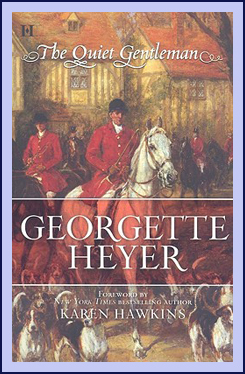
Book Review - Georgette Heyer's The Quiet Gentleman

The Quiet Gentleman by Georgette Heyer
Published by: HQN Books
Publication Date: 1951
Format: Paperback, 352 Pages
Rating: ★★★
To Buy

Gervase Frant had the temerity to survive the Napoleonic Wars. This was a blow to his stepmother and in particular her hopes for his younger half-brother Martin, whom she has reared as if he were going to be the Earl, in spite of primogeniture. To add insult to lack of injury, for a full year after he ascended to be the Earl of St. Erth he wandered around the continent instead of returning to Stanyon to take up his duties. He flippantly claims it was to avoid wearing mourning, but his dandified ways bely the solider he is underneath his perfectly tailored clothes from Weston's. Though one thing is clear, he's going to have an uphill battle with the denizens of Stanyon Castle. He has avoided his "home" as much as he could throughout his life, spending holidays with his maternal grandmother, but now he must face his family and their guests; Mr. Clowne, the chaplain is an unknown quantity, and Miss Morville, a kind neighbor who is acting as companion to Gervase's stepmother, seems to have her head on her shoulders. In fact it's only Theo, his cousin, who has acted as steward for the family, who Gervase is excited to see. Theo is reliable, dependable, and a true friend. There is a tenuous peace that proceeds Gervas's return. A peace that is shattered when he helps out a becoming neighbor, Miss Marianne Bolderwood. Martin only has eyes for her and now Marianne only has eyes for St. Erth. This is not a sustainable situation, and soon things come to a head. As in there are attempts on St. Erth's life. The first attempt could have been imagined, the second could have been written off as an accident waiting to happen, the third attempt was only unsuccessful due to Miss Morville and her swift actions. The attacks are gaining in severity and it is clear that someone wants Gervase dead. But could Martin really be this clever? To get ride of a romantic rival AND ascend to Earl all in one convenient death? Only time will tell, and hopefully Gervase will be around to see how things play out.

The Quiet Gentleman is perhaps the closest to Austen any of Heyer's books I've read this year has come. Though told from a male point of view. In fact I find it rather interesting that all her books that I've read have a masculine viewpoint. That will be something to mull over and look for as I read more of her books. Though my experience with Heyer is she's very hit or miss. I've not found one I love, but I've found some I've loathed, and this one I really like in spite of itself. The Quiet Gentleman has so much going for it but then there's Martin and Marianne. I have major problems with the two of them. Twice Martin forces his attentions on Marianne and both times she comes away shocked and believing Martin's unwanted attention was her fault. A belief that those around her don't contradict and in fact encourage her to just shake off and act normal around Martin. Well, acting normal around Martin led to her being accosted a second time! She was the vicitim. This wasn't her fault AT ALL! I mean, yes, this book was written in the fifties, so victim blaming was at it's height, but dear me it made me angry and uncomfortable. Marianne is a vivacious free spirit and this somehow was her leading Martin on? She was naive, unworldly, and cossetted, how could she expect a man she'd known almost her whole life to just make passionate love to her and force his advances on her? Now it should be made clear he just said things to her that she didn't want to hear and kissed her. But this is still an assault. Especially given the time period. And Marianne blames herself. She blames herself for being a flirt, for being pretty, the light goes out of her and her behavior to everyone changes. She was traumatized and no one really helped her. Yes, there's so much of the book that is just like Austen and is fun matchmaking, but there's this dark underbelly of victim blaming that forever changes a young girl that for the life of me I can not in good conscience fully embrace this book. Especially the denouement which is all about Martin's rehabilitation in the eyes of his cousin. Treat everyone, especially women, with the respect you yourself expect. No exceptions.

Friday, May 6, 2022

Book Review - Lauren Willig's The Temptation of the Night Jasmine

The Temptation of the Night Jasmine by Lauren Willig
Published by: NAL
Publication Date: January 22nd, 2009
Format: Paperback, 464 Pages
Rating: ★★★★★
To Buy

Charlotte has been waiting at Girdings for her knight in shining armor to come, just like those glorious murals on the walls depicting her ancestors bravely battling their foes on long forgotten battlefields or in the books she consumes copiously. She even has her own dragon with her grandmother, the Dowager Duchess of Dovedale. In fact, she's not the only one who would compare her grandmother to a fire-breathing monster, but no one would dare say that to her grandmother's face. Then on Christmas Eve, out of the snow, Robert returns. Fleeing the family home for India all those years ago, the Duke of Dovedale returns like a knight returning from a long crusade in the Holy Land. Charlotte instantly starts picturing her world in that special rose tinted way with a happy ending of hunting unicorns with jam tarts and kissing Robert in the sun, never mind it's bleak midwinter and her grandmother has surrounded her with rogues and dimwits in a final attempt to marry her off. The worst of the lot being Sir Francis Medmenham, descendant of the nefarious founder of the Hellfire Club. But why did Robert return? Is he here to court fair maiden? Or does he have darker designs... He has taken to Medmenham rather fast. The course of true love never ran smooth, especially when misunderstandings abound. If Robert had just talked to Charlotte maybe things would have gone better... Because Robert is out for revenge but he can't let the fair maiden know of his deceit. Breaking her heart for her own good, Robert sinks deeper into Medmenham's world while Charlotte is bustled off to court to wait on the Queen. But following a startling discovery and evidence that the King is going mad once again, Charlotte takes on her own adventure for King and Country. Could it be that Robert's nemesis and the men behind Charlotte's uncovered plot are connected? If only through libraries and boat rides and dark tunnels used for darker purposes Charlotte and Robert could work together and not fret about what ifs, might-have-beens, and almost kisses. Maybe they could save England.

If I were a fictional character who lived in Regency England, there is no doubt in my mind that I'd be Charlotte. During Lauren's Monthly Zoom Read Along I could see in the comments so many of the other bookish Pink fans were declaring how much they were like Charlotte. And I totally believe them. Who else but modern Charlottes would be geeking out over an author holding a monthly Zoom book club for a series that ended years and years ago? Though there is something I would disagree with. Everyone loved reading a book that had a character they so identified with. Me, not so much. See, I read books to escape. I like to read about other people and places, and yes, I get a kick out of it when I see someone who I can relate to, but the problem isn't relating to Charlotte, it is being her. I don't want to read a book about myself. And The Temptation of the Night Jasmine is the closest I've ever come to reading about myself. Now sadly a Robert hasn't shown up and there's a distinct lack of jam tarts at the moment but that is thankfully balanced by the lack of spies and Hellfire Clubs. Whenever I re-read the whole Pink Carnation series this is the book that is always my stumbling block. I just can't get into it because I'm not going away from myself but towards myself, if that makes sense. But at the same time this is a book that for one perfect moment I fell into so deeply I was literally in it. The first time I read The Temptation of the Night Jasmine, fall of 2008 if you're interested in knowing, I went full Thursday Next and fell into it. The scene in the book is right after dinner when Charlotte takes Robert up onto the roof of Girdings. The chill air, the friendly statuary, the kiss. I. WAS. THERE. It was beyond freaky. I usually never see action, even in my dreams, from my point of view, but as an outside observer, but there I was, fully in this book. I expected Robert to ask what I was doing there. Thankfully it didn't get that weird. But all these experiences mean I'm the most ambivalent about The Temptation of the Night Jasmine than any other Pink book... But that doesn't mean for an instant I don't love it. But like the love you have for an Aunt that can sometimes really annoy you. Oh, or the love you have for a dragon of a grandmother?

Friday, April 19, 2019

Book Review - Alison Goodman's Lusus Naturae: A Lord Carlston Story

Lusus Naturae: A Lord Carlston Story by Alison Goodman
Published by: Speak
Publication Date: July 1st, 2016
Format: ebook, 51 Pages
Rating: ★★★★
To Download*

Lord Carlston has returned to England to see if the late Lady Catherine was right about her daughter Helen, that she is a rare direct inheritor of Reclaimer powers. Such an occurrence could mean many things, but in Reclaimer lore it means that a great evil will rise, a Grand Deceiver. This possibility has led Lord Carlston to face the enmity of the ton. He was driven from England three years prior for the murder of his wife, though no body was ever found. His duties have led him to the last place he wants to be on returning to England, part of the clamoring crowd waiting for all the young debutantes to be presented to the Queen and under the gimlet eyes of their mothers. But it affords him the opportunity to catch up with his dear friend and fellow Dark Days Club member Beau Brummel while surreptitiously watching Lady Helen before her debut. While his main purpose attending this event was to meet Lady Helen he cannot ignore the appearance of a Deceiver in their midst. A Deceiver that obviously wants to parlay. The Deceiver, Solanski, promises Lord Carlston information if he will check his mentor, the renowned Reclaimer Benchley, who has been breaking the accord between their kinds, killing Deceivers who are abiding by the rules. Lord Carlston agrees and Solanski confirms that there is a Grand Deceiver... To Lord Carlston it looks like Lady Helen might be their only hope.

What's great about authors writing little stories that fit into their larger series is that they're willing to experiment more with a concept that would otherwise be tossed aside as incompatible with the main books. The "Lady Helen" series by Alison Goodman by it's name alone shows that it follows Lady Helen and is told exclusively from her point of view. There's no switching of characters, no narrative gymnastics, it's all Lady Helen all the time. Therefore this short story is a welcome change of pace. I wouldn't want to see the complete story through the eyes of Lord Carlston, but seeing this one moment, when Lady Helen's and Lord Carlston's paths first cross, it's fascinating, not so much because of Lord Carlston but because we get to see Helen in a different light. Rarely in books do characters sit around and physically describe what they look like. There's usually a passing reference to hair color or height, but it's up to the readers imagination to fill in the rest. Having this short story immediately follow the first book wherein we've already formed a specific view of Helen hearing Lord Carslton's thoughts about her looks and that defiant jaw made me think about her from the outside instead of the inside and somehow this really brought home to me how the other Reclaimers might be worried about this girl being their only hope.

Though this story is also clever in that it helped bridge the one year gap between the first and second books in the series, a time during when details and specifics might become fuzzy in the readers minds. Therefore this story is very neatly done as a reclarification of what the Deceivers AKA the demons of this world are and what exactly the purpose of a Reclaimer is. I say it's neatly done because I really hate when the first few chapters of a book in a series is basically rehashing what we already know and you're just sitting there thinking, are you going to get on with it already? In fact that is how I felt through the entire first episode of the new season of Game of Thrones. The episode was all, hey, remember where we were? And I was all, hey, yes I do, and remember you only have six episode to wrap this all up and you just wasted one of them? Get to the killing already! So thank you Alison for thinking of a nice little alternative to creating reader rage. What's more with the conversation between Lord Carlston and Solanski we not only see that the Deceivers are a little worried about how crazy Benchley has become, I mean, come on, he committed the Ratcliff Highway murders after all, but Solanski definitively states that a Grand Deceiver is here. This is yet another Deceiver warning about what is coming and it fits in so well to know that Lord Carlston knew all along and is therefore more receptive to Lady Helen when she gives him this information, but also why he's willing to help her. I love something I thought I knew shifting every so slightly into a new light!

*This short story is also contained in the paperback edition of The Dark Days Club.

Wednesday, April 10, 2019

Book Review - Zen Cho's The True Queen

The True Queen by Zen Cho
Published by: Ace
Publication Date: March 12th, 2019
Format: Paperback, 384 Pages
Rating: ★★★★
To Buy

Two connected souls wash up on the magical shores of Janda Baik. Sakti speaks Muna's name and Muna knows that it is hers, just as she knows Sakti is her sister. But that is all. Neither girl knows any more. The powerful witch Mak Grenggang takes the girls in unperturbed by the amnesia but willing to help them with their memory when she has free time, which is rare. Sakti shows magical abilities and therefore becomes Mak Grenggang's pupil. Muna doesn't have a bit of magic in her body and therefore helps take care of Mak Grenggang's large household of supernatural beings. It is a simple and quiet life but Sakti is unsettled and mistrustful of Mak Grenggang. She wants to know who she is and why she has forgotten. Everything becomes more urgent when Sakti discovers that she literally has a hole through her body. Parts of her are fading away and she thinks this strongly indicates that she and her sister have been cursed, though Muna isn't convinced the kindly Mak Grenggang is behind it as her sister keeps insisting. They need answers and have heard that the English Raja is hoarding books on magic and therefore sneak to the British Resident's house on the settlement of Malacca where they are soon caught in the act.

Their trespass has severe political ramifications. The British in Malaysia have been waiting for any excuse to go after Mak Grenggang and take control of Janda Baik and Sakti and Muna have given them an excuse. Therefore Sakti and Muna have to be whisked away from the island through the realms of Fairy and into the protection of Mak Grenggang's friend, the Sorceress Royal of England. By Sakti being sponsored as an honored guest and pupil at the Sorceress Royal's school, The Lady Maria Wythe Academy for the Instruction of Females in Practical Thaumaturgy, the English can't justifiably seize Janda Baik. Only as they take the shortcut Mak Grenggang has laid for them through Fairy something horrible happens, Sakti is taken. Only Muna makes it to England and she has to convince the Sorceress Royal and her friend Henrietta Stapleton that she is the magical one and that their first goal is to find her sister. Things can never be that simple though. Fairy can not be accessed from England due to many ongoing issues, the most recent being the Threlfall family losing the Fairy Queen's Virtu, and an all out war with Fairy could come to pass. What is Muna to do when all she wants is her sister? The answer is whatever it takes.

In the first book in this series, Sorcerer to the Crown, we alternated between two characters, the Sorceress Royal, Prunella Gentleman, and her predecessor and now husband (sqweee) Zacharias Wythe. While The True Queen does continue their story they aren't the focus of this book and while at first I was like, I'm not sure I want the story continued in a book that isn't a direct up sequel, I've been completely won over with how Zen Cho has been able to expand her universe while remaining true to it's origins, which has that same snark I love so much from The Magicians. It's not just that we have more locations, from spending time in Janda Baik to seeing other parts of Fairy besides the quick glimpse Zacharias had previously of the court, it's that we see the story through the eyes of so many different characters. The number of POVs in this book has expanded exponentially, so Muna, Sakti, Prunella, Henrietta, Rollo, even a Midsomer, have a little slice of the story! And each character builds the narrative and it's themes, not one of them, even Clarissa Midsomer, taking away from the plot. The constant struggle between desire and duty is explored through more lives and more facets showcasing the importance of family and what sacrifice really means. I couldn't think of a better sequel.

While the character roster is expanding so is our understanding of how magic works in the world Zen Cho has created. I've always liked the idea that magic is science we don't yet understand, and while what we learn here isn't science, it does finally give us an understanding of how magic works in this world. In Sorcerer to the Crown it's clear that magic comes from the Fairy realm as they've put a block on it. Here though we see magic through the eyes of Muna who, while not magical, was taught an entirely different approach to magic in Malaysia. In fact she has many different terms and abilities that the English magicians don't have. She even calls the Queen of the Fairies the Queen of the Djinns. So it makes sense that she would see all magic differently and what she sees is that all magic is actually accomplished by invisible creatures in the air that do the magician's bidding. So all the spells and incantations are just words strung together, sometimes rather rudely, to get these invisible creatures to enact the wishes of the magician. Muna can not believe that this is how magic works! It's wonderful to think that through kindness and flattery anyone can achieve magical feats. The male English magicians who were all rather bombastic in my mind would never deign to believe that being nice can lead to magic and therefore it makes me extremely happy that this is the case.

In fact this whole book is about seeing everything differently. It's about opening up your eyes to the magic that is literally all around us. That love can come in many shapes and sizes and might not be expected or understood, but it is always welcome. This inclusivity prevalent throughout the book made me feel as if the ending was a little flat. Now I'm not going to go and spoil anything for you here, but I will explain a bit around the relationship in question in order to hopefully get my point across, but if you want to be completely ignorant feel free to skip ahead to me talking about dragons, and yes, I talk about dragons! So we have two characters of the same sex who fall desperately in love. You will be shipping them the entire book. Therefore when they don't technically end up together at the end of the book it's kind of heartbreaking. I mean, yes, it's historically accurate, being openly gay during this time in history wasn't exactly the done thing, but at the same time, this is a book about magic and dragons and actual fairies and I kind of was hoping for something more. Not a compromise, not something that will look fine to the outside world, but complete and total happily ever after. Of course seeing as this actually annoyed me so much just goes to show how much I love the characters...

Dragons! See, I told you I'd talk about them. So here's the thing, I never really thought of myself as a big dragon fan. I liked them and all, but then I started noticing things, like how I have a fair amount of stuffed animal dragons and dragon statuary and more than a few books about dragons and Falkor was easily my favorite character in The Neverending Story and then I thought on it and realized, yes, I think I'm a little obsessed with dragons. I mean, I'm not Dragonriders of Porn level obsessed, and thank you forever to whomever wrote the "Home Improvement" episode of The Magicians this season for that joke. But still, it all comes down to the fact that I love me some dragons. Which means I LOVE ME some Rollo Threlfall the familiar of Paget Damerell. The big reveal at the end of Sorcerer to the Crown is that Rollo isn't just a typical Regency buck but is actually a dragon. And therefore his Aunt Georgiana who kind of started the whole narrative going back in book one by asking Rollo to give a speech to some gentlewitches is also actually a dragon. But what I love most is that while they are dragons that doesn't change their underlying characters. Rollo is a Regency buck trapped in a dragon and Aunt Georgiana is the dragon of an aunt you always fear at the local assembly. Regency dragons, is there anything better!?! The answer is no if you were wondering.

But oddly enough it was a small plot point that was the icing on top of the cake for me and that was a hall of talking paintings. Talking paintings are pretty common in books with magic or magical schools, just look to how ubiquitous they are in Harry Potter. Though interestingly enough it's never mentioned how they came to be in Harry Potter, unless it's somewhere on Pottermore and I can't be bothered to slog through that site. I mean Dumbeldore's painting is up like minutes after he's dead, how did they swing that!?! I mean, seriously, how, I NEED to know. Therefore I was more than a little pleased that Zen Cho instead of just having talking paintings that are rude to the students of The Lady Maria Wythe Academy for the Instruction of Females in Practical Thaumaturgy she explains how they are made and why they might be a little rude. Because it's not the personality of the subject that is captured but the personality of the subject as viewed through the eyes of the artist. Oh, as an artist how I loved this. It's like instant revenge for generations on someone who is rude to you! As Mr. Wythe explained: "the paintings have little of their subjects in them - the life that animates them springs from the artist, and the artist's opinions of his subject cannot be taken as a wholly reliable guide to who they were. I am sure the real George Midsomer was much pleasanter than his likeness." Ahem, sure... a "nice" Midsomer. I'll believe it when I see it, maybe in the next book?

Friday, March 16, 2018

Book Review - Elizabeth Hand's Wylding Hall

Wylding Hall by Elizabeth Hand
Published by: Open Road Media Sci-Fi and Fantasy
Publication Date: July 14th, 2015
Format: Kindle, 148 Pages
Rating: ★★★★
To Buy

Julian Blake was a temperamental genius. His manager knew that if Julian stayed in his bedsit in London all summer he'd get no work done and mourn the death of his girlfriend Arianna who committed suicide. So Wylding Hall was let. Julian's British acid-folk band Windhollow Faire would secret themselves in the country for the month of August to work and reconnect. It was a summer that would produce an album named after the grand estate they stayed at that would be under everybody's Christmas Tree that December but would also lead to the disappearance of Julian Blake. A disappearance linked to a white haired girl who mysteriously appeared on the cover of the album whom no one remembered seeing. But then a lot of mysterious things happened that summer. Weird hallways and chambers that went on forever. A library that only two people ever found. A room with hundreds and hundreds of dead birds. A tune in the air that Julian couldn't help humming. And the walks in the woods that the locals warned them never to take. Yet the band and the other people who came in and out of their lives back in that summer in the seventies never compared notes, until now. Now there's a documentary being done about the album, inspired by construction that has unearthed discoveries at the house, and secrets are being revealed. The shape of things is starting to come into focus, but it doesn't seem possible. In the end it comes down to a photo in the local pub, a song Julian unearthed, and a half-naked girl with feathers on her feet.

Sometimes there's a confluence of events that come together just right that elevates an experience to another level. This occurrence started at a joint birthday party where fate decided the next book club selection would be Wylding Hall and ended in an extremely rare consensus that we all liked the book while we dunked fruit into delectable chocolate. But we all agreed, it wasn't just the book, it was something in the air. It's almost as if we were haunted and the book manifested itself for our entertainment. The waning days of summer had set in, mirroring the time frame of the events that happened to the members of Windhollow Faire as August drew to a close and their lease on the hall was up. Despite reality versus fiction and the present versus the past there was this connection that made the book almost real. It's such a short read, a mere 148 pages, and yet I just wanted their summer to be endless and for me to be able to live in this spooky yet somehow homey world. What aided the book so well was the suspension of disbelief was possible through Elizabeth Hand grounding the book in the real world. If she hadn't got the music scene of the time just right nothing else could have fallen into place, and yet she did it. Making this story of the real world yet somehow not quite of it, like the characters had walked through a fairy ring and everything was just slightly distorted. Like when Sergeant Howie ventures to Summerisle in The Wicker Man, the townspeople seem a little off, a little unwilling to talk, and pictures that might illuminate events are quickly hidden away. The balance between believability and the unknown is perfectly struck here.

Yet the way Elizabeth Hand chose to tell the story was an interesting one, yet it did present problems. She goes the route of many a documentary with each of the characters telling their part of the story, therefore capturing that feeling of reality, we've all seen this before. We could be watching a VH1 Behind the Music special about Windhollow Faire after all. Yet given the brevity of the book I had issues with the dramatis personae, it took awhile for their character traits to come through and in the interim I was lost. They were written too similarly and what was odd in my mind, there wasn't a hint of unreliability and their stories all synced up. Maybe I'm just too used to unreliable narrators and Agatha Christie trying to pull one over on me. There was just a sameness to them as Elizabeth Hand quickly cut from one POV to another. It took me quite awhile to realize that Lesley was a female, and seriously, can authors NOT use two too similarly named characters, like Jonathan and Julian? I'm not proud of this but I totally stereotyped the characters to remember who they were, the folklorist, the girlfriend, the dead guy, you get my drift... and not all of them were flattering monikers, just something so I could quickly tell who was who. A really good writer is able to distinguish the different characters enough with their voices that this shortcut of mine wouldn't be a necessity. I felt like it lowered the book. But you could argue that Elizabeth Hand wanted to sew confusion from the start. That she wanted her readers to not get a firm grip on anything. If that was the case? Good on her! See, I'm totally willing to see the other side of things because books are fluid, what the writer intended and what the reader gets could be different, but that doesn't mean both aren't true at the same time.

Though what enchanted me most was the era. Ghost stories just seem to work better when set in a time before technology ran rampant. But I've come to realize that for a ghost story or supernatural spookfest to really catch me there has to be something I connect to. More and more this isn't character driven Victorian stories but more modern pieces set in the not-too-distant past. Like the 70s and 80s. There's a reason why The Conjuring series is doing so well and has so many spinoffs and why so many people have embraced Stranger Things. These are eras that have a distinct look and feel, a time when to get a hold of your friends you had to hope they got your message left with a family member on the one phone in their house or you'd just show up and pray their parents knew where they were. A time when plans couldn't be easily changed. A time when I was innocent and to see that innocence turn malevolent, there's something supercharged about that. Here it's the 70s, and it's perfect. Not just for the distant haze that memory has given me about the decade in which I was born, but because of this insidious supernatural phenomena creeping around the familiar. We have the isolated house, one lone phone, and this kind of golden haze and heat hanging over the events. Therefore when there are clouds or cold, you know something is going to go wrong. There's strange things happening in the house, it's rambling and easy to get lost in. A library that almost no one has found. Yet all of it could be explained away. Everything could be just too much indulgence, until there's proof that this isn't the case. Proof that comes almost at the very end.

Yet that ending is really abrupt. The whole book is kind of a summer idyll interspersed with supernatural phenomena. There's a laziness to it, not in that it's badly written, but in the luxurious pacing. You just want to inhabit the story but then they leave the house, put out the album, and then this interview happens years later... and as for Julian's fate... well, we aren't given anything concrete, we aren't given anything really. That throwaway line about one of the band members maybe seeing him years later doesn't count in my mind. I became invested in these characters lives and I didn't just want the story about THAT summer and their one "hit" album, I wanted to know what came after. How did Lesley become a star? How did Nancy, the girlfriend, end up a professional psychic in Florida? But more importantly, these interviews are all happening not just because of some anniversary for an album that achieved cult status but because there is work being done at the house. Work that uncovers artifacts of archaeological as well as personal interest to our characters. There seems to be a momentum throughout the book that they will all reunite and return to Wylding Hall and yet that never happens. It felt as though right when Elizabeth Hand was about to bring all the different threads together she decided instead she'd finished and just cut the work off prematurely. This is a three-quarters finished story. There is no final act. And THIS was the only bone of contention me and my fellow book clubbers had. Where is the resolution? Where is the final chord?

Because if we are to compare this to a song, they all have a beginning, a middle, and an end. All stories do too. But this one apparently won't. Yes, I have to accept this. I have to concentrate on that which worked so well. What I'm talking about is the purpose of fables and myths and epic songs, all that which goes into folk music. All these tales were told not because they were used as entertainment, but to impart warnings. "These are songs that have been around for hundreds, maybe thousands of years. They existed for centuries before any kind of recording was possible, even before people could write, for god's sake! So the only way those songs lived and got passed on was by singers." These songs were things that needed to be remembered. Things that needed to be known so that danger wasn't stumbled into blindly. While the Brothers Grimm might have gone a little too far with the moralizing, all tales that are passed down are done so with intent. There's a reason the locals get their backs up when these musicians come in asking about what shouldn't be talked of. Though logically IF the locals wanted them to behave perhaps some truth about the village and it's local legends could have warned them off. But that's not the purpose of villagers in these stories, their purpose is to see the strangers blithely walking into danger and keep their mouths shut. The danger that lies in the woods and lures Julian away with the fairies. It's this root of what folk music and folklore is that grounds the entire book in the human experience of tradition. So while it may falter, it still resonates.

Thursday, January 4, 2018

Book Review 2017 #9 - Elizabeth Hand's Wylding Hall

Wylding Hall by Elizabeth Hand
Published by: Open Road Media Sci-Fi and Fantasy
Publication Date: July 14th, 2015
Format: Kindle, 148 Pages
Rating: ★★★★
To Buy

Julian Blake was a temperamental genius. His manager knew that if Julian stayed in his bedsit in London all summer he'd get no work done and mourn the death of his girlfriend Arianna who committed suicide. So Wylding Hall was let. Julian's British acid-folk band Windhollow Faire would secret themselves in the country for the month of August to work and reconnect. It was a summer that would produce an album named after the grand estate they stayed at that would be under everybody's Christmas Tree that December but would also lead to the disappearance of Julian Blake. A disappearance linked to a white haired girl who mysteriously appeared on the cover of the album whom no one remembered seeing. But then a lot of mysterious things happened that summer. Weird hallways and chambers that went on forever. A library that only two people ever found. A room with hundreds and hundreds of dead birds. A tune in the air that Julian couldn't help humming. And the walks in the woods that the locals warned them never to take. Yet the band and the other people who came in and out of their lives back in that summer in the seventies never compared notes, until now. Now there's a documentary being done about the album, inspired by construction that has unearthed discoveries at the house, and secrets are being revealed. The shape of things is starting to come into focus, but it doesn't seem possible. In the end it comes down to a photo in the local pub, a song Julian unearthed, and a half-naked girl with feathers on her feet.

Sometimes there's a confluence of events that come together just right that elevates an experience to another level. This occurrence started at a joint birthday party where fate decided the next book club selection would be Wylding Hall and ended in an extremely rare consensus that we all liked the book while we dunked fruit into delectable chocolate. But we all agreed, it wasn't just the book, it was something in the air. It's almost as if we were haunted and the book manifested itself for our entertainment. The waning days of summer had set in, mirroring the time frame of the events that happened to the members of Windhollow Faire as August drew to a close and their lease on the hall was up. Despite reality versus fiction and the present versus the past there was this connection that made the book almost real. It's such a short read, a mere 148 pages, and yet I just wanted their summer to be endless and for me to be able to live in this spooky yet somehow homey world. What aided the book so well was the suspension of disbelief was possible through Elizabeth Hand grounding the book in the real world. If she hadn't got the music scene of the time just right nothing else could have fallen into place, and yet she did it. Making this story of the real world yet somehow not quite of it, like the characters had walked through a fairy ring and everything was just slightly distorted. Like when Sergeant Howie ventures to Summerisle in The Wicker Man, the townspeople seem a little off, a little unwilling to talk, and pictures that might illuminate events are quickly hidden away. The balance between believability and the unknown is perfectly struck here.

Yet the way Elizabeth Hand chose to tell the story was an interesting one, yet it did present problems. She goes the route of many a documentary with each of the characters telling their part of the story, therefore capturing that feeling of reality, we've all seen this before. We could be watching a VH1 Behind the Music special about Windhollow Faire after all. Yet given the brevity of the book I had issues with the dramatis personae, it took awhile for their character traits to come through and in the interim I was lost. They were written too similarly and what was odd in my mind, there wasn't a hint of unreliability and their stories all synced up. Maybe I'm just too used to unreliable narrators and Agatha Christie trying to pull one over on me. There was just a sameness to them as Elizabeth Hand quickly cut from one POV to another. It took me quite awhile to realize that Lesley was a female, and seriously, can authors NOT use two too similarly named characters, like Jonathan and Julian? I'm not proud of this but I totally stereotyped the characters to remember who they were, the folklorist, the girlfriend, the dead guy, you get my drift... and not all of them were flattering monikers, just something so I could quickly tell who was who. A really good writer is able to distinguish the different characters enough with their voices that this shortcut of mine wouldn't be a necessity. I felt like it lowered the book. But you could argue that Elizabeth Hand wanted to sew confusion from the start. That she wanted her readers to not get a firm grip on anything. If that was the case? Good on her! See, I'm totally willing to see the other side of things because books are fluid, what the writer intended and what the reader gets could be different, but that doesn't mean both aren't true at the same time.

Though what enchanted me most was the era. Ghost stories just seem to work better when set in a time before technology ran rampant. But I've come to realize that for a ghost story or supernatural spookfest to really catch me there has to be something I connect to. More and more this isn't character driven Victorian stories but more modern pieces set in the not-too-distant past. Like the 70s and 80s. There's a reason why The Conjuring series is doing so well and has so many spinoffs and why so many people have embraced Stranger Things. These are eras that have a distinct look and feel, a time when to get a hold of your friends you had to hope they got your message left with a family member on the one phone in their house or you'd just show up and pray their parents knew where they were. A time when plans couldn't be easily changed. A time when I was innocent and to see that innocence turn malevolent, there's something supercharged about that. Here it's the 70s, and it's perfect. Not just for the distant haze that memory has given me about the decade in which I was born, but because of this insidious supernatural phenomena creeping around the familiar. We have the isolated house, one lone phone, and this kind of golden haze and heat hanging over the events. Therefore when there are clouds or cold, you know something is going to go wrong. There's strange things happening in the house, it's rambling and easy to get lost in. A library that almost no one has found. Yet all of it could be explained away. Everything could be just too much indulgence, until there's proof that this isn't the case. Proof that comes almost at the very end.

Yet that ending is really abrupt. The whole book is kind of a summer idyll interspersed with supernatural phenomena. There's a laziness to it, not in that it's badly written, but in the luxurious pacing. You just want to inhabit the story but then they leave the house, put out the album, and then this interview happens years later... and as for Julian's fate... well, we aren't given anything concrete, we aren't given anything really. That throwaway line about one of the band members maybe seeing him years later doesn't count in my mind. I became invested in these characters lives and I didn't just want the story about THAT summer and their one "hit" album, I wanted to know what came after. How did Lesley become a star? How did Nancy, the girlfriend, end up a professional psychic in Florida? But more importantly, these interviews are all happening not just because of some anniversary for an album that achieved cult status but because there is work being done at the house. Work that uncovers artifacts of archaeological as well as personal interest to our characters. There seems to be a momentum throughout the book that they will all reunite and return to Wylding Hall and yet that never happens. It felt as though right when Elizabeth Hand was about to bring all the different threads together she decided instead she'd finished and just cut the work off prematurely. This is a three-quarters finished story. There is no final act. And THIS was the only bone of contention me and my fellow book clubbers had. Where is the resolution? Where is the final chord?

Because if we are to compare this to a song, they all have a beginning, a middle, and an end. All stories do too. But this one apparently won't. Yes, I have to accept this. I have to concentrate on that which worked so well. What I'm talking about is the purpose of fables and myths and epic songs, all that which goes into folk music. All these tales were told not because they were used as entertainment, but to impart warnings. "These are songs that have been around for hundreds, maybe thousands of years. They existed for centuries before any kind of recording was possible, even before people could write, for god's sake! So the only way those songs lived and got passed on was by singers." These songs were things that needed to be remembered. Things that needed to be known so that danger wasn't stumbled into blindly. While the Brothers Grimm might have gone a little too far with the moralizing, all tales that are passed down are done so with intent. There's a reason the locals get their backs up when these musicians come in asking about what shouldn't be talked of. Though logically IF the locals wanted them to behave perhaps some truth about the village and it's local legends could have warned them off. But that's not the purpose of villagers in these stories, their purpose is to see the strangers blithely walking into danger and keep their mouths shut. The danger that lies in the woods and lures Julian away with the fairies. It's this root of what folk music and folklore is that grounds the entire book in the human experience of tradition. So while it may falter, it still resonates.

Friday, March 10, 2017

Book Review - Arthur Phillips's Angelica

Angelica by Arthur Phillips
Published by: Penguin Books
Publication Date: April 3rd, 2007
Format: Paperback, 331 Pages
Rating: ★
To Buy (different edition than one reviewed)

The Barton household is about to be violently upset. Whether it's of a supernatural nature or a more prosaic nature is dependent on who you are listening to. The simple facts are these. Constance Barton and her husband Joseph had a hard time having a child. Two painful miscarriages and finally Angelica was born. In an attempt to thwart her husband's sexual advantages Angelica has been living in their bedroom for four years. Constance couldn't handle more disappointments and Angelica is enough for her. Angelica is her everything. But things are changing and Joseph finally imposes his will, which is a rare occurrence, and Angelica is removed to her nursery and the master bedroom is once more home to the martial bed. That is when the trouble starts. Constance views it as a haunting. There are smells and spectres and while Joseph points out that it could all be due to her high strung nature, she is convinced something more is at play; and is Angelica playing along? Could the child actually be scared or is she feeding off her mother's emotions? When Joseph claims his martial rights with Constance the spectre takes on physical form and something must be done. The maid Nora has heard of a spiritualist who specializes in cleansing houses, Anne Montague, a failed actress who is supplementing her income via overwrought housewives. But Anne sees something in the Barton household to change her mind about her "calling" and helps Constance. As for Joseph, he is easily taken care of... and as for Angelica? It turns out this is her story in more ways than one.    

If you're looking for a book strewn with contradictory stories and lack of resolution, than this here is the book for you! If instead you're looking for a psychological thriller that has supernatural elements, then I'd suggest you walk away. Or at the very least only read Constance's viewpoint, because the only thing going for this book was, aside from Phillips's ability to capture the language of the time period heavily reminiscent of Lewis Carroll, the first section with it's paranormal activities. Because this book isn't about the supernatural it's about unreliable narrators and the fallibility of memory and how each and every person sees the world differently. Which is all fine and good, it's just not the book I thought I was signing up to read and therefore I was a very dissatisfied reader. But more on my complete dissatisfaction later, with spoilers aplenty, so you've been warned. The problem with having four distinct perspectives is that they will never agree, add to this that Angelica is technically the vehicle for the other three narrators, and it's a jumbled mess. Yes, it's interesting to see the different interpretations of the same events, but overall it needed some grounding. There needed to be some character that you could connect to over the others, someone needed to be a little more believable so that you could take that away as what you believe is the truth. Instead, by not having this element the inconclusive ending makes for dissatisfied reading.

Seeing the story in order from the POVs of Constance, Anne, Joseph, and finally Angelica, who we've really been hearing from all along because this is her therapy session, Phillips seemed to want to discount the previous POV. Yes, everyone sees the world in their own unique way, but he seems determined to lessen the book in each section by paving over what came before and making it unbelievable. Therefore instead of being able to pick apart the POVs and find some thread of truth, we have each subsequent narrator totally disproving what came before. With Constance it's a ghost, but then Anne comes along and it's not a ghost it's sexual abuse, though she still lets Constance think it's a ghost. Then along comes Joseph and it's not sexual abuse it's that women be crazy yo. As for Angelica... she confirms nor denies any of these stories. So all is plausible. Say what!?! All is true and nothing is true? I know you can mimic the writing of Carroll, but please, no. Phillips you are no Carroll when it comes to nonsense and riddles. Unreliable narrators are really popular at the moment from Gone Girl to The Girl on the Train, heck this book technically has the ever popular "girl" in the title with Angelica's name, but these books succeed, and I really can't believe I'm saying there's something successful in Gone Girl, but they succeed because you get closure, not some supposedly deep yet ultimately aggravating non-ending.   

But then again, this is a book that basically writes itself off in the end. In fact, rarely have I hated a book so much in it's last few sentences that I grew to despise it and wanted to throw it more than anything."Flames, on the side of my face, breathing-breathl- heaving breaths. Heaving breaths... Heathing..." So let's break down that ending. At the conclusion of the book Angelica, the gimmicky narrator/manipulative bitch we've been hearing from tells her therapist to just ignore everything she's said, he will never understand her and he should just bring on the next "pretty hysteric." Now I've had long talks with one of my friends over this abrupt ending, seeing as we read this book for book club. Her conclusion, in as simplified a manner as I can make it, is that Angelica realizes that the therapist will never understand her, a complex modern woman, and the slight is to the therapist. Whereas I think it's the exact opposite. I think it's the author not bothering to understand women but just flipping them off at the end. They're women, they aren't worth figuring out because this wasn't Angelica's story it was Joseph's story all along. And why do I think this? Because Phillips, while writing so much about women here can't help that he is a male and as evidenced strongly in Joseph's section all his sympathies are with the male of the species so he's just writing from his entitled white male POV. Yeah, so let's throw this book out a window shall we?  

Going back to Joseph's section, not only does it discount everything that Constance and Anne have said, it makes Joseph this tragic figure who isn't understood at work or at home and he just has no friends and blah blah blah blah. I'm sorry your wife doesn't want to sleep with you, could it be because there is no birth control and she doesn't want to almost die having a stillborn child again? Every aspect of Constance's life is put under the microscope, every thing she does, says, feels, is up for debate, whereas Joseph, well, it's just poor Joseph don't pick on him, he's having a bad day, so let's let him be. Why not scrutinize Joseph? Put him under the harsh lights he uses in experimenting on animals, a job that is noble and not at all amoral! The true theme of this book isn't about memory and differing POVs, in Joseph's section we see Phillips's true motive, everything comes down to "poor men." Because obviously, like the recent Portlandia sketch, men have been pushed aside and marginalized too long. All women want from them is to trick them into marriage so they can have babies. Yeah, that's right. This very modern and topical view that women are out there to trick men into baby making is thrust into this Victorian period piece. I just kept thinking, yes, things are cyclical and men could have felt that way then, but more I kept thinking, is the author's girlfriend trying to get him to put a ring on it and a bun in the oven?

So as you can imagine by this point, I'd sworn off the book. Whatever good had happened with Constance and Anne, all was washed away by the modern hypocrisy just screaming at me from these pages that made up Joseph's section. Was there hope that Angelica could redeem the book? As you've read already. No. There wasn't. In fact Angelica's section is so slight it barely deserves a mention, except for one point; Constance and Anne hooking up. This is an issue I have with many male authors, they think that women will just randomly be lesbians if it suits the needs of the men. George R. R. Martin might be the worst, but can't they get that people are born who they are and that's that? You can see why Constance and Anne might be drawn to each other, Constance hasn't fared well at the hands of men, especially in regard to reproduction, and Anne is a wonderful protector and provider. But like the male entitlement that just oozed off the pages earlier, this just seems to be another nail in the coffin of women as manipulators. They got the child they wanted, killed Joseph, and now can live happily ever after. Or you could look at it as Constance doesn't like Joseph or his attentions so therefore she must be gay. In other words, everything in this book is seen through male entitlement glasses, I wouldn't say they're rose colored, they're more shit colored, because what makes you think that it's OK to think like this? Women are people too. I know many men are trying to change this, and reading a book that thinks that way... it just enrages me.

Wednesday, August 24, 2016

Book Review - Leigh Bardugo's Six of Crows

Six of Crows by Leigh Bardugo
Published by: Henry Holt and Co.
Publication Date: September 29th, 2015
Format: Hardcover, 480 Pages
Rating: ★★★
To Buy

What if Grisha could be more powerful? Not to just have their powers amplified but to have them changed. Magnified to a degree that the world itself changes before their eyes and anything is possible. Of course, such a discovery would be desired by the wealthy and the powerful, and especially the military. Bo Yul-Bayur is a chemist who accidentally created Jurda Parem from the common stimulant Jurda. While fatal to Non-Grisha, to Grisha it does all this and more, including making the user an addict after one dose. Afraid of what he has created he attempts to seek asylum in Kerch but is captured by the Drüskelle and taken to the Fjerdan capital of Djerholm and imprisoned in the impenetrable Ice Court. Who knows what the Fjerdan's will do with this technology, seeing as they have been carrying out pogroms on the Grisha "Witches" for as long as anyone can remember. This is where Kaz Brekker comes in. Kaz is the lieutenant of The Dregs and is known as the man who gets things done. So when Mr. Jan Van Eck needs someone to break Bo Yul-Bayur out of the Ice Court he turns to Kaz with the offer of a lifetime. The score from this impossible heist could set him and his crew up for the rest of their lives.
Kaz recruits Inej, the "wraith", Jesper, a born sharpshooter, Wylan, for his demolition skills and the fact that if need be he is Van Eck's son and could be used as a hostage, and Nina, because she's a Grisha who is a Ravkan Heartrender. But more importantly, Nina has a connection to someone who intimately knows Kerch and the Ice Court, former Drüskelle Matthias Helvar. Matthias is in prison because of something Nina said and she's been trying to make it up to him ever since, and breaking him out of prison for a big payday should make them even. Of course their master plan involves sending themselves to prison in Kerch, but at least it will be a change of scene from Hellgate. The improbability and complexity of their plan could go wrong at a million different places, yet it doesn't take them long to be enjoying the hospitality of the Ice Court's prison. This band of thieves will do whatever it takes to get their payday, and whatever obstacles, even those of their own making, must be overcome. They are all good at thinking on their feet, they wouldn't have survived in Ketterdam with all the rival gangs and dangerous alleys if they weren't. But is the payout really worth the risks? And when all is said and done, will they get that payout?
When I finished the Grisha Trilogy I was bereft. I had come to know and love these characters so deeply that I just didn't want to let go. But I could also see that their story was told. It was over and that was that. The light at the end of the tunnel was that Leigh Bardugo was working on a new duology set in the Grishaverse called The Dregs. Eventually retitled Six of Crows with the most amazing cover art I'd seen in recent years I couldn't wait until this book was released and was giving anyone I knew who was lucky enough to get an ARC the side-eye for weeks. OK, months, but you get it, I know you do. I wanted to be back in that world. I didn't care if it was a new country or a new cast of characters, I just wanted more of this wondrous land. And yet, when the time came, I just wasn't swept away. I think of all my book blogging and reading buddies I was the only one who didn't hail it as the best book of last year. In fact, it was nowhere near my top ten. There's even a part of me, looking back, that wonders if three stars was generous. The worldbuilding was still there, and still perfect. Yes it's a little darker, but the void of The Darkling needed to be filled somehow. Yet I just couldn't connect. This heist I had been waiting so long for suddenly didn't seem worth the wait.

The initial problem I faced was there were too many characters given to us too soon. We have six main characters and all their baggage to deal with while certain elements of their backstories are drawn out to excruciating levels with us not finding out answers until the last few pages. To keep this in perspective, A Game of Thrones, the first book in George R. R. Martin's A Song of Ice and Fire, has only eight narrators in a behemoth book of teeny tiny print; and we're barely scratching the surface in that book. To expect THIS book to do more with less seems ludicrous. Also confusing. I need a little time to sink into the narrative of a book, have one character lead me into the world and acclimatise me to the environment before being smacked in the face with the whole gang. There's a reason Ocean's Eleven starts with just Danny Ocean and slowly introduces new characters in little vignettes before having the whole crew together. I think for a book SO like Ocean's Eleven: Ketterdam perhaps the basic framework of a heist film or book could have been better utilized. Instead of starting with the small heist at The Exchange start even smaller and then go bigger.

Yet for a book with six main characters I found one thing very very odd. The exclusion of Wylan Van Eck as a narrator. Six characters but only five POVs!?! That just doesn't add up. I mean yes, there are initially too many characters in this book until you finally get to know them, but then why eliminate a certain one? Why was Wylan left out? Yes, part of it could have been to do with the end twist, but, well, just don't have his POV near the end. Because eliminating him entirely versus just eliminating him for a section makes more sense. There's an imbalance in the book created by this omission. It seriously doesn't make sense to me that we never get Wylan's POV. Especially with his connection to the man who hired Kaz and the crew you'd think Wylan's input would be vital, but instead it's left to other characters to tell Wylan's story. Then there's the whole insulting aspect to this. Wylan is dyslectic and can't read or write. To not have his voice heard when he can't write his own story, WTH! It's just adding insult to injury. I can only hope that Wylan has a say in Crooked Kingdom, but I'm not really keeping my fingers crossed. Kaz's nemesis got a POV at the end of this book and still, no Wylan.

My main problem with the book though was the "problem" with the women. Some people might be saying, how can you have a problem with Inej and Nina when they kick ass and take names? My problem is rooted in the fact that once you look past all their strength their character arcs are oddly stereotypical. At times I thought I was having some sort of out of body experience where this book wasn't written by the writer of the Grisha series populated with strong women and a kick ass female in her own right, but a man who just wrote the typical subjugation line of women in science fiction and fantasy as sex objects and bargaining chips. Inej and Nina spend the entire book showing they are more than what Ketterdam tried to make them in the brothels. They are strong and fierce warriors with love in their hearts. And then all of a sudden they're dressing up as whores to sneak into the Ice Court and ending up as prisoners that only the big brave men can rescue. Excuse me? So all their growth, all their development was for naught? Because they just ended up back at the beginning, victims that need saving? This isn't a just fate for them. This is a cliched, hackneyed fate. They deserve better. I deserve better as a reader!

Though in the end I think the biggest letdown is that Six of Crows just shows us the futility of it all. From the very beginning Kaz's crew are given this impossible task, one at which they could fail at any second, but deep down you know they are going to succeed. But in succeeding they fail. And somehow I knew this. I just knew that they'd make it to the end and yet they'd fail. I don't know if it's all the heist movies I've watched over the years, but somehow I knew it would be like that bus dangling over the precipice at the end of The Italian Job, all that work wouldn't really be worth it in the end. We were left hanging, waiting for the second book. And yes, I'm going to read Crooked Kingdom, but I don't have the excitement anymore. I have a determined resignation. I have no hopes for this book, well, minor hopes that I have a feeling will be quashed quite quickly. Six of Crows was a disservice to the readers. We read a book whose narrative didn't matter. It was nulled and voided at the end and makes you wonder, why then did I bother to read it? Yes, we got to know these characters and to care for them, but it took a long time for that to happen and then it was like everything that had been built between the reader and the story was washed away. I also know that my voice is one small voice among the countless that are lauding this book. Yes, this is just my opinion, but I think a valid one. Leigh Bardugo created a world that I love and then diminished it.

Older Posts Home