Showing posts with label Apocalypse. Show all posts

Friday, December 6, 2024

The Umbrella Academy

Of all the shows my friends and I have watched on our Thursday Night Teleparties since the pandemic started The Umbrella Academy is easily my favorite. Each week I'd patiently wait for the next episode, and let me tell you, there's something about spending that prolonged time with them that makes the show hit so differently than if you binge it. They became my family, a wonderfully fucked up family of ex-childhood superheroes and their continued efforts to thwart the apocalypse that just seems to follow them wherever and whenever they go. The dark humor, the dancing, I was in love with all of it. Until the end. And let's acknowledge upfront, there was no way that the seven Hargreeves siblings and Lila were going to get a happy ending. This isn't the world that they live in. Time and time again they clawed their way to some sort of happiness only to have it brutally taken away. Their deaths were a given. I mean for most of the show one of them actually was dead. So I'm not arguing that ending, I'm arguing how they got there. And I probably should have said spoiler alert, they all die... Now I'm in no way blaming the actors and their spectacular work, it's the writers who let them down. In fact, the ending of season three, with the universe being rebooted would have been a preferable ending to this, whatever this was. Because it seemed like the writers weren't serving the characters, they were serving themselves. They had all these little ideas they'd been kicking around for years and decided to shoehorn them into the overall arc at the expense of the greater story. Why else would we have Klaus wasted on a storyline where he gets pimped out and has a ghost possess him to have sex with his ex? A job he does just to get the drugs. Oh, and he's also buried alive and rescued by a ghost dog, but again, how does this serve the overall story? It doesn't. Nor does Luther being a stripper or Diego working at the CIA or finally having Lila and Five be together. This season started strong because the family was together. But as soon as they separated them they started chipping away at what makes this show work. Their bickering and their badass skills are what brings them together. Also, they weren't paying attention to their own rules. Marigold, AKA what made them them, was a name Harlan gave to his powers. IT WAS NOT THE UNIVERSAL TERM! It was Harlan's term! But then again, they end with a big old plothole; a grandfather paradox. If the Hargreeves don't exist how do their children? It breaks the rules! I just wanted Five to pop in after the credits and be like, actually... This isn't how it happened. At this point you're thinking, damn, she hated this season, why did she rate it in her top ten adaptations of the year? Because I love me my Hargreeves. That's why. This might have ended on a whimper instead of a bang, though the end did kind of start with a bang, Ben and Jennifer sex joke! But it's still one of the best shows out there. It was clever, it was unique, and I want more. I'd be willing to totally forget this season ever happened in fact... But this season did give us something. Closure on why Luther was on the moon and Ben's death. We actually learned how Ben died, and it was way more brutal than you could ever have imagined. And then he died again with the worst CGI I've ever seen that is some horrific tribute to Junji Ito and Kaju. Though I'll let that go. I'll let it all go. So what if I had no emotional connection to this Ben. I at least got to see Megan Mullally and Nick Offerman get down to Cher. Something I imagine is a typical Saturday night for them.

Wednesday, April 24, 2024

Book Review - Andy Weir's Project Hail Mary

Project Hail Mary by Andy Weir 
Published by: Ballantine Books
Publication Date: May 4th, 2021
Format: Hardcover, 496 Pages
Rating: ★★★★
To Buy

Ryland Grace is on a suicide mission. He has been sent to the far reaches of space to find a solution to the Petrova Problem, a single-celled extraterrestrial life form named Astrophage that is feeding off the sun. The Astrophage is killing the sun and that will result in the death of all life on Earth. The Earth's only hope is the distant star Tau Ceti. Despite living amongst a cluster of infected stars it somehow is unaffected by the Astrophage. If Ryland can find out why Tau Ceti is unaffected then perhaps there is a hope for Earth. He and two other scientists have been sent on this one way mission and are Earth's only hope, they are a Hail Mary. The problem is when he awakes from the voyage he is suffering from amnesia and his two crewmates are dead, nothing but desiccated husks. He has no idea who he is, where he is, or what he's supposed to be doing. His memory slowly starts to return but he can't quite reconcile that he somehow went from being a teacher to being an astronaut who still doesn't remember his own name. Before Ryland became a teacher he wrote a research paper about extraterrestrial life that could exist without water. He was laughed out of academia and yet that is exactly what Astrophage is. Before he knows what's happening he's one of the top people in the Petrova Taskforce. And yet this remembered information isn't going to help him when his ship is barreling towards an unknown sun. He is barely able to keep himself alive so how is he supposed to save humanity? The plus side, he's remembered his name. And he might have just discovered intelligent alien life! Because there's another ship out there. Another ship with only one survivor. Another ship that was sent to save it's planet because it too is at the mercy of Astropphage. Maybe together they can save two worlds and make their deaths mean something?

Aside from the amnesia, this has a fairly similar setup to The Martian; man, alone, stuck in space with no way home. So I figured it would go along similar lines. Man would, through his ingenuity, find out how to survive his situation. There might be potatoes. And then it didn't because aliens. That's right folks, Andy Weir wrote about freakin' aliens and I loved it! Yes, he occasionally falls into the trap of being almost too technical with his science, which he somehow avoided in The Martian, and here I would zone out for a minute or two, but then Rocky. Every flaw this book has, and there aren't many, are solved by, but then Rocky. I don't know if I've ever felt such genuine love for a character in my entire life. I realize that some people actually love E.T. for inexplicable reasons, but if they felt for that extraterrestrial what I feel for Rocky, I can kind of understand. I mean just the feeling, in no way can I understand you and your unholy love of that Spielberg monstrosity. My love for Rocky was pure, I wanted to take care of him and make sure nothing bad ever happened to him. Rocky has this childlike wonder, this enthusiasm for life, an insatiable yearning to understand. He balances the more dour and pragmatic Ryland and spurs him on. The two of them become a dynamic duo. They show that problem solving works so much better with two than one. I honestly don't know what this book would have been without Rocky. He is so integral to everything. Not just the plot, but the whole feeling of the book. Oddly enough I think this book hits even stronger because it was released during the Pandemic. Earth is fucked and somewhere, out there, is a friend who can help. Someone who completes you. Someone you never expected. Rocky's optimism and ingenuity is the can-do attitude that every single one of us needed mainlined into out veins after such a long struggle. We all needed Rocky and thank the powers that be that Andy Weir gave him to us.

Friday, August 18, 2023

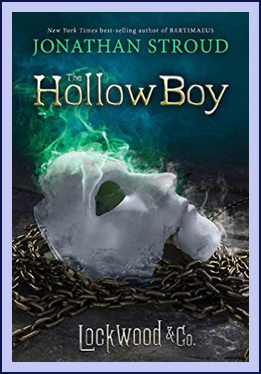
Book Review - Jonathan Stroud's The Hollow Boy

The Hollow Boy by Jonathan Stroud
Published by: Little, Brown Books for Young Readers
Publication Date: September 15th, 2015
Format: Paperback, 385 Pages
Rating: ★★★★
To Buy

London is under siege. The Chelsea district is having a massive outbreak of hauntings. Every agency is being called in to help. Every agency but Lockwood and Co. Which gets under Lockwood's skin. But it's not like he has any spare time to complain at length. Every case that isn't a part of the Chelsea outbreak is falling to him, Lucy, and George, and they are overbooked. 35 Portland Row looks like a bomb has gone off. They haven't done laundry or dishes in weeks. Which makes it the perfect time for Lucy to get away. A few days off with her family will set her up nicely, plus the team is working better than ever before since Lockwood has let her and George more into his life and it's not like a few days off will change everything. Instead her family get on her nerves and when she returns early to Portland Row there's someone at her desk. Someone with perfect hair whom the boys are fawning over. This is Lucy's first impression of Holly Munro, Lockwood and Co.'s new assistant. Lucy is incensed. Sure the house is spotless, sure Lockwood had casually mentioned in passing hiring someone to clean up the place, but not Holly, not now. A few days off did change everything. Now Lockwood is letting Holly come on cases when she was supposed to stay back at Portland Row. Sure Holly's been able to introduce them to a new level of clientele because of her previous job at the Rotwell Agency, but Mrs. Wintergarden would have eventually come to Lockwood and Co. Probably. And while they take care of that haunting Lucy's obsession of attempting to communicate with spirits almost ends tragically. Lockwood is injured and it's all her fault. Her and her stupid Skull. But the case has given them the recognition they want, they are invited to investigate the Chelsea outbreak and to be a part of the big "Take Back the Night!" parade the Fittes and Rotwell agencies are putting on to boost morale. Which works exactly the opposite as they had intended. But through all the chaos one thing is always true, and that's George's ability to do better research than anyone and his research might have come up trumps.

This series is always a bit two steps forward one step back. There's a gangbuster plot, everything is on track, you think, this time, this time it's will be perfection, and then there's a treatise on George being chunky and Lucy unfavorably comparing herself to Holly. I mean the body shaming was the worst it's been yet in this volume and I can't help but think that these books are for younger readers and what message does that send to them? To me, being older and wiser, it just infuriates me, but if I had read this over and over when I was younger, it would have further fed into my body issues. Oh, and let's not forget the other stupid female stereotype this book feeds, let's throw in a female rivalry. Yes, I know it's stupid of the boys, Lockwood in particular, to bring in someone who would upset Lucy when as an agent calm is what is needed, but did Lucy and Holly really have to be rivals? Yes, they'll work everything out in the long run, blah, blah, but the enemy of a female shouldn't naturally be another female, just as a female shouldn't be forced into certain ideas of what their body should and shouldn't be. And while the body shaming is less present than the rivalry, which is a big plot point, it was an unnecessary plot point. There's this amazing apocalypse within an a apocalypse and we're going to focus on fat!?! OK, that makes absolutely zero sense. Also, I now find myself wondering what is the plural of apocalypse. Apocalypses? That seems lazy. But I love that the Problem is a slow burn end of days apocalypse while the Chelsea outbreak is an immediate apocalypse, like global warming versus the fall of democracy, both need to be taken care of but fixing one can help fix the other. Which brings me to something I found very interesting, this book was written in 2015 and yet it felt so very relevant. Life is horrible, here let us distract you with a parade. Which is then set upon by protesters. And those protesters, they really struck be forcibly. It felt like it was perfectly mirroring our world. But maybe the end days have a blueprint I never knew about?

Thursday, January 5, 2023

Book Review 2022 #9 - Jonathan Stroud's The Hollow Boy

The Hollow Boy by Jonathan Stroud
Published by: Little, Brown Books for Young Readers
Publication Date: September 15th, 2015
Format: Paperback, 385 Pages
Rating: ★★★★
To Buy

London is under siege. The Chelsea district is having a massive outbreak of hauntings. Every agency is being called in to help. Every agency but Lockwood and Co. Which gets under Lockwood's skin. But it's not like he has any spare time to complain at length. Every case that isn't a part of the Chelsea outbreak is falling to him, Lucy, and George, and they are overbooked. 35 Portland Row looks like a bomb has gone off. They haven't done laundry or dishes in weeks. Which makes it the perfect time for Lucy to get away. A few days off with her family will set her up nicely, plus the team is working better than ever before since Lockwood has let her and George more into his life and it's not like a few days off will change everything. Instead her family get on her nerves and when she returns early to Portland Row there's someone at her desk. Someone with perfect hair whom the boys are fawning over. This is Lucy's first impression of Holly Munro, Lockwood and Co.'s new assistant. Lucy is incensed. Sure the house is spotless, sure Lockwood had casually mentioned in passing hiring someone to clean up the place, but not Holly, not now. A few days off did change everything. Now Lockwood is letting Holly come on cases when she was supposed to stay back at Portland Row. Sure Holly's been able to introduce them to a new level of clientele because of her previous job at the Rotwell Agency, but Mrs. Wintergarden would have eventually come to Lockwood and Co. Probably. And while they take care of that haunting Lucy's obsession of attempting to communicate with spirits almost ends tragically. Lockwood is injured and it's all her fault. Her and her stupid Skull. But the case has given them the recognition they want, they are invited to investigate the Chelsea outbreak and to be a part of the big "Take Back the Night!" parade the Fittes and Rotwell agencies are putting on to boost morale. Which works exactly the opposite as they had intended. But through all the chaos one thing is always true, and that's George's ability to do better research than anyone and his research might have come up trumps.

This series is always a bit two steps forward one step back. There's a gangbuster plot, everything is on track, you think, this time, this time it's will be perfection, and then there's a treatise on George being chunky and Lucy unfavorably comparing herself to Holly. I mean the body shaming was the worst it's been yet in this volume and I can't help but think that these books are for younger readers and what message does that send to them? To me, being older and wiser, it just infuriates me, but if I had read this over and over when I was younger, it would have further fed into my body issues. Oh, and let's not forget the other stupid female stereotype this book feeds, let's throw in a female rivalry. Yes, I know it's stupid of the boys, Lockwood in particular, to bring in someone who would upset Lucy when as an agent calm is what is needed, but did Lucy and Holly really have to be rivals? Yes, they'll work everything out in the long run, blah, blah, but the enemy of a female shouldn't naturally be another female, just as a female shouldn't be forced into certain ideas of what their body should and shouldn't be. And while the body shaming is less present than the rivalry, which is a big plot point, it was an unnecessary plot point. There's this amazing apocalypse within an a apocalypse and we're going to focus on fat!?! OK, that makes absolutely zero sense. Also, I now find myself wondering what is the plural of apocalypse. Apocalypses? That seems lazy. But I love that the Problem is a slow burn end of days apocalypse while the Chelsea outbreak is an immediate apocalypse, like global warming versus the fall of democracy, both need to be taken care of but fixing one can help fix the other. Which brings me to something I found very interesting, this book was written in 2015 and yet it felt so very relevant. Life is horrible, here let us distract you with a parade. Which is then set upon by protesters. And those protesters, they really struck be forcibly. It felt like it was perfectly mirroring our world. But maybe the end days have a blueprint I never knew about?

Friday, December 16, 2016

Movie Review - The Birds

The Birds
Based on the short story by Daphne Du Maurier
Starring: Tippie Hedren, Rod Taylor, Jessica Tandy, Veronica Cartwright, Suzanne Pleshette
Release Date: March 28th, 1963
Rating: ★★★★
To Buy

Melanie Daniels is picking up a mynah bird for her aunt when she meets Mitch Brenner. As is the nature of this young socialite who is inclined to play practical jokes, the mynah bird having been chosen to repeat certain four letter words, she pretends to be a sales associate willing to help Mitch in his search for two love birds for his little sister's birthday. Of course, it's really Mitch who's playing the joke on Melanie, knowing full well about this girl who likes to play in Italian fountains naked. Melanie, chagrined, decides to one-up Mr. Brenner and shows up later at his home with the love birds only to find he's headed to Bodega Bay to spend the weekend with his family. Never one to be deterred Melanie heads up there to deliver the birds in the most convoluted and confounding manner. Instead of simply driving up to his house she rents a boat to sneak up on his dock and therefore leave the birds as a surprise.

Melanie gets the result she was hoping for, Mitch races back to town to meet her... too bad she's attacked by a bird on the way back, marring her triumphant approach and perfect hairdo. That night she is invited to dinner at the Brenners, where she gets to meet Cathy, the birthday girl, and Mitch's mother, Lydia. After a persistent Cathy insists that Melanie stay for her party the next day Melanie stays with an ex of Mitch's and Cathy's teacher, Annie. That night after dinner with Mitch and his family a bird kills itself against Annie's door. The next day at Cathy's party birds come out of nowhere to harm the children. The attacks become more and more fierce, the death toll rising. The Brenners and Melanie eventually take refuge in a house boarded shut mourning the death of Annie and countless others. As night falls there is no end in sight of these ever vicious, ever increasing attacks that come in waves. As dawn breaks we are left with a minor victory, they survived the night. But how much longer will they live?

The irony of The Birds is that you can see that Daphne Du Maurier would have loved the movie if it hadn't been her own story twisted out of shape and stripped of all subtext. She loved the conventional being destroyed by the unexpected, be it a midget mistaken for a child or a lovely usherette killing RAF officers as a calling. Therefore a meet cute that goes apocalyptic starting with an unexpected braining by a bird in Bodega Bay, yes, this is right up her alley. Only it's not what she had written. The Birds is perhaps the movie by Hitchcock, more than any other, that could be labeled a summer blockbuster, even if this was before JAWS set the standard. That is the problem. Hitchcock wanted to make an apocalyptic blockbuster out of a story of subtlety and nuance. Of course by this third outing with Hitchcock Du Maurier should have known what she was in for. A story about one family's attempt at survival against the onslaught of birds was turned into a romantic comedy with a chance meeting that soon spirals into death, death, and more death, with a side of a man on fire. A world of feathers and blood. Where what you see is what you get.

I can't help but feel sorry for Du Maurier. Sitting, watching this film, you can see how Hitchcock's mind was working when he read and then cannibalized her story. There's the lone telephone booth taken off a Cornish Moor and the school bus that brings our hero's daughter home for school, which lead to Hitchcock thinking; how about an attack IN the telephone booth, and what good is a school bus full of children when you can put a whole school in jeopardy with no bus to protect them? Yes, you can see the genius of Hitchcock at work because these are images forever shared in our zeitgeist. But how must Du Maurier have felt? Betrayed? Again? No wonder people think her story "The Birds" is just about the apocalypse without any deeper meanings, because her story was eclipsed by the iconic images of Hitchcock. Yet it's a DAMN fine and original take on the end of days. Sure it's stripped down and went for shock value, but can you think of a Hitchcock film this memorable and bleak? This is just pure horror. Hitchcock had wanted to end this movie with a shot of the Golden Gate Bridge covered in birds... interesting thought, birds bringing about the end of days, no matter who's the storyteller.

The Birds also broke with convention. Movies have scores, it's a fact of life, they give out an Oscar for it. Heck even all television you watch is scored, some more professionally and competently than others, but we expect melody to underscore our acting. Hence when this doesn't happen, like in the Buffy the Vampire Slayer episode where Buffy's mom dies it stands out as original and is lauded. Now I don't know if Hitchcock was the first to do this stunt, but it still packs a wallop to this day. Seriously, it was gutsy to make this movie with no soundtrack other than practical sounds. Yes, it goes in the exact opposite direction that Du Maurier had pictured with the ominous silent attacks. But having the attacks drown out the very voices of the actors leads to another kind of horror. A cacophonous nature versus a silent one. Aside from the shower scene in Psycho, the scene where Melanie waits outside the school for young Cathy while the birds slowly multiple on the jungle gym is one of the most ominous and scary in film history. The reason why it works so well is the counterbalance of the quietly massing birds with the children's innocent singing. This signing is the only music you'll get. This adds to the realism and also shows that birds turning against us is scary enough with their piercing cries that they don't need a Bernard Herrmann orchestral backing to get the blood pumping.

But a flaw in this film is that we are obviously supposed to be rooting for the humans to win. Or at least I assume we are. The problem is, aside from Annie, I don't like any of the characters. The Brenner family is a dysfunctional family worthy of comparison to the family in Du Maurier's The Scapegoat. While Melanie fits right in with her mommy issues that the distant Lydia can hopefully fix. So while I enjoy this film it's not really my favorite Hitchcock film. I take glee in the death and destruction. Melanie is a spoiled rich girl, Mitch is a magnetic man whom women flock too, which I can not see for the life of me, Cathy is a spoiled and clueless little girl, and Lydia is emotionally remote and almost a cold hearted bitch. This cast of unlikable characters being slowly tortured makes me laugh. I know it's some perverse, dark sense of humor that resides in me, I blame my grandparents, but I take joy in these characters's pain. Because if this is a cross-section of humanity? Let the birds loose. And that is why the ending is dissatisfying. No one wins. It's open ended. The humans are beaten but not destroyed. Yet what chance do they have against the number of birds in the world?

And that's what I really don't get about this film. The ending is inconclusive and the heroine is beaten. Hitchcock was known for subverting expectations with his films, especially with regard to his female leads. Psycho was sold as a new Janet Lee vehicle, and yet she is killed very quickly and the film falls on the shoulders of Anthony Perkins. But there's subverting expectations and then there's this. This feels like something different. I've always felt the ending was a little off. The bubbly socialite turned into a near comatose zombie never sat right with me, and then I watch The Girl, a TV movie about Hitchcock and his relationship with Tippi Hedren. Now I kind of get why the ending of The Birds never sat right with me and also why I hate Marnie, Hitchcock's followup with Tippi, so much. These movies were really about breaking Tippi's will. Subjugating her to Hitchcock's every whim. I think without ever knowing this I felt it in her performance, I felt unease. I felt creeped out. With the recent revelations about Last Tango in Paris you can draw a quick parallel to Melanie's attack in the bedroom. It feels like a rape scene, because it is one. That is the true horror of The Birds. Man's nature, not bird or beast's.

Wednesday, August 10, 2016

Book Review - Emily St. John Mandel's Station Eleven

Station Eleven by Emily St. John Mandel
Published by: Knopf
Publication Date: September 9th, 2014
Format: Hardcover, 336 Pages
Rating: ★★★
To Buy

The famous actor Arthur Leander died on the last night of the old world. He wasn't one to suffer like those in the ER on that snowy night in Toronto hailing the arrival of the Georgian Flu which would kill all but one in two hundred people. Arthur had a fatal heart attack onstage during his star performance in King Lear. He'd never know of the horrors that came after or of how he was a tenuous link between some of the survivors. He was blissfully ignorant of what was to come. Twenty years later Kirsten Raymonde is touring around what used to be Michigan with the Traveling Symphony. When she was a young girl she was in a production of King Lear with the great Arthur Leander. Now she is in a troupe that specializes in bringing Shakespeare to the various outposts of remaining civilization. The troupe tried other playwrights, but people seem to want what was best of the old world, and Shakespeare and classical music remind them of that. While Kirsten herself was too young to remember what was lost from the world before or even the first year after the collapse, she scours abandoned houses for mentions of the great actor who was kind to her and who gave her her most prized possessions, two issues of the comic Station Eleven.

To understand how lives have played out in this new world, we must go back to the previous world. The world where Arthur's first wife was working on a comic, a world where his second wife was conspiciously present at a vapid dinner party celebrating Arthur's wedding anniversary to his first wife. The birth of Arthur's son while Arthur was already moving on to wife number three. Arthur's oldest friend betraying him while his dearest friend Clark will live long past Arthur's death. Each and every step and decision plays a role in a world that Arthur could never imagine and which he will never live to see. A world where an airport is a sanctuary, where survival is insufficient, and where Shakespeare brings people hope. A world that is at one and the same time embracing the past while trying to forge a future. A world that is dangerous to live in. A world where a prophet could spell destruction and ruin for people who only wish to live as they choose. Every moment could be these people's last, yet their survived the end of the world so they must try to rebuild it. To move forward, no matter the cost.

The irony isn't lost on me that a book that touts the credo from Star Trek that "survival is insufficient" is literally only about survival, and I really hope it wasn't lost on the author. There are many ways in which Station Eleven differs from your typical post-apocalyptic story, but the lofty ideals of the book might be the biggest difference. It wants so much to be different, to show that art is needed for sanity and survival, yet in the end all the Traveling Symphony's journey boils down to is surviving to the next day, the next outpost of civilization. If it wasn't for this dichotomy between the book's ideals and what the book actually represents I think it would have worked better. Station Eleven is an intriguing mood piece that embraces different ways of storytelling, from lists to dialogue to interviews, slipping through time and the character's timelines to create a vibrant world which in no way embraces the ideals of that Star Trek quote. It just feels so shoehorned in. Like Emily St. John Mandel heard that line of dialogue and jumped off from there, forgetting that the story and this motto should actually connect. And it's not that I don't fully embrace the idea that we need more to survive, it's just that Station Eleven, boiled down to it's essence, is only about surviving, nothing more. The book might have lofty ideals, but in the end it's a post-apocalyptic story, and those are all about survival.

Aside from this quibble I liked that the narrative wasn't your typical post-apocalyptic story. Post-apocalyptic stories tend to fall into two categories, one is that the apocalypse has just happened and our hero or heroine has to survive the initial destruction of the world to help rebuild it in some nebulous future. The second is that the apocalypse happened generations ago and our hero or heroine is living under a not ideal future regime, in other words, think The Hunger Games. Here we see the initial outbreak, but then we flash forward. Not to some "Hunger Games" world but to a more pioneer world, where the old world isn't long gone, but the new world hasn't fully been formed yet. It's not just about getting from day to day, but also trying to come to terms with the life they now have while still clinging to memories of the past. This, coupled with the flashbacks to the world before the flu, makes this a more intimate and personal story. It's not so much what happened to the world but what happened to these people. What happened to these characters who were connected to Arthur and how they survived in this new world. I can't help thinking about when asked what she most missed of the old world Kirsten won't answer, because it's too personal, and that, right there is why this book works. It's about these people.

Yet by spending so much time with these people and with their pasts we don't get any sense of what the future holds. Perhaps we could say that "survival is insufficient" should be the outlook going forward. All we see is them coping, surviving day to day, year to year, without any real forward momentum. The Traveling Symphony and how they are continually stuck touring one route, year in, year out, kind of symbolizes humanity at it's current stage. They have found a comfortable routine and now don't deviate from it. Yes, their might be risk venturing off the accustomed path, but humanity is stagnating. They aren't trying to fix the world, they're just living in it. My mind kept getting stuck on questions like why don't people try to do this that or the other. Why can't they have electricity? Get some smart people together, congregate in a large community, and FIGURE IT OUT! Twenty years and they have grown lazy. Sure, the author tries to romanticize the situation a bit with the Traveling Symphony harking back to days gone by when troupes traveled the countryside bringing culture to the masses and how Shakespeare himself lived in a plague ridden time. Yes, these are interesting comparisons, but also remember people in Shakespeare's time were trying to better themselves, to move forward, not live in the past and not move on. The only flicker of hope happens in the last few pages; while personally I could have done with the hope a little earlier.

And, of course, because this is a post-apocalyptic story the Big Bad has to be a Prophet who has multiple wives and runs off anyone who doesn't play by his rules. This is Stephen King 101 people. Think of The Stand. This Prophet is the main reason this book is problematic to me. Yes, I can look beyond the lack of hope, I can look beyond the disconnect between the message and what really happens, but I can't look beyond cliched characters that bog down the narrative. This character should have been spooky, terrifying, someone to run from. Instead he's meh. It's not just that his beliefs are bog standard for any post-apocalyptic Prophet, it's that he's predictable. The least you can do with going with a cliche is embrace it. Go all out! Make him over the top, someone so big for their britches that the megalomania carries the character on a wave of crazy through his predictability. Instead I just hoped for him to have as little time on the page as possible. As for his back story... well, if you didn't figure out who he was about two seconds into his first mysterious reveal, aka what he named his dog, there might not be any hope for you. Now I'm not going to spoil this reveal for you, because that is truly cruel, but the predictability of who he is and how he got this way, well, it quite literally smacked this book down a few stars. In fact it made the whole back end of the book slide from a pretty original story into predictable meh.

But in the end what did I expect from a story where the lynchpin is a dislikable actor? Yes, we could go on one of those endless debates about how there are antiheroes and antiheroines, and that characters don't need to be likable, yeah yeah, the Vanity Fair of it all; but I'll always come to the same conclusion, sure, they don't need to be likable, but they at least have to be fascinating. For some people, aka, the people who love to watch Entertainment Tonight and read People and think TMZ is the best news out there might take glee in having an actor, even a fictitious one, be the lynchpin to a story. Because they like celebrity gossip and dishing dirt. But for me celebrity in and of itself doesn't make a character interesting. In fact all Arthur's cheating and his storytelling about his home island made me just want to smack him for his pretensions. The more I learned about him the more I disliked him. I honestly can not see the draw to him. Telling us over and over what a great actor he is doesn't make it so. Making him your lynchpin in a story without fully investing the time to make him fascinating makes your narrative weak. Station Eleven started out so strong, with memorable visuals and interesting developments, like the comic book, but it kept falling off in quality till it ended with a whimper. Much like what the dog Luli would do if reprimanded.

Friday, October 14, 2011

Book Review - Neil Gaiman and Terry Pratchett's Good Omens

Good Omens by Neil Gaiman and Terry Pratchett
Published by: HarperTorch
Publication Date: 1990
Format: Paperback, 412 Pages
Challenge: Horror and Urban Fantasy
Rating: ★★
To Buy
Crawly and Aziraphale have quite literally been there since the beginning. Man, woman, garden, snake. Crawly was the snake. But nowadays he has the car and the suave clothes that befit his side while Aziraphale collects books. What else is there to do when you're waiting for the world to end? The Nice and Accurate Prophecies of Agnes Nutter, Witch predicted it all back in 1655. And that's not the nice that indicates the end of the world next Saturday is a good thing, it's the other, more "precise" kind. It's going to happen. Everything has been put in place, the "horsemen" are assembling, the time has come for the uprising of evil. If only there hadn't been that little mix up with the son of Satan a few years back... because if things had gone to plan it would have been nice and smooth, instead Crawly and Aziraphale aren't sure whose side they're on because they rather like the world as it is, even if any tape left overly long in a car will start blaring Freddie Mercury and Queen. Can you go up against a witch who always knew what was going to happen? Or can you thwart the omens?


While you can see how this book has developed the cult following it has, it still just wasn't it for me. I felt hollow after reading it, most likely due to my inflated expectations. I've read Gaiman and Pratchett at the top of their game, and I just didn't feel this was it... of course, this was before they where GAIMAN and PRATCHETT. Their styles where not yet formed, but I will say they worked well together. They claim that they can't tell who wrote what and they think that perhaps the book started writing itself at some point. I agree with this, not with the book writing it's own text, but who knows, but the bite about who wrote what. The book had a cohesion that made it feel that it was written by one person. The ideas where melded together into one perfect vision and did not feel like two competing minds, which is often the case when two writers collaborate.

More than any gripes I have with plot or character, which I don't really have except that I really thought that Satan's son shouldn't have been such a boring twit, my problem was that it felt so dated, so 1980s. Ansaphones? Really? Ok, I mean, sure they have been referenced on Dr Who recently, as well as being part of the common vernacular of England, but it still made it feel past it's day. Which brings me back to these authors at their current prime. They don't feel dated! Pick up any Discworld book, it feels fresh and now. Grab American Gods before it becomes mainstream with the HBO series. These are classics. Maybe in a few more years the dated will become nostalgia and I'll like. Every book changes every time you read it. I can see why people have wanted an adaptation or a sequel for years, because there is so much you could do now to update this and make it relevant. So many avenues you could explore. As for the original... not my favorite. But as for the Queen joke, it was worth buying the book. That was priceless.

Older Posts Home