Showing posts with label L. Frank Baum. Show all posts

Friday, June 7, 2024

Book Review - Tony DiTerlizzi's The Battle for Wondla

The Battle for WondLa by Tony DiTerlizzi
Published by: Simon and Schuster Books for Young Readers
Publication Date: May 6th, 2014
Format: Hardcover, 496 Pages
Rating: ★★★★★
To Buy (different edition than one reviewed)

Eva Nine might be a human but that doesn't mean she's like their leader Cadmus Pryde. She doesn't want to exterminate all alien races, she wants to coexist. Which was originally Cadmus Pryde's dream. That is until Loroc convinced him that the aliens were a threat to humanity and that he should build weapons of mass destruction. Loroc though had other plans for Cadmus Pryde's warbots. He planned to turn them against their creator, killing Cadmus Pryde and all other humans in New Attica. Because Camus Pryde is nothing more than Loroc's puppet. Until he has no more use for him that is, pinning the warbot attack on Solas solely on Cadmus Pryde's shoulders and making himself look like their saviour. Loroc is a master manipulator and is voracious. He wants all the power for himself, consuming all those, even his siblings, who stand in his way. The added benefit of devouring his siblings is that he gains their abilities through the ancient ritual of Consumption. The longer he is unchallenged the more powerful he will become. And it's up to Eva Nine and her cohort to try to save all of Orbona. She is the advocate for Orbona, now being able to communicate with the world around her after her sojourn in the forest. But that means she has to emerge from hiding in order to get all the various factions, many of which have tried to kill her in the past, to come together for the sake of Orbona. One hope is Loroc's last remaining sibling, his brother Zin. Zin had taken refuge in the ruins of New York City that Eva Nine had previously discovered. Zin is willing to help Eva Nine talk to Queen Ojo to prove that humans didn't attack Solas, it was Lorac using the humans as a scapegoat. Sadly Zin's help costs him his life as his brother absorbs him. As all the players in this drama descend on Solas, it's up to Eva Nine to speak the truth, to show that forgiveness is possible, as is coexistence. Orbono can be a home to all if all will only just listen.

The Battle for WondLa holds a special place in my heart. Not just because it so perfectly finishes this series, but because I got to see Tony DiTerlizzi on tour promoting this book. My friend Janice and I headed to Boswell Book Company in Milwaukee ten years ago now to see Tony DiTerlizzi speak. Over the years I have spent my fair share of time at author events. They can be good, they can be bad, they can be so good or so bad that they come back around on you. Authors run the whole gamut of abilities when it comes to handling crowds. Some are confident and control the room, others almost totally disappear. There are those who totally don't understand their strengths and will read long-winded excerpts when they excel at questions and answers. Needless to say, there is rarely a perfect book event. But then, Tony DiTerlizzi is one in a million. His event was flawless. He had a wonderful presentation, he knew how to interact with the crowd in such a way that he didn't talk down to the kids but also didn't bore the adults. His enthusiasm for literature and art was infectious. And in the signing line he took the time to actually talk to everyone. No one was rushed and from that day forth I went from being a fan to being an acolyte. But even if I had never had this experience with him and getting to see the joy in the eyes of my friend Janice, I would be a fan. Because the WondLa series is just wonderful. It shows valuable life lessons without being preachy or condescending. And I know a lot of Oz fans were drawn to this series because of the connection, but, well, I'm sorry, L. Frank Baum could be a condescending shit. He often talked down to his audience and lectured them when they wouldn't buy his other books and he was "forced" to return to Oz. So yeah, I'm choosing this series of Oz anyday. But what's the biggest compliment I could give this series? It left me wanting more. I wanted to see what became of Eva Nine's life. I wanted to know more. Yes, the epilogues give us hints, but not enough. Though the Cadmus Pryde reveal at the very end? Oh, that left the series on just the right note.

Friday, March 8, 2024

Book Review - George MacDonald's Phantastes

Phantastes: A Faerie Romance for Men and Women by George MacDonald
Published by: A Public Domain Book
Publication Date: 1858
Format: Kindle, 165 Pages
Rating: ★★★
To Buy

Anodos's father has died. When going through his late father's desk he finds a compartment containing an old female fairy. She describes to him the land of Fairy and he dreams of it as he falls to sleep that night. When he awakes his room is transformed. There are recognizable objects, but the forest is encroaching on them. As he alights from bed he realizes that he is in the land of Fairy and that his adventure has begun. He soon learns that the land of Fairy isn't all wonder, there is both good and evil in this magical realm. The evil of the Ash and Alder Tree are notorious, and he has a frightful enounter with the Ash, being saved and protected by the Beech Tree. The Beech turns him to thoughts of love and he falls for a beautiful marble statue, but is tricked by the Ash once more. But soon the Ash isn't the only evil pursuing Anodos, his own shadow becomes antagonistic, and this evil presence weighs on him night and day. When he finds a palace he finally finds respite from the shadow. The library of the palace contains many books. But the magic of the realm of Fairy is that reading one of these books isn't like reading other books, you actually live the story. The adventure is your own. With this magic he lives many lifetimes, but his heart still belongs to the marble lady. He believes he sees her in one of the lives he reads but finds out the truth, she loves another, someone whom he has met. Yet still Adnodos searchs for her. He becomes obsessed that in the long checkered hall of the palace that the statues dance when he is not looking. And he believes that she is there. He is not wrong, but by now he should have realized you need to be careful what you wish for because pursuing the woman means leaving the palace and his shadow returns. The weight and despair plunge him into the depths of his psyche. He has been travelling for he doesn't know how long, always in one direction, towards the rising sun. But what little adventures he has had meeting with people begin to weary and tire him. Is he headed towards a goal? Will he be able to find redemption for the shadow he carries with him? An old woman holds some answers behind four doors. But will reliving his past trauma heal him? He remembers the death of his brother and it's two brothers that will help him to find purpose. They seek to slay tyrannical giants and it's Anodos's songs of his journeys and adventures through Fairy that give them strength in their preparations. But who will give Anodos strength to find his way home?

George MacDonald is probably best known for At the Back of the North Wind and The Princess and the Goblin, children's classics of the highest order. But his book Phantastes is probably the most influential. Within the first few pages you can see why C.S. Lewis referred to him as his "master." And yes, that's because there is a rather prominent wardrobe in the wilderness. You can just picture the Inklings bending over a table at The Eagle and Child and dissecting this tome page by page. Therefore it's hard to discuss this book on it's own. Because Anodos's journey through Fairy is rather prosaic. Nothing much happens and yet the vignettes showcased lit a fire in the minds of other authors. It's not hyperbole to say that Phantastes created the fantasy genre. It's a solid adventure on it's own and competently written, but my true enjoyment from reading it was every time it blew my mind because it connected to another piece of literature or film that I saw in a new light. C.S. Lewis and the wardrobe that took root started here, Lewis Carroll and his humorous turn of phrase to describe the surreal can be read in these pages, but don't forget L. Frank Baum and Dorothy! Though the two examples that most struck me happen in the palace that Anodos discovers. There there is a long hall with a checkerboard floor and music and mirrors and statues and red curtains. Two filmmakers took this as inspiration in their work. The first was Ridley Scott in Legend. When Lili dances with her shadow self and eventually becomes the darker version we then see in the mirror at the end, that was inspired by this! But then again Legend is heavily influenced by fantasy literature, as Terry Gilliam has said Legend is the only film that successfully captured the way he viewed the kitchens in his unrealized production of Mervyn Peake's Gormenghast. But the other auteur might surprise you because it's David Lynch. The antechambers of the Fairy palace's hall are the Black Lodge. The checkerboard floor, the statues, the red curtains, and there's always music in the air? Check, check, check, and check. Mind utterly blown. I'm sure if there was ever an annotated copy of this slim volume it would bulk it out to encyclopedic levels. One day I'd like to read that encyclopedia, as well as rereading Phantastes for itself. Though I have a feeling I'd still find the ending too preachy about "what we call evil." But MacDonald was a minister after all when he wasn't creating entire literary genres.

Saturday, May 28, 2022

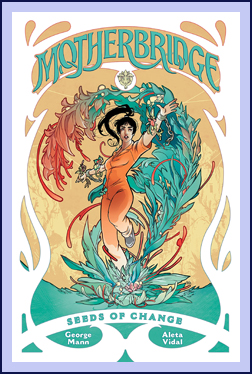
Book Review - George Mann's Motherbridge: Seeds of Change

Motherbridge: Seeds of Change by George Mann and Aleta Vidal
Published by: Dark Horse Books
Publication Date: June 7th, 2022
Format: Paperback, 88 Pages
Rating: ★★★★
To Buy

Twenty years ago Mother Nature did what no human could, she united the world. The World Mother awoke and formed a bridge that spanned the globe, making borders irrelevant and migration anywhere a possibility. A "one-world nation, blind to creed or color, to allegiance or belief." Like so many others Hayley Wells used this miracle to create a new life for herself. She left England and settled in New York where she married and had two children. But then utopia failed. The World Mother went silent and the worldbridge began to die and governments used the opportunity to segregate. To bring the walls back. To make it us and them again. Haley was dragged from her bed in the middle of the night. It didn't matter that she was married to an American, she came into the country illegally as the government saw it and she was to be made an example of. With a gun to her head she was walked out beyond the walls and left to fend for herself. She was thrust into a wondrous and ruinous world. Where nature had reclaimed the constructs of man. She is surprised that there is far more life than she ever expected. She's a refugee and there are others. Haley walks into a confrontation. A group is attacking two individuals and it doesn't sit right with Haley. She tries to break up the fight and somehow the worldbridge stirs for her. This is against everything she has heard. Behind the wall they've been told that the worldbridge is dead, and yet somehow it responded to her. She hasn't just been exiled, she's been lied to. This makes her desire to be reunited with her family by bringing down the walls that separate them even stronger. With the help of Constanza and Doyle can they awaken the World Mother? Can Haley help her new friends survive the forces arrayed against them and return the world to the utopia it had become or will she forever be a refugee?

Despite being such a bookworm now I was a reluctant reader in grade school. Therefore I loved comics and graphic novels. Betty and Veronica, The Family Circus, and in particular Classics Illustrated Comics, which was basically CliffsNotes in an illustrated format and made me appear far more widely read than I really was at the time. As I got older and appreciated prose more I never turned my back on my first literary love. Which is why I'm a happy camper when authors whose prose work I love expand to other mediums. George has been working in comics for years and Motherbridge: Seeds of Change is another stellar addition to his copious output. What I really connected to was that I could appreciate it at the age I am now and as that young girl hiding behind the table in the far corner of the library so the librarian, Sister Marie, wouldn't yell at me for sneaking a peak at the comics. What I'm rather inexpertly saying is, that while this comic is written for adults it has such relevant topics that it could be read by young reluctant readers and would give them a book that is very of the moment but that doesn't talk down to you, like L. Frank Baum was notorious for. Because Motherbridge: Seeds of Change is bringing in some heavy topics; immigration, female rights, climate change, forced separation, the military industrial complex, and yet it never feels preachy or politicized, while still being political. It makes you open your eyes. And isn't that what reading is about? People who read are more empathetic and we need empathy now more than ever. It would also be nice if nature actually came along and "tried to balance the system for us," but I have a feeling we're going to have to do the work. But if more people read books like this, if more people connect to each other, what couldn't we do?

Friday, October 23, 2020

You

Back in 2018 when I first heard about You I was instantly hooked by the idea that Dan Humphrey had finally reached the pinnacle of his evolution. He was nothing more than a stalker on Gossip Girl, so to actually end up killing the object of his affection, well, that was logical wasn't it? I applaud Penn Badgley for being willing to not just rewrite the history of what made him a teenage heartthrob, but to lean into the creepier aspects of Dan to become Joe. Season one of You was a powerhouse of stalking and bookish New York with Joe's bookstore and Beck's delusions of being an author, just throw in a rare L. Frank Baum book and a Salinger, and the book geek in me was as obsessed with this show as Joe was with Beck. Therefore I was a little hesitant as to how I'd like season two. Joe was being yanked out of his New York intelligentsia bubble and being transplanted in Los Angeles, the least Joe place I can think of. And yet... it worked. It REALLY worked. Joe meant to kept his head down and just survive and here he is being drawn into the world of Love Quinn and her co-dependent brother Forty. The stalking of Love is on a much more equal footing than with Beck. She herself has dark secrets and a past and somehow like calls to like and you find yourself rooting for these two crazy people to succeed. At the same time as this there's a part of Joe trying to be a social justice warrior. We saw this in season one with his care of the neighbor kid Paco and here he embraces his landlord's little sister Ellie. Because of these he gets pulled into the world of comedian and friend of Forty, Henderson, who is just as creepy on screen as off. So in barely no time at all Joe has forged new connections and a new life for himself, this time with people who are willing to back up his murderous inclinations. But we know that a happily ever after couldn't be on the cards for a killer... so the story continues and who knows who will be his next obsession. Could it be you?    

Friday, July 20, 2018

Books of Wonder

Bookstore: Books of Wonder

Location: New York, New York

Why I Love Them: Initially I only knew Books of Wonder as a publisher of books, mainly reprints of old titles in beautiful new editions. Therefore I was really excited when I was planning a trip in 2000 to visit New York for a David Bowie concert to learn that Books of Wonder wasn't just a publisher but a bookstore as well! In fact it was the bookstore that was the basis for Meg Ryan's "The Shop Around the Corner" in You've Got Mail. I remember taking a cab downtown and how busy the street was, just like in a movie. I couldn't wait for this small independent bookstore to take me far away from reality with it's cuteness. I think perhaps I needed to remember that movies and reality are two totally different things. Because the bookstore wasn't anything like I imagined. I don't know if it was undergoing renovations or what, but the inside was cordoned off and really small with very few books on white bookshelves that were movable. Seeing as there were few shelves I don't know what they would have done with more books. The whole store felt sparse and temporary. Where was the original artwork they were known to display? Where was the space for their epic signings? It felt too awkward to ask the clerk why their store was so disappointing so instead I looked over their shelves to find something to buy. As most of their self-published books I already owned I picked up a copy of The Princess and the Goblin for my mother and a new Redwall book for myself. But one day I will go back and solve this disappointing mystery!   

Best Buy: When I really started getting into collecting special editions of books the Books of Wonder reprints of L. Frank Baum's Oz books were something I really looked forward to finding. They'd release them on a schedule unknown to me but every time I'd go to Borders I'd check to see if the next Oz book had been republished and do a dance of joy if there was a new one on the shelf. So while I technically didn't buy them at the store I'm still making them my best buy. They did had a lovely window display that I took a really bad picture of if you want some proof! If you force me to choose, the favorite of the Oz books would be Ozma of Oz with The Emerald City of Oz as a close second. Ozma of Oz because it's the book that the movie Return to Oz is heavily based on, though there is no shock treatment in the book, and The Emerald City of Oz for the amazing glitter spot varnish, it's so pretty! What's interesting to me about the Oz books is that I've never finished reading the whole series. They start so strong and keep tapering off in quality until you kind of just tune out. The main problem I have is that L. Frank Baum is so bitter about these being his only popular books. His introductions are not even slightly veiled hostility but outright rage at everyone making him write Oz books. His hatred leaks into the narrative and he writes in a very condescending tone so that once you leave behind the books with the unique spines and move onto the standardized design, which I admit does look nice on a bookshelf, you just kind of stop reading. In fact I feel an attempt to finish coming on again... let's see how far I get this time!  

Friday, October 20, 2017

Book Review - Philip Pullman's The Amber Spyglass

The Amber Spyglass by Philip Pullman
Published by: Alfred A. Knopf
Publication Date: October 10th, 2000
Format: Hardcover, 518 Pages
Rating: ★★★
To Buy (different edition than one reviewed)

The final war with the Authority has come. The sides have been drawn. Ignorance and control or knowledge and freedom. That which was known as God was really just taking credit for creating that which was in existence long before him. Now his second in command is power hungry and wants absolute control over all worlds. A modern inquisition, which Lord Asriel will fight until his dying breath. Yet it's the breath of his daughter that is needed. She needs to live. She needs to fulfill the prophecy that she will put an end to death and become the new Eve. This might prove rather tricky as the Magisterium has sent a priest to kill her and her own mother is currently holding her captive in a drug-induced sleep in a Himalayan cave. It is up to Will, Lyra's staunch friend, to pull himself together after seeing the father he spent his life searching for killed in front of him by a witch and then have a pair of angels appear to direct the bearer of the subtle knife to Lord Asriel. But Will is up to the challenge and along the way to Lyra meets one of her old allies, the armoured bear, Iorek Byrnison, who has fled the arctic as the opening between worlds Lord Asriel has created has destroyed his icy fortress of Svalbard. They find Lyra in the nick of time, taking her out from under the hands of the Magisterium and Lord Asriel. While Lyra was drugged she dreamt of her friend Roger in the land of the dead and upon waking knows what she and Will must do. If his knife can open a window into any world, surly that includes the land of the dead. They will journey there with two new companions, the Gallivespian, the Chevalier Tialys and the Lady Salmakia who ride upon dragonfly steeds, and speak to Roger. Will might even get a chance to talk to his father. After that? Well, who knows how their journey will effect the war... but effect it it will, especially once they are reunited with their friend Mary.

Well, the "end" is here. I say "end" in quotes because as we know now it's not really the end but back in 2000 it was that. The big battle, the Authority toppled, the end and the beginning all in one. Pullman could have concentrated on the war, made an unsubstantial confection of explosions worthy of the big screen sometime in the summer months with angels fighting angels but instead he decided to focus on his characters. Lyra and Will take center stage, as well as new favorites, and instead of a grinding depiction of war we're given something bigger. A journey of self discovery and redemption and hope while the war just happens to be going on off to the side. Am I the only one to say "thank god" only to realize that Lord Asriel would totally disapprove that I, as a thinking person, am giving thanks to an organization that thrives on ignorance and he made a holy war to topple? While The Golden Compass is Lyra's story and The Subtle Knife is Will's story, The Amber Spyglass is about their journey towards not just growing up, but the knowledge of what it is to love. They are the Adam and Eve of this story and as such they must taste the fruit of knowledge offered up by Mary and basically reboot the world. The problem in this though is the vagueness that Pullman uses when describing their love. I can't tell if it's because he's trying to write around it because this was intended for a younger audience, but is their love more than love? Are they sneaking off into the savanna for some hanky panky? He's embracing the ellipses, more than once I might add, and after this long of a journey with these characters I NEED to know if just the knowledge of love was enough to bring about the second fall or if Lyra and Will actually had sex.

As for those we know had sex... let's look to Lyra's parents, Lord Asriel and Mrs. Coulter, I'm sorry, she's too scary to ever to refer to her casually by her first name. SO much of this series is dealing with parental issues. A lot of that is to do with the fact that as we grow up we have our parents to look to as to what we will become and this either is something we embrace or something we buck. But there's no getting around the fact that Lyra's parents are horrible parents and this is the crux of the series. Lyra is drawn into their world and their war. She is at times a pawn but usually THE major player in all of it. But her parents aren't static, they change over time until they make the ultimate sacrifice for Lyra and one is believable and the other isn't plausible in the least. Lord Asriel's journey and his faith in Lyra make sense. He saw her grow up, pretending to be her uncle, and he is willing to die to protect Lyra because he knows that his daughter will end the war he has wagged. His sacrifice at the end makes sense. He dies taking down the angel in power while also giving Lyra time to escape and fulfill her destiny. But Mrs. Coulter. I just don't get her. When she shows up in Oxford and swoops Lyra away to be a part of her world it's almost like Lyra is a doll she's picked up to dress and play with. Yes, she does save her from intercision at Bolvanger, and she saves her again from the church to hide her away in a dank cave in the Himalayas, but why? She claims it's because her grinchian heart has grown three sizes because of her daughter, but I don't buy it. They say every mother has this overriding instinct to protect their child and lavish it with love, but that's not true. Just look at the world around us, just look at this story. I don't buy that Mrs. Coulter would sacrifice herself for Lyra. For her own purposes, yes, but for her daughter? No way.

Yet I don't have as many issues with Mrs. Coulter as I have with the Mulefa. Those loving elephant faced, diamond skeletoned people whom Mary spends all her narrative with freak me out. But to be fair, it's not in their nature, it's in their wheels. Father Gomez the killer priest was so right when he said that their use of wheels was evil, and yes, I know I'm agreeing with an evil assassin, but seriously, wheels! Yes, I know, technically it's ingenious evolution, but the truth is me and wheeled creatures have a dark history, one which makes me hate them all. Are there things that you saw as a child that just ingrained themselves so deeply in you that they make up a substantial part of your nightmares and neuroses? Not the standard teeth falling out nightmare that so many of us suffer, but a hate of zombies from seeing a certain movie too young. Or a fear of elevators because of what the hell was in outer space when Charlie and Willy Wonka stepped out of the glass elevator (and yes, I cop to this one). Well, when I was very young I stumbled on the comic adaptation of Return to Oz. If you haven't seen Return to Oz, well, firstly you should, but secondly, it's a really dark re-imagining of Oz and the second and third books in the series by L. Frank Baum. There's shock treatment and a lady with removable heads. So while the shock treatment just gave me interesting knowledge, and the lady with removable heads made me slightly freaked, there was one part of the movie that terrified me: The Wheelers. Forget flying monkeys, these minions of the witch Mombi are "people" with wheels for hands and hatred in their hearts and they will hunt you down. Therefore I can not condone these Mulefa, they are in essence that world's Wheelers! BEWARE THE WHEELERS!

OK, no more Wheeler talk, it's near Halloween, this movie is bound to be airing and the nightmares will return. Let's discuss a pet peeve of mine; quotes at the start of chapters, or even at the start of a book. I know for a lot of authors that they have a special meaning, that perhaps this certain line that they have included inspired them or sheds meaning on their writing or captures the essence of whatever is to come like some cryptic clue, but can I just ask all you writers out there to stop. If it's a clue or whatever it's annoying because after reading the chapter you have to go back and re-read it and see if you got it and if you didn't you just end up feeling really stupid. But most of the time, it just comes off as pretentious: "Yes, I have a Shakespeare quote because I've read all Shakespeare and know more than you, ha ha." "What, this obscure poet, you've never heard of them? How can you even live with yourself?" "Don't you just feel that this line wouldn't get it's meaning fully across without the weird spelling of the words and all that is implied by it's antiquity." So IF you're one of these authors, just know, THIS is what's going through my head and makes me hate you just a little bit. Or, if I'm honest, quite a lot occasionally. Here though, besides making me hate Pullman a little, because yes, I can see these quotes at the beginning of each chapter do reflect the world he's created and inspired him so I can't completely hate them though I reserve the full right to hate the tiny ass font they were set in, I can hate them for a logical reason... These quotes are all from authors from our world. Yeah, I agree, quotes from another world would be weird, but then again it might work. Why might it work? Because it wouldn't be grounding The Amber Spyglass so completely in Will's world. Like 10 pages in the whole book take place in that world yet each and every quote comes from there? Bad move Pullman. Bad move. You are tearing down the worlds you built and I don't even know if you realize it.

Though for all my nitpicking what I think Pullman got SO right is the new definition of the Kingdom of Heaven. Lyra and Will are told that each world has to build their own Heaven, which means that it's about cherishing and caring for the world and it's people because you're building the Kingdom with each act, with each thing you put back into the world. Which makes Will and Lyra's final separation into their own worlds make sense. Yes, it may pain them, but they are each such extraordinary people that think of what they can accomplish and build in each of their worlds? Their journey and their sacrifice create a new start, a new chance to fix the problems they see all around that have been caused by three hundred years of damage from the subtle knife and millennia of damage from the Authority. It's not just the humanitarian nature of this that so resonates with me, it's that when I think of heaven I don't think of some weird ethereal place I think of the world around me. Hence, if there is a heaven it would be here on earth. The best thing we could be given is a chance to live again, which is why reincarnation makes sense to me. Though within this I still have to question where Mary stands. She's an ex-nun who doesn't believe in God anymore and hence has turned to physics. Yet while the events around her show that "God" was really just taking credit for something he didn't do and that now his second in command is going power crazy, I think some part of Mary should have gone, "Oh wow, there really was a God and angels and etc etc." Yet she's still firmly entrenched in her new beliefs and despite there being correlations she just doesn't see that both things can be true. But then again she was friends with people who had wheels!!!

Wednesday, October 11, 2017

Book Review - Philip Pullman's The Golden Compass

The Golden Compass by Philip Pullman
Published by: Alfred A. Knopf
Publication Date: 1995
Format: Hardcover, 399 Pages
Rating: ★★★★
To Buy (different edition than one reviewed)

Lyra Belacqua has had the run of Jordan College in Oxford her whole young life. The poor scholars just don't know what do to with the unruly girl. With her daemon Pantalaimon by her side and her best friend Roger she has scaled the roofs, waged war on the Gyptians, and spent her life going where she pleased. Though she'd never made into the Retiring Room... the night she does is a momentous one. It's not just the success of a campaign she's long wagged, but her uncle Lord Asriel has arrived unexpectedly and within a short amount of time she saves his life and learns about something that is to become her obsession, Dust. She can feel the capital "D." But Lord Asriel leaves, alive, and life goes back to normal, that is until kids start disappearing all over England. The kidnappers are given the moniker of Gobblers and soon they aren't just in Oxford, but they've taken Roger! Lyra is determined to save him yet she is sidetracked by the lovely Mrs. Coulter. She arrives and whisks Lyra off her feet and to London, where she is to serve as her assistant. The coincidence of Mrs. Coulter's arrival and that of the Gobblers isn't noticed by Lyra until later. When she realizes that this mysterious woman is responsible and is bankrolled by the church she runs away to find Roger. Teaming up with the Gyptians they travel north. There Lyra will see the most amazing sights and also face the most horrific betrayal. But with Pantalaimon, an armoured bear, witches, an aeronaut, and the mysterious alethiometer, Lyra might just succeed and find out what this Dust is.

I first stumbled on His Dark Materials during a very turbulent time in my life. There was loss and chaos and somehow these books reflected that and made me realize things were going to be OK. I would even go so far as to say that they really helped inform my DNA and pushed me to read more, to escape into the magical worlds located innocuously between two covers but also to look outside myself, to forge new friendships and rebuild what had become of my life. These books even helped form one of my most lasting friendships. You know how finding someone who likes the same book as you is like a recommendation for that person? Well I recommended this series to my friend Jess early in our friendship and her embracing of them was like a gold star next to my name saying that I would make a good friend, which I hope I still am! But having our friendship founded on books, and I will add Buffy the Vampire Slayer, has lead to me finding more and more friends through the love of literature. I guess, as I write this, I never really grasped how much this one book changed me. The Golden Compass isn't my favorite book, but it is a formative book and all these years later I still enjoyed sinking back into Lyra's world.

Though this time I saw Lyra's world very differently. It's not that the book has changed in the least since I first picked it up or even since I re-read it before the movie came out, it's that I have changed and my world view has expanded. This of course not only makes sense but also is part and parcel of the book. The Golden Compass is all about growing up and becoming a part of the adult world. Learning about all the things, all the innuendo that slipped past you for years. Losing your innocence. It's like having the blinders taken off and what struck me forcibly this time was how much The Golden Compass is like an adult version of The Wizard of Oz. Now I'm not talking Wicked territory, though having read those books probably helped me to see this book more clearly. I mean all the elements are here, though slightly distorted. There's Lyra's daemon standing in for Toto, there's the Wicked Witch, Mrs. Coulter, there's bears and balloons and misunderstandings and and and... I just found it so interesting how the themes and the imagery from L. Frank Baum's book seemed to have so much influence here. Yet while it mirrors it it's not a carbon copy. While The Wizard of Oz is a classic, it's a flawed classic that's too saccharine and too condescending. Here we are given a new classic, it has all the elements there but is better. More adult, more adventure, and more, dare I insult a Tin Man and say heart?

The heart of this series is not our heroine Lyra, but the relationship between Lyra and her daemon Pantalaimon. I had a daemon once. He was black and white and furry and was quite literally my soul. When I first read The Golden Compass I had just lost his brother and at the age of fourteen Spot became an indoor cat. Over the next eight years we became even more inseparable so when the inevitable separation came I was gutted. It has been almost nine years of feeling like I'm not all there. Feeling as if a part of me is gone. On my previous two readings Spot was alive and well and with me and our parting was a thing never to be contemplated. Yes, it would happen, but one didn't dare actually think about it. This time though he is no longer with me and therefore all the emotions that Lyra feels at the possible severing, of the intercision between her and Pantalaimon devised by Mrs. Coulter to stop Dust settling wasn't hypothetical to me, it was a reality. My soul has been split and I can well see why those who actually survive this horror become ghosts or zombies. The pain is almost unbearable. Yet to never have had the connection would be worse. Philip Pullman captures the connection between humans and animals so exquisitely that while I was hurting all over again the fact that someone else out there gets it. That someone else out there knows the power of that connection, a power to literally unlock worlds, is something of a comfort.

Yet there were also discomforting thoughts that this book brings up, questions about the Church. The school my mom was a librarian at actually banned these books when the movie came out because of Philip Pullman's beliefs. Though I think reading the books and having a discussion over the content would be far more productive than slamming a book because its author is an atheist. But the parent to lodge the initial complaint kind of has a point in that the church is depicted very badly. No that doesn't mean I'm in favor of banning any books, it just means that I am open enough to see that they have a point. The church, through the process of intercision, wants to maintain the innocence of children by not allowing dust to settle on them. And yes, they are willing to do this at the expense of their young lives. This brings about a lot of questions. Mainly, if their daemon is their soul and it is cut from them how exactly do they enter heaven? The soul is what is most important, not what happens here on earth and yet they are forfeiting their souls through this procedure. I just don't get the church's backward thinking. Of course I believe all this is addressed in the proceeding volumes, I haven't read them in awhile and this is something my mind kept coming back to while reading The Golden Compass. What's more just look to the church in our world, with all the molestation and sexual assaults. These scandals clearly show that the church itself is one of the greatest risks to children's innocence and yet in Lyra's world they are all about protecting it? Yes, these are heavy thoughts that perhaps need more time to be addressed than in this review...

Let's move onto other topics, how about worldbuilding? Philip Pullman has built this amazing and parallel world to ours with steampunk elements and animal familiars and then he ever so slightly slips up. There's the scholarly world of Oxford, the glamorous world of Mrs. Coulter, which I picture very 1920s, the rough and tumble like of the Gyptians, all fitting together into this very British world view and then there's the Bolvager facility. A facility that just doesn't fit into this written world. I'm not talking about what they do at the facility, that is very much of this imagined world, I'm talking about the building itself with it's tunnels under the snow and the ceiling tiles that can admit a girl who is rather small for her age into it's secrets. It's just too Michael Crichton. I felt like I was reading the description of the facility built at the bottom of the ocean in Sphere. Or like I was about to watch the episode of The X-Files "Ice" which was clearly an ode to Michael Crichton with it's alien parasite living in the frozen tundra. Yes, the book regains it's momentum after this bump in the road, but it's still a bump that could have been fixed! This one little section takes you out of the story and makes you feel like you're visiting your own doctor's office. Yes, facilities like this the world over are very similar, but did this facility a world away have to be? Couldn't it have had some of the vast imagination that fueled the rest of this book? Pretty please? Make the connection to itself NOT to us.

Wednesday, September 20, 2017

Emerald City

Emerald City is, in my mind, the most successful adaptation of the Oz mythos in years, yeah, suck it Wicked and that movie with Zach Braff! Yet NBC never really knew what to do with this new Oz that was Steampunk and political and self-referential, heck, in one episode Vincent D'Onofrio played some Pink Floyd! So they just exiled it to a lingering death on Friday nights except for those few viewers, like me, who waited every week to see what new twist would happen. This had the grandeur of the old Merlin adaptation NBC did back in the day with Cersei Lannister as Quinevere or The 10th Kingdom, both epic fantasy but with classic appeal. In fact, there's no doubt in my mind that once people find this show on DVD or streaming it will become a favorite like these other two standards. But what's more by actually exploring the plotlines from the second Oz book, The Marvelous Land of Oz, wherein the Princess Ozma is hidden within the body of a boy, Tip, the show was able to cover far more currently relevant issues of gender identity than when the book was first published in 1904. Seriously, nothing was wrong with this series other than it probably cost NBC too much to make with the luscious sets and amazing locations. This show made me feel for the first time in years a desire to go back and immerse myself in the lore of Oz but also to figure out this new mythology. Emerald City inspired the reader and the watcher in me, but more importantly the storyteller, and I just wish I was getting one more chapter.

Thursday, January 14, 2016

Book Review 2015 #6 - Angela Thirkell's High Rising

High Rising by Angela Thirkell
Published by: Virago Modern Classics
Publication Date: 1933
Format: Paperback, 276 Pages
Rating: ★★★★★
To Buy

Laura Moreland is off to her cottage in High Rising with her son Tony for the winter holidays. Her three other boys are all grown up and flung to the far reaches of the earth after she ably raised them alone as a widowed author. In fact she ended up with quite a following for her fun and frivolous tales told in the world of high fashion staring Madame Koska. In fact many of her fans are right on her doorstep, with her assistant Anne Todd being a neighbor who nurses her ailing mother but has a penchant for couture. Fellow author, though of a historical and biographical bent, George Knox lives in nearby Low Rising with his daughter Sibyl. In fact the holiday season is bound to be interesting by a new arrival at the Knox's house, because it's sure not going to be enlivened by Tony's litany of train facts. George Knox has a new secretary, a Miss Una Grey. Miss Grey, while competent, seems to have her eye on her employer for a precipitous rise in her station. The locals aren't having any of this and soon the gossip over this "Incubus" has both High and Low Rising talking. But George Knox is an honorable man and he can't send a poor, defenseless orphan out into the world, no matter how ambitious and amorous her attentions. Though perhaps Miss Grey isn't as she has presented herself and that might just turn the tables and perhaps give Laura an idea for a new book.

How would it feel to write all your books in a world created by another person? I guess a good author to ask would be Gregory Maguire whose "Wicked Years" are set in the world created by L. Frank Baum in The Wonderful Wizard of Oz. Though Maguire expanded and parodied the world that Baum created making it very much his own. The reason I bring this up is that most of Angela Thirkell's books are set in the fictional English county of Barsetshire created by Anthony Trollope in his six book series that make up The Chronicles of Barsetshire. I'm of two minds with this. One is that it's an interesting experiment freeing the author in this case from onerous worldbuilding. The other mind is going: lazy, plagiaristic hack, and seeing as she often quoted from other authors without attribution, leaning towards plagiarist. But I knew I'd have to come to a conclusion on my own by reading the books, despite the enthusiastic recommendations of my many friends. And seeing as they are set in a world created by Trollope, I felt I'd have to read those first. It's not like I have anything against Trollope, in fact I quite love him, I just wasn't enamoured of his first Barsetshire book The Warden. But having at least nominally dipped my toe into the world created by Trollope I felt I could take a plunge into this world that Thirkell expanded on.

What struck me most about this book is why did she bother to set it in Barsetshire? This could have been any little small British town anywhere, so why did she frame it within someone else's work? Was it her desperate need for a map? Maps are easy to come by, you pick them up anywhere. Get them while you get your gas! It's not like there was a wicked witch with green skin that needed to be her antihero, so why do it? Because, in all seriousness, by co-opting the world of another author she is doing a great disservice to herself and her work. Going into the book I had prejudices against it's originality because of this. Yet it is so original, minus the county. There's a freshness to it, a world weary snark that spoke to me so deeply that I just wanted to be a part of this story. High Rising has an honesty that makes the misanthrope in me happy while at the same time creating a cast of characters that are in a happy place; which makes me wonder if it was maybe love versus laziness that made Angela Thirkell set her books in Barsetshire. Maybe she loved the world so much that deep down in her bones she didn't want to leave and set out to spend her life there? If this is the case then perhaps her books are some of the very first fan fic there is. Now that would be an interesting topic for a dissertation, "Angela Thirkell, the Origins of Fan Fiction."

The character of Laura Morland is now my literary heroine. I seriously adore her. In a time when parents are always PC in books and television shows like The Slap make headlines it's so refreshing to have a heroine who loves her children but knows that they are annoying brats. Laura will willingly hate on her child, but not vindictively. She points out that which aggravates one in the young but never is mean spirited about it. Ah, to have children in a book that aren't precious or precocious! Laura is just honest. She knows herself, she knows the world, she just seems to know everything, including the perfect put-down for an ill-advised yet ardent suitor and seriously, can I be her when I grow up? She is not deluded, she knows she's not the best writer in the world, she knows where she belongs. To read about a person who knows their place in the world so well is interesting. Because so often the world doesn't make the least sense and we can never quite fit, always feeling like the last puzzle piece that obviously doesn't go where it is supposed to. Yet here comes Laura, self assured, self deprecating, self reliant, and true to that self. So many books are about characters finding their place, trying to fit in, the struggle is all, to read a story with a heroine who is past all that is a luxury. To me, this is the ultimate comfort read. I, like Laura, will chose my bed and a gruesome book over King Lear any day.

Another aspect of Laura that I love that extends outwards to the whole of High Rising is this love of the literary, books within books. We have a handful of authors as our main characters and they run the gamut from poets to scholars to cozy mystery writers. I love how Thirkell is able to convey their personalities through their chosen mediums. Adrian Coates was a published teenage poet, and has therefore the right level of demureness coupled with a desire to forget his opus that you would expect of a languishing poetic soul. George Knox is verbose and preachy, which you would expect of a historian. Laura, well, Laura I think is the author in disguise, all honest about her work being their to pay the bills. Laura in fact shares a kindred spirit with another of my favorite literary character, Ariadne Oliver, who, as anyone knows, is Agatha Christie in disguise in her own Poirot mysteries. Perhaps there's just something about authors "secreting" themselves into their own stories that lends something extra, something jovial to the story that is addictive. The ability for anyone to laugh at themselves is key to a good personality, in my mind, so therefore an author who can do the same and then incorporate that into their work, well, that just tickles me. It is rare to find a book that so tailors with what I value in life and in literature, and High Rising is definitely a book written for me.

The most interesting fact of this entire book is even the character I hated, aka Miss Una Grey, aka the Incubus, I loved to hate, and rarely have I hated a character more. I totally disagree with Alexander McCall Smith's statement in the introduction that Miss Grey should have our sympathy. Doesn't he see that she is a total sociopath? She's not a poor lonely girl who is misunderstood, she is a lying, manipulative, she-devil. Yes, sure, occasionally working with someone you might develop feelings, but she takes it to stalker levels. In fact she takes everything too far. She does her job flawlessly, but this is balanced by her doing her crazy flawlessly too. Everything is done to the perfect extreme. When I tried to think of other characters that you are meant to love to hate, Caroline Bingley, Blanche Ingram, Loki, yes, I had to work Tom Hiddleston in somehow, never have I had such a visceral reaction where I longed for the moment everyone would have the definitive proof of her wrong doing and she would be sent packing. This was up there with the childish glee I got when watching The Parent Trap for the first time and the upstart Vicky was sent packing, bear cubs and all! I almost want to re-read the whole book again just to see Miss Grey get what's coming to her.

Wednesday, December 23, 2015

Christmas is About Books

For me Christmas has always been about books. Even before I was the biggest book nerd out there, Christmas and books went together like a hand in a glove. There was a local children's bookstore in Madison called Pooh Corner that I'd invariably get gifts from. They'd come wrapped in that way only a store could do with a little tag with Pooh and Piglet. Usually they were wrapped in brown paper, but somehow that didn't matter, that red yarn ribbon was just the right accent. My shelves still contain all these books from Christmases past; except for Maurice Sendak's version of The Nutcracker. Seriously, those illustrations are the stuff of nightmares. But there was always a frisson of excitement waiting for these books to come from friends and family. Unlike presents from my parents or grandparents, the rules about waiting to open them were more lax so I could often finagle an unwrapping within a few hours of their arrival, though once a package from my aunt somehow circumnavigated the globe before arriving long past Christmas. Luckily books don't perish. As for presents from my parents, my brother and I were often allowed to open one present on Christmas Eve. One year I picked a present that I had been intrigued with because of it's book-like shape. It was On the Banks of Plum Creek, which happens to be one of my favorite books in the Little House series. In fact I received all the books in hardcover that year, though my mom insisted that they be on display in our fancy bookshelves, because she was also a fan. Some years my parents were more cunning in their wrapping so you couldn't detect books from that distinct book-like shape. My brother and I received the entire Children's Illustrated Classics in a box that could have easily fit the both of us! But the true Christmas gift was when I didn't have to assemble anything for my brother, he of the ever elaborate GI Joe and Lego playsets, and I could curl up with one of my new books.

As the years went by my love of curling up with a book became more and more prevalent. I recently heard of the holiday in Iceland, Jólabókaflóð, literally, "the Christmas book flood." You get a new book on Christmas Eve, then crawl into a freshly made bed of crisp and clean sheets and read the night away. To me, this sounds divine, and indicates that I need to get myself to Iceland. There's an Icelandic saying that everyone has a book in their stomach, but I think it's in the blood. It thrums through you. It's not just the story you have to tell but all the stories that become a part of you. Recently I was contacted through my blog by a representative of Invaluable, the world's largest live auction marketplace. They were wondering if I would like to write a blog post on my passion for books and my dream literary collection. This got me thinking, when did my buying of whatever books I felt like reading start to become collecting? When did I start consciously forming a library? When did this need start thrumming through my veins? I think it might have started with that set of Little House books. For the first time my worn and battered copies of books I loved were replaced with nice new editions, though I still have the worn ones as well. But I don't think I realized this at the time. The books were a lovely present and that is all I thought about it. It was another series of Children's books that awoke the collector in me. Books of Wonder started to release these lovely facsimile editions of the Oz books by L. Frank Baum and I eagerly awaited the release of each one. While the collecting of these books indicates the starting of my library, it's more than that, it's the collecting of an author's oeuvre. It's finding an author you connect with that you need to have all their books, and if possible signed copies. Once the number of first editions and signed copies start to take over the rest of the books, a true collection is forming.

My great-grandfather, Joseph Martin, was a Justice of the Wisconsin State Supreme Court and an avid collector of books, a few of which I'm lucky enough to have; lucky indeed seeing as his daughters liked to randomly divide up the matched sets, hence I have half of Pride and Prejudice. He had read somewhere that to be a true gentleman you had to have a library of ten thousand books, but you also have to have read them. I am slowly but surely headed there. But there's only so much shopping at used bookstores and secondhand shops that helps to fill out your collection. There are those books; the white whales that will never show up at these type of stores. Those books too valuable, or perhaps invaluable, that you have to look for elsewhere. These books would be the centerpiece of your collection. The keystone to everything. Your very own Holy Grail. So what are my dream books? What do I want to see on my shelf? What would my library look like, aside from the fact that it is TARDIS-like in that it can ever expand to hold all my books? Well, firstly I see one of those globes that open and hold maps or drinks. I can't help it, ever since reading The Secret History of the Pink Carnation Lauren Willig has somehow made this a must. The more attainable of books would be a signed first edition of The Princess Bride. I've been coveting a copy of that for years. I'd then move onto signed first editions of all my favorite Terry Pratchett books. Then onto rarer fare, signed first editions of Agatha Christie, maybe even Arthur Conan Doyle's The Hound of the Baskervilles to be thematic with my blog at the moment. Of course the holiest of holies? These would have to wait until I had my English Country House, but first editions of all Jane Austen, especially ones before she was credited by name and only say "By a Lady." Oh, and editions of all the Brontes's work, when published under their "Bell" pseudonyms, or even just a scap of one of those letters their father cut up for fans. And and and... a girl can dream can't she? A girl can go to bed on Christmas Eve after reading and dream of all the possibilities of what books are wrapped and waiting for her under the tree. It's Christmas after all, what other time of the year is there to dream big and believe in miracles? Or signed first editions of Jane Austen?

Wednesday, November 11, 2015

Book Review - Robert Newman's The Case of the Baker Street Irregular

The Case of the Baker Street Irregular by Robert Newman
Published by: Aladdin Paperbacks
Publication Date: 1978
Format: Paperback, 228 Pages
Rating: ★★★
To Buy (different edition than one reviewed)

Andrew arrives in London from Cornwall with his guardian Mr. Dennison. Andrew is overwhelmed by the great metropolis bustling around him. He and his guardian have a small room near Baker Street where they are staying. After they settle in they walk around the neighborhood and Andrew gets a glimpse of the great detective himself, Sherlock Holmes! The next few days Mr. Dennison is busy and Andrew doesn't see much of him. The young lad is starting to know the area and befriends a young girl who goes by the name Screamer and whose brother is one of Sherlock Holmes's Baker Street Irregulars. They spend a great day at the zoo but then everything changes for Andrew. He sees his guardian, Mr. Dennison, bundled into a carriage against his will by a cabbie with a broken nose. His landlady is very helpful and they report the incident to the police, but soon Andrew's steps are dogged by the man with the broken nose and he takes refuge in the poorer areas of London. Beaten and stripped in an alleyway, Screamer, her brother, and their mother, Mrs. Wiggins, take Andrew in. But Andrew knows he is a burden on this poor family and happily takes any jobs he can get. One comes down from the great detective himself. Andrew is to lead a blind fiddler around town for a few days. Little does Andrew know at first that the blind fiddler is Sherlock Holmes and that their work together might solve not only the theft and forgery of some paintings, the disappearance of Mr. Dennison, but also find Andrew a home. It's all in a day's work for the world's greatest consulting detective!

My younger brother's bookshelves growing up consisted of Dr. Seuss, The Berenstein Bears, and magic books. There would occasionally be a book that didn't fit into these three categories, a book for school or a video game guide, but that was a rare occurrence. Some time last year the two of us were clearing out a few random boxes that contained stuff from his old bedroom, and yes, we did find old Christmas candy, the less said about that the better... but we also found this book I had never heard of, The Case of the Baker Street Irregular. It went into the pile dubbed, "Stuff That is Now Mine." Because seeing that book I had an idea. An idea that morphed into Sherlocked. That night I sat down at my computer and started making a list of all the books I had or wanted to read that were inspired by Arthur Conan Doyle and his creation, Sherlock Holmes. From middle grade reads written by Eve Titus to continuations written by Anthony Horowitz to loving parodies written by Neil Gaiman, within a few short minutes I had a list of almost twenty books and that got me thinking about how much Sherlock Holmes has been a part of my life in one form or another. From movies with cartoon mice to watching PBS with my mom, Sherlock has always been there for me. My three-month long Sherlocked extravaganza was born then and there and I knew that one of the books I read would have to be The Case of the Baker Street Irregular.

The Case of the Baker Street Irregular is a book that is painfully middle grade. What do I mean by that without being overly critical. Yes, laugh all you want that I'm worried about being overly critical. But I did enjoy the book, it's just that the author has some issues that are common in older books written for a younger audience (cough, L. Frank Baum, cough.) Primarily he talks down to his audience. He dumbs things down to make his audience get the concepts, but to a painful degree. The book is peppered with that dreaded concept of "teaching moments." He seems more concerned with educating his readers than creating a thrilling story that just happens to educate. This lends an overall flatness to the book. There is no fluctuation with excitement or danger or even mystery. The book plods along with it's slow snail pace and it's not until you accustom yourself to this that you can enjoy the book for what it is, not what it isn't. Newman is obsessed with locations and maps and characters muddling along through the morass of London in a way that does more to confuse than aid the reader. It isn't until Holmes in disguise is working with Andrew that the book finds it's legs. Before this moment it's two stories running tangentially that you are just waiting to connect. The book is also clever in that their working together isn't spelled out for you til the end. You know what's going on, but you're not 100% sure, and this is truly the only mystery the book affords that is worth your time.

What bothered me most about the book was the Baker Street Irregulars themselves. Ignoring the fact that the title of this book annoys me because of the singular versus the plural, the Irregulars aren't handled right. It felt to me like Newman didn't want to handle the actual social status of a street urchin in Victorian England because it would create too much of a disconnect with his readers so he made characters that would resonate more with kids today, couching the book in terms a young reader would get. In other words, see the "dumbing down" of above. So instead of true street urchins we have Mrs. Wiggins and her two children that are acceptably poor but not destitute. No, no, and no again. The Irregulars don't have families! Well, they might have siblings in their gang but NOT parents to go home to at night. This is some sort of rose-tinting of the Victorian era that is unacceptable to me. It somehow lessens what the Irregulars are. They are a force to be reckoned with because they have eyes and ears everywhere, they are always watching, not going home to their mom and dad at the end of the day! This is why in the new adaptation, Sherlock, that he uses a homeless network. The homeless problem of today with it's ubiquitousness is equal to what the street urchin epidemic was in Victorian times. They are everywhere so we have learned to tune them out. I just feel that for a book that liked it's "teaching moments" that to not handle an actual problem that is still ongoing in different forms is sloppy writing. Not to mention it just pissed me off and was totally against canon!

But the truth is if you can't get Holmes and Watson right then just don't write about them. Go big or go home. The genius of Eve Titus is that she was able to capture the language of Conan Doyle so perfectly that even a book written for very young children had that spark necessary to interest readers in the world's number one consulting detective. Newman doesn't get Holmes and Watson right at all and therefore is forced to make everyone else so bloody boring that Holmes and Watson are interesting by comparison. I don't think the correct way to interest someone in books is to make your story so boring in parts that their only alternative is to read the original work to get the point you were trying to make. While I've never been 100% on board with the quality of Conan Doyle's writing, when you see someone else fumbling simple descriptions and settings, not to mention the dreadful dialogue, you realize that perhaps you've underestimated Conan Doyle all along. And it's not just the set-up that failed for me, it's that the characterizations were so wrong. Watson was lippy and took control versus being obsequious. Holmes actually bothered to explain things as they were happening instead of reveling in the great reveal at the end. With all that was wrong you are probably confused as to why I liked the book. It's because of the seismic shift half-way through when Holmes is undercover with Andrew. Holmes was quiet and terse and secretive, and FINALLY Holmes. While after this little interlude Holmes went back to being wrong, and dare I say, melodramatic, because Holmes himself couldn't think of a more condemning word, that short interlude made the book worth everything else.

And I haven't even come to the crimes perpetrated in the book. Conan Doyle has a way with creating crime. He created stories that appeared mysterious and convoluted till the end reveal when it all made sense. In a nutshell they baffled while NEVER being illogical. The ending always fit with everything that came before. It's like if you were doing a puzzle but didn't have a picture of what you were working on. Once you finish it the picture is clear and everything fits together. Newman apparently didn't get this memo on how to craft a mystery. The crimes perpetrated in these pages are too convoluted and illogical. They are full of unnecessary red herrings and twists just to cover up their failings. But I seriously can not even when it comes to the illogical. I am quite literally baffled by the stupidity and lack of sense. Let's just look at the theft of the paintings. So their owner Lytell is short on money. Keep in mind short on money means he NEEDS money. Therefore to get money he is auctioning off several famous paintings. These paintings are stolen from the auction house and replaced with forgeries. Now if the thieves then went on to sell these paintings on the black market it would make total sense. Instead they ransom the paintings back to Lytell. So let me get this straight. Lytell doesn't have money, so you steal his paintings he was using to get money and then demand money of him? WHAT THE HECK! If he didn't have the money in the first place how would he have money now? Not to mention that this involves so much more work than necessary with trying to deceive Holmes and finding a decent forger. OK, now I'm starting to wonder why I liked this book... I think it might be the reverse effect of "Last Good Book I Read." Meaning I was reading a lot of shitty comics so this looked good in comparison. So maybe skip this one after all? But read the part where Holmes is undercover, that's fun.

Wednesday, July 22, 2015

Book Review - Angela Thirkell's High Rising

High Rising by Angela Thirkell
Published by: Virago Modern Classics
Publication Date: 1933
Format: Paperback, 276 Pages
Rating: ★★★★★
To Buy

"If you haven’t read Angela Thirkell yet, you’re in for a treat! I’ve always described her books as a cross between Waugh and Wodehouse. They have the kindly good humor of Wodehouse and the satirical eye of Waugh. What they really do brilliantly, though, is showcase a timeless (and idealized) image of village life, in which vicars are always daydreaming over their pipes and muddling over the annual fete, the bossy grande dame of the village throws amateur theatricals, young men just down from Oxford go into sulks, and everyone, in the end, goes merrily on their appointed ways.

There are aristocrats in Thirkell’s Barsetshire books (Lord Pomfret, for one, or Lady Emily, for another), but it isn’t primarily an aristocratic world. This is the province of the gentry, of gentlemen farmers, lady novelists, schoolmasters in tweed jackets, and rising young barristers. It’s a very restful and charming sort of world and provided the foundation for my image of my heroine, Rachel’s, childhood in just such a small village." - Lauren Willig

Laura Moreland is off to her cottage in High Rising with her son Tony for the winter holidays. Her three other boys are all grown up and flung to the far reaches of the earth after she ably raised them alone as a widowed author. In fact she ended up with quite a following for her fun and frivolous tales told in the world of high fashion staring Madame Koska. In fact many of her fans are right on her doorstep, with her assistant Anne Todd being a neighbor who nurses her ailing mother but has a penchant for couture. Fellow author, though of a historical and biographical bent, George Knox lives in nearby Low Rising with his daughter Sibyl. In fact the holiday season is bound to be interesting by a new arrival at the Knox's house, because it's sure not going to be enlivened by Tony's litany of train facts. George Knox has a new secretary, a Miss Una Grey. Miss Grey, while competent, seems to have her eye on her employer for a precipitous rise in her station. The locals aren't having any of this and soon the gossip over this "Incubus" has both High and Low Rising talking. But George Knox is an honorable man and he can't send a poor, defenseless orphan out into the world, no matter how ambitious and amorous her attentions. Though perhaps Miss Grey isn't as she has presented herself and that might just turn the tables and perhaps give Laura an idea for a new book.

How would it feel to write all your books in a world created by another person? I guess a good author to ask would be Gregory Maguire whose "Wicked Years" are set in the world created by L. Frank Baum in The Wonderful Wizard of Oz. Though Maguire expanded and parodied the world that Baum created making it very much his own. The reason I bring this up is that most of Angela Thirkell's books are set in the fictional English county of Barsetshire created by Anthony Trollope in his six book series that make up The Chronicles of Barsetshire. I'm of two minds with this. One is that it's an interesting experiment freeing the author in this case from onerous worldbuilding. The other mind is going: lazy, plagiaristic hack, and seeing as she often quoted from other authors without attribution, leaning towards plagiarist. But I knew I'd have to come to a conclusion on my own by reading the books, despite the enthusiastic recommendations of my many friends. And seeing as they are set in a world created by Trollope, I felt I'd have to read those first. It's not like I have anything against Trollope, in fact I quite love him, I just wasn't enamoured of his first Barsetshire book The Warden. But having at least nominally dipped my toe into the world created by Trollope I felt I could take a plunge into this world that Thirkell expanded on.

What struck me most about this book is why did she bother to set it in Barsetshire? This could have been any little small British town anywhere, so why did she frame it within someone else's work? Was it her desperate need for a map? Maps are easy to come by, you pick them up anywhere. Get them while you get your gas! It's not like there was a wicked witch with green skin that needed to be her antihero, so why do it? Because, in all seriousness, by co-opting the world of another author she is doing a great disservice to herself and her work. Going into the book I had prejudices against it's originality because of this. Yet it is so original, minus the county. There's a freshness to it, a world weary snark that spoke to me so deeply that I just wanted to be a part of this story. High Rising has an honesty that makes the misanthrope in me happy while at the same time creating a cast of characters that are in a happy place; which makes me wonder if it was maybe love versus laziness that made Angela Thirkell set her books in Barsetshire. Maybe she loved the world so much that deep down in her bones she didn't want to leave and set out to spend her life there? If this is the case then perhaps her books are some of the very first fan fic there is. Now that would be an interesting topic for a dissertation, "Angela Thirkell, the Origins of Fan Fiction."

The character of Laura Morland is now my literary heroine. I seriously adore her. In a time when parents are always PC in books and television shows like The Slap make headlines it's so refreshing to have a heroine who loves her children but knows that they are annoying brats. Laura will willingly hate on her child, but not vindictively. She points out that which aggravates one in the young but never is mean spirited about it. Ah, to have children in a book that aren't precious or precocious! Laura is just honest. She knows herself, she knows the world, she just seems to know everything, including the perfect put-down for an ill-advised yet ardent suitor and seriously, can I be her when I grow up? She is not deluded, she knows she's not the best writer in the world, she knows where she belongs. To read about a person who knows their place in the world so well is interesting. Because so often the world doesn't make the least sense and we can never quite fit, always feeling like the last puzzle piece that obviously doesn't go where it is supposed to. Yet here comes Laura, self assured, self deprecating, self reliant, and true to that self. So many books are about characters finding their place, trying to fit in, the struggle is all, to read a story with a heroine who is past all that is a luxury. To me, this is the ultimate comfort read. I, like Laura, will chose my bed and a gruesome book over King Lear any day.

Another aspect of Laura that I love that extends outwards to the whole of High Rising is this love of the literary, books within books. We have a handful of authors as our main characters and they run the gamut from poets to scholars to cozy mystery writers. I love how Thirkell is able to convey their personalities through their chosen mediums. Adrian Coates was a published teenage poet, and has therefore the right level of demureness coupled with a desire to forget his opus that you would expect of a languishing poetic soul. George Knox is verbose and preachy, which you would expect of a historian. Laura, well, Laura I think is the author in disguise, all honest about her work being their to pay the bills. Laura in fact shares a kindred spirit with another of my favorite literary character, Ariadne Oliver, who, as anyone knows, is Agatha Christie in disguise in her own Poirot mysteries. Perhaps there's just something about authors "secreting" themselves into their own stories that lends something extra, something jovial to the story that is addictive. The ability for anyone to laugh at themselves is key to a good personality, in my mind, so therefore an author who can do the same and then incorporate that into their work, well, that just tickles me. It is rare to find a book that so tailors with what I value in life and in literature, and High Rising is definitely a book written for me.

The most interesting fact of this entire book is even the character I hated, aka Miss Una Grey, aka the Incubus, I loved to hate, and rarely have I hated a character more. I totally disagree with Alexander McCall Smith's statement in the introduction that Miss Grey should have our sympathy. Doesn't he see that she is a total sociopath? She's not a poor lonely girl who is misunderstood, she is a lying, manipulative, she-devil. Yes, sure, occasionally working with someone you might develop feelings, but she takes it to stalker levels. In fact she takes everything too far. She does her job flawlessly, but this is balanced by her doing her crazy flawlessly too. Everything is done to the perfect extreme. When I tried to think of other characters that you are meant to love to hate, Caroline Bingley, Blanche Ingram, Loki, yes, I had to work Tom Hiddleston in somehow, never have I had such a visceral reaction where I longed for the moment everyone would have the definitive proof of her wrong doing and she would be sent packing. This was up there with the childish glee I got when watching The Parent Trap for the first time and the upstart Vicky was sent packing, bear cubs and all! I almost want to re-read the whole book again just to see Miss Grey get what's coming to her.

Tuesday, February 5, 2013

Book Review - Gail Carriger's Etiquette and Espionage

Etiquette and Espionage, Finishing School Book the First by Gail Carriger
Published by: Little, Brown Books for Young Readers
Publication Date: February 5th, 2013
Format: Hardcover, 320 Pages
Rating: ★★
To Buy

Sophronia isn't exactly like other girls her age. Rather then sitting prettily in a chair and waiting to be wooed, she'd rather be climbing up a tree. Her mother therefore has decided she needs to go to finishing school... yet the finishing school that takes her isn't what it seems. While they will make a lady out of her, they aren't interested in quelling her unusual habits, but in cultivating them for a more open ended meaning of finishing. A school devoted to the arts of espionage will obviously have a few evil villains and traitors in the mix. Sophronia and her posse of friends soon stumble on a plot to leak information for an astonishing new invention to the evil Picklemen, who have already attacked the school once. It is up to them to stop this from happening, this is what they are being schooled in after all...

I wanted to like this book, I really really did. Thankfully, now that more reviews are coming out it seems to be just me, which I hoped was the case, because I love Gail's writing but I just didn't love this. While reading this book I did something I rarely ever do, and that's set the book aside for awhile. Usually when a book isn't working for me I try to push on through till I reach a point where either I grudgingly find something to like and my opinion is changed or I finish it and can mark it off my list and get it out of my life and onto the next book. But I love Gail so much I thought that everything I was hating about the book was just in my head. So I set it aside and read something else, which I really enjoyed. Feeling hopeful that my joy in books was undiminished, I picked up Etiquette and Espionage again and found that I still could barely stand reading it. The book was indeed a book I had to push through till the end and then I had a hard talking to with myself as to the rating I'd give it... let's put it this way, it was saved from the one star rating just because of Bumbersnoot. Who doesn't love a Steampunk version of K-9 without all the annoying "mistress" stuff?

Dumbing down. That is the flaw that got in my craw. There is nothing I hate more then feeling like an author is talking down to me, which is a fatal flaw of L. Frank Baum, or dumbing down their writing so that little old me can understand it. Oh gosh, I just can't handle the overly big words, it makes my brain hurt. I have noticed that several authors who have written for a predominately adult audience aren't quite able to make this shift into YA. For some reason they treat their audience differently and change their writing stylistically. The thing is, the YA market is a very discerning audience. Gail's previous books have much cross genre appeal and she could have easily just taken out the sexy bits of her previous books and that would have been enough. But instead we get a book that is predominately action which lacked a snap to the language, and it felt flat. The witty repartee seemed pushed aside for plot expedience, making the whole book lackluster. Etiquette and Espionage felt like a wonderful book that had been mercilessly bowdlerized to make it into a blockbuster that was dumbed down for the masses. Gone is the chatter over tea and scones, in is the heroine climbing the side of a dirigible... why? Because obviously that's the easiest way to get to the bowels of the ship? Excuse me what? Action action action to me is dull, please bring back the chats over tea.

Yet it wasn't just the writing that was dull, but the plot and characters. For a heroine, Sophronia was very one dimensional. She was good at physical activities such as climbing... yeah, that's it for Sophronia. Oh, except that she is so obtuse! I mean, it's understandable that at first she didn't get the joke and the true meaning behind a "finishing school" but that she continuously didn't get it just drove me insane. I just wanted anyone at all to pull her aside and go, "Ok, so, Sophronia, we know that in your world getting finished means getting all your accomplishments polished so that you can be married off, but look at the classes we teach here, finishing can also mean killing someone, ok, now stop being so dumb." Add additional characters even dumber than her as sidekicks and a very basic espionage plot, and the book just didn't appeal to me at all. Sorry.

Though there is one aspect of the book that bothered me beyond all the dumbing down and that is Soap. Soap himself doesn't bother me as such, in that he's just a stock minority character to round out Sophronia's team, it's his name. In another instance of Sophronia's stupidity, upon first meeting Soap she doesn't realize that he is black because he is covered in soot from coal. His name comes from the fact that no matter how much he washes, he'll still look like he's covered in soot. Excuse me? Um... this name offends me on so many levels. I don't care if it's irony or self parody on Soap's part, to me it's racist. While the name is countered by his portrayal and the fact that he is a love interest, the name is just so so wrong. Even before this time in England, there where quite wealthy and well respected blacks in the community, thank you Regency House Party. Slavery was first abolished in 1807 with any people slow to the party being taken out with the Slavery Abolition Act 1833, while this book is set in 1851. So, while I know racism even lingers to this day, there was so much upheaval and change and so much good being done before the setting of this book that by naming the character Soap, it just feels like two steps backwards.

So, wow, this is turned into a rather wordy review now didn't it? I guess I just really needed to justify those two stars which have been worrying rather a fair few of my friends who are also huge fans of Gail Carriger. In summation, I don't think this book will get Gail many new readers. There is just too much world building that is dependent on having read the previous books, written for a much older audience who will not appreciate the dumbing down of the writing. The only little joy I got from this book, aside from Bumbersnoot, was seeing characters from The Parasol Protectorate at a younger age... though not all cameos are successful. Yet there are ways this series could work. I liked the school and the fixed environment, just flesh it out more, set aside more chapters to fully explore this school. Show us classes. Make it Harry Potter on a damn dirigible not debutantes climbing dirigibles! And please, before anything else, give Soap a real name.

Wednesday, November 30, 2011

Goodbye to Oz

While it's true the month of November is drawing to a close, as months are wont to do, that doesn't mean that Oz is going away! Oz has become part of our collective consciousness. Just the other day I recommended the name Dorothy to a friend for her upcoming baby and she said it was too "Ozzy" (meaning wizard of, not bat biting Osbourne). Over a hundred years later and that name still brings up images of tornadoes and checked gingham. We might not be able to physically get there, but just by opening the pages of a book we will be instantly transported, without the need of a cyclone, typhoon, earthquake or magical accessory. If you've been reading the reviews I've posted, you'll probably notice I'm rather harsh on the failings of the main characters and sometimes the repetition of the plots. The thing is though, while Oz has failings, they do not take away from what has been created here.

Oz is some of the most magical worldbuilding you'll ever read. Baum created a magical fairyland that has spanned centuries! He started writing this books during the reign of Queen Victoria, and to this day we have new adaptations, new books, new satires, all because this world he created is so loved. The few reviews I've written only span about half of the Oz books Baum himself wrote, having written fourteen books and a series of short stories all about that wonderful world. I hope that if nothing else, this month has increased peoples knowledge of Oz, showing there's more than just the one book, and made everyone realize how awesome Flying Monkeys are. How can they not be awesome! You still have a few hours to have one of your own!

Wednesday, November 23, 2011

Book review - L. Frank Baum's Dorothy and the Wizard in Oz

Dorothy and the Wizard in Oz (Oz Book 4) by L. Frank Baum
Published by: Books of Wonder
Publication Date: 1908
Format: Hardcover, 272 Pages
Rating: ★★★★
To Buy

Dorothy once again ends up in the land of Oz because of a natural disaster. This time it isn't a storm at sea or a tornado. This time the ground literally opens at her feet from an earthquake and down she tumbles. She was on the way with her new kitten Eureka to meet up with her Uncle at his Brother-in-Laws ranch in California after the long trip back from Australia when Dorothy, her cousin Zeb, and the horse and buggy went a tumbling down. And they tumble and tumble, falling far but apparently not increasing in speed. They seem to be slowing down. A weird fairy world appears below them illuminated by multicolored suns where all the buildings are glass and gravity seems far more flexible. Also as it's a fairy world Jim the horse pulling the buggy and Eureka soon start chatting away. The people whom they descend on aren't at all pleased with their arrival. The Mangaboos quickly take the trespassers off to their wizard when whom should appear above? Dorthy's own wonderful wizard of Oz!

The Wizard has good timing and not only saves them all from the Mangaboos' wizard, but performs some wonderful humbug magic with nine cute little piglets, that Eureka thinks looks decidedly tasty. The Mangaboos are a strange and cold people, it's like they have no blood, which it turns out they don't, being vegetables! They soon revolt and throw the motley crew out of their land, wherein their true adventure begins, travelling through a land of invisible people where invisible bears are there, oh my. Wooden gargoyles and dragonettes all block the path on their way out of the center of the earth. Luckily when all seems lost, the deus ex machina of Oz swings fully into action and the wizard returns to the land he belongs in.

Looking back on this book I have this odd memory of hating it. Maybe that belief let me free up my expectations and just love it. The wizard is an unlikable humbug, Zeb doesn't do much, Jim the horse has to do the majority of the heavy lifting, but Eureka and the piggies are a delight in this odd comical children's version of what Journey to the Center of the Earth would mean to them. There's a Roald Dahl playfulness that is sometimes lacking in the earlier books that has Baum almost forcing the plot and the characters to interact. Dorothy and the Wizard in Oz felt like it just flowed from his pen. Though I do still have Dorothy issues. Dorothy, in another sign of her egocentrism, never thinks of what hell she's putting her family through until she gets bored and it's time to go home. Her Aunt and Uncle where actually MOURNING HER! Full on, black mourning. She almost killed her Uncle with her disappearance on the way to Australia, where they where going for HIS health, and here it is a few months later and she scares them again. There really needs to be a way to not scare the heck out of these good Kansas farm folk. Also, in a total non sequitur, how stupid is Toto? All other animals get to Oz or a fairy land and start chattering away, yet Toto never spoke once in the first book. He must be a total dullard.

Enough odd rantings, I want to state clearly why this book is the best Oz book. Eureka! This kitty cat is all the best qualities of cats, which none cat lovers will probably see as negatives, not understanding the subtlety of cat awesomeness. She's manipulative, vain, only out for herself and never hides the fact that she wants to eat those pork filled piggies. Everyone in Oz always extols their virtues and how wonderful they are, showing them to be pompous asses. Eureka just is. No one really likes her, no one really cares to have her around, but she never justifies, never apologizes, and just is. She won't even defend herself when she is brought to trial on charges of murder (one of the piggies of course). If all the characters would just learn to "be" this series would work so much better. Don't talk about it, don't extol, just be. And if you can, be a cat.

Friday, November 18, 2011

Book Review - L. Frank Baum's Ozma of Oz

Ozma of Oz (Oz Book 3) by L. Frank Baum
Published by: Everyman's Library
Publication Date: 1907
Format: Paperback, 624 Pages
Rating: ★★★
To Buy
 
Dorothy and her Uncle are headed to Australia for his health. The sea voyage turns into a harrowing experience when Dorothy is blown overboard. The plucky little girl from Kansas is resourceful and is able to cling to a chicken coop and ride through the storm, soaking wet, but without fear. This is just the beginning of another adventure. Come morning she is making for landfall in what she takes to be a fairy land. It isn't Oz, because Oz is surrounded by a deadly desert on all sides, but it is most definitely fairy, how else would the chicken Billina be able to talk to her. Animals only talk in fairy worlds. Soon after landing the fact that this world is magical is increased by a tree that grows lunch pails, men called wheelers who have wheels on there hands and feet and a windup man, Tik-Tok, who works through his wonderful engineering.
 
Once Dorothy gathers a posse, she heads inland to the capital city where the royal family have been enslaved by the evil Nome King and the country is run by a vain relative of the royals, Princess Langwidere, who has a room full of heads that she switches out whenever she wants to be prettier, or in a different frame of mind, that raven haired head sure has a temper. Soon all the denizens of Oz arrive in this land, which, as Dorothy surmised, was close but not Oz. Dorothy is reunited with all her friends and finally meets Ozma, whom she becomes fast friends with. The delegation from Oz has come to rescue the royal family after hearing of their plight. They all set out for the Nome King's domain to find that he is a tricky and conniving man who will twist any situation around to his advantage. Yet, never underestimate a plucky chicken from Kansas!
 
Back when the Oz books where being re-released and I was starting my journey into reading I totally held this as my favorite Oz book. But looking back I realize it's less because of the book and more because of the movie Return to Oz. When I was little I remember finding a comic book adaptation of the movie in my school library. I remember reading it up to where Dorothy leaves the asylum. Also being extremely traumatized by it. Dorothy going to get electroshock treatment was enough to do permanent psychological damage to me. After I read the comic the first time I was never able to find it in the library again. I cannot account for that, but it made me start to think I had made the whole thing up and that, like Dorothy, Oz, like this comic, wasn't real.
 
Of course I got a little older and realized that it was a movie, which also traumatized me. Take the wheelers, add in a psycho who keeps heads in glass cases and switches them like we would clothes, and it was the stuff of nightmares. When I finally got to read the books I realized that this movie was an amalgam of The Marvelous Land of Oz and Ozma of Oz, more heavily influenced by Ozma. But the movie took the best bits and omitted all the boring stuff. If there's one thing that annoys me about Oz it's that every time we have a reunion of the characters it's unendurably long with lots of crying and kissing and discussing how they are better than everyone else. Because, these characters really think they are awesome. I'm surprised all the egos fit in one room! But despite all the faults, every time I read about the tree with lunch pails growing from it and the wheelers and the castle of the Nome King with people being turned into knickknacks, it takes me back to my childhood. This is a book for nostalgia, the horror and the magic that lives when you are young, and to get that back, even for a few minutes, is magic indeed.

Older Posts Home