
Showing posts with label For the Love of Book Clubs. Show all posts

Friday, August 30, 2024

Book Review - Neil Gaiman's Unnatural Creatures

Unnatural Creatures Stories Selected by Neil Gaiman
Published by: HarperCollins
Publication Date: April 23rd, 2013
Format: Hardcover, 480 Pages
Rating: ★★
To Buy

Beasts both natural and unnatural are all around us. What if there was a spot. It starts out on you tablecloth. Which is most vexing. But then it moves. It grows. And it's coming for you! But a spot as some sort of creature is definitely "unnatural." Wasps on the other hand... Everyone has had an experience with wasps. They bring terror with their painful stings. There nests seem nothing put paper, but what if that paper was something special. What if that paper was highly detailed maps of the surrounding area? Then they'd be an even bigger threat. A threat to the safety of humans. And maybe a threat to other insects too. A Griffin is a creature beloved by fantasy readers, but this griffin seeks a friend. But instead of the friend showing others that the Griffin isn't a monster he is tarred with the same brush. Which leads us back to a more recognized creature, snakes. Ozioma, despite being shunned from her community must help them with her unique powers with snakes. The creatures go back and forth from the mundane to the magical. Who doesn't want to learn about a tontine involving a sunbird? Though the sunbird might object when it learns what's on the menu. Did you know that dragons can be invisible? And that werewolves, even when seeming polite, might be very very dangerous. Then there's the Cockatoucan. A bird whose whims and whimsy become reality. And can a tree really be a beast? Also, what happens when in the future beasts are forgotten? Could a person from the future mistake a unicorn for a horse? Well, they are quite similar except for the whole horn... There are also different lands, lands of color! Back in the real world though magic can be everywhere, even at the National History Museum with a platypus turning into a mermaid. The manticore though is more worrying. As are werewolves that don't "have" to change... Because denying what you are is never a good idea. Humans themselves can even view themselves as monsters, even if they don't turn into a wolf at the full moon. Backpedaling to the monsters that might be more artifacts, what about bicycles? Bicycles could become sentient right? And the most deadly beast of all is death... Stories and creatures creepy and deadly, with small children being killed and timelines being messed up. If only someone would wrangle the creatures... But then again, there would need to be a consistent definition wouldn't there? And it might include you!

There comes a time when you realize that an author you like and respect might, just might, have shit taste in books. I remember seeing Erin Morgenstern speak with such fervor about The Secret History by Donna Tartt that as soon as I got home from Erin's event I ordered a copy to read immediately. The Secret History isn't one of my favorite books. I wouldn't even say I liked it just a little. I adore The Night Circus, and the opposite could be said for The Secret History. Now let's take another case study; Patrick Rothfuss. I love Pat, I can't wait for him to one day in the distant future finish Doors of Stone, I mean he's got a stronger chance of finishing than George R.R. Martin does at this point, but Pat, we need to have a talk about your taste in books. In particular comics. You have bad taste. Or at least taste that doesn't align with mine. It's so bad that if you recommend it I know to avoid it like the plague. So, in that regards, you are very very useful. Though we do appear to agree on The Chronicles of Narnia, but I call that a rare nostalgic outlier. Which brings me to the fact that this book is a selection of short stories chosen by Neil Gaiman, an author who, until recently, I respected. And he didn't lose my respect because of his selection of short stories, I'm not that critical of someone's taste in books, and I read this book long ago, he lost my respect due to the recent sexual assault allegations. The media isn't covering this case much but from everything I've read I believe the victims. Because we should always believe the victims. Especially when they have the receipts. So writing this review now is colored by this new knowledge. Someone I respected no longer deserves that respect, no longer deserves the odes I and others have written on this very blog. So I'll try to review this as impartially as I can, which, if I'm honest, isn't much at all. But it's just work he chose and only one he wrote, so I won't tar the other authors with the same brush. For all I know they were or are very nice people. But then again I thought the same of Neil Gaiman. And there's actually only one story I found worth the purchase price. Though one good story can make a book work. It just so happened it was the first story in the book so everything else paled in comparison to "●." Gahan Wilson's story is totally the inspiration for the Doctor Who episode "Blink," and is very British, scary, and interesting, with an abrupt and shocking ending. All the rest? Not so much.

Wednesday, August 28, 2024

Book Review - Lev Grossman's The Magicians

The Magicians by Lev Grossman
Published by: Penguin Books
Publication Date: August 11th, 2009
Format: Paperback, 402 Pages
Rating: ★★★
To Buy

Quentin Coldwater is special. He has a GPA higher than most people realize they go. But every time he reaches a goal he no longer wants it. He is dissatisfied and disillusioned with his life at seventeen. Then something happens to him that feels like it could be lifted straight from his favorite book series by Christopher Plover, Fillory and Further. On a cold bleak fall day in Brooklyn after discovering a dead body and having an odd interaction with an attractive paramedic, Q walks through a community garden and ends up on a sea of freshly cut summer lawn. There's someone waiting for him. His exam is about to start. Never mind that Quentin knows nothing about this mysterious place or this exam, something in him tells him that the fictional Chatwins would rise to the challenge and so will he. After a series of honestly baffling tests he is told what he has started to suspect since he walked onto that lawn; magic is real. Not only that but he has been accepted to the prestigious Brakebills University for Magical Pedagogy. Here, after five years of matriculation, he will graduate a magician. His former life will be left behind and a new world will be opened to him. Quentin leaps into his new life but is distressed that his dissatisfaction seems to have followed him. His new life is nothing like his old life and yet the depression is seeping in. He has a new group of friends, the Physical Kids, Eliot, Janet, Josh, and Alice. Especially Alice. They are a prestigious clique, hanging out in their cottage and just drinking in their youth and their powers. But this grows stale. Eliot, Janet, and Josh graduate a year before Quentin and Alice and by the end of their final year at Brakebills Quentin seriously doesn't care about anything, not even his relationship with Alice, which he spectacularly destroys by sleeping with Janet and Eliot. And just when the entropy of his life is almost too much to bear in walks what might save him, what has to save him... The knowledge that Fillory is real and that they can go there. These books saved Q's life again and again. Who knows, maybe they will save him again? Or perhaps he's doomed to a life of despair and disillusionment.

I have now read this book three times in order to write a review that will do The Magicians justice. The problem is that each time I have read it my opinion has been so vastly different I don't know how to take in all these variables. I mean, how much of my opinion was shaped by my love of the television series? Well, the second time I read it, a lot. I was even changing Janet to Margo in my head. But four years after the show has ended so much has changed that I feel like I'm seeing the book with new eyes. There's such a jaded quality to Q. Nothing will ever bring him satisfaction or contentment. This is postmodernist Brideshead Revisited, or, as my friend Flavia said, nothing more than a "wall of pure nihilistic snobbery." And yes, that is true. But given the way of the world and all that we've been through over the past few years, I'm feeling in a very jaded and nihilistic mood. What really connected to me this time though was the fallibility of authors. Christopher Plover's Fillory and Further series is like Narnia or Harry Potter. That comfort read that so many children retreat to even as they age. Because the more adult you are the more you need that comfort blanket. Though much like real authors of that era, J.M. Barrie, Lewis Carroll, Plover had a dirty secret. A secret that changed Fillory forever. But time and time again these older authors aren't mentioned, it's J.K. Rowling and Harry Potter that is entwined with The Magicians. And J.K. Rowling is such a problematic author I don't even know where to start. There were rumors for years that she wasn't the beacon of light many people took her to be. It was only in 2013 when she started writing under a pseudonym chosen because Robert Galbraith Hall created conversion therapy that the mask started to slip. Though not many people picked up on the significance of her nom de plume. By Troubled Blood, the fifth book published as Galbraith in 2020, the mask was fully off. She's a full on TERF. The hate she spews is almost incomprehensible, unless you look at the world around us. Make America Hate Again! That disillusionment with her means this hit just right. Throw in the horrors of what Amazon and Netflix are frantically trying to cover up about Neil Gaiman, and well, this book reads less postmodernist, less open to interpretation, and more, the world sucks, magic isn't going to help, everyone is horrible. And somehow that was very cathartic. Unvarnished truth.

Friday, August 23, 2024

Book Review - James S.A. Corey's Leviathan Wakes

Leviathan Wakes by James S.A. Corey
Published by: Orbit
Publication Date: August 30th, 2016
Format: Paperback, 592 Pages
Rating: ★★★
To Buy

Little does Julie Mao realize that when The Scopuli was taken it would set in motion a chain of events that will forever change the solar system. Jim Holden and his crew make their living as ice miners. Their ship, The Canterbury, receives a distress call from The Scopuli and they go to investigate it. Holden, Naomi, Amos, Alex, and Shed board their ship to ship vessel, The Knight, to go get a closer look. The Scopuli is derelict. There are no signs of any life. No signs of Julie. But Holden knows something is wrong, so they head back to The Knight and that's when The Canterbury is blown out of the sky by what Holden assumes is a stealth ship belonging to Mars. In his rage at such senseless waste Holden broadcasts the destruction of The Canterbury to the whole solar system, not caring if this triggers a war between Earth and Mars. Not caring about any ramifications, just hoping for justice for the friends he lost. But Holden hasn't quite connected the dots. He and his four crew members should have died on The Canterbury because whatever they found on The Scopuli is worth killing for. He's determined to find out exactly what it all means, damn the consequences. Detective Miller has been taken off his usual beat on Ceres. His higher ups have given him the case of a missing girl to be investigated as a favor to her wealthy Lunar family. The girl is Julie Mao. She was a decorated pinnace pilot who gave it all up. She became active in politics and moved to Ceres and joined the OPA. The Outer Planets Alliance is a thorn in the side of Detective Miller, but a thorn he can deal with. He understands their desire to not be controlled by Earth. People on Earth can't comprehend what it's like out in the belt so why should they be allowed any say? He might not be the best at his job, and he might drink a little too much, but he's also like a dog with a bone, he will figure out what happened to Julie, even after his boss demands he drops the case, damn his job and his sanity. It's not long before he learns about The Scopuli and realizes that Holden might be the only one who can answer his questions. But when they finally meet at Eros Station things are much more complicated than either of them imagined and everything is about to change.

It's rare that I pick up a straight up science fiction book. And Leviathan Wakes is a weird one to pick up because it's an amalgam of all that came before. Yes, it stands on its own, but so much is borrowed or re-interpreted that it's sometimes hard to let it stand on its own. You can't help thinking what else it reminds you of. Here's a little Firefly, here's a little Battlestar Galactica, here's a little Doctor Who, here's a little Red Dwarf, here's a little Blade Runner. Each and every one of these instances pulls you out of the book. I can almost forgive Fred Johnson being Yaphet Kotto from Alien, but when Kaylee literally walks onto Holden's ship, well, that's a step too far. Yet of ALL the references crammed in the most obvious is Blade Runner. Because Detective Miller is just Rick Deckard under another name and without the whole is he, isn't he a replicant controversy. Now, I'm not saying this is a bad thing, I'm just saying it's a thing. It's actually the Noir aspect of this book that is a little divisive, not the Blade Runner homage. It's hard to get a Noir story right. You have to have just the right amount of hard drinking, bitterness, and delusions, which Miller does have. But the problem is balancing Miller's plot with Holden's plot. While they do eventually connect and Holden's plot has a mystery at its center, it is in no way Noir. And when the two storylines merge, the Noir aspect is sacrificed to the bigger storyline. So then why do it at all in the first place if you're going to eventually ditch it? I just feel that this dichotomy between the two narrators should have been thought out more in advance. Yes, it's good to have two very distinct narrators, but they shouldn't feel like they inhabit two different genres. A book needs to be some sort of cohesive whole to work and the styles of these two characters seem to be constantly fighting. In fact I wonder if perhaps this book was written more like the letter game, seeing as James S.A. Corey is actually two people. That might account for the two narrative styles being at such odds. They really needed an editor to fix this. And to fix the inner monologues, the overblown space politics, and the space battles that go on too long. But they got the future right. They made it believable, and that means I'll stick around for a few more volumes.

Wednesday, August 21, 2024

Book Review - Austin Wright's Tony and Susan

Tony and Susan by Austin Wright
Published by: Grand Central Publishing
Publication Date: 1993
Format: Paperback, 336 Pages
Rating: ★
To Buy

Susan's ex-husband Edward views her as "his greatest critic." Could it be because she was so critical of his life choices, abandoning law school for a career as a writer, that she cheated on him and eventually divorced him for a philanderer? Or is his sending her his manuscript for Nocturnal Animals an olive branch? A way to forgive the past twenty-five years? A way for him to tell her what his book is missing and why. She reluctantly takes up the mantle of critic, after putting it off for months, at the thought she will see him again. The book is about mathematician Tony Hastings. He and his wife and their daughter are on their way to their country house in Maine. Three men in a truck accost them on the highway. Tony's wife Laura and his daughter Helen are brutally raped and murdered. He did nothing to stop it. Not that there's anything he could have done. Or so the police insist. Tony falls into a deep depression. He's fatalistic and rants about green houses and terrorists and war and death. He is spiraling out of control. It's only after a year when he's able to positively identify one of the murderers that he starts to move on with his life. He begins a relationship with one of his former grad students and feels like he's on stable ground again. But then he finds out that the killer of his wife and daughter is about to be set free. The cop who was assigned to the case is dying of Cancer and he wonders if Tony would be interested in some vigilante justice. At first Tony thinks that he is incapable of such violence. But hearing the murderer confess tips him over the edge and he kills the man. Wounding himself in the process. He stumbles out into the woods, blind, in pain, and awaiting his own death. Susan finds herself enjoying the book and connecting with Tony. She wants to talk to Edward about this book he has created. About their life they had together. Maybe she, like Tony, has regrets. But Edward will have the last word by saying nothing.

Rarely does a book annoy me to such a level that I never want to have it in my sight again, and I'm not even talking about how this book failed when it was released in the United States but was somehow a hit in England so that when it was reissued in the United States to coincide with the film adaptation they didn't even bother to go back to the original text and instead released the version with of all the Britishisms still intact. That was just mildly WTF. But that lack of initiative, that lack of drive, that complete incomprehensible stupidity just emanates from every page in this book and made me want to throw it across not just the room but the continent. Begone from my sight foul demon. Of course what I did was give it to another member of my book club to read and told her to never give it back to me. Ever. Let's dig into the stupidity of this book and the book within the book. The characters and not just dimmer than a dead light bulb they are all too dumb to live. Not to mention they don't even achieve anything beyond one-dimensionality. Why does Susan feel a need to recap Nocturnal Animals for us? We're reading it too. It sucks. And if she likes this bably written piece of shit well, what does that tell us about her? Or maybe there's some sort of mirroring of her own lack of a single brain cell with Tony's lack of a brain at all. He totally lets his wife and daughter be caught and is oblivious to the consequences but then again Tony Hastings always refers to himself as Tony Hastings. Because that's so normal. You know what? Tony Hastings is a fucking coward who always thinks of himself as Tony Hastings. But what about the characters that aren't even here? Like Edward. We never hear from Edward so his writing and Susan must speak for him. Well seeing as we don't even get Susan's opinions just random thoughts and how she's burying herself and her feelings below the floorboards through the trapdoor every night, hoping to learn anything about Edward from her is futile. And Nocturnal Animals is futile. Reading this book was futile. But more than that, it verged on infantile.

Friday, August 16, 2024

Book Review - China Miéville's The Last Days of New Paris

The Last Days of New Paris by China Miéville
Published by: Del Rey
Publication Date: August 9th, 2016
Format: Hardcover, 224 Pages
Rating: ★ 1/2★
To Buy

In 1941 at the Villa Air-Bel in Marseilles Aleister Crowley's disciple Jack Parsons channels the objective chance of the refugee Surrealists living their into a device that Jack hopes he can use against the Nazis. He had originally planned to travel to Prague and raise the golem, but travel to that city is impossible and he thinks that this new plan will work. Only he doesn't have a chance to try it out as the device is stolen and taken to Paris where it explodes. What comes to be known as the S-Bomb detonates at Les Deux Magots changing the face of Paris. Soon Surrealist paintings, sculptures, drawings, even ideas, the very dreams of the movement have come alive and are walking the streets of Paris. The manifs destroy all in their path except for those who are aligned with the beliefs of their creators. La Main à plume before the S-Bomb was a collective created by friends of André Breton that distributed their published manifestos, but now, with the advent of the manifs, they are the leaders of the resistance in Paris. Main à plume IS the resistance! The Nazis do not take kindly to the manifs and Main à plume. Their control of Paris wavers and the battle limps on. When the S-Bomb was detonated Thibaut was only fifteen years old. Shortly thereafter when the Nazis rounded up and killed his family he saw his first manif. As an acolyte to the ideals of Surrealism he was in awe. Now he is twenty-four and disillusioned by the war. He has worked his way up in the ranks of Main à plume, but devastating losses have been too much for him. He plans to get out. Even if it kills him. And that's when he meets Sam. She claims to be a photographer who has entered Paris to document "The Last Days of New Paris" and she wants to see it all. She has ulterior motives, and it might involve the exquisite corpse he's travelling with. But Thibaut realizes, even if she does he wants her ersatz book to exist. Even if he has to write it himself. Though Thibaut is troubled. When he met Sam she was being attacked by manifs that the Nazis seemed to control. That has always been the Nazis goal, their own manifs. But they have never succeeded. With the help of Alesch, the traitor-priest, and Mengele, the Nazis first raised demons from the very pits of hell to have creatures capable and competent enough to take on the manifs. Now they might have created a hybrid. Something so dangerous that the very denizens of hell have sent someone to stop it. Can Thibaut save this dreamlike Paris that is his home from the enemy, or will it fall to the ultimate Nazis weapon?

This book makes me feel sad and stupid. Sad because I remember when I first read this book my friend Sarah was in Paris and I was talking to her about it. I thought she'd enjoy it because she was walking in the footsteps of Thibaut and she could have my copy when she returned home because at the time I never planned to read it again. She died in July of 2020. She was only thirty-two. Stupid because instead of providing us context China Miéville just namedrops, but not logically, he does it in the way Mark Z. Danielewski does in House of Leaves, just lists and lists of names, both people and places. I should not need an episode of Drunk History and a miniseries about Varian Fry I just happened to watch on Netflix to actually understand anything of what is happening. Almost all of his characters are real people but how is the reader to know this? What makes it a thousand times worse is that I'm not a neophyte. I have a degree in art, albeit not in art history, but I took five art history courses and three of those specifically covered this period in art and I was just lost. So who exactly is this book written for? Not for those ignorant of Surrealism, because they'd be totally lost. Not for those familiar with Surrealism, because they'd be totally lost as well. So did he just write this book for himself? With the occasional pretentious art history professor at some painfully small liberal arts college thinking it's genius because of that one trip they took to Paris thirty years before and they've made it their entire identity. Because that's all I've got. And there could have been something here, some alchemical combination of Jasper Fforde and R.W. Chambers if only the world had been expanded and explained. For example let's take what an exquisite corpse is. Everyone has played this game even if they never knew it by name. I remember doing it in first grade so obviously my teacher wasn't going to mention it's rather grotesque nomenclature. As MoMA states, it's a "game in which each participant takes turns writing or drawing on a sheet of paper, folding it to conceal his or her contribution, and then passing it to the next player for a further contribution. The game gained popularity in artistic circles during the 1920s when it was adopted as a technique by artists of the Surrealist movement to generate collaborative compositions." This is information vitale to the plot of the book but it's only badly explained by Surrealist Simone Kahn in the footnotes and not explained at all in the story. I mean, explain just one thing Miéville, just one! And for the love of all that is holy, stop going all meta! YOU did not need to be in this book! In fact, my recommendation is to just go watch Strange Angel on Paramount+ and Transatlantic on Netflix and never read this book. It was really a waste to read it a second time.

Wednesday, August 14, 2024

Book Review - Mary Roach's Stiff

Stiff by Mary Roach
Published by: W. W. Norton Company
Publication Date: April 17th, 2003
Format: Paperback, 303 Pages
Rating: ★★
To Buy

What happens to us when we die? That is what Mary Roach is interested in. And not the big philosophical questions, those are reserved for her second book, Spook. Here she delves into the meat of the question. What happens to our bodies when we die? And she means bodies. When we are no more than a corpse. The thing is, corpses are a very valuable tool. There are things that can't be learned about the human body while we're alive and therefore bodies are quite prized. Research and experimentation are key to knowing how to help us live and live longer and live better and live safer. But due to cultural beliefs experimentation on human remains has been a taboo for a long time and in some cases still is. This led to a lucrative rise of body snatchers. Bodies were in demand and medical students needed access to bodies, therefore these rather odious resurrection men were in high demand. Thankfully over time people have realized the importance of leaving their bodies to science. And Mary Roach was touched by the respect the students at the University of California, San Francisco, had in their gross anatomy lab towards their assigned cadavers. In fact much of Mary Roach's investigations revolved around institutes for research and therefore she spent a lot of time at universities. At Wayne State University they use bodies to test crash impact. Many view this as beyond what is acceptable to do to a corpse. But how are we to survive crashes unless we have some way of knowing how they affect the human body? These bodies and the scientists behind the studies should be commended for their work. And how about the research of human decay? This is invaluable to the study of forensics and in catching killers. The University of Tennessee does field research on just this subject. And by field, it's literally a field with corpses in different states of decay in different situations. It's like Disneyland for people who love CSI. And then there's the Harvard Brain Bank, where they study neurological diseases. This kind of research will be necessary to the understanding of Parkinson's. The human body can tell us so much, the question is, can you help in that study? Because people handle grief in their own ways and at the end of the day it's what those you leave behind need as well as your own wishes.

There was a time when I thought I would totally be a pathologist. It was medicine but without having to deal with the living and instead dealing with the mysteries of the dead. This career path was spurred on by watching way too much CSI and reading Michael Crichton's early works. So, given this possible career path I thought I would love this book. I didn't. And I didn't like Mary Roach's Spook which I had previously read and should have loved. I mean, come on, it's all about the supernatural and faking ecoplasm and giving birth to rabbits. I'm pretty sure that book talked about the rabbit lady. I double checked and yes, Mary Toft is mentioned in Spook if you need to learn about this famous hoax which I believe is even mentioned on an episode of What We Do in the Shadows. I can't confirm that right at this moment but I'm willing to go rewatch that entire show if you really need to know. Leaving the rabbits alone, what all this has done is it has led me to the conclusion that Mary Roach is not for me. I just don't like her writing style. It's inconsistent section to section, making it feel more like a short story collection by various authors, which as you should know by now, I'm not a fan of. The corpse research station was interesting. As was the Harvard Brain Bank. Which I really was interested in given that my mother had Parkinson's and that perhaps her suffering could help find better methods of care because if not just for me this needs to be assiduously studied for future generations. But then that Harvard morgue scandal broke, but the AI overlords are telling me that the brain bank isn't associated with the morgue... But that doesn't mean I trust them. But I wouldn't really trust any university with my money let alone my brain because stewardship is out the window at the moment and it's all about appropriating funds for pet projects and their own glory. And again I have become sidetracked. Yet that is fitting for this book, it's a common theme disjointedly told. Also is this really supposed to be humorous? I mean really!?! And to say the book is both "lively and fresh" ugh no. At least this is one author I can write off. She's just not for me.

Friday, August 9, 2024

Book Review - Nick Frost's Truths, Half Truths and Little White Lies

Truths, Half Truths and Little White Lies by Nick Frost
Published by: Hodder Stoughton
Publication Date: October 8th, 2015
Format: Paperback, 352 Pages
Rating: ★★★
To Buy

Nick Frost's early life was marred by loss. When he was ten his older sister died of an asthma attack. At fifteen his parents lost everything, including their home, and they moved in with the neighbors. His mother took solace in cooking and drinking which might have helped precipitate her stroke. Nick left school in order to help support his family. The times when he found peace as a young man was when he went on kibbutz in Israel. He might have stayed there forever if possible. But family would draw him home and he took up a variety of low paying restaurant gigs to get by. He got through the monotony of his days by filling them with humor. Making his coworkers laugh with impressions and caricatures. And it was at a North London Mexican restaurant where he would meet Simon Pegg and the course of his life would change forever. The fast friendship that formed between Frost and Pegg is legendary. They're still together when the women they were both with when they first met are long gone in the past. They were even roommates who snuggled down in the same bed. But it's the opportunity that Pegg presented Frost that changed everything. Simon Pegg and Jessica Hynes née Stevenson were working on a television show for Channel 4. The show about slackers looking for a place in the world, in particular a place to live, is now, rightfully, a cult classic. But more importantly, the twenty-seven year old Frost was introduced to the world of acting and his character of Mike Watt on Spaced isn't just beloved, but was Frost's own creation that he worked on to entertain his coworkers in the various restaurants he worked at. He might never have thought that an acting career would be in his cards, but Frost and Pegg became household names. They went on to make the Cornetto Trilogy with Edgar Wright, who directed Spaced. But the fame, the acclaim, the cult following, most of that is in the future. This book only takes us up to Frost on the brink of fame. He's still ghost hunting with Pegg, he's still having wild parties with mates at their flat. He's still talking about the kibbutz lifestyle. For now, this is the formative years of the legend that is Nick Frost. How's that for a slice of fried gold?

Do you want to learn about Nick Frost's life? Probably pick up another book. Do you want to learn about kibbutzim? Well then, this book is for you. And yes, that is what baffles me most about this book. We get little glimpses of his life with a dark, nihilistic bent, but most of the book is about the peace he found while on various kibbutzim. I'm happy he was able to find a place where he was at peace that wasn't the rapidly approaching grave which he mentions. Often. But, I mean, didn't someone at some point go; "Hey, Nick, why don't you talk more about your friendship with Simon Pegg? You know when you talk about your ghost hunting experiences? That was awesome. And that is what we're looking for more of. Not, you know, another kibbutz." This book literally had only two outlooks on life, we're all going to die, or we will be temporarily saved from the inevitability of the grave by going on kibbutz. Nick Frost's early life was filled with death and loss and he doesn't really talk about how that affected him. We can see that he turned to humor and drugs and alcohol and food as coping mechanisms, but it's more inferred than spoken outright. This isn't a deep dive, this is a morose wade. I wonder what it would be like to be his child. He often talks about this book being the way his child will get to know him because he assumes he'll die young. Well, if you want to be there for your kid, now kids, wouldn't you, I don't know, try to change the habits that could result in an early death? Yeah, sure, there's genetics, but also, might I counter, there are doctors? There are ways to get healthier. I mean, dammit, this book was so fatalistic. He's a comic genius and he downplays how he created the character of Mike Watt on Spaced, but here's the thing, he created this classic character and I would really like to know more about that than his premonitions of an early death. His followup book, A Slice of Fried Gold, looks to be even less about himself, now almost being a cookbook. I just, I just don't know. Is it because he has created so many coping mechanisms that he can't talk about himself or does he just not want to talk about himself? Because, if you don't want to talk about yourself a memoir isn't really what you should be attempting to write.

Wednesday, August 7, 2024

Book Review - Daryl Gregory's Spoonbenders

Spoonbenders by Daryl Gregory
Published by: Knopf
Publication Date: June 27th, 2017
Format: Kindle, 416 Pages
Rating: ★★
To Buy (different edition than one reviewed)

Fourteen year old Matty Telemachus rather awkwardly finds out he can astrally project. He's just thinking inappropriate thoughts about his cousin Mary Alice and discovers that when he's sexually aroused or, in this first instance, masterbating, he can leave his body behind. Which makes him wonder, is he unique or are his gifts inherited? It turns out that his family is none other than the Amazing Telemachus Family. They were the darlings of TV talk shows until they imploded on air. Which means no one in the family will talk to Matty about their past. Which makes him start digging. His grandfather and grandmother met in a government study into psychic powers. Teddy had conned his way in but Maureen was a genuine psychic. They fell in love and married, having three children. Irene, Matty's mother, is a human lie detector, Frankie is telekinetic, and Buddy can see the future. But the past is in the past and the family's powers have done nothing but destroy their lives, turning them into barely functional adults. Irene can't hold down a job or maintain a stable relationship, Frankie has used his powers for nefarious means and is now in deep with the mob, and Buddy, well, Buddy spends his time digging holes in the backyard and is practically nonverbal. In fact, when Frankie realizes his nephew has been perving on his daughter instead of taking him to task he decides to use Matty to help free himself from the mob. His genius plan is to rob the mob and then pay back his debt with their own money. No matter how "amazing" his family once was, any sane person can see that this plan is flawed. But Frankie, and the whole family, is desperate. Their mother was their rock and without her the family is spiraling. And now the CIA have come knocking. They were reviewing their files from Project Stargate and were wondering if any of the newest generation of family members had started exhibiting powers. Little do they know about Matty... Who might just be the key to solving all their problems, but not as Frankie had planned. The family is in for a reckoning and their whole world is about to change.

I feel like I've been swindled by Teddy Telemachus. If you read the actual blurb of the book you think this is going to be a romp about a gifted family. And it is not that. At all. This was a bait and switch. The best character, Maureen Telemachus, is dead and gone by the time the action starts, and the family isn't just dysfunctional but I dislike them all. Deeply. I was hoping for nostalgic television talk shows with psychic stunts, and instead this is just your basic boring Chicago mafia tale. With a whole heap of nineties historical inaccuracies. I assume the other decades also have historical inaccuracies, but I just caught the blatant ones from my childhood. A SNES doesn't have a standby light. It does have a light when the power is on. No standby light. And these inaccuracies just made me more annoyed with the book than I can adequately explain. It wasn't just that this wasn't the book I thought it would be, it was that it just wasn't a good book. Because having a deceptive blurb isn't the end of the world. In fact a book I read quite recently was nothing like I thought it would be and yet it still completely won me over. So much so that I had to order the sequel from England so that I could read it a full month early because of the US publication date not being synchronous. But all of these pale in comparison to my problem with Matty. Um, how are we supposed to feel about Matty? Because he really creeps me out. I know his cousin Mary Alice is adopted, thus skirting the whole incest vibe, but, um... Is he supposed to be the hero? Or is he supposed to embody how flawed the family is? Because as I said before and will say again, he just creeps me out. I read enough books with gifted people to know that emotion can trigger their powers, but did it have to be masterbating? And masterbating to thoughts of his cousin? Oh, and then when he can't trigger his powers near the end of the book when it's necessary to save their family Mary Alice lets him cop a feel!?! Ew, no, ick. I did not sign up for pervy incestuous teenagers trying to take down the mafia. I wish I could expunge this book from my mind because I feel dirty.

Friday, August 2, 2024

Book Review - James Joyce's Dubliners

Dubliners by James Joyce
Published by: Wisehouse Classics
Publication Date: 1914
Format: Kindle, 142 Pages
Rating: ★★
To Buy (different edition than one reviewed)

In Dublin, as in any town, people's lives are interconnected. They form friendships and relationships and create families. The young learn from the old but sometimes the old have their own epiphanies. A young boy experiences death for the first time when his friend, Father Flynn, dies, and as he listens to the stories surrounding him he realizes that the Father Flynn he knew wasn't the one they knew. But death is just one thing children learn, they also learn about rules and how to break them and then, worst of all, what happens when you break your heart. But as you age, sometimes you learn that love isn't everything, as Eveline chooses her family and her home over love overseas. Though what can you get overseas that you can't get at home? You can wine and dine with the best of them. Drinking, dancing, cards, games, just be wary of your wallet. Of course, if your wallet does end up a little empty, who's to say you can't con your way to being flush again? You just need to find the right people to swindle, like housemaids in wealthy homes. And for every young person contemplating marriage there's another contemplating the road not taken. The carefree life of the intellectual with no ties to bind. Though it's the saddest of cases when you lash out at those who love you who you view as chains around your neck. No child should ever be hurt. Because family and those who you care for should be held precious. Sweets and cake and joy in each other's presence is the greatest of gifts, even if you accidentally forget the cake. One never knows when your chance at happiness might pass you by. Love those who love you, marvel in their presence in your life. You don't want to only be a memory. Though if a memory, raising a glass and reciting a poem wouldn't go amiss. And that is all life is. Love and loss. We never know the pain of others. We never know what the person in bed beside us might have suffered. We only know that we need each other and have to be kind and true and hopefully our better angels will triumph.

The Irish are one of the most stereotyped cultures; everyone can hold their pint and tell a story and is a little light-fingered. But is this stereotype true? Is the belief that Ireland is full of drunk thieving storytellers based on truth or based on tropes that writers such as James Joyce disseminate and have therefore ingrained in society? This was my constant struggle while reading this book. Was he picturing the world he knew or the world that would be an accepted truth? And I can't come to a conclusion. I've tried to discuss this before and all I ever get out of people is that "James Joyce is classic." Well, what about these issues I have? Being classic doesn't mean you can't be wrong! And I know, I'm a neophyte when it comes to Joyce, I haven't read any of his other works, just these fifteen short stories about drunks and creepy priests with abrupt endings. So I don't get the larger context, I don't have the intertextuality. He obviously loved his country and this book brims with national pride so I would assume he wouldn't want to be a contributing factor to the stereotyping of his countrymen and women. But I can't get around that this is exactly what it feels like. When I was younger I always went to Irish Fest in Milwaukee. I went for the culture and the music, most everyone else went to get blind drunk. Not helped once they stopped selling funnel cake. And all these midwesterners thought that this is what it is to be Irish. To just get plastered. I mean, the same can be said for every Saint Patrick's Day everywhere. But Ireland and Irish culture are more than this. So maybe what I'm saying is that James Joyce is limiting. He's limiting his country to the cultural stereotypes of the day. Because there is progress. Look to a television show like The Irish R.M. based on books from the turn of the last century where it was all about the British being exasperated by those wiley drunks to the late nineties show Ballykissangel where, yes, there were still cons and drunks, but they talked about their problems and actually helped one of their own get sober. And yes, I might have been on a weird nostalgia trip recently and rewatched these shows. But there was progress. There was something more. And that's what I expected of this classic writer. Something more.

Wednesday, July 31, 2024

Book Review - Tomi Adeyemi's Children of Blood and Bone

Children of Blood and Bone by Tomi Adeyemi
Published by: Anchor
Publication Date: March 6th, 2018
Format: Paperback, 496 Pages
Rating: ★★
To Buy

In Orïsha King Saran put an end to the maji. He didn't just find a way to stop the flow of magic he also murdered all divîners over the age of thirteen to protect his land. A decade later divîners are still persecuted. Maligned, taxed, and looked down on, they are second-class citizens. Zélie is a powerless divîner still mourning the murder of her mother. But she trains with Mama Agba so that she will be able to protect her family should King Saran send anyone else to finish the job he already started a decade ago. On the day of her graduation royal guards descend on the fishing village of Ilorin and levy an increase in taxes. One Zélie and her family can ill afford. Zélie and her brother Tzain decide to go to the capital city of Lagos to sell a rare fish at market to pay the new taxes. While they are successful in making money they also run into a heap of trouble, the Princess Amari. She has stolen a scroll from her father after he used it to awaken the powers of Amari's one and only friend whom she then witnessed him murder. Hiding Amari in Ilorian will put the entire village at risk, especially as Amari's brother Inan is the commander of the Royal Army and will do anything to prove his loyalty to his father, even hunt down his own sister and burn a village of innocents to the ground. It's Mama Agba who tells Zélie, Tzain, and Amari that they must travel to the ancient temple of Chândomblé to restore magic. Their journey will not be an easy one with Inan on their tail. Especially as it turns out he is a maji who can infiltrate Zélie's dreams. It is his self-loathing that drives him to carry out his father's wishes. At the temple Zélie's powers are awakened, though it leaves her in a weakened state. Once again escaping the clutches of Inan they realize that he isn't the only risk as Orïsha is rife with those who wish them harm from corrupt guards to nefarious nobles. Battles, kidnappings, corruption, the trio are hunted but occasionally they find help from those who want magic restored and the balance of power to shift. But can they succeed when the odds are stacked against them? Will Zélie be able to forge a link with her ancestors back to the Sky Mother and save Orïsha? Only time will tell.

I read this book when it was released and the one thing that I hoped would come of it is that it would open the door to similar, though better written, literature. Which if you peruse the shelves of your local bookstore or library you will see it has done. Because without it's legacy this book is nothing. It doesn't even feel like a finished book. It needed to be more polished, more refined, and the errors definitely had to be removed. And don't get me started on how rough the worldbuilding is. Orïsha doesn't work, compass points are all over the map. And not figuratively. This feels like it was rushed to print. They saw their chance to label Tomi Adeyemi the next J.K. Rowling and went for it. A label that hasn't aged well. At all. In fact with the big climactic scenes it almost felt as if this was a treatment for a movie. Tomi Adeyemi would just fill in the details later with the VFX people and not bother to put it on the page now. But seeing as the film adaptation has been in production limbo for years now, perhaps the time could have been taken to tighten up the book? Because, shocking as it may be to some people, a book can be the final form of a story, not everything has to be adapted into a film or television show. In fact some people don't want their favorite books adapted to appease the masses. And who is this book really written for? The sheer amount of tropes strung together to faintly resemble a story shows Adeyemi to be an immature writer. The story is told through different character's voices and you could not tell the voices apart. When I really lost it though was when I found lines in this book that were in a "Which YA Trope Do You Hate?" Quiz that I took online. The most notable being "she released the breath she didn't know she was holding." Though in fairness, a lot of authors stumble into that one. It was more the cumulative effect that got to me. The lack of originality, the warring evolutionary progress of different people, and the fact that she did high seas Hunger Games. That one was just a step too far. A desert town wastes ALL there clean water to have a battle to the death on boats? Um, why!?! I mean, really, why!?! In the end this book had me wondering what the actual fuck. But at least reading other reviews I don't feel alone. Everyone was confused. Well almost everyone. Those few who weren't were this book's target audience.

Friday, July 26, 2024

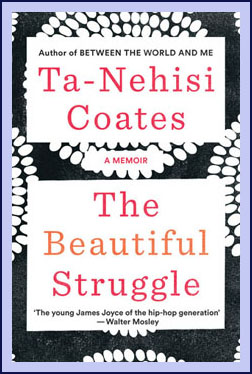
Book Review - Ta-Nehisi Coates's The Beautiful Struggle

The Beautiful Struggle by Ta-Nehisi Coates
Published by: Verso
Publication Date: 2008
Format: Paperback, 227 Pages
Rating: ★★
To Buy

Baltimore was collapsing around him as Ta-Nehisi grew up. But in an age of decline you can always find a way to survive and, perhaps, thrive through the cracks even during a crack epidemic. You just need to have a goal and to have the knowledge, or, as his brother Big Bill would say, the "Knowledge;" the ability to survive in a culture of violence. These were lessons his family taught Ta-Nehisi well. His father, Paul, believed strongly in education and in raising his sons to be proud black men despite a society that points to those very black men as the problem. Even though people like to think of the seventies and in particular the eighties in America as some sort of economic renaissance, America was, and still is, a deeply racist country, stigmatizing those of color, and Paul knew that this knowledge was paramount to the raising of his sons, and maybe that's why he was so hard on them, he would never let his sons forget this while at the same time making sure they were proud of their heritage. Paul Coates, Conscious Man, was a vet and member of the Black Panthers and an autodidact. He believed in the power of words and language and ran a publishing house out of his basement, the Black Classic Press (BCP), that was committed to distributing the collective stories of the African-American people. But he also had a deputy patriarch with his son Big Bill who helped Ta-Nehisi with the Knowledge. Ta-Nehisi, as seen through the eyes of his family, had an exemplary life ahead of him, if only he'd see his future clearly. Though when Ta-Nehisi starts telling his story, he doesn't yet have a goal, he doesn't have a Mecca, he just wants to survive in an uncertain world. Yet the thing about children is they eventually grow up. But having his father not just encourage but insist on intellectual curiosity paid off. Ta-Nehisi moves beyond the lures of rap culture and basketball and begins to think about what he wants to do with his life and he starts to take his education seriously. He gets into Baltimore Polytech, a magnet school that is his way out of Baltimore and to his chosen Mecca, Howard University. Though Ta-Nehisi isn't as academically gifted as his siblings and is soon kicked out of Baltimore Polytech. But he does eventually reach Howard University, after walking the halls of many a Baltimore-area school. He has struggled to survive in a hostile world and he has made it out. Thanks to his family.

I'm not a big fan of nonfiction in general so I'm not singling out memoirs as something I don't like to read. In fact they're probably the only subset of nonfiction I'm OK with, with notable exceptions. But this is never a book I would have ever picked up of my own volition. The thing is, I don't really like reading about other people's lives. I should clarify, "real" peoples lives. I love me my "fictional" friends. Even people I like and respect I won't often pick up a book about them because I often find out something that colors my opinion of them for the worse. I can't make it go away, so I'm sorry, Nelson Mandela, you gave pictures of your wife and daughters to inmates to masterbate to, and every time your name is mentioned that is the first thing I think of. As for how Bob Geldof lost his virginity... That's best never mentioned. Then there's the disconnect. You're reading about someone's life and you're thinking that for once, you've found someone on the same wavelength as you, and then they say something or do something, and you're just done with them. I will point out that this generally happens for me when reading nonfiction books by female authors when they start talking about having kids. But it's a obstacle that can not be overcome. So I didn't have many hopes going into Ta-Nehisi Coates's memoir. Though this would stand for any memoir. It was interesting. Will I ever read it again? No. Do I respect Ta-Nehisi Coates more after reading about him? Perhaps. He's at least now no longer that guy who wrote the highly lauded Black Panther run but a celebrated author in his own right. What I found most interesting was that he's only three years older than me so we have many of the same cultural touchstones. I saw some reviewers complaining that when he mentioned Star Wars or The Lord of the Rings that it brought them out of the narrative, that it felt like he was trying too hard to show his geek cred and that he was "aware" of white culture. Whereas I thought it was a good framework to help those who are completely ignorant of the privilege that they grew up in that while these cultural moments are moments of connection for all of us we need to look at what else was happening in his life. There is a part of us that is the same but there is a part of him that we can never understand because these aren't our lived in experiences. And that's what made this book for me. That chasam, that gap between white privilege and black power, I felt that he told it in a way that made me connect and that is so rare in a memoir. I might not truly be able to understand his life but I get it if that makes sense. I empathize and applaud.

Wednesday, July 24, 2024

Book Review - Chloe Benjamin's The Immortalists

The Immortalists by Chloe Benjamin
Published by: G.P. Putnam's Sons
Publication Date: January 9th, 2018
Format: Hardcover, 352 Pages
Rating: ★★
To Buy

On a hot summer day in 1969 the four Gold siblings, ranging in age from seven to thirteen, embark on an adventure. Daniel, age eleven, has heard rumors of a woman on Hester Street who will tell you the day that you will die. They have combined their allowances into a bag and head off in search of the woman. For an epic quest she is found quite easily, only they must each face her alone. They never speak of what they learned except once, nine years later, after their father's funeral, when they will be together for the last time. Klara dares her siblings to reveal when they will die. Varya has a long life ahead of her, Daniel will only life to forty-eight, Klara to thirty-one, Simon just says it's when he's young. It is clear that all of them have spent the last nine years dwelling on their fates and this knowledge will forever shape their lives consciously and unconscionably. Simon, youngest sibling and soonest to die, has his life laid out for him. Varya and Daniel went off to college, Klara has always had a weird desire to be a magician, but Simon, Simon is the last sibling at home, taking care of their mother and the family business. But Klara knows that his fate is weighing on him so she offers him an alternative, follow her to San Francisco and live the life he was meant to lead now. He throws himself into dance and hedonism and dies four years later from AIDS, on the day he was told he would die. This shakes the siblings considerably, but seeing as they didn't know his exact date, they can't lend too much credence to it. It's Klara who makes sure her death date is right to continue the augury. Is there any chance for Daniel or Varya to avoid their fates? Or were they given self-fulfilling prophecies? And is it better to burn bright and flame out than exist without really living?

The undeserved success of The Immortalists is why I will never like populist literature. This book wanted to be everything to everyone and failed because the vision and the execution were worlds apart. There is no unifying style, first we have Armistead Maupin shorthand, then magic, then vengeance, then Michael Crichton, yes, I get it, the siblings are vastly different, but a book needs to feel cohesive, and this doesn't. Could we perhaps have had one narrator? An overseer or omniscient being, perhaps one of the siblings that unifies all their stories, not shatters it. Klara is the only one whose voice didn't feel like nails on a chalkboard. She was mystical, magical, she could have been our narrator. After all she believes she can hear Simon after his death, why doesn't she carry the narrative weight? Because as this stands, the only way to really fix The Immoralists would be if each sibling had their own book instead of some shorthand story that is painted in such broad strokes that it doesn't just verge on but is stereotypical. And that is why I loath this book. Take away the fact that the storylines are nothing special and you see that Chloe Benjamin is a lazy writer. She wants readers to connect to a time instead of to a character. She uses cultural shorthand, Forest Gumping her way through the 20th century, so that us readers will connect to their own nostalgia of that time versus bothering to create characters who the readers can connect to on their own. I mean, these siblings literally can not have been there for all these events. Oh, the day they found the fortuneteller was the day of the Stonewall Riots? And the day Simon hooked up with his boyfriend was the day Harvey Milk was shot? Oh, they were listening to Paul Simon's Graceland? Give me some more rampant consumerism in-between cultural touchstones why don't you? Because I know Benjamin has to be shilling for the drug companies and I know she wants some Milwaukee's pickles! She is supposedly now a Wisconsinite after all but does she actually know that Devil's Lake isn't between Chicago and Madison but further north? And that no one has ever referred to Door County as a collection of islands.

Friday, July 19, 2024

Book Review - Dave Itzkoff's Robin

Robin by Dave Itzkoff
Published by: Henry Holt and Co.
Publication Date: May 15th, 2018
Format: Hardcover, 544 Pages
Rating: ★★★
To Buy

Robin Williams' upbringing is perhaps not what you'd expect. He was scholastically gifted and was from an affluent family where his closest companion was the maid in their palatial forty room house. He even got accepted into Julliard where his classmates were Christopher Reeve, William Hurt, and Mandy Patinkin. Though his own comedic style and love of mimicry and accents wasn't exactly what the classical and staid school was known for they could see he was a genius but he left without getting a degree conferred on him. He started his stand-up career in San Franscisco but to really make it you had to go to Los Angeles, so that is what he did. He worked the clubs as well as working whatever television work he could pick up especially during pilot season. Though he was notorious for stealing the jokes of other comedians, no one really thought that this was malicious, he just heard it and didn't know from where and so incorporated it into his act. Which was problematic to the comedians who had actually written the material, because once Robin had done it no one else could use it. But it was a last minute spot on an episode of Happy Days that would change his life. The episode "My Favorite Orkan" was so popular his character of Mork got his own television show. Mork and Mindy was a juggernaut. Everything from magazines to lunchboxes featured Robin's face. Despite it's success and cultural status the show was cancelled after four seasons. But that seemed fine with Robin because he was now chasing bigger Hollywood dreams. He desperately wanted awards and an Oscar. This is where the Julliard training starts to make sense. With The World According to Garp, Good Morning, Vietnam, and Dead Poets Society his serious credits started to roll in. Though it wouldn't be until 1997 and Good Will Hunting that he would get the respect of his peers he had been longing for with an Oscar. In the meanwhile he was making his name as serious business at the box office with films for a younger audience with Hook, FernGully, Aladdin, Mrs. Doubtfire, and Jumanji. But behind the scenes there were issues, and not just with Disney who actually sent him an apology Picasso. He burned through three marriages and had severe addiction problems. At least his addiction to cocaine had a check on it when John Belushi died the morning after they had partied together. But later his alcoholism took a toll. Though it was the Parkinson's diagnose that led to his suicide in 2014 at the age of 63. A blazing talent gone in an instant.

I've never really considered myself a fan of Robin Williams. He was just a fact of life, like death and taxes. He was omnipresent. Or at least for those of a certain age. Growing up in the eighties and nineties he was everywhere; films, television, Comic Relief, there was no getting away from him. And the truth of the matter is, I'd never really thought about it. I had never realized his complete and total omnipresence in my life until I read this book. It's like my childhood paralleled his fame and he was there every step along the way as I grew up. When Nick at Nite started in the mid eighties I watched it religiously. Perhaps six was a little too young to be watching some of the fare, but my grandmother and I watched it together, so my theory was if she thought if was inappropriate she would have turned it off. Now that I'm older I realize she wouldn't have. But there was Robin on Mork and Mindy and Happy Days and SCTV! He was there for my formative years with his manic humor. And no one of my generation can forget the mega success of Hook followed by Aladdin. I can't even count the number of times my friends and I in college got together and just watched Aladdin, well, sang along to Aladdin, just as comfort viewing. As for the number of times I watched Toys... I don't even want to guess, it was one of those films that was so odd that whenever it was on I just watched it all. As I aged I started watching other films of his, my discovery of Kenneth Branagh and Terry Gilliam led to so many favorite films that Robin is in, Dead Again being at the forefront. And I will never forget the time my friend Sara became obsessed with Good Will Hunting and watched it on a loop while recovering from having her wisdom teeth removed. So many memories. In fact it's because of Robin Williams that I will NEVER go to the bathroom during movies. I missed the end of Hook and was traumatized for years. Robin was just in my life, watching movies at home with friends or going out to the theater with my family, he was always there. And this book brought home that fact to me. I'm not one of those people who will forever mourn him. He randomly trends on Twitter because people miss him. I don't. But he was, unbeknownst to me, so much a part of making me me that this book was a very personal experience. Yes, it's uneven and spends the bulk of it's time on his early career and not enough on his fame, but I can forgive it that. I can forgive it a lot of the nostalgia.

Wednesday, July 17, 2024

Book Review - Gene Wolfe's The Fifth Head of Cerberus

The Fifth Head of Cerberus by Gene Wolfe
Published by: Orb Books
Publication Date: 1972
Format: Paperback, 252 Pages
Rating: ★
To Buy

The sister planets of Saint Anne and Saint Croix were founded by French colonists, long since gone, but their influence can still be felt along the streets of Saint Anne. At 666 Saltimbanque Street is a house that the gentlemen of Port-Mimizon are known to frequent. High up in this house lives a young boy and his brother David. Behind the barred windows they can hear the clients down in the garden and up on the rooftop, surrounded by orange trees. Though it is their father and the woman, Madame, they find far more intriguing. One day the boy is brought to his father's study and told he will be called Number Five and visit him nightly to run tests. Previously Number Five and his brother David were taught by Mr. Million, a robot that acted as nanny and tutor, drilling the kids in science and rhetoric and often taking them to the library and slave market. Now that Number Five is older he will also start to pull his weight around the house, they all have their work cut out, his father keeps the girls clean, and now Number Five will be acting as gatekeeper for the brothel. But it's the tests his father puts Number Five through that are destroying him. He suffers immensely and has long blackouts, sometimes lasting months. Number Five finally realizes that he must kill his father, only this has implications for one of their clients. John V. Marsch is an anthropologist who was working on Saint Croix, searching for the lost Annese, the aboriginals of the planet. He came to the house on Saltimbanque Street in search of Dr. Aubrey Veil to ask about Veil's Hypothesis, wherein the doctor posited that the aboriginals could mimic the settlers so completely that they killed them and took their place. Dr. Veil is in fact Number Five's aunt and the Madame of the brothel and this means Marsch often visits resulting in him being arrested for the murder Number Five commits. While stuck in prison Marsch chronicles his imprisonment and his research on Saint Croix. He even assembles a story about the early aboriginals. Yet how could a man born on Earth know so much about a culture that has moved into the back of beyond if it even exists? The answer might lie in Veil's Hyposthesis and the young man, V.R.T., who claimed to be half-aboriginal and whom Marsch hired to take him out into the wilderness for years. In a future world where cloning is possible does it seem that far-fetched that shapeshifters could exist too?

There are books that people go back to and read over and over again because they feel like they keep missing something the last time they read it. They feel that the book hides new discoveries that will be revealed to them one day if they are patient enough and work for it. While I am a proponent of rereading a book on the other hand if the book is elliptical and dense and just too much work to read it the first time I think it is the definition of insanity to attempt to read it again. And that is how I feel about The Fifth Head of Cerberus. It's dreamlike, it's dense, and whatever it was trying to tell me, well, I don't care to find out because reading every single line in this book was painful. I finished it. I did that much at least. But I just don't get it. Because while the structure of the three connecting novellas initially works, what increasingly annoyed me was that this book felt less and less like something written with an audience in mind and more and more like a writing experiment that Gene Wolfe did to entertain himself. I'm all for experimentation in writing, but at the end of the day you still have to be able make it intelligible. The elliptical writing that purposefully omits details, jumping around in the timeline without reason, and then not bothering to write full sentences, and randomly changing the narrative voice, this does not make me a happy camper. And as for the "dreamquest".... If I had wanted to read bad origin myths like I was forced to read as a freshman in high school where a lady was trying to have sex with a worm but it turns out it was a stick, well I would have gone back and read that book again, you know, for nostalgia. I would not have chosen this. In fairness, Gene Wolfe perfectly aped that style of writing so on one level it succeeds, on another it just drove me crazy. Plus there are so many big moral issues handled in such a clumsy manner. We have cloning, slavery, sex work, and all of it is just part of the world and not really a problem. Well, to me it was a problem. When the only woman of power is a famous doctor who ends up working as a madame and all the other women are sex slaves to men we have issues. But issues that I will not delve further into because I will never pick up this book again to peal back the layers of the onion as it were.

Friday, July 12, 2024

Book Review - Neil Gaiman and Terry Pratchett's Good Omens

Good Omens by Neil Gaiman and Terry Pratchett
Published by: HarperTorch
Publication Date: 1990
Format: Paperback, 412 Pages
Rating: ★★★★
To Buy

Crowley and Aziraphale have quite literally been there since the beginning. Man, woman, garden, snake. Crowley was the snake, Aziraphale was wielding the flaming sword while guarding the gates of Eden, but please don't ask about where the sword is now. But nowadays Crowley has the car and the suave clothes that befit his side while Aziraphale collects books. What else is there to do when you're waiting for the world to end? The Nice and Accurate Prophecies of Agnes Nutter, Witch predicted it all back in 1655. And that's not the nice that indicates the end of the world next Saturday is a good thing, it's the other, more "precise" kind. It's going to happen. Everything has been put in place, the "horsemen" are assembling, the time has come for the uprising of evil to herald the end of days. If only there hadn't been that little mix up with the son of Satan a few years back. Because if things had gone to plan it would have been a nice and smooth end to the world, instead it's complicated. Of course some of that was on purpose. Crowley and Aziraphale aren't sure whose side they're on because they rather like the world as it is, even if any tape left overly long in a car will start blaring Freddie Mercury and Queen. So they formed a plan. Crowley was meant to switch the son of an American diplomat with the Antichrist. Which he did. He and Aziraphale then posed as benevolent beings in this boy's life so that good and evil had an equal chance when the end days came. But not even their plan has gone to plan because the baby was switched again. Because the real Antichrist is a boy named Adam Young who has grown up in the perfect idyll of Lower Tadfield, Oxfordshire. Which means now that the Apocalypse is nigh the race is on to find the real Antichrist. But Crowley and Aziraphale aren't the only ones looking for Adam. There's Anathema Device, the descendant of Agnes Nutter, and Newton Pulsifer, a descendant of the Witchfinder who burned Agnes at the stake and the only current recruit to the Witchfinder Army. With time against them they all end up working together in ways they never would have thought. But can you go up against a witch who always knew what was going to happen? Or can you thwart the omens?

I first picked up Good Omens when it was rumored that Neil Gaiman would be stopping by the 2011 North American Discworld Convention here in Madison, Wisconsin. I found it kind of lacking. Too many characters, too many dated jokes, an ending that was more whimper than bang. I love Gaiman and Pratchett but I was not sure I loved them together. Then Neil made his magnificent appearance with Pratchett and their stories, their friendship, breathed new life into the story for me. I could see what they were trying to do which didn't really happen for me when reading the book. I was too busy figuring out who was who and who wrote which section. After that talk I decided that I should, in the near future, reread it with this newfound appreciation. Of course given my reading habits the near future turned into eight years. But at least it wasn't a whole decade! The main reason I picked it up again is because the book had been adapted by Amazon and David Tennant and Michael Sheen were starring as Crowley and Aziraphale, a more perfect casting I could never imagine. So I reread the book and I enjoyed it doubly as much as I previously did. I still had issues, I still think there are too many characters and sometimes the little vignettes staged to get a certain joke across instead of adding to the narrative take away from the overall structure of the book. Because this book doesn't flow. It's setup after setup and some work and some don't. Which leads me to inevitably talk about the adaptation, which did a good job of fixing some problems while adding in new ones. Who hired Frances McDormand to narrate? She was horrible. But ignoring Frances McDormand, which I admit is hard to do, the adaptation was the opportunity to fix the book and, for the most part, fix it they did. In particular the third episode "Hard Times" which chronicles the friendship of Crowley and Aziraphale through the ages is one of the best hours of television you will ever watch. It is two people who are genuinely friends playing two characters who, despite being on opposite sides of the celestial war, are genuinely friends. It ALL comes down to friendship, and that is a good thing.

Wednesday, July 10, 2024

Book Review - Michael Chabon's The Amazing Adventures of Kavalier and Clay

The Amazing Adventures of Kavalier and Clay by Michael Chabon
Published by: Picador USA
Publication Date: September 19th, 2000
Format: Paperback, 639 Pages
Rating: ★★
To Buy

In 1939 Europe isn't safe if you're Jewish. Josef Kavalier lives in Prague but is unable to use the travel visa his parents obtained for him due to the ever changing policies of the Nazi Party. "Joe" was studying escapology and his teacher, Bernard Kornblum, has a plan. To smuggle Joe out with the Golem of Prague, a prize the Reich desperately wants. Concealed in the coffin Joe eventually makes his way to New York City and his cousin Sammy Klayman. Joe's one mission on reaching New York City is to find a way to get his family to join him. This requires money. Upon learning of Joe's artistic abilities as well as his knowledge of escapology, Sammy comes up with a plan that he pitches to his boss, Joe and Sam, under the moniker Kavalier and Clay, are going to write a comic, The Escapist. The Escapist will fight Fascism and punch Hitler in his ugly mug and laugh in the face of Germans with his Golden Key that lets him escape any bonds. But the creators of the comics, while decently paid, often didn't get the monetary rewards or fame they deserved. Even when the comic makes the leap to radio. The cousins grow frustrated. Joe has his family to rescue and a girl he's fallen for, while Sam has literary ambitions and is coming to grips with his sexuality, awakened due to the voice actor who plays the Escapist. These aspects of themselves and their desires play out in the worst way possible. Joe's family dies. Even his younger brother, Thomas, whom he had managed to get out of Europe. Thomas's boat, The Ark of Miriam, was bombed by a German U-boat and he now lies dead on the ocean floor. Meanwhile Sam is involved in a police raid on a getaway with several other homosexuals. He is violently assaulted and raped by FBI agents. When he finally makes his way back to New York City he finds that Joe is gone, he's enlisted in the Navy, and his girl, Rosa, is pregnant. Sam's trauma after his assault makes him sublimate his homosexuality and he wants to live a "normal" life. A nice nuclear family in the suburbs with a white picket fence. Which is what he offers Rosa. They can marry and raise little Tommy as their own. Only they will know the truth. That is until one day when Joe finally returns to their lives. Will Kavalier and Clay reunite or will all their lives once again implode?

I have repeatedly tried to embrace Michael Chabon and I just can't. There's no doubt he has immense talent as seen in his stunning prose. I just don't like what the prose are about or how they're structured. And I really think that it's not just his writing I dislike, I dislike him as a person. But it hasn't evolved to the hate I hold for his microdosing wife. So yes, applaud his use of obscure and verbose language, which, coming from Columbia University leads to Pulitzers, but coming from me, is a backhanded compliment. You shouldn't need a dictionary to read a book. And the thing is, I really tired with this book. I really really did because it's one of my friend's favorite books and to just have to say it wasn't for me left my stomach completely tied up in knots. Seriously, the stomach acid produced was extraordinary. I had to see my doctor. But this mix of magical realism and historical fiction with a weird Lovecraftian sidequest just didn't work for me. Though what it really came down to is Jack Kirby. It would not be hyperbolic to say that comics as we know them would not exist without Jack Kirby. Kirby, with the occasional assist from Stan Lee, co-created some of the most famous superheroes that now make up the MCU, from Captain America to Thor to the X-Men. With Joe Simon he created the single most famous comic book cover of all time; Captain America punching Hitler. That cover was published in March of 1941, nine months before the United States finally entered WWII. And for many it felt like the call to arms it was. But also a shocking statement from an unexpected source, a Jewish comic book artist. Kirby died in 1994 and tragically his later years were spent fighting Marvel to exert control over properties he had created. A struggle that his children continued. Marvel wanted to consign Kirby to history while Stan Lee "hijacked" Kirby's legacy to embolden his own and become "the man." The only way to sum up Kirby's legacy is that he was done wrong by. Therefore I have major issues with this book. I know that in his afterword Michael Chabon states that he wants "to acknowledge the deep debt I owe in this and everything else I've ever written to the work of the late Jack Kirby, the King of Comics." So, you were so in his debt that you did what everyone else had done before and hijacked his life to create your fictional story!?! You had other artists creating his Captain America cover when real comic book artists appear in this book. You could defend Chabon by saying that his characters are an admixture of several real life comic book artists... And yet he singles out Kirby. Chabon, I don't care who or what you are but you done wrong by Kirby and therefore you done wrong by be.

Friday, July 5, 2024

Book Review - Mark Dery's Born to be Posthumous

Born to Be Posthumous by Mark Dery
Published by: Little, Brown and Company
Publication Date: November 6th, 2018
Format: Hardcover, 512 Pages
Rating: ★★
To Buy

In 1980 the world became aware of Edward Gorey. His unique style of pen and ink drawing with only a splash of read suited Masterpiece Theatre's spinoff, Mystery!, to a tee and everyone was watching. The opening credits animated by Derek Lamb are iconic. What's more the sets the various hosts used were designed by Gorey, much like his Broadway production of Dracula three years earlier for which he won a Tony. He became known as the king of the macabre. Without him there would be no Tim Burton, no Neil Gaiman, no Lemony Snicket, though perhaps we could have done without Lemony Snicket. His cultural impact has not waned since his death in 2000. Thanks to the Edward Gorey Charitable Trust and Pomegranate Communications his name and his work are constantly available. But while he really came to the forefront thanks to PBS he had been making a name for himself in New York since the fifties. The young Gorey was a prodigy, growing up throughout the Chicago area. His scholarships to various Ivy League schools had to be deferred due to the war and he served at the Dugway Proving Ground in Utah. In 1946 he finally entered Harvard majoring in French Literature, because if you're going to read the great and melodramatic French novels you have to read them in French. In an interesting twist of fate he would room with Frank O'Hara who would also go on to be a darling of the literary world. But it wasn't just books that interested Gorey, it was all art, theatre, ballet, poetry, prose. His academic career was rocky, it all depended on if he was interested at the time in what he was doing. When he was he'd be on the Dean's List, when he wasn't, he was threatened with expulsion. His actual training in art was negligible. But that is what he'd go on to be known for, not writing some obscure commentary on French Literature. After college he got a job illustrating book covers for the Art Department of Doubleday Anchor. Covers that are iconic to this day. Especially his vibrant cover for The War of the Worlds. At the end of his tenure there he started to publish little books indepently. Some under his own name, some under cunning psdeynoms and anagrams. Through the Gotham Book Mart he became a bit of a celebrity to those in the know. He was also a man about town, always seen at the New York City Ballet where Balanchine was king. Eventually he settled on Cape Cod where this now internationally famous artist spent time with his cats and making stuffed figures to sell at the local theatre. But no one can say he didn't leave his mark. If only sartorially.

If you want to read about Edward Gorey, this book isn't for you. Literally pick up any book by Edward Gorey and you will get more concrete information and entertainment out of it than this volume. But if you want to read about an author projecting his suppoistions, speculations, and downright crazy conspiracy theories on their subject, then this book is for you. Because Mark Dery has written a book his subject would hate. He has taken a complex and fascinating intellectual and decided to focus on Edward Gorey's sexuality. Hundreds of pages questioning if Gorey was or wasn't gay. It's like Mark Dery needed to make Gorey gay. But more than that, he didn't just want Gorey to be gay, he wanted him to be the victim of sexual assault by the clergy as a child. At least he admits it's pure speculation but he claims that the ominous nature of the clergy in Gorey's stories coupled with the abuses of the Catholic Church in Chicago when Gorey was growing up point to his insights as being accurate. What the fuck? It's one thing to postulate on sexuality, it's another to just wholey fabricate something in a biography without any kind of proof. And I will point out that in Gorey's work, everyone, not just the clergy, are menacing. It's kind of Gorey's M.O. But more to the point is that in a book that is 415 pages long minus the acknowledgements, references, and endnotes, it took Dery until page 410 to include a quote from an interview Gorey did in 1980 with Boston Magazine wherein he said "Well, I'm neither one thing nor the other particularly... I suppose I'm gay. But I don't really identify with it much." HE SAID HE WAS GAY! AND YOU, MARK DERY, KNEW IT! For 99% of this "biography" you made me listen to your speculations when you knew. YOU KNEW! You wrote about something that wasn't even a something. Gorey is an icon, and yes, him being a gay icon is important, but just use HIS WORDS not your fabricated suppositions. But then again, by the end of this book I didn't trust the author at all. He refers to Gorey's work as etchings, which they are not. He should show us the pictures instead of badly describing them but we only get twenty-six badly reproduced pieces completely out of context. And I'm sorry, but I too watched that Dick Cavett interview, and he wasn't fawning over Gorey and his work, he had no freaking idea who Gorey was and Gorey knew it. The only positive to reading this book is it enraged me so much I went back and read all the Amphilgorys and fell in love with Gorey and his work all over again.

Wednesday, July 3, 2024

Book Review - Madeline Miller's Circe

Circe by Madeline Miller
Published by: Little, Brown and Company
Publication Date: April 10th, 2018
Format: Hardcover, 393 Pages
Rating: ★★
To Buy

Circe's family is divine. Her one companion is her brother, Aeëtes, who is also shunned by their mother. But soon Circe is alone, Aeëtes sent far away, just like all her other siblings. In despair she falls for a mortal, Glaucos. Knowing that she can never have a life with a mortal she begs her grandmother to transform her love into a god. Her grandmother can not help. So Circe uses a secret her brother Aeëtes found and transforms her love using pharmaka. He is welcomed into the family with open arms but he is married off to Scylla, not Circe. Circe once again uses pharmaka and transforms Scylla into a monster. Her own father, Helios, doesn't believe that Circe is that powerful. But Aeëtes does. He tells their father that he and his sister are pharmakis. Witches. Due to willingly searching out pharmaka, which are magical herbs that grow from blood spilled when the Titans and Olympians battled, Circe is exiled to the island of Aiaia. There she hones her craft and luxuriates in the freedom of exile. No longer alone among her family but alone with herself. Though Hermes brings her distressing news, Scylla is the terror of the seas. When the opportunity arises to leave her island she tries to stop Scylla but just sees the horror she has wrought. More horror awaits her as she acts as midwife to her sister who births the Minotaur. Returning to Aiaia she is lonelier than ever, though family occasionally pass through. Always with demands. But at least they don't pose the danger of man. The captain of a lost ship rapes her. She starts taking the precaution of turning all sailors into pigs. But Odysseus is different. He's smart and witty and a born storyteller. When he finally departs she is pregnant with his child, Telegonus. She hides him away for years and years until he builds himself a boat and goes and kills his father. Accidentally. When he returns home he brings with him Odysseus' wife, Penelope, and her son, Telemachus, seeking her protection. But perhaps her island isn't a refuge but a crutch. A place to hide from the world. Now, perhaps, with Telemachus by her side, she might see the world.

Every once in awhile I have this almost uncontrollable urge to read Homer. In recent years this is because Tasha Alexander's wondrous creation, Lady Emily, is always espousing reading him. In the original Greek. And if there's one person in life that it wouldn't be bad to emulate, it's Lady Emily. She's smart, witty, and well educated. Something we all wish we were. This is one of the reasons I was so excited to read Circe. Here I could dip my toe back in the Aegean while getting to see Odysseus through the female gaze. And while I wasn't the member of my book club who mentally checked out as soon as there were people with blue skin, I quickly remembered why I don't read Homer. I hate Odysseus. With a passion. I don't know what makes me forget this information and then keep trying to reread the Odyssey, but it's a hate the likes of which Mrs. White would sympathize. I read the Odyssey in freshman English and I detested it. Odysseus is just everything wrong with men. I just can't with him. The first time I fooled myself into thinking that I couldn't have hated the Odyssey as much as I thought was when NBC did a prestige miniseries in 1997 staring Armand Assante and Greta Scacchi. The real reason I was interested in it is because Jim Henson's Creature Shop did the special effects but that's just extraneous information. I didn't make it through the miniseries. I don't think I even made it through part one. And Odysseus is the reason I didn't like Circe. This isn't her story. It's his. And his. And his. And his. There is no insight into her unless you call a woman's entire life being formed around the men in it revolutionary, well, then I guess that's an insight, but personally I'd say, welcome to womanhood... Especially around 12th or 13th century BCE. I just can't understand why people are saying this is such a powerful and feminist book. Did we read the same book? Because her life is blighted by men and in the end she sacrifices everything for a man and it's never about her it's about them. This is just the Odyssey from another point of view without any depth. I don't care if there are blue skinned people, I don't care if Odysseus had to make a cameo, I do care that this is being praised as revolutionary writing when it's just the same old thing. This could have been something. But it wasn't. Stop deluding yourself that it was.

Friday, June 28, 2024

Book Review - Robert Macfarlane's Underland

Underland by Robert Macfarlane
Published by: W.W. Norton and Company
Publication Date: May 2nd, 2019
Format: Hardcover, 496 Pages
Rating: ★★★
To Buy

Humankind has had such an impact on the world it is now a designated epoch, the Anthropocene. Robert Macfarlane takes it on himself to look at the forgotten realms of the Earth and see how they have been impacted by humankind and in turn how they have impacted us. Macfarlane takes eleven journeys to come to grips with the underland. Because that is where our history is, in deep time. With all that history laid bare the question is posited, are we really the caretakers that the Earth deserves? Humans have been around for such a short amount of time and yet the damage we have done is incalculable. Starting near his home his first journey takes him to the cave systems in the Mendips in Somerset. There he wonders if the Earth might just swallow him whole. The mental strain of the dangers he's about to face become apparent. He's not just taxing himself physically on these journeys, but mentally. He is placing himself at the mercy of the Earth and the Earth isn't kind to those who journey where they shouldn't. In Boulby, Yorkshire, he visits a mine that's so deep that it goes under the North Sea where Dark Matter is studied. So far underland as to be undisturbed by the disturbances of man. But the underland can also be studied above ground. The trees of Epping Forest have an understory beneath the forest that lets them communicate using fungi, a wood wide web if you will. Having experienced in England some of the great natural and manmade conduits to the underland he visits France and perhaps one of the most famous underground spaces in the world, the Paris Catacombs. There are the sections that are for tourists, but that isn't what he's interested in. He's reached out to urban explorers, those who map the terrain of abandoned buildings and have therefore taken a great interest in the Catacombs. Those who illegally tour the mines of Paris which were built for the access of workers are called cataphiles. They take Macfarlane on a journey he will never forget. Rooms that haven't been seen in hundreds of years and modern graffiti that seems to exist solely to say, I was here. The underland is vast, there are starless rivers, nuclear dumps, caves that can only be accessed at certain times of the year. Robert Macfarlane tasks himself to record it all, to pass on what he's learned, and to teach us to be better stewards of this amazing planet.

For me I had a problem with a disconnect between what this book was sold as and what it actually is. Underland was said to deliver "an epic exploration of the Earth's underworlds as they exist in myth, literature, memory, and the land itself." What I really connected to in that teaser was the myth and literature part. Which Robert Macfarlane never really addresses. I mean, come on! Book girl here wants to hear all about the underworld in literature. He barely touches on Alice's Adventures in Wonderland, and that one is just a gimme! What about all the tales of the realms of fairies being underground? Underhill anyone anyone? Bueller? Bueller? Fairy Mounds? Fairy Forts? I mean seeing as this book is about the magic of the Earth and what it means to people I think an exploration of how we've peopled that land in our myths and fairy tales would be quite important. But again, the book was sold as something it was not. The problem being my expectations were repeatedly crushed. I kept thinking, oh, the next section, that will be the section I've been waiting for. And if never was. Therefore I think that this book would be better on a reread. I'd have no expectations because I know what it's about and they'd be reigned in. The problem is I'm rather claustrophobic, and well, I don't know if I could read this book again. If there's one thing I'd tell anyone who was about to read this book, besides ranting about literary tradition being omitted, is that if you are even slightly claustrophobic you can not read this book. My Dad has a friend who told him he had to read this book, knowing that my claustrophobia is nothing compared to my Dad's, I laughed and laughed and said he can never read this book. Ever. I even thought, maybe I could find a section he could read... But no. Claustrophobics, run away run away. And I just realized I reached the point in my review where I'm just doing odd movie quotes so will move this along, no more Monty Python. The other problem I faced was while this is a whole interconnected narrative it's basically broken down into stories. Short stories. I don't really like short stories. There's no consistency. So while I loved "Invisible Cities (Paris)," "Red Dancers (Lofoten, Norway)" left me cold. The journeys he went on were so diverse that his writing style was inconsistent and annoying. To me. I can see why others found it magical, I just found it highly competent. Which, trust me, is a compliment.

Older Posts Home