Showing posts with label Hot Fuzz. Show all posts

Wednesday, September 25, 2024

Scott Pilgrim Takes Off

Scott Pilgrim is a bizarre cultural anomaly. Edgar Wright made the most Edgar Wright film in the history of Edgar Wright and suddenly everyone knew who Scott Pilgrim was, making it a cult classic if not a box office success. The star studded movie brought the beloved characters from Bryan Lee O'Malley's comics to life in a way that incorporated their comics origin. Problems and all. And that's the thing. Behind all the whip pans and utterly surreal cameos, Scott Pilgrim vs. the World is a problematic film. Not even touching the whole Scott's dating a teenager whom he then cheats on, he and Ramona have no chemistry, the League of Evil Exes don't really explain their endgame, and it's misogynistic overtones and "girl fight" just plain haven't aged well. Scott Pilgrim is an underdog hero who you actually don't like that much. Which makes it an odd choice to readapt as a cartoon. In this day and age. With the entire original cast from the movie doing the voices of their characters for the English language version. Many people, me included, assumed that Scott Pilgrim Takes Off would just be an animated retelling of the movie, which, to be honest, I had no interest in. Therefore I was planning on skipping it. And then I read a major spoiler, Scott Pilgrim dies. Though dies should be "dies." Which made me instantly want to watch it. Because this show is basically launching the Scott Pilgrim Multiverse. AKA a Multiverse I could get behind. And I can see Bryan Lee O'Malley's point. They didn't want to retell the same story, just as I didn't want to watch it. This refocuses the narrative on Ramona and actually develops her character beyond just being a plot device. She's a three dimensional character who goes on a journey of discovery and confronts her exes and helps them and herself to move on. This is about letting go of all the emotional baggage you hold on to. It's about finding out who you really are and what drives you and what makes you run. I never thought in a million years to find a Scott Pilgrim adaptation to be deep and meaningful and yet, here we are. Don't get me wrong, it's still bonkers crazy. In fact at times it's a bit too frenetic with fights and music and all the meta. I mean, seriously, all the meta is insane. From Simon Pegg and Nick Frost having a random Hot Fuzz reunion to Edgar Wrong to ultimate vegan powers to Knives finally having a purpose and the musical deep cuts. There was just so much going for it and yet at the same time I kind of feel I've moved beyond Scott Pilgrim. This show gave me closure. The film and what it meant to me at that time in my life is over and done with but I liked revisiting old friends and not having to cringe at their behavior. I'm not saying I'll never watch or read Scott Pilgrim again. In fact the books have kind of been calling to me to incorporate the present and the past. But for now I'm good.

Wednesday, April 17, 2024

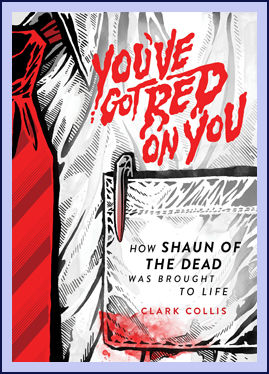
Book Review - Clark Collis's You've Got Red on You

You've Got Red on You: How Shaun of the Dead Was Brought to Life by Clark Collis
Published by: 1984 Publishing
Publication Date: November 23rd, 2021
Format: Hardcover, 424 Pages
Rating: ★★★
To Buy

Shaun of the Dead is one of those films like Twister that whenever you catch it on TV while flipping the channels you can't help but keep watching it. The humor, the pacing, the pathos, the music, everything is perfection. I dare you to listen to "Don't Stop Me Now" without wishing you had a pool cue in your hand. Of course it wasn't an easy film to make. At the time Edgar Wright and Simon Pegg were only known for their quirky cult comedy Spaced and here they were pitching a major motion picture that was very zombie niche. In fact, they would have been happy had this film only had an audience of one if that audience was George Romero. And if he liked it. They really wanted him to like it. This was an epic love letter to the man and the aesthetic he had created. But it took a lot of convincing to get everyone on board with their vision. At times the studio was pushing for "names." Which means, in an alternate universe Nick Frost isn't in this film but for some reason Gillian Anderson is. Which could have been a little awkward given how Tim Bisley felt about Dana Scully.... With new interviews from the cast and crew and complete access to Edgar Wright, You've Got Red on You shows a detailed behind the scenes picture of how this zomromcom came to life. The long hours shooting without air conditioning. The people whose entire job was just to maintain blood spatter continuity. What it's like being covered in blood spatter in that heat. The fact that David Bowie was really "funny" about the Labyrinth soundtrack and therefore a zombie was attacked with the Batman Soundtrack instead. I mean, Prince was their first choice, but it didn't hurt to have a backup. And then once the film was wrapped, would anyone watch it? Thankfully George Romero approved and anything else was a slice of fried gold. They didn't realize though that it would be so successful. But this was down to clever marketing. In order to break the US the trio of Pegg, Wright, and Frost toured the US. They did an old fashioned hard sell going town to town, and because of this they didn't just create a fanbase, they created true fans. Fans that would come out on their next two tours when they promoted Hot Fuzz and The World's End. Fans that would repeatedly buy all the different versions of the film that were released and would follow them to the ends of the Earth. Or at least to the pub on a Sunday afternoon.

I don't know how I first heard of Shaun of the Dead, I'm guessing a trailer before another movie in the summer of 2004, but I was an early convert. I was a member of the "Shaun Street Squad" which was a website designed to spread the word about the film and where you could earn sweet sweet swag by doing fan art and fanfic. And yes, I actively participated, cashing in my points for a pint glass and then some. And then opening day I was there in the theater having dragged my friend Matt along with me to see this film everyone was talking about. After that first viewing I became an acolyte of Simon Pegg's. Spaced, Hippies, Asylum, Randall and Hopkirk (Deceased), and branching out, Black Books, and Little Britain, where Monty Python, Red Dwarf, and Blackadder were my formative years of British sitcom, Simon Pegg came in to inform my early post college years. So I had one question going into this book, could it give me any revelations? The answer is not really. Aside from David being written for David Walliams, which makes everything make sense to me. But it's such a well laid out and eminently readable history of the film that a lack of anything new didn't really bother me. It was also, for the most part, pretty unbiased, showing Edgar warts and all with an ongoing feud he had with the director of photography David Dunlap. And while Edgar admits to this feud Edgar himself might be the only real problem with this book in that it was Edgar's voice that was predominate. His view of how things happened. Yes, others were interviewed, but Edgar's voice and Clark Collis's reverence for him carried the narrative. And as for Collis.... It's his inferences in the end that make the book not achieve it's full potential. Because in the final analysis the author places too much cultural importance on Shaun of the Dead. Yes, it's was culturally important in bringing about the more romcom side of zombies, but was it THE REASON that zombies because popular again? No. That would be 28 Days Later and The Walking Dead comics, which were released in 2002 and 2003 respectively, whereas Shaun of the Dead was released in April 2004 in England, us in the states had to wait for a fall release. Also, I found it odd that Collis never once mentions iZombie which in comic and televisual form were both heavily influenced by Shaun of the Dead. And of course THE MOST IMPORTANT FACT was omitted from this book. Because of Shaun of the Dead we got Hot Fuzz, perhaps the most perfect movie ever.

Friday, February 16, 2018

Book Reveiw - Emily Brontë's Wuthering Heights

Wuthering Heights by Emily Brontë
Published by: Modern Library
Publication Date: 1847
Format: Hardcover, 400 Pages
Rating: ★★
To Buy (different edition than one reviewed)

Mr. Lockwood has rented Thrushcross Grange in Yorkshire as an escape from his hectic London life. Being an amiable man he is perplexed by his landlord, Heathcliff, who is standoffish and lives a remote life with an odd household at Wuthering Heights. After being trapped the night at Wuthering Heights Lockwood beseeches his housekeeper at Thrushcross Grange, Nelly Dean, to tell him the tale of Heathcliff and the other residents of Wuthering Heights. Nelly agrees, because she remembers it all, starting thirty years earlier when Mr. Earnshaw lived at Wuthering Heights with his son Hindley and his daughter Catherine. After a trip to Liverpool he returned with Lockwood's landlord, Heathcliff, a foundling to incite the jealousy of Hindley and the love of Cathy. When Mr. Earnshaw finally died and Hindley returned home with his new wife it was time to enact his revenge on Heathcliff, banishing him to the stables as a lowly servant. Before Hindley's return Cathy thought that she and Heathcliff would never be parted, but soon she is betrothed to Edgar Linton of Thrushcross Grange claiming she could never marry Heathcliff because it would degrade her. Heathcliff leaves Wuthering Heights and only returns once he is a wealthy man and seduces Edgar's sister for revenge. Death soon claims Cathy and then Hindley and the feud goes to the next generation fueled by Heathcliff. But can love come back to a place where hate has flourished?

The problem with reading a book like Wuthering Heights is that this is a book that has been adapted to death, and I've watched them all. From the Laurence Olivier adaptation that eliminated the second generation for expediency and a stab at a happy ending, to the 1998 version solely watched for Matthew Macfadyen as Hereton Earnshaw, to the badly bewigged Tom Hardy in the only version I actually like. I've seen them all. Each one brought a new perspective and a twist with their interpretation of the text, so that going back to the source I found that nothing new was brought to the table. I'd seen it all and not to throw too much shade at Emily Brontë, but her framing device of narrators within narrators akin to Mary Shelley's Frankenstein feels a bit forced. But yet I needed to read it. The reason I finally decided to read Wuthering Heights was that I had been meaning to for so long it seemed like a glaring oversight and might be considered as the book in longest residence on my "to be read" pile. I had years earlier picked up the book and made it through a few chapters of Lockwood's overwrought rambling only to put it down and forget about it. In the intervening years I had read all of Anne Brontë's work, re-read Jane Eyre more times than I can count, and started viewing Anne as the most talented of the Brontës, but I couldn't secure her the title without finally giving in to a reading of Emily's one prose piece. PS, if the star rating didn't tip you off, Anne wins.

The main problem with Wuthering Heights is that you quite literally hate everyone. These are not nice people. I mean they are SERIOUSLY NOT NICE PEOPLE! They are threatening to murder each other daily and that's what, OK? Is that supposed to show the strength of their attachments? And that is somehow supposed to translate into one of the greatest love stories ever? Hell no. It's dysfunction city. There's a reason why when Thursday Next is assigned to help council the characters in Wuthering Heights in her third adventure, The Well of Lost Plots, that it is a comedic highlight, because these people SERIOUSLY need counseling. All books need you to have someone worth rooting for, and I can't think of a single character I would like to spend one minute with. Even the "nicer" characters at Thrushcross Grange are lured into Heathcliff's world of revenge and hate and tainted by association. The second generation doesn't get a pass either, they are so passive that by letting this happen they are continuing the cycle. Yes, with Heathcliff eventually gone there's a tiny little ray of hope at the end. But is it really hope? Hundreds of pages of hate and rage and passion, because I don't think we can call it love, and once the house has been exorcised of Heathcliff everything can be fine? Nope. Burn that house to the ground and move far far away.

Yet there is a reason this is a classic. And no, I don't think it's because of anything to do with the characters or the plot. It might have to do with the passion, because it was rare for a book then to show such cruelity and be so harsh while in the throes of so-called love. But I think the only real reason it survives is two fold, one is the connection to this great literary dynasty that is the Brontës, but secondly, in among the dross, there are lines of sheer beauty. Emily was a poet, she was not a prose writer, so it makes sense that she can capture beauty and emotion in a single line that she couldn't accomplish with chapters and chapters of storytelling. In chapter nine is perhaps the best example of what Emily could do when giving full reign to her powers: "It would degrade me to marry Heathcliff now; so he shall never know how I love him: and that, not because he's handsome, Nelly, but because he's more myself than I am. Whatever our souls are made of, his and mine are the same; and Linton's is as different as a moonbeam from lightning, or frost from fire... I cannot express it; but surely you and everybody have a notion that there is or should be an existence of yours beyond you. What were the use of my creation, if I were entirely contained here? My great miseries in this world have been Heathcliff's miseries, and I watched and felt each from the beginning: my great thought in living is himself. If all else perished, and he remained, I should still continue to be; and if all else remained, and he were annihilated, the universe would turn to a mighty stranger: I should not seem a part of it.—My love for Linton is like the foliage in the woods: time will change it, I'm well aware, as winter changes the trees. My love for Heathcliff resembles the eternal rocks beneath: a source of little visible delight, but necessary. Nelly, I am Heathcliff! He's always, always in my mind: not as a pleasure, any more than I am always a pleasure to myself, but as my own being"

Though for all the beauty, all the evocation of emotions in this one section, easily the most quoted of all, there are pages and pages of limp prose. Just unintelligible horrible writing. In particular there is Joseph; an elderly servant who lacks all humanity and is therefore very religious. The problem with Joesph is his stupid dialect. Yes, dialect is important, it gives the reader a feeling for the time, the place, and the character. But bad dialect, or dialect used improperly can ruin a novel. Look to The Secret Garden, the children use the broad local dialect to mock the servants cruelly, yet for some bizarre reason we're supposed to view this as cute. I don't. It made me hate that book. Joseph's dialect is 100% unintelligible. I quite literally have no idea what he was saying. A dialect should be a compromise to some extent. You need to capture all that I said above, time, place, BUT you have to make it accessible to readers. If you've seen the Red Riding Trilogy you'll understand where I'm going here. Like Wuthering Heights, these are films set in Yorkshire. Now some of the actors went too far with their accents, making them too heavy and unintelligible, then there was Sean Bean, who knows the acting business and made a nice compromise between accent and accessibility. Look to Sean Bean! Because really, Joseph became a joke, like in Hot Fuzz where Karl Johnson as PC Bob Walker is pretty unintelligible and needs a translator, usually Nick Frost's Danny Butterman, but there's the one scene where Bob has to translate for David Bradley as a local farmer because even Danny can't understand him. That's what it felt like here! But it wasn't meant to be funny!

Yet even without all this, even if I hadn't watched all the adaptations and hadn't hated all the characters there is one thing that this book lacked, and that was the element of surprise. At the beginning of the book there is a family tree. This tree gives everyone's birth and death and a quick perusal shows you, wow, yes it shows you everything. All their kids and the marriages, everything. I'm like Patrick Stewart on Extras. Yes, genealogy is to me interesting in books, especially when you start going Game of Thrones epic, but here, with such a small cast of characters, the book is spoiled from page one. Which makes me wonder, was this in the first printing? Because this comes after Charlotte's introduction to the book, so did she maybe add it for spite? Everyone knows Charlotte wasn't a fan of Emily's writing, with rumors being that Emily actually had another finished manuscript that Charlotte burned... so was Charlotte trying to just alienate the readers? Or was it Emily who just felt like everything was a foregone conclusion and that we should know from the start we're in for death and misery... because that's what this book is, death and misery. It has become a classic just by proximity to other great works and really, classics do need to be challenged and re-evaluated, because a hundred plus years later I don't think this book has anything left to give us whereas Jane Eyre and even The Tenant of Wildfell Hall are constantly surprising.

Wednesday, March 8, 2017

Book Reveiw - Emily Brontë's Wuthering Heights

Wuthering Heights by Emily Brontë
Published by: Modern Library
Publication Date: 1847
Format: Hardcover, 400 Pages
Rating: ★★
To Buy (different edition than one reviewed)

Mr. Lockwood has rented Thrushcross Grange in Yorkshire as an escape from his hectic London life. Being an amiable man he is perplexed by his landlord, Heathcliff who is standoffish and lives a remote life with an odd household at Wuthering Heights. After being trapped the night at Wuthering Heights Lockwood beseeches his housekeeper at Thrushcross Grange, Nelly Dean, to tell him the tale of Heathcliff and the other residents of Wuthering Heights. Nelly agrees, because she remembers it all, starting thirty years earlier when Mr. Earnshaw lived at Wuthering Heights with his son Hindley and his daughter Catherine. After a trip to Liverpool he returned with Lockwood's landlord, Heathcliff, a foundling to incite the jealousy of Hindley and the love of Cathy. When Mr. Earnshaw finally died and Hindley returned home with his new wife it was time to enact his revenge on Heathcliff, banishing him to the stables as a lowly servant. Before Hindley's return Cathy thought that she and Heathcliff would never be parted, but soon she is betrothed to Edgar Linton of Thrushcross Grange claiming she could never marry Heathcliff because it would degrade her. Heathcliff leaves Wuthering Heights and only returns once he is a wealthy man and seduces Edgar's sister for revenge. Death soon claims Cathy and then Hindley and the feud goes to the next generation fueled by Heathcliff. But can love come back to a place where hate has flourished?

The problem with reading a book like Wuthering Heights is that this is a book that has been adapted to death, and I've watched them all. From the Laurence Olivier adaptation that eliminated the second generation for expediency and a stab at a happy ending, to the 1998 version solely watched for Matthew Macfadyen as Hereton Earnshaw, to the badly bewigged Tom Hardy in the only version I actually like. I've seen them all. Each one brought a new perspective and a twist with the interpretation of the text, so that going back to the source I found that nothing new was brought to the table. I'd seen it all and not to throw too much shade at Emily Brontë, but her framing device of narrators within narrators akin to Mary Shelley's Frankenstein feels a bit forced. But yet I needed to read it. The reason I finally decided to read Wuthering Heights was that I had been meaning to for so long it seemed like a glaring oversight and might be considered as the book in longest residence on my "to be read" pile. I had years earlier picked up the book and made it through a few chapters of Lockwood's overwrought rambling only to put it down and forget about it. In the intervening years I had read all of Anne Brontë's work, re-read Jane Eyre more times than I can count, and started viewing Anne as the most talented of the Brontës, but I couldn't secure her the title without finally giving in to a reading of Emily's one prose piece. PS, if the star rating didn't tip you off, Anne wins.

The main problem with Wuthering Heights is that you quite literally hate everyone. These are not nice people. I mean they are SERIOUSLY NOT NICE PEOPLE! They are threatening to murder each other daily and that's what, OK? Is that supposed to show the strength of their attachments? And that is somehow supposed to translate into one of the greatest love stories ever? Hell no. It's dysfunction city. There's a reason why when Thursday Next is assigned to help council the characters in Wuthering Heights in her third adventure, The Well of Lost Plots, that it is a comedic highlight, because these people SERIOUSLY need counseling. All books need you to have someone worth rooting for, and I can't think of a single character I would like to spend one minute with. Even the "nicer" characters at Thrushcross Grange are lured into Heathcliff's world of revenge and hate and tainted by association. The second generation doesn't get a pass either, they are so passive that by letting this happen they are continuing the cycle. Yes, with Heathcliff eventually gone there's a tiny little ray of hope at the end. But is it really hope? Hundreds of pages of hate and rage and passion, because I don't think we can call it love, and once the house has been exorcised of Heathcliffe everything can be fine? Nope. Burn that house to the ground and move far far away.

Yet there is a reason this is a classic. And no, I don't think it's because of anything to do with the characters or the plot. It might have to do with the passion, because it was rare for a book then to show such cruelity and be so harsh while in the throes of so-called love. But I think the only real reason it survives is two fold, one is the connection to this great literary dynasty that is the Brontës, but secondly, in among the dross, there are lines of sheer beauty. Emily was a poet, she was not a prose writer, so it makes sense that she can capture beauty and emotion in a single line that she couldn't accomplish with chapters and chapters of storytelling. In chapter nine is perhaps the best example of what Emily could do when giving full reign to her powers: "It would degrade me to marry Heathcliff now; so he shall never know how I love him: and that, not because he's handsome, Nelly, but because he's more myself than I am. Whatever our souls are made of, his and mine are the same; and Linton's is as different as a moonbeam from lightning, or frost from fire... I cannot express it; but surely you and everybody have a notion that there is or should be an existence of yours beyond you. What were the use of my creation, if I were entirely contained here? My great miseries in this world have been Heathcliff's miseries, and I watched and felt each from the beginning: my great thought in living is himself. If all else perished, and he remained, I should still continue to be; and if all else remained, and he were annihilated, the universe would turn to a mighty stranger: I should not seem a part of it.—My love for Linton is like the foliage in the woods: time will change it, I'm well aware, as winter changes the trees. My love for Heathcliff resembles the eternal rocks beneath: a source of little visible delight, but necessary. Nelly, I am Heathcliff! He's always, always in my mind: not as a pleasure, any more than I am always a pleasure to myself, but as my own being"

Though for all the beauty, all the evocation of emotions in this one section, easily the most quoted of all, there are pages and pages of limp prose. Just unintelligible horrible writing. In particular there is Joseph; an elderly servant who lacks all humanity and is therefore very religious. The problem with Joesph is his stupid dialect. Yes, dialect is important, it gives the reader a feeling for the time, the place, and the character. But bad dialect, or dialect used improperly can ruin a novel. Look to The Secret Garden, the children use the broad local dialect to mock the servants cruelly, yet for some bizarre reason we're supposed to view this as cute. I don't. It made me hate that book. Joseph's dialect is 100% unintelligible. I quite literally have no idea what he was saying. A dialect should be a compromise to some extent. You need to capture all that I said above, time, place, BUT you have to make it accessible to readers. If you've seen the Red Riding Trilogy you'll understand where I'm going here. Like Wuthering Heights, these are films set in Yorkshire. Now some of the actors went too far with their accents, making them too heavy and unintelligible, then there was Sean Bean, who knows the acting business and made a nice compromise between accent and accessibility. Look to Sean Bean! Because really, Joseph became a joke, like in Hot Fuzz where Karl Johnson as PC Bob Walker is pretty unintelligible and needs a translator, usually Nick Frost's Danny Butterman, but there's the one scene where Bob has to translate for David Bradley as a local farmer because even Danny can't understand him. That's what it felt like here! But it wasn't meant to be funny!

Yet even without all this, even if I hadn't watched all the adaptations and hadn't hated all the characters there is one thing the this book lacked, and that was the element of surprise. At the beginning of the book there is a family tree. This tree gives everyone's birth and death and a quick perusal shows you, wow, yes it shows you everything. All their kids and the marriages, everything. I'm like Patrick Stewart on Extras. Yes, genealogy is to me interesting in books, especially when you start going Game of Thrones epic, but here, with such a small cast of characters, the book is spoiled from page one. Which makes me wonder, was this in the first printing? Because this comes after Charlotte's introduction to the book, so did she maybe add it for spite? Everyone knows Charlotte wasn't a fan of Emily's writing, with rumors being that Emily actually had another finished manuscript that Charlotte burned... so was Charlotte trying to just alienate the readers? Or was it Emily who just felt like everything was a foregone conclusion and that we should know from the start we're in for death and misery... because that's what this book is, death and misery. It has become a classic just by proximity to other great works and really, classics do need to be challenged and re-evaluated, because a hundred plus years later I don't think this book has anything left to give us whereas Jane Eyre and even The Tenant of Wildfell Hall are constantly surprising.

Friday, February 3, 2017

Theatre Broadcast - Frankenstein

Frankenstein
Based on the book by Mary Shelley
Starring: Benedict Cumberbatch, Jonny Lee Miller, Ella Smith, John Killoran, Steven Elliot, Lizzie Winkler, Karl Johnson, Daniel Millar, Naomie Harris, George Harris, Mark Armstrong, John Stahl, amd Andreea Paduraru
Release Date: March 17th, 2011
Rating: ★★★
Unavailable 

The creature is born. Abandoned at birth to find his legs, his voice, his reason for being, all on his own. Like a newborn colt he twitches and flails, stumbles and tumbles, grass, rain, they give him joy. Fire brings warmth and danger. What is sustenance? What is cruelty? Is it the pain at the hands of others? He spies on a family, they show him love and compassion. The de Laceys are good if poor. The young couple's father, blind to the horror of the creature's physiognomy, teaches him to read and shows him true kindness. They hold discourses on philosophy and the meaning of life. The Creature has hope, soon destroyed by de Lacey's son Felix and daughter-in-law Agatha. They view the creature as a monster. So the creature will show them what a monster he is. He burns their home to the ground while they sleep. This act signals to the monster that it is time to meet his creator. The man responsible for making and then abandoning him, Victor Frankenstein; whose life of privileged perfection is about to come crumbling down around him. Don't make a deal with a devil if you aren't prepared for the consequences.

While I would like to be one of those people who when hearing their favorite actor is in a play can jump on a plane and go see them wherever the production is I am sadly not one of those people. Oh how I was tempted though by Danny Boyle bringing Frankenstein to the stage with two of my favorite actors, Benedict Cumberbatch and Jonny Lee Miller. But thankfully there's this thing called National Theatre Live which brings the most popular of British Theatre to cinemas around the world, a real boon for this Cumberbitch. So while I couldn't afford a trip to England, I could easily afford a few movie tickets. In fact because of the conceit of Benedict and Jonny switching roles every night I bought tickets to both showings, but after seeing it the one time with Benedict as the Creature, I knew I couldn't watch it again. It's not that it's bad, it's that it's very intense. It has this visceral quality that is so relentless that even though it's been quite a few years since I have seen it this production is still seared into my mind. Like the light bulbs flashing on the stage, it's afterimage is still on my retina.

As anyone who has read Frankenstein will tell you the center, the spine of the book, if you will, is the Creature's story. Therefore this production wisely decided to follow the Creature's journey, and leave Victor where he belongs, as a minor part, not the star. This also worked well for the staging with Benedict and Jonny switching roles each night. The Creature is a rather physically demanding role and to be able to have respite and be Victor every other night, not even showing your face until almost half way through the show, must be a blessing. But it's more than just that, this conceit gets to the heart of what Frankenstein is about. The book by Shelley is about the duality of Victor and the Creature being halves of the same whole. They are one person separated into two. The struggle between man and monster becomes an inner struggle with the fluidity of the role. It's like getting front row seats to someone arguing with themself. One side retreats, the other side lashes out. It's not until Victor admits defeat, admits responsibility for severing himself from the Creature that they are able to move forward, ever onward.

This duality only works because of the genius in the casting of the leads. As I have seen time and time again the National Theatre has a distinct problem with peopling the rest of their productions with stars of equal caliber. Sometimes it's one actor who really stands out as quite possible the worst job of portraying Laertes you could ever imagine, other times it's a more widespread pandemic. But sometimes it's all down to the casting agent and director, and it's a great actor in a role they were just never meant to play. This production of Frankenstein had a pandemic on it's hand as soon as Victor entered stage left. The first half predominately staring Benedict as the Creature and Karl Johnson as de Lacey was perfect. But then again, Karl Johnson is an amazing actor, even if you are only fleetingly aware of him his Twister Turrill in Lark Rise to Candleford, he will easily convert you to loving him, as will his mumbling in Hot Fuzz. But after the de Lacey's went up in smoke so did all quality in the cast. Scenes with Victor's father and his true love Elizabeth were painful. The sign of an uneven production is when you can't decide if it's more painful to watch the rape scene or M. Frankenstein rail against Victor's stupidity.

Whatever imbalance there was in the cast I was at least in love with the set design enough that I could distract myself well. In undergrad I majored in Art but I minored in Theatre. And no, no delusions of being an actor here, despite the fact I was forced to take an acting class, I was tech all the way. In particular set design and scene painting. Therefore a well designed set can literally transport me. Whereas a boring set, like those few ladders used in Hiddles's Coriolanus, yeah, here comes boredom... thankfully relieved by Mark Gatiss and a very short tunic on Tom. But here the set perfectly captured the feeling of a time when we were on the verge of such technological breakthroughs. If you think about the science behind Mary Shelley's writing, what she envisioned, this set just perfectly melds with this driving force of progress. She never once mentions how the Creature was animated, but the constant references to Mont Blanc and lightning make the electical component inevitable. Here brought about by the popping and surging of hundreds and hundreds of Steampunk light bulbs. Combined with the train relentlessly driving forward, the future is coming whether we want it to or not, with the force of a steam engine!

If I had to point to one thing this production needed, I would say it needed a heart. Yes, the Creature does an admirable job of showing the emotions that Victor keeps under lock and key, but does the Creature love? I would say he doesn't. In fact, I would say that it's the lack of love in him and his life that leads him to do so much evil. But Victor doesn't have love either. The heart of the book, if we are to stick with this anatomical theme, was Victor's best friend Clerval. He cares for Victor and loves him and it's his death that finally breaks Victor and makes Victor willing to damn himself and the rest of his family to a similar fate. Yet Clerval is absent. Yes, this streamlines the narrative, making it all about the duality of the Creature and Victor, but while this is all well and good, you need someone to care about, someone to root for, someone whose death will actually make you feel. Because the wanton destruction of half the cast doesn't really dent your tear ducts when they were doing a bad job to start with. Clerval needed to be here, he needed to be an actor of equal caliber to Jonny and Benedict, and in fact... perhaps they could have pushed the duality future? Have a third actor that alternates roles. Because seriously, emotion is needed. Shelley didn't write a story about wanton destruction, but the search for humanity. Clerval is the epitome of that.

Wednesday, May 25, 2016

Book Reveiw - Emily Brontë's Wuthering Heights

Wuthering Heights by Emily Brontë
Published by: Modern Library
Publication Date: 1847
Format: Hardcover, 400 Pages
Rating: ★★
To Buy (different edition than one reviewed)

Mr. Lockwood has rented Thrushcross Grange in Yorkshire as an escape from his hectic London life. Being an amiable man he is perplexed by his landlord, Heathcliff who is standoffish and lives a remote life with an odd household at Wuthering Heights. After being trapped the night at Wuthering Heights Lockwood beseeches his housekeeper at Thrushcross Grange, Nelly Dean, to tell him the tale of Heathcliff and the other residents of Wuthering Heights. Nelly agrees, because she remembers it all, starting thirty years earlier when Mr. Earnshaw lived at Wuthering Heights with his son Hindley and his daughter Catherine. After a trip to Liverpool he returned with Lockwood's landlord, Heathcliff, a foundling to incite the jealousy of Hindley and the love of Cathy. When Mr. Earnshaw finally died and Hindley returned home with his new wife it was time to enact his revenge on Heathcliff, banishing him to the stables as a lowly servant. Before Hindley's return Cathy thought that she and Heathcliff would never be parted, but soon she is betrothed to Edgar Linton of Thrushcross Grange claiming she could never marry Heathcliff because it would degrade her. Heathcliff leaves Wuthering Heights and only returns once he is a wealthy man and seduces Edgar's sister for revenge. Death soon claims Cathy and then Hindley and the feud goes to the next generation fueled by Heathcliff. But can love come back to a place where hate has flourished?

The problem with reading a book like Wuthering Heights is that this is a book that has been adapted to death, and I've watched them all. From the Laurence Olivier adaptation that eliminated the second generation for expediency and a stab at a happy ending, to the 1998 version solely watched for Matthew Macfadyen as Hereton Earnshaw, to the badly bewigged Tom Hardy in the only version I actually like. I've seen them all. Each one brought a new perspective and a twist with the interpretation of the text, so that going back to the source I found that nothing new was brought to the table. I'd seen it all and not to throw too much shade at Emily Brontë, but her framing device of narrators within narrators akin to Mary Shelley's Frankenstein feels a bit forced. But yet I needed to read it. The reason I finally decided to read Wuthering Heights was that I had been meaning to for so long it seemed like a glaring oversight and might be considered as the book in longest residence on my "to be read" pile. I had years earlier picked up the book and made it through a few chapters of Lockwood's overwrought rambling only to put it down and forget about it. In the intervening years I had read all of Anne Brontë's work, re-read Jane Eyre more times than I can count, and started viewing Anne as the most talented of the Brontës, but I couldn't secure her the title without finally giving in to a reading of Emily's one prose piece. PS, if the star rating didn't tip you off, Anne wins.

The main problem with Wuthering Heights is that you quite literally hate everyone. These are not nice people. I mean they are SERIOUSLY NOT NICE PEOPLE! They are threatening to murder each other daily and that's what, OK? Is that supposed to show the strength of their attachments? And that is somehow supposed to translate into one of the greatest love stories ever? Hell no. It's dysfunction city. There's a reason why when Thursday Next is assigned to help council the characters in Wuthering Heights in her third adventure, The Well of Lost Plots, that it is a comedic highlight, because these people SERIOUSLY need counseling. All books need you to have someone worth rooting for, and I can't think of a single character I would like to spend one minute with. Even the "nicer" characters at Thrushcross Grange are lured into Heathcliff's world of revenge and hate and tainted by association. The second generation doesn't get a pass either, they are so passive that by letting this happen they are continuing the cycle. Yes, with Heathcliff eventually gone there's a tiny little ray of hope at the end. But is it really hope? Hundreds of pages of hate and rage and passion, because I don't think we can call it love, and once the house has been exorcised of Heathcliffe everything can be fine? Nope. Burn that house to the ground and move far far away.

Yet there is a reason this is a classic. And no, I don't think it's because of anything to do with the characters or the plot. It might have to do with the passion, because it was rare for a book then to show such cruelity and be so harsh while in the throes of so-called love. But I think the only real reason it survives is two fold, one is the connection to this great literary dynasty that is the Brontës, but secondly, in among the dross, there are lines of sheer beauty. Emily was a poet, she was not a prose writer, so it makes sense that she can capture beauty and emotion in a single line that she couldn't accomplish with chapters and chapters of storytelling. In chapter nine is perhaps the best example of what Emily could do when giving full reign to her powers: "It would degrade me to marry Heathcliff now; so he shall never know how I love him: and that, not because he's handsome, Nelly, but because he's more myself than I am. Whatever our souls are made of, his and mine are the same; and Linton's is as different as a moonbeam from lightning, or frost from fire... I cannot express it; but surely you and everybody have a notion that there is or should be an existence of yours beyond you. What were the use of my creation, if I were entirely contained here? My great miseries in this world have been Heathcliff's miseries, and I watched and felt each from the beginning: my great thought in living is himself. If all else perished, and he remained, I should still continue to be; and if all else remained, and he were annihilated, the universe would turn to a mighty stranger: I should not seem a part of it.—My love for Linton is like the foliage in the woods: time will change it, I'm well aware, as winter changes the trees. My love for Heathcliff resembles the eternal rocks beneath: a source of little visible delight, but necessary. Nelly, I am Heathcliff! He's always, always in my mind: not as a pleasure, any more than I am always a pleasure to myself, but as my own being"

Though for all the beauty, all the evocation of emotions in this one section, easily the most quoted of all, there are pages and pages of limp prose. Just unintelligible horrible writing. In particular there is Joseph; an elderly servant who lacks all humanity and is therefore very religious. The problem with Joesph is his stupid dialect. Yes, dialect is important, it gives the reader a feeling for the time, the place, and the character. But bad dialect, or dialect used improperly can ruin a novel. Look to The Secret Garden, the children use the broad local dialect to mock the servants cruelly, yet for some bizarre reason we're supposed to view this as cute. I don't. It made me hate that book. Joseph's dialect is 100% unintelligible. I quite literally have no idea what he was saying. A dialect should be a compromise to some extent. You need to capture all that I said above, time, place, BUT you have to make it accessible to readers. If you've seen the Red Riding Trilogy you'll understand where I'm going here. Like Wuthering Heights, these are films set in Yorkshire. Now some of the actors went too far with their accents, making them too heavy and unintelligible, then there was Sean Bean, who knows the acting business and made a nice compromise between accent and accessibility. Look to Sean Bean! Because really, Joseph became a joke, like in Hot Fuzz where Karl Johnson as PC Bob Walker is pretty unintelligible and needs a translator, usually Nick Frost's Danny Butterman, but there's the one scene where Bob has to translate for David Bradley as a local farmer because even Danny can't understand him. That's what it felt like here! But it wasn't meant to be funny!

Yet even without all this, even if I hadn't watched all the adaptations and hadn't hated all the characters there is one thing the this book lacked, and that was the element of surprise. At the beginning of the book there is a family tree. This tree gives everyone's birth and death and a quick perusal shows you, wow, yes it shows you everything. All their kids and the marriages, everything. I'm like Patrick Stewart on Extras. Yes, genealogy is to me interesting in books, especially when you start going Game of Thrones epic, but here, with such a small cast of characters, the book is spoiled from page one. Which makes me wonder, was this in the first printing? Because this comes after Charlotte's introduction to the book, so did she maybe add it for spite? Everyone knows Charlotte wasn't a fan of Emily's writing, with rumors being that Emily actually had another finished manuscript that Charlotte burned... so was Charlotte trying to just alienate the readers? Or was it Emily who just felt like everything was a foregone conclusion and that we should know from the start we're in for death and misery... because that's what this book is, death and misery. It has become a classic just by proximity to other great works and really, classics do need to be challenged and re-evaluated, because a hundred plus years later I don't think this book has anything left to give us whereas Jane Eyre and even The Tenant of Wildfell Hall are constantly surprising.

Sunday, November 30, 2014

George Mann Q&A

So, instead of inflicting more of my dream casting on you I thought perhaps you might want to hear a little from the author himself to whom the month of November has been dedicated. So without further ado, I bring you George Mann!

Question: The first memorable book from you childhood often extends its influence throughout your life. What is your favorite book that you re-read a million times from when you were little?

Answer: I was a very lucky child, in that I was read to extensively from an early age. I had the Hobbit, the complete Chronicles of Narania and all sorts, all before the age of 6. So I think I absorbed a lot of that, and it’s all still in here, somewhere.

A formative book for me, though, was The War of the Worlds by HG Wells. That was a real revelation. I’ve always considered it one of the first great science fiction novels, and I adore how the aliens are defeated at the end by the common cold, rather than the Victorians themselves.

Question: You have created your own vigilante superhero with The Ghost. What was your favorite superhero growing up?

Answer:  It’s always been Spider-Man, and, to be honest, is still is. There’s something about the web-crawler that’s always appealed to me. I think it might be because, at heart, he’s just a normal, geeky guy, who saves the day because he has to, and because no one else is going to do it. In many ways he’s similar to the Doctor in that (see below) – he finds himself in these perilous, fantastical situations, and although he’s handy with his fists, it’s usually through intellectual endeavour that he saves the day. At least, in my favourite stories.

Of course, I’ve always been a huge fan of Batman, too. I prefer him in his ‘dark detective’ mode, stalking the streets of Gotham to solve crimes in a way the police aren’t able.

Question: Growing up what was the television show that you most anticipated every week and why?

Answer: I think you know the answer to this one…it was definitely Doctor Who. It was just so different from everything else at the time. Weird, wonderful fantasy that had a huge and lasting impact on my psyche. I loved how the Doctor would just stumble into these amazing, colourful adventures, and always win the day through cleverness, charm, or wit. It was real fuel for the imagination.

Question: Victoriana and sensational supernatural stories are really making a comeback with shows like Ripper Street and Penny Dreadful. Why do you think people are continually drawn to these subjects?

Answer: I think it’s because the Victorian period is now distant enough to seem unknowable and strange (and therefore fertile ground for sensationalising), but at the same time close enough that it still feels half-familiar. I also think there’s something about the fact that the Victorian era feels like the borderlands between the modern world and the past, science vs superstition. There was a clear preoccupation with ‘occult science’ and superstition in that age, and a view that anything was possible, if only we could find the means to achieve it. Science would prove the existence of the spirit world, that sort of thing. So again, it’s great material for a writer to get their teeth into.

Question: You've written 34 books this year, or at least it seems that what with a new book on the shelves every few weeks. Seriously, when do you not write?

Answer: Ha! I’m always writing. At the same time, though, some of that is to do with scheduling and just a coincidence of when the books are published.

I do have trouble stopping, though. Some would say it’s an affliction. I’m not happy unless I’m working on a story of some kind, in one medium or other.

Question: With the future of traditional publishing avenues in limbo many writers are turning to self-publishing. What do you make of this trend, the advantages and the pitfalls, and how will it affect traditional publishing?

Answer: Well, first and foremost I’m a big believer in the adage ‘everyone needs an editor’. I think that editor can take many different forms, but you need someone who can cast an impartial eye over your work, who knows story and structure, and who will be honest with you about the quality of what you’ve written. That’s very important, I think. So I’d never want to dispense with that.

I think digital self-publishing has a place, though. I love the idea of serializing a Newbury and Hobbes story at some point, for example, over a number of parts, like an old story paper. And clearly people are making a great success of it. Personally, though, I find the interactions I have with my publishers very, very helpful. And it helps to have a team of salespeople and publicists working on your books – if I had to do that stuff myself it would never happen, and I wouldn’t sell any books!

Really, for me, it comes down to the fact that I’d rather be writing new stories than worrying about formatting an ebook, promoting and selling it, etc etc. But I know it’s a great tool for other people, and I’d never rule it out.

Question: When you started writing the Newbury and Hobbes series did you intentionally write them as Steampunk or did you just write what you felt and it fit perfectly in the Steampunk Genre?

Answer: I’m not even sure they are steampunk! (Shock! Horror!). I definitely didn’t set out to write in any genre. In fact, The Affinity Bridge was quite the opposite. I’d spent years trying to write a big, sprawling space opera, because I thought that was the genre I should have been writing in, and it was so depressing. I just wasn’t getting anywhere with it. I wrote The Affinity Bridge for me, and just threw in everything I was interested in or loved. They’re Victorian fantasias, really, rather than steampunk. There’s not very much punk about them. They were the aesthetics of steampunk, sometimes, but they’re at least as concerned with the supernatural.

Question: With your books being interconnected we have had glimpses of the future of many of your beloved characters. As for the Newbury and Hobbes Series specifically, do you have an end in sight or is your plan to just keep writing? And when will we see The Revenant Express?

Answer: I tend to work in story arcs, rather than planning to the end of the series. So the first big N and H story arc will end in book 6, but I have no intention of retiring them. They may have a little break, but I have lots more stories to tell, if people want to keep reading them. I might also go back and write some more stories with Newbury and Templeton Black, as I enjoyed writing ‘The Dark Path’ very much.

There’s a whole bunch of N and H stuff happening next year. I’m really excited about it. New stories in three different mediums! The Revenant Express is one of them. The others, I can’t quite reveal yet. But soon!

Question: Many authors don’t think of their characters in terms of actors, but I’ve been having a little fun doing the dream casting for the hopefully one day forthcoming miniseries (fingers crossed) and I was wondering if you’ve ever thought of who could bring your characters to life?

Answer: Ha! Yes, I’ve been watching your casting with interest. I don’t feel I can say too much about casting at the moment, for reasons that will become clear later (and it’s not a TV series, alas – at least not yet), but I will say that I originally had Tom Ward in mind when I first wrote about Newbury.

Question: With the hugely successful Engines of War you are the first writer to tackle The War Doctor. How did it feel to be basically given a Doctor with a blank slate (well, minus that stuff in “The Day of the Doctor”)?

Answer: Oh, it was amazing! A dream come true, in fact. A little daunting, but so exciting, and so inspiring. I still can’t believe what they allowed me to get away with in that book. To this day, I still can’t quite actually believe it happened.

Question: In my opinion it’s unfair to ask people who their favorite Doctor is (how can I ask someone to choose when I can’t choose between Tom Baker and Matt Smith myself), so I’ll give you a twist, who is your favorite Doctor to write for? It can be one you haven’t written for yet.

Answer:  I enjoyed writing for the Eleventh Doctor a lot, but really, it has to be the War Doctor. I had SO MUCH fun with Engines of War. I’ve always wanted to write for the Eighth Doctor too. Hopefully I’ll have the opportunity at some point.

Question: You are now showrunner for Doctor Who, we won’t go into details as to how you secured the job, there may have been a cage match to the death with Moffat and Gatiss, that is unclear, but what are the top three changes you would make?

Answer: That’s a tough question. I really don’t know! Bring in more new writers, perhaps. Introduce a new male companion, maybe someone who isn’t a love interest of one of the leads. Try to persuade the BBC to do additional Easter and Halloween specials. More two-parters. I don’t think there are any silver bullets and I think it must be one of the hardest jobs in TV.

Question: What’s next for George Mann? 

Answer: The Revenant Express! Finally! And a bunch of other exciting N and H projects, as mentioned earlier. A new Ghost novel, Ghosts of Karnak, some more Doctor Who, and maybe some new things that I’m toying with at the moment…

Question: Favorite movie you’ve seen this year?

Answer: Guardians of the Galaxy. Without a doubt.

Question: Point Break or Bad Boys 2?

Answer: Point Break. I’m not sure I’m even aware of Bad Boys 2!

Friday, November 14, 2014

Book Review - George Mann's The Executioner's Heart

The Executioner's Heart by George Mann
Book Provided by the Author
Published by: Tor
Publication Date: July 9th, 2013
Format: Hardcover, 336 Pages
Rating: ★★★★★
To Buy

Newbury has been sinking further into the mire his friends had hoped to extricate him from. His days are made up of dark arts and drugs. Yet little do they know he is doing it for them. His and Amelia's visions of a darkness to come brought by the sinister Executioner need to be studied so that it can perhaps be avoided. Though with bodies turning up with their hearts ripped out, perhaps the darkness is nearer at hand then they had hoped. With motives being questioned and no one knowing who to trust, can Sir Maurice and Veronica survive the darkness to find a bright future?

The way George's books are written they lend themselves to be read at breakneck speed wherein you never set them down. Alas life almost never allows for such luxuries. Work, appointments, commitments, sleep, anything and everything can be thrown in your path of just wanting to read one more chapter. The more interruptions that happen the more the story loses it's immediacy and the more likely you are to forget salient details and the narrative to lose it's impact. As it happens I had been reading the previous volume during my downtime at a Steampunk convention (fun for the tie-in, but hard when you just had to leave for a panel during a fight scene.) After the close of the convention I had factored in a few days of rest and recuperation before transitioning back to real life. This time allowed me the luxury of getting to read The Executioner's Heart without interruption.

I have just finished the last page and I seriously don't know what to do. The book enveloped me completely and I was just mesmerized. The best stories compel you ever onward, waiting for the next twist, the next chapter, the next book. I gobbled this volume up and I am sated. I just hope it will last, because while I'm not saying that I've reached the point of searching for cheap airfare and just showing up on George's doorstep, each book has built on the previous volume creating a greater story as we watch the characters and George's writing develop, and I do want more. As soon as possible. I know where you live George.

George has a knack with his characters. They have depth and originality. You can view them all as real people that you could meet on the street, that is if you could get to the street where they live. But what really makes his books stand out, which I'm sure I've mentioned before in passing, is that not just the heroes and heroines are well rounded but so are the villains, more so in this volume. In the previous three volumes we have gotten an understanding of those who would thwart Newbury and Hobbes, but in The Executioner's Heart we get even more insight. By having chapters telling us the story of The Executioner, we get a glimpse into what makes her tick, literally. By having these little flashes of her past, while we can't condone her actions, we come to an understanding. We know why she is what she is, but even the why and the how bring up more questions.

The clockwork heart and other infernal devices that have been prolonging Queen Victoria's life have long been a theme in this series, but now they are literally the heart of the matter. With Queen Victoria and The Executioner we have two individuals living beyond their time on earth by clockwork hearts. Both these women are depicted as, well, excuse the pun, but heartless. They are cold and calculating. They do what needs to be done. This brings the idea of man versus machine into stark relief. What is it that makes us human? We talk about love and emotion as being a part of the heart, when really they are seated somewhere in our brain.

But is it the removal of this organ that makes us less then human? Is it just this that sets these two women apart? Or is it the end result of that procedure that makes them something else? Is it living beyond their time that is what breaks them? Seeing the world change and not being a part of that change eroding your humanity? Immortal creatures from Gods to vampires are all in some way monstrous in the stories we tell. Is this because they are unable to connect to what it is to be human? There are just so many questions posed and as the book comes to a close, well, the answer is more important then ever. Gaw George, I might not have the next volume but you have left me so much to ponder!
One fact though I never need to dwell on is that at the end of the day the true villain is the one who tries to justify their deeds as being for "The Greater Good." Every baddie ever from Voldemort to the Neighborhood Watch Alliance of Sandford has used this excuse for their actions. Personally if anyone started spouting this dogma in front of me I'd take to my heels immediately. Or you know, go all righteous on their asses like Newbury. The thing is evil deeds cannot be justified. There aren't gradations of evil or wrong. If you do something wrong it's wrong. Yes, you could do something more wrong, but that's just going more evil, you're already evil from the wrong act. Having some people die without their say to save more... just no. It might be a "tough decision" but committing evil is never for "the greater good." There will always be a taint. Always.

Friday, October 25, 2013

3rd Doctor Book Review - Mark Gatiss's Last of the Gaderene

Last of the Gaderene by Mark Gatiss
Published by: BBC Books
Publication Date: January 4th, 2000
Format: Paperback, 320 Pages
Rating: ★★★★
To Buy

Wing Commander Alec Whistler fell in love with the town of Culverton, as well as a young lady, when he was stationed there during the war flying spitfires out of the aerodrome. He might have lost the love of his life in an air raid, but thankfully he survived the war and went on to make Culverton his home. Though as the village fete approaches it is a sad day in Culverton because the Ministry of Defense has closed the aerodrome and sold it to a mysterious company, Legion International, "getting us where we want to go." When Legion International breaks the quite of this quaint town with their loud lorries and there black-shirted employees who are a little overzealous in meting out punishment on those that stand in their way, Whistler calls up an old friend with connections to get to the bottom of what is going on.

Brigadier Lethbridge-Stewart is glad to help an old friend. Luckily The Doctor is still hanging around, though his imposed exile on 20th century earth, which included a forced regeneration, has blessedly been lifted, the Brigadier asks for him and Jo Grant to check out the situation in Culverton. The instant they arrive they know something is wrong. The head of operations at Legion International, Bliss, is an odd and secretive woman. Plus, when The Doctor sneaks into the air hangers he sees somethings that don't add up with the company's proposed purpose. Why a vertical wind tunnel? Then the very man they came to meet, Wing Commander Alec Whistler, disappears, and his young neighbor, Noah, who was doing some investigating with Whistler shows up in such a state of shock his life is feared for. Whistler isn't the only one who has disappeared... though some have returned. Different. Smiling. Strange. The Doctor calls in the Brigadier to come to Culverton. He needs his governmental clout, and if that doesn't work, he needs his weapons.

It is no surprise to me that when they chose the lineup of books to mark the 50th anniversary this year that among them was a Mark Gatiss book. Besides being one of the writers for the new series he is a fanboy extraordinaire through and through. Even if you haven't read the book's introduction, where he rhapsodizes about his new Zygon and his three different Jon Pertwee action figures, you just need to watch any one of his Doctor Who Confidentials to realize how much he knows about Doctor Who and how much he loves it. He fits into that rare category that David Tennant and Russell T. Davies occupied on Confidential, where he can just talk for hours on the subject but yet make it interesting. It didn't surprise me in the least when two of the three of these men left Doctor Who that Confidential wasn't able to endure. They were that show. In fact, Mark Gatiss can easily be credited with helping Doctor Who survive during its extended hiatus, during which time he wrote many Doctor Who books, Last of the Gaderene being one of them.

Though all these foreknowledge just made me leery that the book might not live up to the hype that I had created in my own mind. I mean, sure, Gatiss is a successful writer outside the sphere of Doctor Who, quite awhile before I even knew who he was I had picked up his first Lucifer Box book, The Vesuvius Club, based on a blurb on the cover by Stephen Fry, and I wasn't disappointed. In fact his fun camp series fits very well within the same genre as Doctor Who. But the fact has to be pointed out that while a gifted writer, he does have a tendency to stick to a proscribed series of tropes. Gatiss has a predilection for a period atmosphere, usually Victorian or WWII, and a desire to bring in the military... of course, the more I think about this, The 3rd Doctor being The Doctor of his formative years, perhaps these themes are actually a result of Doctor Who! The Doctor being stranded on earth in the 20th Century and having to work with UNIT... yes... this might explain a lot. But it also means that when asked to write a book for said Doctor, well, he didn't disappoint.

If you've picked up this book, you are obviously a Doctor Who fan. I can't really see anyone picking this book up on a whim, though I bet it would still work, but don't take my word for it. There is a chance though that you might not be too familiar with this Doctor. What Gatiss has done is given us a little glimpse, a vignette, of The Third to ease us into the story. While Last of the Gaderene takes place while The Doctor is still working with UNIT, he is no longer technically stranded on earth anymore. In a little side jaunt celebrating his freedom we get some classic Jon Pertwee moments as he races through a jungle in his puffy shirt and tight slacks, white hair haloing his head. A karate chop here and there, celebrating the "action Doctor" that he is with his cape flying behind him. In just this short little chapter you see not only his mannerisms and sartorial choices, but with his willingness to sacrifice himself for someone he barely knows, you see that compassion that is a hallmark of The Doctor. You can also feel the glee that Gatiss had in writing this camp Doctor in all his glory. A true passion for your subject can really go a long way to make the reader love the story as well.

But what made me fall for the book was it's pure Britishness. The real star of this book is the village of Culverton and it's beautiful English way of life that is shattered. The fact that the vicar and The Doctor show the most amount of concern for a tire track tearing up the edge of the village green just makes me giggle with glee, much the way I do for all of Hot Fuzz, which has a similar MO. What appeals to this yank about British television and literature is this quaint idealized way of country life. The village fetes and tombolas. The village green and the local pub. A place that is timeless whenever the story takes place. Yet it's the stories that take it one step further, the ones, like Midsomer Murders, that show us the evil that lurks beneath the surface. They break the sanctity of this idealized life. The calm that is broken with an alien invasion force in full black-shirt regalia. Yes please! I feel it in my bones that this level of campy satire with the dandy of a Third Doctor was perfectly realized with this book and is the first book in this select series which I would heartily recommend, despite the fact that oddly, yet again, we have a "legion" mind meld, telepathic thing going on, which I guess must be the theme... we'll have to see if Tom Baker stumbles onto it next...

Wednesday, March 14, 2012

Book Review - Terry Partchett's Snuff

Snuff by Terry Pratchett
Published by: Harper
Publication Date: October 11th, 2011
Format: Hardcover, 416 Pages
Rating: ★★
To Buy

Samuel Vimes has finally been made to go on vacation. Sybil insists, as does Lord Ventinari. They have this lovely estate they never go to and young Sam needs country air, and apparently lots of poo to look at. The country is good for poo... but then again, so are the streets of Ankh Morpork... it's just different. Of course, you can take the copper away from the watch house, but Sam will always be a copper. Always asking the uncomfortable question, pushing on people and never willing to let things be. His fellow noblemen, how Sam hates being in the same titled category as the likes of Rust, soon realize that Sam is going to be a problem. A problem that they will solve.

After the local blacksmith disappears after a confrontation with Sam and copious amounts of blood are found on his estate, Sam is "arrested" by the local copper Feeney. It only takes a few minutes to get Feeney over to his side and then the hunt is on for the body that used to contain all that blood. The body is that of a young Goblin girl. Goblins are a tricky subject. They are technically classified as vermin, not creatures capable of love and feeling like Dwarves, Trolls and the like. Sam doesn't care though. I body is a body and if the law has to catch up to him, then so be it. Soon Sam has a plethora of suspects, but they are all lower level henchmen. Sam wants to know all the secrets in this sleepy shire and wants to get all the skeletons out of the closets. He wants who is behind the Goblin problem, and if he has to turn to his darker half, if he has to take on Old Treachery, the dangerous river known for damn slams, then he will. Sam Vimes is a copper to the core!

I felt that this started out so strongly. Snuff was like Terry Pratchett doing a little cosy country mystery with balls and tea promised but with coppers, a la Hot Fuzz. The Pride and Prejudice spoof was one of the best written parodies in all Austen parodies, yes I'm looking at you vampires and zombies. Why didn't I ever think how funny the juxtaposition of a lumberjack would be against Mrs. Bennet? But did we get one ball, one gala? NO! Instead we got a treatise on Goblin rights. About how to categorize sentience from plain vermin. Sam Vimes would not approve of a bait and switch! Unless of course it was to catch a criminal, but he'd have a lot of inner monologues, and I am no criminal.

Snuff is well plotted, which is a rarity in Discworld, where there's usually lots of threads running every which way and then somehow tangling all together at the end, in some sort of knot, if I'm to stick with the thread analogy. Yet, it just didn't work. Maybe Sam Vimes needs his watchmen by his side to maintain the humor. Because Sam has successfully functioned outside Ankh Morpork before, yet not here. If the plot had stuck with the country house and the ingrained superiority of the landed gentry versus the peasants and not brought in the Goblin slaves, then this could have been the best book yet. Instead he retreads familiar ground and eventually ends up making this some sort of sea faring tale with a battle against Old Treachery. Sigh... what could have been... Hot Fuzz meets Jane Austen.

Another disappointment was that I've been reading the Discworld books in order so that I don't miss out on something. They can stand alone, but their cumulative history is so wonderful, knowing the first time Wee Mad Arthur appeared, or getting a joke that would only be gotten had you read the first Witches book. But here I skipped ahead because of my excitement hearing passages at the North American Discworld Convention, I shouldn't have done that... what really happened in Koom Valley!?! I think Thud! has to be required reading to get half of what's going on with Sam's internal monologues. So maybe after I finally get to Thud! (I'm still like nine books behind) and then get back up to Snuff (five books later), I might appreciate this book for what it is and not bemoan what it isn't.

Sunday, November 22, 2009

Spotlight: Rafe Spall

I'm starting a new recurring post where I'll be spotlighting the actors and actresses I love the most. Some will be well known, others well known to those who frequently watch the BBC like me. But all the best at what they do! I'll discuss where I first saw them, what made them finally memorable to me, taking them out of the ranks of, "you know that actor in part three of that miniseries" to me actually remembering their name and looking for it in upcoming productions. I will also have a, I didn't realize it was them segment, were apon rewatching a series I will have the "by jove" moment where I realize I knew them longer than I thought I did. There will also be the occasional, I wish they hadn't done that, as well as the obligatory bio and what to look forward to. So here goes, the premiere post of "Spotlight!" Which I thought I'd give a Desperate Romantics slant, because that's what I'm immersed in currently.

Name: Rafe Spall

First Impression: One of the two Andy's in Hot Fuzz, cause talking to them is always an uphill battle. Also great sunglasses.

Lasting Impression: George Emerson in Andrew Davies' A Room With a View (watch it if you haven't seen it!)

What else you've seen them in: From The Chatterly Affair to Dracula, to Wide Sargasso Sea to Desperate Romantics, Rafe has made a name for himself in the costume dramas. But his talents aren't just limited to waistcoats and corsets... he's also stared in more modern period pieces, such as the biopic of Frankie Howerd with David Walliams, and the gritty He Kills Coppers. There is also the modern fair of Hot Fuzz and Cracker.

Can't believe it's them: Remember that really chunky no necked employee at Shaun's work in Shaun of the Dead? That was, surprisingly Rafe Spall! I still can't believe that the tall, good looking man who's been a focal point in recent miniseries is the same as that chunky acne ridden teen who gets turned into a zombie!

Wish they hadn't: Kidulthood... not that it's bad, it's just written by my nemesis, Mickey Smith from Doctor Who, aka Noel Clarke.

Bio: Acting must run in his veins, because his father is none other than Peter Pettigrew, Timothy Spall. In fact his father co-stared with him in A Room with a View as his character's father, Mr. Emerson.

Older Posts Home