Showing posts with label Wuthering Heights. Show all posts

Wednesday, July 1, 2026

Season 41 - South Riding (2011)

I know there are those out there who love this adaptation of the book by Winifred Holtby, but I am not one of them. I even gave it a second chance but I just can't with it. If anything I hate it even more. Given the cast and the crew you'd think this would be right up my alley, but the cat hanging out in the alley trying to upstage Anna Maxwell Martin and Douglas Henshall is the only part of this miniseries that I actually like. If you've watched the 1978 adaptation of The Prime of Miss Jean Brodie you are in the wheelhouse of what I was hoping for with this series. A look at women overcoming the roles they were forced into because of their sex and raising each other up and tearing each other down within the setting of a local community and its school. And there are glimpses of that. But instead there's a prevalent dirty old man vibe that I can't get beyond. The creepy sexualization of children in a school presentation, the lecherous board member, and then the problem of David Morrissey's Robert Carne are too much for me. All the dramatic music in the world won't trick me into liking a series which holds up a rapist as the romantic ideal. But surely, that's not what this series is doing you say? Oh yes. It is. So Robert Carne has a wife Muriel. She is institutionalized and he has bankrupted himself to make sure she gets the best care despite the fact she would rather just be at home. But she wouldn't have had to be institutionalized if not for him. She had been told she is under no circumstance to have a child. Robert knows this. They practice safe sex with a diaphragm. He comes back from the war and finds her flirting with other men in her bedroom, he snaps and proceeds to rape her. Muriel gets pregnant with a child, their delicate daughter Midge, and she loses her mind. From the show you can assume it's unspecified hysteria that probably arises out of postpartum psychosis, though it's never spelled out. But what is spelled out is that this is all the result of having a child. Therefore it is Robert's fault. Supposedly the weight of caring for this woman he has never stopped loving is what has damaged his heart and he will one day succumb to an angina attack. Which, if I'm honest, he deserves. He deserves death and pain and more. If he loved this woman so much why did he destroy her? And he KNEW it would destroy her. Enter radical schoolteacher Sarah Burton played by Anna Maxwell Martin. She is the antithesis of everything Robert Carne stands for and yet she falls for him. She falls for him hard. And I am flummoxed as to why. They have one or two dances at a hotel over the holidays and are ready to jump into bed together, all while he's hallucinating his wife, and that was all it took to steal her heart. Does she have like a Heathcliff complex? That she falls for the worst in humanity? I really would like to know more about her fiance that died during the war. Was he also a deplorable? Because make no mistake, if this were contemporary and set in America Carne would be MAGA. And yet, as Sarah is declaiming her love for him, she says she hates everything he believes in and stands for. Um, girl, what someone believes in and stands for are what they are, so how do you love him exactly!?! As I said previously, I just can't with this. South Riding can go ride off into the sunset. Or better yet, die in a cliff collapse.

Friday, April 4, 2025

Book Review - Riley Sager's The Only One Left

The Only One Left by Riley Sager
Published by: Dutton
Publication Date: June 20th, 2023
Format: Hardcover, 400 Pages
Rating: ★★★★
To Buy

Kit McDeere is out of options. When she became a caregiver she never thought it would mean that years would pass by without barely even noticing. The patients changed, the routine didn't. And then her name was splashed across the papers. She was taking care of her mother who had terminal Cancer. Only her mother died of a drug overdose. Her name has been cleared but it is not clean and no one is willing to take a chance on her. No one except for another person with nothing left to lose. Lenora Hope was an urban legend when Kit was growing up. There was a rhyme and everything, "At seventeen, Lenora Hope. Hung her sister with a rope. Stabbed her father with a knife. Took her mother’s happy life. 'It wasn’t me,' Lenora said. But she's the only one not dead." Kit never thought Lenora was real, and yet she is. Lenora needs constant care, she's in her seventies and confined to a wheelchair from a series of strokes. The only way she can communicate is using her left hand, mainly taping out yes or no answers. And yet when Kit arrives at Hope's End she is terrified of this bedridden woman. It doesn't help that the previous beloved nurse disappeared in the night never to be heard from again. The story that Kit is told, that she had to leave for a family emergency, doesn't add up. Especially when Kit tries to put unpack in her new room. Because there is no room for her possessions because their place is taken up with the previous nurse's possessions. Clothes, books, even her medical kit. This doesn't make any sense. The other staff aren't that comforting, a house keeper, a cook, a young maid, and a groundskeeper. They all seem to be a part of the pall that hangs over the estate. And as for the house itself? How does anyone live here? The floor is canted as the whole house leans towards the ocean, promising that one day it will crash off the cliffs into the cold waters below. Could that be what happened to her predecessor? One day she got too close to the edge and over she went? Kit doesn't know what or who to trust, is the schoolyard chant tainting her perceptions, or are the cracks in the walls getting bigger, the creaks in the night, the shadows under the crack in the door to Lenora's room, everything is imbued with menace. And yet, she stays, because Lenora is able to laboriously type with her left hand, and she has promised to tell Kit the truth. But what if the truth is the most dangerous secret of all?

Riley Sager perfectly understands the building blocks of a good Gothic novel. It all goes back to family and location. Just think of Flowers in the Attic, AKA incest in the attic, the Gothic pulp of it's day, family and location. Here we have two families full of secrets and a location that is to die for, literally, it might just collapse into the ocean at a moments notice. The way that Sager weaves Lenora Hope's tragic history of lost love is the stuff of Gothic nightmares. A mother, father, and sister tragically murdered, and her, alone, living at the scene of the crime, trapped forever in the past, with only her loyal retainers. A woman who should be a subject of pity but instead is a subject of fear. Fear that works it's way into Kit McDeere's mind as her own family trauma is revealed. A mother dead, the Cancer was killing her but that isn't the cause of death. That death is why Kit is at Hope's End. But there's more. There's always more with Sager, and the way these two women's lives start to come together shows what a master storyteller he is. As for the house? I never really feel that a book can be considered Gothic without a memorable location. There are so many pretenders out there who don't realize this necessity. Hill House, Manderley, Wuthering Heights, Belasco House, and now Hope's End, these are the gold standard. These are places you dream about, places that haunt you. Places you never want to visit but after you read about can never leave. Hope's End is perfection, in the most decrepit, moldering, uninhabitable way possible. It's not just that the evidence of the murders still lingers, blood spots on the stairs, a missing pool table, and a broken chandelier, it's that the house is literally falling into the ocean. You could call it hubris to build a house on a cliff, but that just adds to Lenora's father haunting her forever, his vanity destroyed her in more ways than one. But what really got to me was the fact that once you're on the second floor there's a cant the house. It is leaning towards oblivion. This makes Hope's End a kind of fun house, or should I more correctly say a house of horrors? An attraction at a local fair that has an air of menace about it, where dark carnies prowl the space between tents, and the fun house is the most terrifying place you could be trapped. Every second that they stay in the house is a second too long. You know as they do, that everything will come crashing down in the end, but the wait for that end is agonizing. This book had me reading with baited breath, a not uncommon occurrence with Sager's writing, but the ending crashed on me like the weight of those stones on the ocean as Hope's End fell. That was some ride.

Friday, December 30, 2022

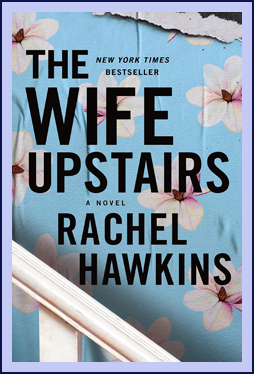
Book Review - Rachel Hawkins's The Wife Upstairs

The Wife Upstairs  by Rachel Hawkins
Published by: St. Martin's Press
Publication Date: January 5th, 2021
Format: Kindle, 227 Pages
Rating: ★
To Buy (different edition than one reviewed)

To be one of the housewives of Thornfield Estates, now that would be something. The gated community feels a world away from the apartment "Jane" begrudgingly shares with John, literally the last person she wants to share a roof with, but he is literally her last lifeline. Perhaps that's why Jane takes the odd piece of jewelry while walking the housewives' dogs, not just to help herself financially, but to feel like she's one of them. But if things go according to plan she won't be a dog walker for long. One of the houses seems different from the other McMansions. It's set back a bit from the street and Jane can't help but admire it. While she's standing in the middle of the street one day the owner of the house peels out of the driveway and almost hits her. Luckily the only thing hurt is the car. Eddie Rochester's car. The mysterious widower whose wife Bea ran the famous Southern Manors lifestyle brand and tragically disappeared with her best friend Blanche the previous year while at their lake house. Eddie Rochester who would be a catch in anyone's book. Jane knows she has to play this right. She can tell that he's interested and actually finds the "real" her funny. It's not long before she's out from under John's thumb, despite his attempts to extort her and Eddie for money, and under Eddie's roof. She even starts to ingratiate herself to the other housewives. But she has two big problems to overcome, their love of Bea and Blanche, and the fact that she's not a wife. Until Eddie puts a ring on it it seems the housewives will be friendly but still hold her at a distance because they aren't sure if she'll be sticking around. If Jane has anything to say about it she'll be there for the long haul. But the longer she's there, as soon as that ring is on her finger, she starts to wonder is this all there is? And what about the rumors about Eddie? What really happened to Bea and Blanche. Once Blanche's body is found everything changes. Will Jane lose this life she's fought so hard to get or will Bea take it all away from her?

Rachel Hawkins premise for this book is Jane Eyre deserved better than Mr. Rochester. While I disagree for a number of reasons, not the least of which is that given Jane's situation in life in the original novel her prospects were limited, I don't disagree that it's nice that Jane got the money and the dog in this version. The problem I have is this version of Jane. This isn't my Jane. This isn't anyone's Jane. Unless you like manipulative grasping assholes. Sure, she's a survivor, but does she have to be such a bitch? Rachel Hawkins clearly thinks that Mr. Rochester was below Jane and instead of elevating him she brought Jane down to his level. Why!?! I mean, really, why? I just don't get the purpose of this retelling other than the author airing her own grievances without really keeping it all in context. And she's drawing from some classic material, not only is she reinterpreting Jane Eyre, but there's also a lot of Wide Sargasso Sea folded in, and a huge helping of Rebecca, which makes a ton of sense given Daphne Du Maurier's obsession with the Brontes. But that's where so many of my issues then come from. These three books are classics, they are beautiful and lyrically written, and this, this is just workman language. Therefore whenever Rachel Hawkins actually uses a line from the source material, for example when she says that "[w]hatever souls were made of, mine and Jane’s were the same - or at least similar enough" dragging Emily Bronte and Wuthering Heights to the table, you are just gobsmacked by how basic this book's writing really is. But when Bea declares that "[r]eader, I fucked him" I'm sure my groan was audible for many miles. If I wasn't reading on my Kindle, well, the book would have been hurled. Much as I felt like doing. I'm sorry, that's not a funny joke and the fact that Rachel Hawkins thinks it is is a true sign as to why I would never have liked this book. I am so wary of retellings and yet, despite everything in me saying, oh, this could be different, this could be good, reader, I hated it.

Wednesday, August 17, 2022

Book Review - Jane Austen's Emma

Emma by Jane Austen
Published by: Max Press
Publication Date: 1815
Format: Hardcover, 240 Pages
Rating: ★★★★★
To Buy (different edition than one reviewed)

Emma Woodhouse is the center of her world. Looked upon by all in her small community as the perfect woman, the doting daughter, the charitable neighbor, the ideal future wife. Yet little do they realize that she is the spider at the center of a web thinking everyone is there for her amusement. They are mere playthings to her and she has just lost her most favorite toy. Her governess Miss Taylor has married and become Mrs. Weston, thus constricting Emma's household to just her and her father and the occasional visits from Mr. Knightly. Therefore, despite Mr. Knightly's stern warnings, Emma finds herself a new favorite to play with. And what better game than matchmaking? Harriet Smith is a nobody, her parents having given her away. Emma has fanciful notions of whom Harriet's parents could be and therefore eschews Harriet marrying the kind farmer Robert Martin and sets Harriet on the path to conjugal bliss with the vicar Mr. Elton. But Mr. Elton is a social climber and fancies that he is worthy of Emma's hand. Once aware of her mistake you'd think that Emma would have taken the hint and stopped her matchmaking, but she soldiers on. Mr. Weston's son, Frank Churchill, soon arrives on the scene to pay his respects to his new mother, and while first marked out for Emma, Emma soon thinks that happy is the man who changes Emma for Harriet. In all her ploys Emma never really sees that she is being callous and her jokes are at the expense of others, such as the poor Miss Bates and her niece Jane Fairfax, and have real world consequences. She lives in a bubble that desperately needs to be burst, and no matter how hard Mr. Knightly tries he can't seem to get through to Emma. In fact it's her favorite new toy, Harriet, who wields the needle and pops the bubble, opening Emma's eyes while also taking the shine off herself. Will Emma be able to fix what her childish games have wrought? Or will she lose her happily ever after?

There are things I can't help but question on every reading of Emma... mainly the Mr. Knightly/Emma age gap. I totally agree with Andrew Davies that having a man sixteen years older than you saying he first loved you when you were thirteen is more than a little icky. If Mr. Knightly had just refrained from saying that and a few other choice lines he wouldn't have come across as the Humbert Humbert of his day. Because really, when you think of it, a sixteen year age difference isn't that creepy. In fact there's far more than sixteen years between Marianne Dashwood and Colonel Brandon, and there's eighteen between me and Colin Firth, not that I've counted that often... But what I found interesting this time is that this creep factor wasn't so much there for me anymore. Perhaps it's because I have found far bigger creeps in this book, I'm sorry Frank Churchill, you're an irredeemable psychopath. Or perhaps it's because I see why Emma falls for Mr. Knightly. It's not his superiority above all others, it's the fact that Emma has Daddy issues. Serious Daddy issues. Issues that lead her to basically marry her "other" father. Are we to blame Mr. Knightly for taking advantage of the situation and forming Emma into the perfect woman? Or should we just say Emma needs therapy? My vote is for therapy. In fact, while Jasper Fforde perfectly parodied a group therapy session in the Thursday Next books for the characters of Wuthering Heights, I think the residents of Highbury need some counseling too. Emma for her Daddy issues, Mr. Knightly for grooming. And then look to Emma's treatment of Harriet. She bullies her, ghosts her, and then badmouths her. Oh, and Frank Churchill, he will need his own breakout session. Who flirts with other women in front of their fiance? Sure, she's a secret fiance, but still, how could Jane take that? Of all Austen's books Emma is the one I sometimes just can't deal with.

Wednesday, April 14, 2021

Season 31 - The Way We Live Now (2001-2002)

Every once in awhile you stumble on a miniseries that gives you a new perspective on an actor you love, like Hugh Bonneville's villainous turn in Daniel Deronda which I talked about last week. And every once in awhile you stumble on a miniseries where you fall in love with an actor previously unknown to you. But the rarest of the rare is when both these events happen within the same miniseries, and that's what happened when I first watched The Way We Live Now. Let's tackle a returning favorite first, David Suchet. David Suchet plays the indomitable Augustus Melmotte, a wealthy foreigner taking in interest in British Rail. Everybody knows Suchet as Poirot. I mean it's not just a role, he IS Poirot and I will fight anyone who disagrees. If you've watched any of the interviews or documentaries with him that often air on PBS it's amazing how unlike Poirot he is. He becomes the character created by Agatha Christie. Which is why his completely submerging himself into the roll of Melmotte shouldn't be a surprise, but it is. I mean I even saw him in The Importance of Being Earnest as Lady Bracknell and he was her! But I'd never searched out films or shows with him starring other than Poirot so The Way We Live Now opened my eyes to his range, his professionalism, and how I definitely need more of him in my life, hence my going to see The Importance of Being Earnest. And speaking of someone welcome in my life at ANY time, let's talk Matthew Macfadyen. Matthew Macfadyen plays Sir Felix Carbury, who is wooing Augustus Melmotte's daughter in a vain attempt to right his family's financial problems. Nowadays everyone knows Matthew as Mr. Darcy opposite Keira Knightly. Keep in mind that film was four years away from happening when I first watched The Way We Live Now. So I hunted up everything I could that Matthew starred in, which wasn't much at the time! Even Spooks was a year away! But thankfully there was Enigma, Murder Rooms, Wuthering Heights, the one with him having no lines, and maybe it's best to skip Maybe Baby. I was enamored of this English John Cusack as my friend Jess dubbed him. To this day I will watch him in anything! Though there are a few that I wish I could forget. Looking at you Any Human Heart!

Wednesday, March 17, 2021

Season 39 - Wuthering Heights (2009)

The thing about Wuthering Heights is I always really want to like it but never do. I've seen more adaptations than I can count all hoping that one would strike a cord in me. I chased down old productions for actors I liked just in the vain hope that maybe, just maybe, having say, Matthew Macfadyen in it would improve it. He did not. Hell, he didn't even speak as far as I can remember. In fact the introduction on that old VHS tape from the library was more interesting than the production itself. Thank you Russell Baker for explaining exactly why I hated the Laurence Olivier one so much! Most of the novel was cast aside in favor of a "happy" ending for the 1939 film. Yes. They tried to make Wuthering Heights have a happy ending! The mind boggles. Therefore I didn't have much hope for this new version staring that guy who was good in The Virgin Queen, that guy from The Walking Dead and Love Actually (a film I detest), and Owen from Torchwood. And yes, this is exactly how I categorized it in my head. Well, my lack of expectations led me, late one Sunday night, to find the first version of Wuthering Heights I enjoyed. No, enjoyed is too milquetoast, I was enraptured by it. Yes, it has a grim beginning with Tom Hardy as Heathcliff disinterring Catherine's skeleton while wearing a really bad wig, Tom, not the skeleton. But as I'm sure everyone else who's seen Tom Hardy act will agree, there's just something so magnetic about him, you can't look away. He became Heathcliff. What's more, Charlotte Riley was so perfectly cast as Catherine that she and Tom fell in love. You can feel their attraction through the screen. This is real. This is emotional. This is what Catherine and Heathcliff should always be. That heat, that passion, that tragedy. Thankfully in real life they are living a happily ever after and Tom isn't out back digging a grave where he will later cradle her corpse. But this didn't just become my all time favorite Wuthering Heights adaptation, if forever made me fans of Tom Hardy and Charlotte Riley, who while perfection in this, are even better in Taboo and Jonathan Strange and Mr Norrell respectively.

Friday, March 15, 2019

Book Review - Tasha Alexander's Dangerous to Know

Dangerous to Know by Tasha Alexander
Published by: Minotaur Books
Publication Date: October 26th, 2010
Format: Hardcover, 306 Pages
Rating: ★★★★★
To Buy

Emily is still reeling from her miscarriage in Constantinople. A happy honeymoon filled with intrigue and connubial bliss destroyed by one bullet. She must take solace in the fact that she saved a young girl's life and caught a killer and not dwell on the fact that she and Colin might never be able to have children now. Ensconced in Normandy, Emily's recuperation would be far more successful if it wasn't under the gimlet eye of her mother-in-law. The feeling of being a constant disappointment to Colin and his mother pushes Emily continually outside the four walls of the house that feel like they're closing in on her. But soon even the countryside won't offer her respite. On one of her rides she comes upon a young girl brutally murdered. So brutal that when she is finally able to lead the police back to the crime scene there are murmurs that Jack the Ripper might be calling Normandy his new home. Emily gets a little bit of celebrity with the locals for finding the body, but Colin worries if perhaps it's best if Emily's attention was drawn elsewhere. She doesn't need to investigate the most dangerous of crimes and be continually putting herself in danger.

Colin is therefore a little relieved when his mother's neighbors, George and Madeline Markham, have a diversion for Emily to occupy herself with. They are great art collectors and a new Monet painting has just appeared in their fortress like home. Emily's dear friend Cecile, arriving from Paris, recognizes the piece as one just finished and stolen from Giverny. Emily correctly comes to the conclusion that her favorite thief, Sebastian Capet, has returned to spice up her life with Greek quotations left on her pillow each night. But even Sebastian, with his laissez-faire attitude, can not deny that danger lurks near at hand for Emily. The murdered girl looked eerily like Emily and once it's discovered she wasn't the Rippers typical victim, being from a well-to-do family who had placed her in an asylum, Colin is all for Emily heading straight back to England and waiting for him there. Yet Emily can not do that. Yes, she wants to obey Colin, but never before has that meant leaving his side. But could retreating be in her best interest? She just doesn't know! She can no longer trust her mental faculties after she sees the ghostly apparition of a young child. Is this her grief over her own loss or is she on the path to the asylum like the Ripper's victim?

At the end of each adventure with Lady Emily I think to myself, the next volume couldn't possibly be better, and yet each and every time Tasha proves me wrong. This volume instantly became my favorite, but who knows what will happen when I read the next book? But I don't know how it could surpass the Gothic goodness of Dangerous to Know! This book almost felt like I was reading one of Emily's favorite authors! But could Mary Elizabeth Braddon come up with such a tale that Jack the Ripper, the Norman Heathcliff, and the ghostly apparition of a child people the pages!?! If she did I'm sure she wouldn't be able to capture the meta humor that Emily arches her eyebrows at with her love/hate relationship with Normandy's version of Wuthering Heights. But what called to me most was the Jack the Ripper angle. Long before the term Murderino came into existence I was one. I would watch all the Unsolved Mysteries I could, especially if they were historical. Therefore it shouldn't be surprising that I'm a bit of a Ripperologist. I have watched or read every movie, book, comic, TV series I can on Jack the Ripper. Therefore this inclusion in Emily's investigation made by blood sing! Oh, to combine my favorite heroine with what I find the most intriguing unsolved murders of the 1800s? How did Tasha know that this would be my wish for a perfect book!?!

Though I think the inclusion of Jack the Ripper in a story wherein Emily is dealing with the loss of her child would be significant only to a Ripperologist. What could I mean you ask? Well, let me break it down. Let's look to the canonical five. The first victim, Mary Ann Nichols suffered abdominal incisions, which were seen again in the second victim Annie Chapman. But all this was leading up to what would be done to the fifth and final victim, Mary Jane Kelly. All her internal organs from her abdomen, in particular her reproductive organs, were removed, and her breasts were cut off. While there are theories, much like with the Black Dahlia, that these wounds could have been used to cover up a botched abortion, one thing is clear, Jack the Ripper was targeting women who made their money from sex and then killed them in such a way as to destroy what made them female, the ability to reproduce, only fully succeeding with Mary Jane Kelly. And as for the theories of Mary Jane Kelly's daughter... well, all this shows that by including Jack the Ripper in Dangerous to Know Tasha was adding another level of gut punch to Emily. Not only would she be traumatized by finding the poor girl in the field mutilated to such a degree, but to then have the reminder that her miscarriage basically scooped out her insides and made them as empty as Mary Jane Kelly's... chilling.

Tasha then compounds this loss with the ghostly child who leaves behind blue ribbons. So many ghost stories of the Victorian era or written about the Victorian era deal with children and mothers who have lost their children. Wilkie Collins's The Woman in White, which Emily was sure to have read, Susan Hill's The Woman in Black, a more modern classic, and even a book that Tasha recommended to me, Angelica by Arthur Phillips, these are three books just off the top of my head that I thought of while reading Dangerous to Know. I am sure there are plethora more, even Henry James's The Turn of the Screw for example. But what Tasha does is she is smart enough to create her own mythology, first the story of the young girl who fell off a cliff, then the local gossip surrounding a young child that was killed at George and Madeline Markham's house that Madeline has conflated with her own pregnancy losses. Then there's the poor victim and what she endured... but where Tasha excels is that she draws a parallel between these stories and the loss endured by Victorian women. I believe it is Cecile who comments that she doesn't think she can think of a single one of their friends who hasn't suffered a similar loss to Emily's. Childbirth and childhood were dangerous undertakings during this time and the ghost stories are almost a way to normalize the fear these women constantly felt, even if it has the effect of unsettling them at the time.

For all that I loved there's one thing that made me go WTF!?! And that was Colin's behavior. Emily married Colin because he accepted who she was and wanted to be by his side, investigating and solving crimes, and now he's trying to wrap her up in cotton wool and let nothing bad ever happen to her again. YOU KNEW WHO SHE WAS WHEN YOU MARRIED HER YOU DUMBASS! She wouldn't have married him if she knew he was going to pull a 180 and decide to become the typical Victorian husband. She had that once and while at the time what Philip offered was what she thought she wanted, she has grown since then and become this awesome hoyden. Sure, she was badly injured and their unborn child was lost, but Dear God Colin, she doesn't need you pulling this shit when she's trying to piece her life back together. And yes, I know this is a plot device, one to destabilize Emily even more as well as show what marriages were really like during the Victorian era, but that doesn't mean it stopped my blood from boiling. Though it does actually all tie back into the killer, whose motives I did not see coming, and the idea of what we are willing to do for love. Would we break the will of our loved one if we think it's in their best interest? Would we imprison them for their safety? Would we kill for them?

Yet one thing is certain, I don't think Colin's mother would approve of his coddling of Emily. Madame Hargreaves is who I think Emily will evolve into. Yes, it's trite to say that boys marry women who remind them of their mothers, but going beyond that, Colin believes in the rights and equality of women, so it would make sense that he would find a woman he viewed as his equal to marry. At first I, like Emily, was wary of her mother-in-law, but I grew to really appreciate her, so much so that she better be returning in a later book! I love the little insights into the mind of Mrs. Hargreaves with her journal entries, a device Tasha has used from the first book in this series starting with Philip's journal and later being letters from Emily's various friends, that give us insight that Emily herself doesn't have that acts as a catalyst to the plot. What tickles me is that Mrs. Hargreaves is so hard on Emily, she just doesn't see what Colin does. But we, as readers, see that all her criticisms are because Emily has turned inward and is recovering and that the "real" Emily would perfectly match her mother-in-laws' expectations. By the end of the book they have come to an understanding, but I can't wait to meet them again now that they are on equal footing. The government of England better send out a warning, because these women want the right to vote! Long live strong women!

Wednesday, December 5, 2018

Book Review - Daphne Du Maurier's Rebecca

Rebecca by Daphne Du Maurier
Published by: Virago Press
Publication Date: 1938
Format: Paperback, 448 Pages
Rating: ★★★★★
To Buy (different edition than one reviewed)

"Last night I dreamt I went to Manderley again. It seemed to me I stood by the iron gate leading to the drive, and for a while I could not enter, for the way was barred to me. There was a padlock and chain upon the gate... Then, like all dreamers, I was possessed of a sudden with supernatural powers and passed like a spirit through the barrier before me. The drive wound away in front of me, twisting and turning as it had always done."

As she looks back on the twists and turns that brought her to Manderley, the second Mrs. de Winter can't help but wonder how her life ended up as it did. She had resigned herself to an existence as a paid companion trailing behind whomever had hired her, the reprehensible Mrs. Van Hoppper being her employer at the beginning of her story. That all changed when Maxim de Winter entered her life in his fast car. He was in the south of France fleeing the memories of his dead wife Rebecca and the one thing that blotted her out was the young girl who would become his second wife. Yet perhaps their union was foolish, or Maxim's dream to return to Manderley was unwise. Because back in England their life is haunted by the memories of his first wife, Rebecca. The specter that is hallowed by the housekeeper, Mrs. Danvers, and is a constant comparative presence for the new wife. Could Rebecca destroy their happiness from beyond the grave? Or will Rebecca need a little assistance from Mrs. Danvers?

When I was young my mother subscribed to The Franklin Library Mystery Masterpieces. Each month a new book would arrive and we'd set it in pride of place on our console bookshelf that housed our most prized possessions, this being the eighties it mainly housed records and our record player. The little nine year old that I was loved that each month another volume would come and expand the display on that orangey wood that just glowed with an inner light. Then one day The Franklin Library sent us the biggest box I had ever seen. They were discontinuing the Mystery Masterpieces and they sent us the remaining volumes all at once. At this time we probably had only ten volumes, so forty-two books showed up one day to our great astonishment and delight.

Until recently these books have been packed away as self space was scare; all but a few choice volumes which I had secreted away. When I was young I loved to spend time reading the spines and looking at the pictures and wondering what the books were about and making up my own stories, especially about The Thirty-Nine Steps, which really disappointed me when I found out what it was truly about. When they first arrived I was too young to read most of the titles, and when I was older I was too into movies to bother with books. That all changed. Obviously. But Rebecca, the movie, was like a gateway drug. I adored the film and then I looked on our shelf. There was Rebecca by Daphne Du Maurier, one of the first books we'd gotten in this series, after the obligatory Agatha Christie volume that is. This particular edition would make it's way into my library and my heart.

Rebecca is that rare book that cries out to be read and re-read over and over again, each time a different interpretation and meaning unearthed. The opening line that transports you, like a dream, to Manderley. You can get lost in the happy valley among the flowers and never want to return from those magical pages. But I don't think that you truly get the book's greatness without knowing the context of Du Maurier's world, mainly her obsession with the Brontes. This is much in the vein of why people don't realize the genius of Northanger Abbey, which is a parody of the Gothic genre, not "serious" like Austen's other books! Du Maurier's first book, The Loving Spirit, takes it's name from a poem by Emily Bronte. More then twenty years after writing Rebecca her misguided biography on Branwell Bronte was published and forever secured her connection to them. Therefore the echoes of Jane Eyre that haunt Rebecca should not be thought a surprise or the least bit unintentional. Du Maurier was writing a new classic that would pay homage to and reflect Jane Eyre. A Jane Eyre for modern sensibilities, if you will.

Just as Jamaica Inn is to Wuthering Heights, so is Rebecca to Jane Eyre, just look at the similarities. The naive young girl ready for love, the misanthropic hero, the crazy wife, the destructive fire. What amazes me is that if you look at just the building blocks of these two books they should be eerily similar, yet they aren't. Each book is a classic in it's own right, but the ghost of Jane Eyre isn't the only ghost that Rebecca tackles, after all there is Rebecca herself. While there is that chilling line delivered by Mrs. Danvers "Do you think the dead come back and watch the living?" What we think of as ghosts can take many forms. There are no spectral apparitions here, no things that go bump in the night, but that doesn't mean Rebecca doesn't haunt Manderley.

Rebecca recurs persistently in the consciousness of the second Mrs. de Winter causing her distress and anxiety, but she was also the bosom friend of Mrs. Danvers. Mrs. Danvers, more then anyone, works to keep Rebecca alive and in doing so makes her specter part of the foundation of Manderley itself. This is an interesting conceit on Du Maurier's part, because really, this is a ghost story without a ghost. The memory and emotion left behind is what haunts us, and if anyone could do this, it's Rebecca. As Captain Jack Harkness said on Torchwood, "Human emotion is energy. You can't always see it or hear it, but you can feel it. Ever had deja vu? Felt someone walk over your grave? Ever felt someone behind you in an empty room? Well there was. There always is."

Yet Rebecca isn't the only ghost. There's another person who haunts Manderley, she is always there, ever present, but in the shadow of Rebecca. I am of course talking about the second Mrs. de Winter. She is but mere shadow, a trace, a semblance of a person. She in fact has no name but that which Rebecca had, Mrs. de Winter. This is the most fascinating aspect of the book and many others have discussed it's importance, that the heroine has no name. One result of this namlessness is that she is a ghost, a cipher, a way to tell Rebecca's story through new eyes but without complicating the matter by creating a character with backbone.

Of course this is a two edged sword, on the one hand Du Maurier is pushing the second Mrs. de Winter into the background, but on the other hand by creating a blank slate, a character who has no real "character" we are able to put ourselves more easily into her shoes. This literary trick, I mean, really, I want to stand and applaud Du Maurier. By giving us this conduit there are so many ramifications to the narrative. By being one with the second Mrs. de Winter you therefore embrace Maxim, her husband, and therefore condone his actions. The genius of Rebecca is that Daphne Du Maurier has made you complicit in murder and you loved every second of it.

Friday, October 19, 2018

Book Review - Tasha Alexander's Dangerous to Know

Dangerous to Know by Tasha Alexander
Published by: Minotaur Books
Publication Date: October 26th, 2010
Format: Hardcover, 306 Pages
Rating: ★★★★★
To Buy

Emily is still reeling from her miscarriage in Constantinople. A happy honeymoon filled with intrigue and connubial bliss destroyed by one bullet. She must take solace in the fact that she saved a young girl's life and caught a killer and not dwell on the fact that she and Colin might never be able to have children now. Ensconced in Normandy, Emily's recuperation would be far more successful if it wasn't under the gimlet eye of her mother-in-law. The feeling of being a constant disappointment to Colin and his mother pushes Emily continually outside the four walls of the house that feel like they're closing in on her. But soon even the countryside won't offer her respite. On one of her rides she comes upon a young girl brutally murdered. So brutal that when she is finally able to lead the police back to the crime scene there are murmurs that Jack the Ripper might be calling Normandy his new home. Emily gets a little bit of celebrity with the locals for finding the body, but Colin worries if perhaps it's best if Emily's attention was drawn elsewhere. She doesn't need to investigate the most dangerous of crimes and be continually putting herself in danger.

Colin is therefore a little relieved when his mother's neighbors, George and Madeline Markham, have a diversion for Emily to occupy herself with. They are great art collectors and a new Monet painting has just appeared in their fortress like house. Emily's dear friend Cecile, arriving from Paris, recognizes the piece as one just finished and stolen from Giverny. Emily correctly comes to the conclusion that her favorite thief, Sebastian Capet, has returned to spice up her life with Greek quotations left on her pillow each night. But even Sebastian, with his laissez-faire attitude, can not deny that danger lurks near at hand for Emily. The murdered girl looked eerily like Emily and once it's discovered she wasn't the Rippers typical victim, being from a well-to-do family who had placed her in an asylum, Colin is all for Emily heading straight back to England and waiting for him there. Yet Emily can not do that. Yes, she wants to obey Colin, but never before has that meant leaving his side. But could retreating be in her best interest? She just doesn't know! She can no longer trust her mental faculties after she sees the ghostly apparition of a young child. Is this her grief over her own loss or is she on the path to the asylum like the Ripper's victim?

At the end of each adventure with Lady Emily I think to myself, the next volume couldn't possibly be better, and yet each and every time Tasha proves me wrong. This volume instantly became my favorite, but who knows what will happen when I read the next book? But I don't know how it could surpass the Gothic goodness of Dangerous to Know! This book almost felt like I was reading one of Emily's favorite authors! But could Mary Elizabeth Braddon come up with such a tale that Jack the Ripper, the Norman Heathcliff, and the ghostly apparition of a child people the pages!?! If she did I'm sure she wouldn't be able to capture the meta humor that Emily arches her eyebrows at with her love/hate relationship with Normandy's version of Wuthering Heights. But what called to me most was the Jack the Ripper angle. Long before the term Murderino came into existence I was one. I would watch all the Unsolved Mysteries I could, especially if they were historical. Therefore it shouldn't be surprising that I'm a bit of a Ripperologist. I have watched or read every movie, book, comic, TV series I can on Jack the Ripper. Therefore this inclusion in Emily's investigation made by blood sing! Oh, to combine my favorite heroine with what I find the most intriguing unsolved murders of the 1800s? How did Tasha know that this would be my wish for a perfect book!?!

Though I think the inclusion of Jack the Ripper in a story wherein Emily is dealing with the loss of her child would be significant only to a Ripperologist. What could I mean you ask? Well, let me break it down. Let's look to the canonical five. The first victim, Mary Ann Nichols suffered abdominal incisions, which were seen again in the second victim Annie Chapman. But all this was leading up to what would be done to the fifth and final victim, Mary Jane Kelly. All her internal organs from her abdomen, in particular her reproductive organs, were removed, and her breasts were cut off. While there are theories, much like with the Black Dahlia, that these wounds could have been used to cover up a botched abortion, one thing is clear, Jack the Ripper was targeting women who made their money from sex and then killed them in such a way as to destroy what made them female, the ability to reproduce, only fully succeeding with Mary Jane Kelly. And as for the theories of Mary Jane Kelly's daughter... well, all this shows that by including Jack the Ripper in Dangerous to Know Tasha was adding another level of gut punch to Emily. Not only would she be traumatized by finding the poor girl in the field mutilated to such a degree, but to then have the reminder that her miscarriage basically scooped out her insides and made them as empty as Mary Jane Kelly's... chilling.

Tasha then compounds this loss with the ghostly child who leaves behind blue ribbons. So many ghost stories of the Victorian era or written about the Victorian era deal with children and mothers who have lost their children. Wilkie Collins's The Woman in White, which Emily was sure to have read, Susan Hill's The Woman in Black, a more modern classic, and even a book that Tasha recommended to me, Angelica by Arthur Phillips, these are three books just off the top of my head that I thought of while reading Dangerous to Know. I am sure there are a plethora more, even Henry James's The Turn of the Screw for example. But what Tasha does is she is smart enough to create her own mythology, first the story of the young girl who fell off a cliff, then the local gossip surrounding a young child that was killed at George and Madeline Markham's house that Madeline has conflated with her own pregnancy losses. Then there's the poor victim and what she endured... but where Tasha excels is that she draws a parallel between these stories and the loss endured by Victorian women. I believe it is Cecile who comments that she doesn't think she can think of a single one of their friends who hasn't suffered a similar loss to Emily's. Childbirth and childhood were dangerous undertakings during this time and the ghost stories are almost a way to normalize the fear these women constantly felt, even if it has the effect of unsettling them at the time.

For all that I loved there's one thing that made me go WTF!?! And that was Colin's behavior. Emily married Colin because he accepted who she was and wanted to be by his side, investigating and solving crimes, and now he's trying to wrap her up in cotton wool and let nothing bad ever happen to her again. YOU KNEW WHO SHE WAS WHEN YOU MARRIED HER YOU DUMBASS! She wouldn't have married him if she knew he was going to pull a 180 and decide to become the typical Victorian husband. She had that once and while at the time what Philip offered was what she thought she wanted, she has grown since then and become this awesome hoyden. Sure, she was badly injured and their unborn child was lost, but Dear God Colin, she doesn't need you pulling this shit when she's trying to piece her life back together. And yes, I know this is a plot device, one to destabilize Emily even more as well as show what marriages were really like during the Victorian era, but that doesn't mean it stopped my blood from boiling. Though it does actually all tie back into the killer, whose motives I did not see coming, and the idea of what we are willing to do for love. Would we break the will of our loved one if we think it's in their best interest? Would we imprison them for their safety? Would we kill for them?

Yet one thing is certain, I don't think Colin's mother would approve of his coddling of Emily. Madame Hargreaves is who I think Emily will evolve into. Yes, it's trite to say that boys marry women who remind them of their mothers, but going beyond that, Colin believes in the rights and equality of women, so it would make sense that he would find a woman he viewed as his equal to marry. At first I, like Emily, was wary of her mother-in-law, but I grew to really appreciate her, so much so that she better be returning in a later book! I love the little insights into the mind of Mrs. Hargreaves with her journal entries, a device Tasha has used from the first book in this series starting with Philip's journal and later being letters from her various friends, that give us insight that Emily herself doesn't have that acts as a catalyst to the plot. What tickles me is that Mrs. Hargreaves is so hard on Emily, she just doesn't see what Colin does. But we, as readers, see that all her criticisms are because Emily has turned inward and is recovering and that the "real" Emily would perfectly match her mother-in-laws' expectations. By the end of the book they have come to an understanding, but I can't wait to meet them again now that they are on equal footing. The government of England better send out a warning, because these women want the right to vote! Long live strong women!

Friday, February 16, 2018

Book Reveiw - Emily Brontë's Wuthering Heights

Wuthering Heights by Emily Brontë
Published by: Modern Library
Publication Date: 1847
Format: Hardcover, 400 Pages
Rating: ★★
To Buy (different edition than one reviewed)

Mr. Lockwood has rented Thrushcross Grange in Yorkshire as an escape from his hectic London life. Being an amiable man he is perplexed by his landlord, Heathcliff, who is standoffish and lives a remote life with an odd household at Wuthering Heights. After being trapped the night at Wuthering Heights Lockwood beseeches his housekeeper at Thrushcross Grange, Nelly Dean, to tell him the tale of Heathcliff and the other residents of Wuthering Heights. Nelly agrees, because she remembers it all, starting thirty years earlier when Mr. Earnshaw lived at Wuthering Heights with his son Hindley and his daughter Catherine. After a trip to Liverpool he returned with Lockwood's landlord, Heathcliff, a foundling to incite the jealousy of Hindley and the love of Cathy. When Mr. Earnshaw finally died and Hindley returned home with his new wife it was time to enact his revenge on Heathcliff, banishing him to the stables as a lowly servant. Before Hindley's return Cathy thought that she and Heathcliff would never be parted, but soon she is betrothed to Edgar Linton of Thrushcross Grange claiming she could never marry Heathcliff because it would degrade her. Heathcliff leaves Wuthering Heights and only returns once he is a wealthy man and seduces Edgar's sister for revenge. Death soon claims Cathy and then Hindley and the feud goes to the next generation fueled by Heathcliff. But can love come back to a place where hate has flourished?

The problem with reading a book like Wuthering Heights is that this is a book that has been adapted to death, and I've watched them all. From the Laurence Olivier adaptation that eliminated the second generation for expediency and a stab at a happy ending, to the 1998 version solely watched for Matthew Macfadyen as Hereton Earnshaw, to the badly bewigged Tom Hardy in the only version I actually like. I've seen them all. Each one brought a new perspective and a twist with their interpretation of the text, so that going back to the source I found that nothing new was brought to the table. I'd seen it all and not to throw too much shade at Emily Brontë, but her framing device of narrators within narrators akin to Mary Shelley's Frankenstein feels a bit forced. But yet I needed to read it. The reason I finally decided to read Wuthering Heights was that I had been meaning to for so long it seemed like a glaring oversight and might be considered as the book in longest residence on my "to be read" pile. I had years earlier picked up the book and made it through a few chapters of Lockwood's overwrought rambling only to put it down and forget about it. In the intervening years I had read all of Anne Brontë's work, re-read Jane Eyre more times than I can count, and started viewing Anne as the most talented of the Brontës, but I couldn't secure her the title without finally giving in to a reading of Emily's one prose piece. PS, if the star rating didn't tip you off, Anne wins.

The main problem with Wuthering Heights is that you quite literally hate everyone. These are not nice people. I mean they are SERIOUSLY NOT NICE PEOPLE! They are threatening to murder each other daily and that's what, OK? Is that supposed to show the strength of their attachments? And that is somehow supposed to translate into one of the greatest love stories ever? Hell no. It's dysfunction city. There's a reason why when Thursday Next is assigned to help council the characters in Wuthering Heights in her third adventure, The Well of Lost Plots, that it is a comedic highlight, because these people SERIOUSLY need counseling. All books need you to have someone worth rooting for, and I can't think of a single character I would like to spend one minute with. Even the "nicer" characters at Thrushcross Grange are lured into Heathcliff's world of revenge and hate and tainted by association. The second generation doesn't get a pass either, they are so passive that by letting this happen they are continuing the cycle. Yes, with Heathcliff eventually gone there's a tiny little ray of hope at the end. But is it really hope? Hundreds of pages of hate and rage and passion, because I don't think we can call it love, and once the house has been exorcised of Heathcliff everything can be fine? Nope. Burn that house to the ground and move far far away.

Yet there is a reason this is a classic. And no, I don't think it's because of anything to do with the characters or the plot. It might have to do with the passion, because it was rare for a book then to show such cruelity and be so harsh while in the throes of so-called love. But I think the only real reason it survives is two fold, one is the connection to this great literary dynasty that is the Brontës, but secondly, in among the dross, there are lines of sheer beauty. Emily was a poet, she was not a prose writer, so it makes sense that she can capture beauty and emotion in a single line that she couldn't accomplish with chapters and chapters of storytelling. In chapter nine is perhaps the best example of what Emily could do when giving full reign to her powers: "It would degrade me to marry Heathcliff now; so he shall never know how I love him: and that, not because he's handsome, Nelly, but because he's more myself than I am. Whatever our souls are made of, his and mine are the same; and Linton's is as different as a moonbeam from lightning, or frost from fire... I cannot express it; but surely you and everybody have a notion that there is or should be an existence of yours beyond you. What were the use of my creation, if I were entirely contained here? My great miseries in this world have been Heathcliff's miseries, and I watched and felt each from the beginning: my great thought in living is himself. If all else perished, and he remained, I should still continue to be; and if all else remained, and he were annihilated, the universe would turn to a mighty stranger: I should not seem a part of it.—My love for Linton is like the foliage in the woods: time will change it, I'm well aware, as winter changes the trees. My love for Heathcliff resembles the eternal rocks beneath: a source of little visible delight, but necessary. Nelly, I am Heathcliff! He's always, always in my mind: not as a pleasure, any more than I am always a pleasure to myself, but as my own being"

Though for all the beauty, all the evocation of emotions in this one section, easily the most quoted of all, there are pages and pages of limp prose. Just unintelligible horrible writing. In particular there is Joseph; an elderly servant who lacks all humanity and is therefore very religious. The problem with Joesph is his stupid dialect. Yes, dialect is important, it gives the reader a feeling for the time, the place, and the character. But bad dialect, or dialect used improperly can ruin a novel. Look to The Secret Garden, the children use the broad local dialect to mock the servants cruelly, yet for some bizarre reason we're supposed to view this as cute. I don't. It made me hate that book. Joseph's dialect is 100% unintelligible. I quite literally have no idea what he was saying. A dialect should be a compromise to some extent. You need to capture all that I said above, time, place, BUT you have to make it accessible to readers. If you've seen the Red Riding Trilogy you'll understand where I'm going here. Like Wuthering Heights, these are films set in Yorkshire. Now some of the actors went too far with their accents, making them too heavy and unintelligible, then there was Sean Bean, who knows the acting business and made a nice compromise between accent and accessibility. Look to Sean Bean! Because really, Joseph became a joke, like in Hot Fuzz where Karl Johnson as PC Bob Walker is pretty unintelligible and needs a translator, usually Nick Frost's Danny Butterman, but there's the one scene where Bob has to translate for David Bradley as a local farmer because even Danny can't understand him. That's what it felt like here! But it wasn't meant to be funny!

Yet even without all this, even if I hadn't watched all the adaptations and hadn't hated all the characters there is one thing that this book lacked, and that was the element of surprise. At the beginning of the book there is a family tree. This tree gives everyone's birth and death and a quick perusal shows you, wow, yes it shows you everything. All their kids and the marriages, everything. I'm like Patrick Stewart on Extras. Yes, genealogy is to me interesting in books, especially when you start going Game of Thrones epic, but here, with such a small cast of characters, the book is spoiled from page one. Which makes me wonder, was this in the first printing? Because this comes after Charlotte's introduction to the book, so did she maybe add it for spite? Everyone knows Charlotte wasn't a fan of Emily's writing, with rumors being that Emily actually had another finished manuscript that Charlotte burned... so was Charlotte trying to just alienate the readers? Or was it Emily who just felt like everything was a foregone conclusion and that we should know from the start we're in for death and misery... because that's what this book is, death and misery. It has become a classic just by proximity to other great works and really, classics do need to be challenged and re-evaluated, because a hundred plus years later I don't think this book has anything left to give us whereas Jane Eyre and even The Tenant of Wildfell Hall are constantly surprising.

Monday, December 11, 2017

Tuesday Tomorrow

Bloodstains with Bronte by Katherine Bolger Hyde
Published by: Minotaur Books
Publication Date: December 12th, 2017
Format: Hardcover, 288 Pages
To Buy

The official patter:
"Classic novels and crime solving intertwine in Katherine Bolger Hyde's charming series. Bloodstains with Bronte is the second in a series that will puzzle and please fans of mystery and masterpieces alike.

Windy Corner is being remodeled into a writers' retreat. Two of the young workers, Jake and Roman, are showing too much of the wrong kind of interest in Katie, Emily's young single-mother housekeeper.

It's a stormy autumn and Emily is reading Wuthering Heights. Roman, a dark and brooding type, reminds her of Heathcliff. At a Halloween murder mystery fundraiser at Windy Corner, someone is found stabbed to death. Windy Corner's very own detective, Luke, is reluctantly forced to investigate Katie.

Luke digs into the background of the contractor, Jeremiah Edwards, and Emily, now reading Jane Eyre, realizes Jeremiah resembles St. John Rivers in his obsessive, tormented piety. Will Luke figure out who the murderer is before Katie ends up in jail or someone else is killed?"

Because what says good cozy read other than Brontes and murder? Only me then?

Mad Hatters and March Hares edited by Ellen Datlow
Published by: Tor Books
Publication Date: December 12th, 2017
Format: Hardcover, 336 Pages
To Buy

The official patter:
"From master anthologist Ellen Datlow comes an all-original of weird tales inspired by the strangeness of Lewis Carroll’s Alice’s Adventures in Wonderland and Through the Looking-Glass and What Alice Found There.

Between the hallucinogenic, weird, imaginative wordplay and the brilliant mathematical puzzles and social satire, Alice has been read, enjoyed, and savored by every generation since its publication. Datlow asked eighteen of the most brilliant and acclaimed writers working today to dream up stories inspired by all the strange events and surreal characters found in Wonderland.

Featuring stories and poems from Seanan McGuire, Jane Yolen, Catherynne M. Valente, Delia Sherman, Genevieve Valentine, Priya Sharma, Stephen Graham Jones, Richard Bowes, Jeffrey Ford, Angela Slatter, Andy Duncan, C.S.E. Cooney, Matthew Kressel, Kris Dikeman, Jane Yolen, Kaaron Warren, Ysbeau Wilce, and Katherine Vaz."

So... I'm more interested in this to see if anyone can actually succeed, because all Alice inspired writing I've ever read has failed miserably, because seriously, there's no one like Carroll.

Wednesday, March 8, 2017

Book Reveiw - Emily Brontë's Wuthering Heights

Wuthering Heights by Emily Brontë
Published by: Modern Library
Publication Date: 1847
Format: Hardcover, 400 Pages
Rating: ★★
To Buy (different edition than one reviewed)

Mr. Lockwood has rented Thrushcross Grange in Yorkshire as an escape from his hectic London life. Being an amiable man he is perplexed by his landlord, Heathcliff who is standoffish and lives a remote life with an odd household at Wuthering Heights. After being trapped the night at Wuthering Heights Lockwood beseeches his housekeeper at Thrushcross Grange, Nelly Dean, to tell him the tale of Heathcliff and the other residents of Wuthering Heights. Nelly agrees, because she remembers it all, starting thirty years earlier when Mr. Earnshaw lived at Wuthering Heights with his son Hindley and his daughter Catherine. After a trip to Liverpool he returned with Lockwood's landlord, Heathcliff, a foundling to incite the jealousy of Hindley and the love of Cathy. When Mr. Earnshaw finally died and Hindley returned home with his new wife it was time to enact his revenge on Heathcliff, banishing him to the stables as a lowly servant. Before Hindley's return Cathy thought that she and Heathcliff would never be parted, but soon she is betrothed to Edgar Linton of Thrushcross Grange claiming she could never marry Heathcliff because it would degrade her. Heathcliff leaves Wuthering Heights and only returns once he is a wealthy man and seduces Edgar's sister for revenge. Death soon claims Cathy and then Hindley and the feud goes to the next generation fueled by Heathcliff. But can love come back to a place where hate has flourished?

The problem with reading a book like Wuthering Heights is that this is a book that has been adapted to death, and I've watched them all. From the Laurence Olivier adaptation that eliminated the second generation for expediency and a stab at a happy ending, to the 1998 version solely watched for Matthew Macfadyen as Hereton Earnshaw, to the badly bewigged Tom Hardy in the only version I actually like. I've seen them all. Each one brought a new perspective and a twist with the interpretation of the text, so that going back to the source I found that nothing new was brought to the table. I'd seen it all and not to throw too much shade at Emily Brontë, but her framing device of narrators within narrators akin to Mary Shelley's Frankenstein feels a bit forced. But yet I needed to read it. The reason I finally decided to read Wuthering Heights was that I had been meaning to for so long it seemed like a glaring oversight and might be considered as the book in longest residence on my "to be read" pile. I had years earlier picked up the book and made it through a few chapters of Lockwood's overwrought rambling only to put it down and forget about it. In the intervening years I had read all of Anne Brontë's work, re-read Jane Eyre more times than I can count, and started viewing Anne as the most talented of the Brontës, but I couldn't secure her the title without finally giving in to a reading of Emily's one prose piece. PS, if the star rating didn't tip you off, Anne wins.

The main problem with Wuthering Heights is that you quite literally hate everyone. These are not nice people. I mean they are SERIOUSLY NOT NICE PEOPLE! They are threatening to murder each other daily and that's what, OK? Is that supposed to show the strength of their attachments? And that is somehow supposed to translate into one of the greatest love stories ever? Hell no. It's dysfunction city. There's a reason why when Thursday Next is assigned to help council the characters in Wuthering Heights in her third adventure, The Well of Lost Plots, that it is a comedic highlight, because these people SERIOUSLY need counseling. All books need you to have someone worth rooting for, and I can't think of a single character I would like to spend one minute with. Even the "nicer" characters at Thrushcross Grange are lured into Heathcliff's world of revenge and hate and tainted by association. The second generation doesn't get a pass either, they are so passive that by letting this happen they are continuing the cycle. Yes, with Heathcliff eventually gone there's a tiny little ray of hope at the end. But is it really hope? Hundreds of pages of hate and rage and passion, because I don't think we can call it love, and once the house has been exorcised of Heathcliffe everything can be fine? Nope. Burn that house to the ground and move far far away.

Yet there is a reason this is a classic. And no, I don't think it's because of anything to do with the characters or the plot. It might have to do with the passion, because it was rare for a book then to show such cruelity and be so harsh while in the throes of so-called love. But I think the only real reason it survives is two fold, one is the connection to this great literary dynasty that is the Brontës, but secondly, in among the dross, there are lines of sheer beauty. Emily was a poet, she was not a prose writer, so it makes sense that she can capture beauty and emotion in a single line that she couldn't accomplish with chapters and chapters of storytelling. In chapter nine is perhaps the best example of what Emily could do when giving full reign to her powers: "It would degrade me to marry Heathcliff now; so he shall never know how I love him: and that, not because he's handsome, Nelly, but because he's more myself than I am. Whatever our souls are made of, his and mine are the same; and Linton's is as different as a moonbeam from lightning, or frost from fire... I cannot express it; but surely you and everybody have a notion that there is or should be an existence of yours beyond you. What were the use of my creation, if I were entirely contained here? My great miseries in this world have been Heathcliff's miseries, and I watched and felt each from the beginning: my great thought in living is himself. If all else perished, and he remained, I should still continue to be; and if all else remained, and he were annihilated, the universe would turn to a mighty stranger: I should not seem a part of it.—My love for Linton is like the foliage in the woods: time will change it, I'm well aware, as winter changes the trees. My love for Heathcliff resembles the eternal rocks beneath: a source of little visible delight, but necessary. Nelly, I am Heathcliff! He's always, always in my mind: not as a pleasure, any more than I am always a pleasure to myself, but as my own being"

Though for all the beauty, all the evocation of emotions in this one section, easily the most quoted of all, there are pages and pages of limp prose. Just unintelligible horrible writing. In particular there is Joseph; an elderly servant who lacks all humanity and is therefore very religious. The problem with Joesph is his stupid dialect. Yes, dialect is important, it gives the reader a feeling for the time, the place, and the character. But bad dialect, or dialect used improperly can ruin a novel. Look to The Secret Garden, the children use the broad local dialect to mock the servants cruelly, yet for some bizarre reason we're supposed to view this as cute. I don't. It made me hate that book. Joseph's dialect is 100% unintelligible. I quite literally have no idea what he was saying. A dialect should be a compromise to some extent. You need to capture all that I said above, time, place, BUT you have to make it accessible to readers. If you've seen the Red Riding Trilogy you'll understand where I'm going here. Like Wuthering Heights, these are films set in Yorkshire. Now some of the actors went too far with their accents, making them too heavy and unintelligible, then there was Sean Bean, who knows the acting business and made a nice compromise between accent and accessibility. Look to Sean Bean! Because really, Joseph became a joke, like in Hot Fuzz where Karl Johnson as PC Bob Walker is pretty unintelligible and needs a translator, usually Nick Frost's Danny Butterman, but there's the one scene where Bob has to translate for David Bradley as a local farmer because even Danny can't understand him. That's what it felt like here! But it wasn't meant to be funny!

Yet even without all this, even if I hadn't watched all the adaptations and hadn't hated all the characters there is one thing the this book lacked, and that was the element of surprise. At the beginning of the book there is a family tree. This tree gives everyone's birth and death and a quick perusal shows you, wow, yes it shows you everything. All their kids and the marriages, everything. I'm like Patrick Stewart on Extras. Yes, genealogy is to me interesting in books, especially when you start going Game of Thrones epic, but here, with such a small cast of characters, the book is spoiled from page one. Which makes me wonder, was this in the first printing? Because this comes after Charlotte's introduction to the book, so did she maybe add it for spite? Everyone knows Charlotte wasn't a fan of Emily's writing, with rumors being that Emily actually had another finished manuscript that Charlotte burned... so was Charlotte trying to just alienate the readers? Or was it Emily who just felt like everything was a foregone conclusion and that we should know from the start we're in for death and misery... because that's what this book is, death and misery. It has become a classic just by proximity to other great works and really, classics do need to be challenged and re-evaluated, because a hundred plus years later I don't think this book has anything left to give us whereas Jane Eyre and even The Tenant of Wildfell Hall are constantly surprising.

Wednesday, May 25, 2016

Book Reveiw - Emily Brontë's Wuthering Heights

Wuthering Heights by Emily Brontë
Published by: Modern Library
Publication Date: 1847
Format: Hardcover, 400 Pages
Rating: ★★
To Buy (different edition than one reviewed)

Mr. Lockwood has rented Thrushcross Grange in Yorkshire as an escape from his hectic London life. Being an amiable man he is perplexed by his landlord, Heathcliff who is standoffish and lives a remote life with an odd household at Wuthering Heights. After being trapped the night at Wuthering Heights Lockwood beseeches his housekeeper at Thrushcross Grange, Nelly Dean, to tell him the tale of Heathcliff and the other residents of Wuthering Heights. Nelly agrees, because she remembers it all, starting thirty years earlier when Mr. Earnshaw lived at Wuthering Heights with his son Hindley and his daughter Catherine. After a trip to Liverpool he returned with Lockwood's landlord, Heathcliff, a foundling to incite the jealousy of Hindley and the love of Cathy. When Mr. Earnshaw finally died and Hindley returned home with his new wife it was time to enact his revenge on Heathcliff, banishing him to the stables as a lowly servant. Before Hindley's return Cathy thought that she and Heathcliff would never be parted, but soon she is betrothed to Edgar Linton of Thrushcross Grange claiming she could never marry Heathcliff because it would degrade her. Heathcliff leaves Wuthering Heights and only returns once he is a wealthy man and seduces Edgar's sister for revenge. Death soon claims Cathy and then Hindley and the feud goes to the next generation fueled by Heathcliff. But can love come back to a place where hate has flourished?

The problem with reading a book like Wuthering Heights is that this is a book that has been adapted to death, and I've watched them all. From the Laurence Olivier adaptation that eliminated the second generation for expediency and a stab at a happy ending, to the 1998 version solely watched for Matthew Macfadyen as Hereton Earnshaw, to the badly bewigged Tom Hardy in the only version I actually like. I've seen them all. Each one brought a new perspective and a twist with the interpretation of the text, so that going back to the source I found that nothing new was brought to the table. I'd seen it all and not to throw too much shade at Emily Brontë, but her framing device of narrators within narrators akin to Mary Shelley's Frankenstein feels a bit forced. But yet I needed to read it. The reason I finally decided to read Wuthering Heights was that I had been meaning to for so long it seemed like a glaring oversight and might be considered as the book in longest residence on my "to be read" pile. I had years earlier picked up the book and made it through a few chapters of Lockwood's overwrought rambling only to put it down and forget about it. In the intervening years I had read all of Anne Brontë's work, re-read Jane Eyre more times than I can count, and started viewing Anne as the most talented of the Brontës, but I couldn't secure her the title without finally giving in to a reading of Emily's one prose piece. PS, if the star rating didn't tip you off, Anne wins.

The main problem with Wuthering Heights is that you quite literally hate everyone. These are not nice people. I mean they are SERIOUSLY NOT NICE PEOPLE! They are threatening to murder each other daily and that's what, OK? Is that supposed to show the strength of their attachments? And that is somehow supposed to translate into one of the greatest love stories ever? Hell no. It's dysfunction city. There's a reason why when Thursday Next is assigned to help council the characters in Wuthering Heights in her third adventure, The Well of Lost Plots, that it is a comedic highlight, because these people SERIOUSLY need counseling. All books need you to have someone worth rooting for, and I can't think of a single character I would like to spend one minute with. Even the "nicer" characters at Thrushcross Grange are lured into Heathcliff's world of revenge and hate and tainted by association. The second generation doesn't get a pass either, they are so passive that by letting this happen they are continuing the cycle. Yes, with Heathcliff eventually gone there's a tiny little ray of hope at the end. But is it really hope? Hundreds of pages of hate and rage and passion, because I don't think we can call it love, and once the house has been exorcised of Heathcliffe everything can be fine? Nope. Burn that house to the ground and move far far away.

Yet there is a reason this is a classic. And no, I don't think it's because of anything to do with the characters or the plot. It might have to do with the passion, because it was rare for a book then to show such cruelity and be so harsh while in the throes of so-called love. But I think the only real reason it survives is two fold, one is the connection to this great literary dynasty that is the Brontës, but secondly, in among the dross, there are lines of sheer beauty. Emily was a poet, she was not a prose writer, so it makes sense that she can capture beauty and emotion in a single line that she couldn't accomplish with chapters and chapters of storytelling. In chapter nine is perhaps the best example of what Emily could do when giving full reign to her powers: "It would degrade me to marry Heathcliff now; so he shall never know how I love him: and that, not because he's handsome, Nelly, but because he's more myself than I am. Whatever our souls are made of, his and mine are the same; and Linton's is as different as a moonbeam from lightning, or frost from fire... I cannot express it; but surely you and everybody have a notion that there is or should be an existence of yours beyond you. What were the use of my creation, if I were entirely contained here? My great miseries in this world have been Heathcliff's miseries, and I watched and felt each from the beginning: my great thought in living is himself. If all else perished, and he remained, I should still continue to be; and if all else remained, and he were annihilated, the universe would turn to a mighty stranger: I should not seem a part of it.—My love for Linton is like the foliage in the woods: time will change it, I'm well aware, as winter changes the trees. My love for Heathcliff resembles the eternal rocks beneath: a source of little visible delight, but necessary. Nelly, I am Heathcliff! He's always, always in my mind: not as a pleasure, any more than I am always a pleasure to myself, but as my own being"

Though for all the beauty, all the evocation of emotions in this one section, easily the most quoted of all, there are pages and pages of limp prose. Just unintelligible horrible writing. In particular there is Joseph; an elderly servant who lacks all humanity and is therefore very religious. The problem with Joesph is his stupid dialect. Yes, dialect is important, it gives the reader a feeling for the time, the place, and the character. But bad dialect, or dialect used improperly can ruin a novel. Look to The Secret Garden, the children use the broad local dialect to mock the servants cruelly, yet for some bizarre reason we're supposed to view this as cute. I don't. It made me hate that book. Joseph's dialect is 100% unintelligible. I quite literally have no idea what he was saying. A dialect should be a compromise to some extent. You need to capture all that I said above, time, place, BUT you have to make it accessible to readers. If you've seen the Red Riding Trilogy you'll understand where I'm going here. Like Wuthering Heights, these are films set in Yorkshire. Now some of the actors went too far with their accents, making them too heavy and unintelligible, then there was Sean Bean, who knows the acting business and made a nice compromise between accent and accessibility. Look to Sean Bean! Because really, Joseph became a joke, like in Hot Fuzz where Karl Johnson as PC Bob Walker is pretty unintelligible and needs a translator, usually Nick Frost's Danny Butterman, but there's the one scene where Bob has to translate for David Bradley as a local farmer because even Danny can't understand him. That's what it felt like here! But it wasn't meant to be funny!

Yet even without all this, even if I hadn't watched all the adaptations and hadn't hated all the characters there is one thing the this book lacked, and that was the element of surprise. At the beginning of the book there is a family tree. This tree gives everyone's birth and death and a quick perusal shows you, wow, yes it shows you everything. All their kids and the marriages, everything. I'm like Patrick Stewart on Extras. Yes, genealogy is to me interesting in books, especially when you start going Game of Thrones epic, but here, with such a small cast of characters, the book is spoiled from page one. Which makes me wonder, was this in the first printing? Because this comes after Charlotte's introduction to the book, so did she maybe add it for spite? Everyone knows Charlotte wasn't a fan of Emily's writing, with rumors being that Emily actually had another finished manuscript that Charlotte burned... so was Charlotte trying to just alienate the readers? Or was it Emily who just felt like everything was a foregone conclusion and that we should know from the start we're in for death and misery... because that's what this book is, death and misery. It has become a classic just by proximity to other great works and really, classics do need to be challenged and re-evaluated, because a hundred plus years later I don't think this book has anything left to give us whereas Jane Eyre and even The Tenant of Wildfell Hall are constantly surprising.

Monday, February 8, 2016

Tuesday Tomorrow

Arcadia by Iain Pears
Published by: Knopf
Publication Date: February 9th, 2016
Format: Hardcover, 528 Pages
To Buy

The official patter:
"From the author of the international best seller An Instance of the Fingerpost, Arcadia is an astonishing work of imagination.
Three interlocking worlds. Four people looking for answers. But who controls the future—or the past?

In 1960s Oxford, Professor Henry Lytten is attempting to write a fantasy novel that forgoes the magic of his predecessors, J. R. R. Tolkien and C. S. Lewis. He finds an unlikely confidante in his quick-witted, inquisitive young neighbor Rosie. One day, while chasing Lytten’s cat, Rosie encounters a doorway in his cellar. She steps through and finds herself in an idyllic, pastoral land where Storytellers are revered above all others. There she meets a young man who is about to embark on a quest of his own—and may be the one chance Rosie has of returning home. These breathtaking adventures ultimately intertwine with the story of an eccentric psychomathematician whose breakthrough discovery will affect all of these different lives and worlds.

Dazzlingly inventive and deeply satisfying, Arcadia tests the boundaries of storytelling and asks: If the past can change the future, then might the future also indelibly alter the past?"

This sounds like an especially awesome episode of Inspector Morse or Lewis or Endeavour! 

The Revolving Door of Life by Alexander McCall Smith
Published by: Anchor
Publication Date: February 9th, 2016
Format: Paperback, 304 Pages
To Buy

The official patter:
"Excitement abounds when the revolving door of life brings fresh faces and hilarious new developments to the residents of 44 Scotland Street.

Things are looking up for seven-year-old Bertie Pollock. The arrival of his spirited grandmother and the absence of his meddlesome mother—who is currently running a book club in a Bedouin harem (don’t ask)—bring unforeseen blessings: no psychotherapy, no Italian lessons, and no yoga classes. Meanwhile, surprises await Scotland Street’s grown-ups. Matthew makes a discovery that could be a major windfall for his family, but also presents a worrisome dilemma. Pat learns a secret about her father’s fiancée that may shake up her family, unless she can convince the perpetually narcissistic Bruce to help her out. And the Duke of Johannesburg finds himself in sudden need of an explanation—and an escape route—when accosted by a determined guest at a soirée. From the cunning schemes of the Association of Scottish Nudists to the myriad expressive possibilities of the word “aye,” Alexander McCall Smith guides us through the risks and rewards of friendship, love, and family with his usual inimitable wit and irresistible charm."

New 44 Scotland Street! Woo hoo!

Nelly Dean by Alison Case
Published by: Pegasus
Publication Date: February 9th, 2016
Format: Hardcover, 400 Pages
To Buy

The official patter:
"A gripping and heartbreaking novel that re-imagines life at Wuthering Heights through the eyes of the Earnshaws’ loyal servant, Nelly Dean.

Young Nelly Dean has been Hindley’s closest companion for as long as she can remember, living freely at the great house, Wuthering Heights. But when the benevolence of the master brings a wild child into the house, Nelly learns she must follow in her mother’s footsteps, be called "servant" and give herself over completely to the demands of the Earnshaw family.

But Nelly is not the only one who finds her life disrupted by this strange newcomer. As death, illness, and passion sweep through the house, Nelly suffers heartache and betrayals at the hands of those she cherishes most, tempting her to leave it all behind. But when a new heir is born, a reign of violence begins that will test even Nelly’s formidable spirit as she finds out what it is to know true sacrifice.

Nelly Dean is a wonderment of storytelling and an inspired accompaniment to Emily Bronte’s adored work. It is the story of a woman who is fated to bear the pain of a family she is unable to leave, and unable to save."

What better way to spend a bleak February day then seeing Wuthering Heights in a new perspective?

The Princess in Black and the Hungry Bunny Horder by Shannon and Dean Hale
Published by: Candlewick
Publication Date: February 9th, 2016
Format: Hardcover, 96 Pages
To Buy

The official patter:
"It’s a case of monstrous cuteness as the Princess in Black encounters her biggest challenge yet: a field overrun by adorable bunnies.

Princess Magnolia and her unicorn, Frimplepants, are on their way to have brunch with Princess Sneezewort, an occasion Frimplepants enjoys more than anything in the world. But just when he can smell the freshly baked bread and the heaping platters of sugar-dusted doughnuts, Princess Magnolia’s glitter-stone ring rings. The monster alarm! After a quick change in the secret cave, Princess Magnolia and Frimplepants are transformed into the Princess in Black and her faithful pony, Blacky. But when they get to the goat pasture, all they can see is a field full of darling little bunnies nibbling on grass, twitching their velvet noses, and wiggling their fluffy tails. Where are the monsters? Are these bunnies as innocent as they appear?"

Bunnies, bunnies, it must be bunnies!

Fridays with the Wizards by Jessica Day George
Published by: Bloomsbury USA Childrens
Publication Date: February 9th, 2016
Format: Hardcover, 240 Pages
To Buy

The official patter:
"Princess Celie and her companions have made it home safely from the Glorious Arkower, and everything is back to normal now that the Eye of the Castle is where it belongs. With more magical griffins to care for, Celie, Lilah, and Rolf have their hands full. But when the dangerous ancient wizard Arkwright escapes the dungeon and goes missing within the Castle, no one can rest until he is found. Only Celie knows where he is most likely hiding--deep within the secret passageways behind the walls of their beloved Castle. With danger lurking behind every tapestry and under every trap door, Celie must find the wizard and save her family.

Readers will be swept away by another charming magical adventure featuring Princess Celie and her very special Castle."

Rounding off the week with another Utah YA writer...

Older Posts Home