


























Book Review - Ta-Nehisi Coates's The Beautiful Struggle
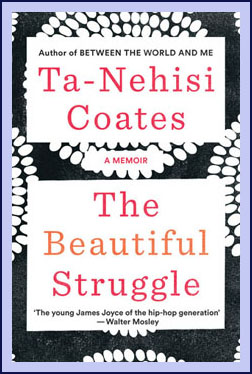
Published by: Verso
Publication Date: 2008
Format: Paperback, 227 Pages
Rating: ★★
To Buy
Baltimore was collapsing around him as Ta-Nehisi grew up. But in an age of decline you can always find a way to survive and, perhaps, thrive through the cracks even during a crack epidemic. You just need to have a goal and to have the knowledge, or, as his brother Big Bill would say, the "Knowledge;" the ability to survive in a culture of violence. These were lessons his family taught Ta-Nehisi well. His father, Paul, believed strongly in education and in raising his sons to be proud black men despite a society that points to those very black men as the problem. Even though people like to think of the seventies and in particular the eighties in America as some sort of economic renaissance, America was, and still is, a deeply racist country, stigmatizing those of color, and Paul knew that this knowledge was paramount to the raising of his sons, and maybe that's why he was so hard on them, he would never let his sons forget this while at the same time making sure they were proud of their heritage. Paul Coates, Conscious Man, was a vet and member of the Black Panthers and an autodidact. He believed in the power of words and language and ran a publishing house out of his basement, the Black Classic Press (BCP), that was committed to distributing the collective stories of the African-American people. But he also had a deputy patriarch with his son Big Bill who helped Ta-Nehisi with the Knowledge. Ta-Nehisi, as seen through the eyes of his family, had an exemplary life ahead of him, if only he'd see his future clearly. Though when Ta-Nehisi starts telling his story, he doesn't yet have a goal, he doesn't have a Mecca, he just wants to survive in an uncertain world. Yet the thing about children is they eventually grow up. But having his father not just encourage but insist on intellectual curiosity paid off. Ta-Nehisi moves beyond the lures of rap culture and basketball and begins to think about what he wants to do with his life and he starts to take his education seriously. He gets into Baltimore Polytech, a magnet school that is his way out of Baltimore and to his chosen Mecca, Howard University. Though Ta-Nehisi isn't as academically gifted as his siblings and is soon kicked out of Baltimore Polytech. But he does eventually reach Howard University, after walking the halls of many a Baltimore-area school. He has struggled to survive in a hostile world and he has made it out. Thanks to his family.
I'm not a big fan of nonfiction in general so I'm not singling out memoirs as something I don't like to read. In fact they're probably the only subset of nonfiction I'm OK with, with notable exceptions. But this is never a book I would have ever picked up of my own volition. The thing is, I don't really like reading about other people's lives. I should clarify, "real" peoples lives. I love me my "fictional" friends. Even people I like and respect I won't often pick up a book about them because I often find out something that colors my opinion of them for the worse. I can't make it go away, so I'm sorry, Nelson Mandela, you gave pictures of your wife and daughters to inmates to masterbate to, and every time your name is mentioned that is the first thing I think of. As for how Bob Geldof lost his virginity... That's best never mentioned. Then there's the disconnect. You're reading about someone's life and you're thinking that for once, you've found someone on the same wavelength as you, and then they say something or do something, and you're just done with them. I will point out that this generally happens for me when reading nonfiction books by female authors when they start talking about having kids. But it's a obstacle that can not be overcome. So I didn't have many hopes going into Ta-Nehisi Coates's memoir. Though this would stand for any memoir. It was interesting. Will I ever read it again? No. Do I respect Ta-Nehisi Coates more after reading about him? Perhaps. He's at least now no longer that guy who wrote the highly lauded Black Panther run but a celebrated author in his own right. What I found most interesting was that he's only three years older than me so we have many of the same cultural touchstones. I saw some reviewers complaining that when he mentioned Star Wars or The Lord of the Rings that it brought them out of the narrative, that it felt like he was trying too hard to show his geek cred and that he was "aware" of white culture. Whereas I thought it was a good framework to help those who are completely ignorant of the privilege that they grew up in that while these cultural moments are moments of connection for all of us we need to look at what else was happening in his life. There is a part of us that is the same but there is a part of him that we can never understand because these aren't our lived in experiences. And that's what made this book for me. That chasam, that gap between white privilege and black power, I felt that he told it in a way that made me connect and that is so rare in a memoir. I might not truly be able to understand his life but I get it if that makes sense. I empathize and applaud.
 I was not one of those kids, like Stephen Colbert, who spent their childhood immersed in Tolkien. But I hung out with those kids. And then things turned up a notch when I started college. One of my friends moved into a co-op called Rivendell and I finally read The Hobbit. And blasphemous as it is, I think that is still my favorite story. But it was the community of Rivendell that had the greatest effect on me. Soon four of my best friends lived in the co-op and I was acquaintances with everyone else. I spent more time there than I did at my own home leading to several housemates saying that I should just move in already as I practically lived there. Though I never did. But one thing that Rivendell took really seriously was The Lord of the Rings. Everyone in the house was fanatical about the books, taking it so far as to have a feud with fellow co-op Lothlórien, because down with loose elves? Loth did have a rather libidinous reputation. So when the the Peter Jackson films went into development everyone at Rivendell couldn't wait for the film to come out. I used the time between the announcement and the release to do some cramming, ie, I read the trilogy. Then when it was announced The Fellowship of the Ring was being released in December of 2001, that's when me and the Rivdendwellers started working on our costumes. There were cloaks, there were ears, there was everything you could imagine. Even my precious. And there we were on opening night being sucked into the world Peter Jackson brought to life. We were there the next two years as The Two Towers and The Return of the King were released. When Peter Jackson released his extended cut of The Return of the King we had a movie night at Rivendell in the dungeon-like television room where we watched Buffy the Vampire Slayer every Tuesday night. The Lord of the Rings was so much a part of my life for so long that I wasn't sure how I'd handle The Rings of Power. And it wasn't so much that Peter Jackson wasn't a part of it, I lost faith in him after The Hobbit trilogy, I mean he could have just made The Hobbit and it would have been good, but no, that didn't happen. But the cast was made up of so many British actors I like and from all the pre-release material it looked right. Yet it's best to go in with no expectations and no assumptions. After all, this was having to pull from the same source material as a beloved trilogy, so how could they make it work? The answer is Prince Durin IV. OK, there are other awesome characters, and Galadriel could have carried this whole show on her shoulders, and I was triumphant that I figured out who Sauron was before he was revealed, and I am still scratching my head about the Harfoots who are living contradictions because they never walk alone and yet leave people behind, but it all comes down to Durin. Oh and Elrond. Their friendship and their depth of connection and emotion shows what draws people again and again to The Lord of the Rings, friendship, or, in the words of Tolkien, fellowship. Oh, and can we talk about Durin getting a free table by making up a lie about the stone it was made of? It's how I'm planning on getting all my tables from now on; dwarven guilt. Say it with a nice Scottish burr.
 The Other Wind by Ursula K. Le Guin


