Showing posts with label Jack the Ripper. Show all posts

Wednesday, August 26, 2026

Season 55 - Miss Austen (2025)

If there's one thing Janeites can agree on since time immemorial, or since fans of Jane Austen agreed on a moniker, that one of the greatest unsolved mysteries of Jane's life is why her sister Cassandra burned practically all of Jane's letters. Of all the letters Jane wrote in her lifetime only 160 remain. What was in those letters that Cassandra deemed necessary to expunge? I mean, one of the surviving letters is Jane getting blind drunk and puking, so, why'd Cassandra do it!?! In fact, most Janeites, if given a chance to change one aspect of the history surrounding Jane, would probably choose for the phoenix-like return of the letters, while I personally would have liked Jane to have lived long enough to finish Sanditon so that she'd have written seven novels instead of six. At least she wrote more books than Jack the Ripper had victims. Why am I bringing up Jack the Ripper while discussing Jane Austen's letters? Because it is another of life's mysteries that will forever remain unsolved. Unless the premise to Anthony Horowitz's show Crime Traveller becomes a reality that is. Miss Austen is a bittersweet story of family connections and sisterly love that involves Cassandra Austen going to attend the deathbed of family friend Reverend Fowle, who, if fate had been kinder, would have been Cassandra's brother-in-law. Whilst helping the Reverend's daughter Isabella dismantle the household on the Reverend's death Cassandra hopes to find her sister Jane's letters to Isabella's mother Eliza who was Jane's dearest friend. But it is not an easy task with Eliza's sister Mary, who is also Cassandra's sister-in-law, on the hunt for the letters. What follows is a dreamlike rumination of the past and present and what you are willing to sacrifice for love and will that sacrifice be worth it in your dying days. Here we see Cassandra as a driving force. She was Jane's dearest friend and confidant but she also acted as a midwife to Jane's books. This posits that she turned away from a traditional life because she knew she had a greater purpose. The love of Cassandra's life wasn't Tom Fowle, it was Jane. Cassandra was the shepherd and the champion of Jane. In a scene where she starts to place Jane's books on their bookshelf, it isn't just Jane's legacy, it's their legacy. And when Jane dies it's up to Cassandra to protect that legacy. She was Jane's secret keeper and Jane wanted no one to see the darker side of her. The bleak thoughts and the moments of despair. She wanted to be remembered for her work. Work she published anonymously while alive, though don't read too much into that because it was the convention more than anything else. And historically it must be remembered that Frances Burney was viewed as an author equal to Jane but when her letters were published they overshadowed her works. Perhaps Cassandra didn't want this for her beloved sister. Let the work Jane wanted to share with the world be that by which she is known. And only that. And by the end of Miss Austen after crying your way through Jane's death you are so emotionally raw you will believe anything. Of course Cassandra had to do this. It's what Jane would have wanted. But then, later, once you've recovered, you realize that we're not talking about a few letters taken from a vicarage, we're talking about the destruction of approximately three thousand letters. The scale isn't taken into consideration here. So while emotionally I fully want to believe Gill Hornby's suppositions, the logical part of my brain says that this wholesale destruction must mean something more. Something we will never know. 

Wednesday, November 5, 2025

Miss Austen

If there's one thing Janeites can agree on since time immemorial, or since fans of Jane Austen agreed on a moniker, that one of the greatest unsolved mysteries of Jane's life is why her sister Cassandra burned practically all of Jane's letters. Of all the letters Jane wrote in her lifetime only 160 remain. What was in those letters that Cassandra deemed necessary to expunge? I mean, one of the surviving letters is Jane getting blind drunk and puking, so, why'd Cassandra do it!?! In fact, most Janeites, if given a chance to change one aspect of the history surrounding Jane, would probably choose for the phoenix-like return of the letters, while I personally would have liked Jane to have lived long enough to finish Sanditon so that she'd have written seven novels instead of six. At least she wrote more books than Jack the Ripper had victims. Why am I bringing up Jack the Ripper while discussing Jane Austen's letters? Because it is another of life's mysteries that will forever remain unsolved. Unless the premise to Anthony Horowitz's show Crime Traveller becomes a reality that is. Miss Austen is a bittersweet story of family connections and sisterly love that involves Cassandra Austen going to attend the deathbed of family friend Reverend Fowle, who, if fate had been kinder, would have been Cassandra's brother-in-law. Whilst helping the Reverend's daughter Isabella dismantle the household on the Reverend's death Cassandra hopes to find her sister Jane's letters to Isabella's mother Eliza who was Jane's dearest friend. But it is not an easy task with Eliza's sister Mary, who is also Cassandra's sister-in-law, on the hunt for the letters. What follows is a dreamlike rumination of the past and present and what you are willing to sacrifice for love and will that sacrifice be worth it in your dying days. Here we see Cassandra as a driving force. She was Jane's dearest friend and confidant but she also acted as a midwife to Jane's books. This posits that she turned away from a traditional life because she knew she had a greater purpose. The love of Cassandra's life wasn't Tom Fowle, it was Jane. Cassandra was the shepherd and the champion of Jane. In a scene where she starts to place Jane's books on their bookshelf, it isn't just Jane's legacy, it's their legacy. And when Jane dies it's up to Cassandra to protect that legacy. She was Jane's secret keeper and Jane wanted no one to see the darker side of her. The bleak thoughts and the moments of despair. She wanted to be remembered for her work. Work she published anonymously while alive, though don't read too much into that because it was the convention more than anything else. And historically it must be remembered that Frances Burney was viewed as an author equal to Jane but when her letters were published they overshadowed her works. Perhaps Cassandra didn't want this for her beloved sister. Let the work Jane wanted to share with the world be that by which she is known. And only that. And by the end of Miss Austen after crying your way through Jane's death you are so emotionally raw you will believe anything. Of course Cassandra had to do this. It's what Jane would have wanted. But then, later, once you've recovered, you realize that we're not talking about a few letters taken from a vicarage, we're talking about the destruction of approximately three thousand letters. The scale isn't taken into consideration here. So while emotionally I fully want to believe Gill Hornby's suppositions, the logical part of my brain says that this wholesale destruction must mean something more. Something we will never know. 

Wednesday, June 25, 2025

Book Review - Maureen Johnson's The Vanishing Stair

The Vanishing Stair by Maureen Johnson
Published by: Katherine Tegen Books
Publication Date: January 22nd, 2019
Format: Paperback, 400 Pages
Rating: ★★★★★
To Buy

Stevie feels like the world has turned upside down. If there was one person in the world whom she thought she would never be grateful for it's Edward King. The conservative politician with White House dreams whom her parents worship and work for has been a divisive subject for years. And yet here he is in her living room giving her what she most desires in the world, a return ticket to Ellingham Academy. After the tragic death of Hayes Major and the disappearance of Ellie Walker, Stevie's parents pulled her out of Ellingham faster than she thought possible. They never thought she belonged there, hell she was never sure she belonged there, but it's where she needs to be. She needs to solve the Truly Devious case, and if that means making a deal with the devil then so be it. Even if it means spying on David. To be fair, David is the one who dropped the bombshell that he's Edward King's son on her only when his hand was forced. But that can be unpacked another day, what needs to be unpacked now is the tin she found in Ellie's room with new evidence relating to the Truly Devious case. Who exactly are Frankie and Edward and how do they tie into the mystery? Well if anyone alive knows that it's Dr. Irene Fenton. Dr. Fenton wrote THE BOOK on the crime; Truly Devious: The Ellingham Murders. Charles Scott, the head of Ellingham Academy and Stevie's advisor, has arranged for her to be Dr. Fenton's research assistant. Stevie has access to the attics at Ellingham Academy and has been cataloging the items within and therefore can verify china patterns used and other seemingly useless details for an updated edition of Dr. Fenton's book. Because if there's one thing she's quickly learned about Dr. Fenton it's that she is even more obsessed with the Truly Devious case than Stevie herself. Dr. Fenton's house looks like a cliched conspiracy theorist's hideout. But somewhere among all those secreted papers maybe Dr. Fenton has found a new clue, one thing Stevie does learn from her is that there's a secret tunnel in her school lodging. On Halloween Stevie and David and Nate look for the tunnel in Minerva House and find more than they bargained for, Ellie's body. Stevie feels in over her head. Everyone seems to have a secret and none moreso than Ellingham Academy itself. One thing is clear, with all these bodies piling up she might solve the case but she might also end up dead.

This is THE BOOK that made me fall in love with this series. Perhaps I related too strongly to a quirky writer with a few too many cats... and I also have a borderline obsession with moose. But really it was Frankie and Edward that captured my imagination. What I loved is that this book took the ingeniously repurposed Dorothy Parker poem that was viewed as the ominous warning of the crime to come and in fact gave the case it's moniker and turned it on it's head. Which in turn made me think of something else tangentially related and kind of blew my mind as to why I never thought of it before. It's also extra ironic that it has to deal with Jack the Ripper, a case that Stevie views as a little too sensationalized and therefore not for her. So in her book Portrait of a Killer: Jack the Ripper - Case Closed Patricia Cornwell makes a big deal of the fact that the "From Hell" letter which is believed to written by Jack the Ripper was written on the same kind of paper the artist Walter Sickert used, meaning that he must be Jack the Ripper. She has spent millions buying up his artwork and trying to find DNA evidence to prove her point but here Stevie got me wondering, what if Cornwell is right about the letter but wrong about Sickert? Yes, it's commonly believed that the "From Hell" letter is genuine, but what if it's not? What if it was written by a deluded artist and actually had nothing to do with the crime? In other words, the person who writes the letter might not be the killer. This revelation that Stevie stumbles upon with regard to the "Truly Devious" letter and Frankie and Edward just ignited my brain. Coincidences can happen, especially when someone wants to be thought of as evil. If you're two teenagers wanting to be Bonnie and Clyde or an artist wanting to be the most notorious serial killer of all time, wouldn't you do something to try to get that notoriety? In Frankie and Edward's case they didn't know things would play out as they did, but they sure got what they wanted. And this gave me what I wanted. A case I thought was pretty straightforward, a case I figured I had solved, but then Maureen Johnson throws this little wrench in and makes me think, I mean really think. That's why this series is so good, nothing is as it appears and death is a very real possibility. The question is is moose also a possibility?

Friday, February 9, 2024

Book Review - Alan Moore and Eddie Campbell's From Hell

From Hell: Master Edition by Alan Moore and Eddie Campbell
Published by: Top Shelf Productions
Publication Date: 1999
Format: Kindle, 582 Pages
Rating: ★★★★
To Buy (different edition than one reviewed)

Queen Victoria's eldest son Eddy has been a bad boy. He's been slumming in the East End with his tutor Walter Sickert. There Eddy met and secretly married a shop girl, Annie Crook. This will not do for the future King of England and his mother decides to set it right. She separates the couple, bringing Eddy home and sending the wife to Bedlam, unaware that there was a child in the care of one Mary Kelly. This is when Sir William Withey Gull enters the picture. He is a respected doctor, an esteemed and high ranking freemason, who saved the Prince's life when he was ill years previously. For his services he was promoted to Physician-in-Ordinary to Queen Victoria. The Queen calls on him to deal with her son's wife and he operates on Annie Crook's thyroid gland impairing her sanity. The Queen and her doctor believe the threat is past when Mary Kelly realizes that she and her friends have a meal ticket thanks to her knowledge of the marriage and the baby named Alice. Prostitutes Polly Nichols, Annie Chapman, Liz Stride, and Mary Kelly would never resort to blackmail if not for the fact their very lives are in danger by the Old Nichol Gang unless they pay up. So Mary sends Walter Sickert a letter. Walter goes to Princess Alix, Eddy's mother. After what happened previously she says this matter must be taken to Victoria immediately and Victoria calls in Sir William. Sir William has recently recovered from a stroke and approaches this undertaking in the name of the Queen as his great work. With the help of his driver Netley they identify the four women and Sir William goes about plotting their deaths. He has informed his fellow Masons at the police that murders are about to commence, but neither realize how significant they will be or how they will terrorize London. Sir William's knowledge of anatomy allows him to be brutal and precise with his work, though at least the first death is as painless as he can make it. The fear that grips London after the death of Polly Nichols means that all the prostitutes are steeped in terror. The newspapers make a sensation of the cases, dubbing the killer "Jack the Ripper." And Jack is here to usher in the future no matter the body count.

Alan Moore is the grand old wizard of graphic novels and it would not be an understatement to say that he created the genre as we know it today. But for all that he is divisive. You either love his work or you hate it, or you're one of those weird people who is really into Watchmen and when they released a totally credible and faithful adaptation you say it's not "your" Watchmen. I sometimes just don't get people. But I'm starting to get the Alan Moore fantascism, despite my hatred of Watchmen and The League of Extraordinary Gentlemen, whose adaptation everyone should be complaining about. And I somehow saw that twice in theaters. For me From Hell is his magnum opus, his great work. And being an armchair Ripperologist I was able to enjoy it without believing anything that he wrote about the crimes. Because for all the theories out there on who Jack the Ripper is I have never once found it even slightly plausible that it was a Freemason cover-up at the behest of Queen Victoria. And no matter how fun they made the film Murder by Decree with a camp James Mason and a psychic Donald Sutherland flailing through the streets of London if they couldn't make me believe the theories spouted by Stephen Knight in Jack the Ripper: The Final Solution, I'm sorry, but Alan Moore didn't stand a chance. And while I could blame my dislike of the theory for avoiding the graphic novel for so many years, I didn't know that this was the theory espoused, the only knowledge I really had of the comic was that it was loosely, and I say very loosely, the inspiration for the 2001 Johnny Depp film. Which, well, the less said the better. Except for this, they tried to combine Abberline and Lees into one character to have a psychic cop. Yeah. They did that. So why did I finally decide to pick up the book after all this time? Honestly, I'm not sure. I was just feeling in a gloomy Victorian mood and was rewatching Penny Dreadful and just thought, you know what, now's the time. And here's the thing, if I had known it was more about the world the murders happened in I would have picked it up so much sooner, though I'm glad I didn't because the colorization by Eddie Campbell gave the artwork more depth and definition. The way that Sir William discusses the history of London reminded me of what I love so much about the Rivers of London series by Ben Aaronovitch. There's a depth and richness to the history of London with it constantly building and reinventing itself on the remnants of history. Always moving forward into the future. And if this book shows one thing it's that these murders were a force that would move London inexorably forward into a whole new world.

Friday, January 27, 2023

Book Review 2022 #1 - Maureen Johnson's The Vanishing Stair

The Vanishing Stair by Maureen Johnson
Published by: Katherine Tegen Books
Publication Date: January 22nd, 2019
Format: Paperback, 400 Pages
Rating: ★★★★★
To Buy

Stevie feels like the world has turned upside down. If there was one person in the world whom she thought she would never be grateful for it's Edward King. The conservative politician with White House dreams whom her parents worship and work for has been a divisive subject for years. And yet here he is in her living room giving her what she most desires in the world, a return ticket to Ellingham Academy. After the tragic death of Hayes Major and the disappearance of Ellie Walker, Stevie's parents pulled her out of Ellingham faster than she thought possible. They never thought she belonged there, hell she was never sure she belonged there, but it's where she needs to be. She needs to solve the Truly Devious case, and if that means making a deal with the devil then so be it. Even if it means spying on David. To be fair, David is the one who dropped the bombshell that he's Edward King's son on her only when his hand was forced. But that can be unpacked another day, what needs to be unpacked now is the tin she found in Ellie's room with new evidence relating to the Truly Devious case. Who exactly are Frankie and Edward and how do they tie into the mystery? Well if anyone alive knows that it's Dr. Irene Fenton. Dr. Fenton wrote THE BOOK on the crime; Truly Devious: The Ellingham Murders. Charles Scott, the head of Ellingham Academy and Stevie's advisor, has arranged for her to be Dr. Fenton's research assistant. Stevie has access to the attics at Ellingham Academy and has been cataloging the items within and therefore can verify china patterns used and other seemingly useless details for an updated edition of Dr. Fenton's book. Because if there's one thing she's quickly learned about Dr. Fenton it's that she is even more obsessed with the Truly Devious case than Stevie herself. Dr. Fenton's house looks like a cliched conspiracy theorist's hideout. But somewhere among all those secreted papers maybe Dr. Fenton has found a new clue, one thing Stevie does learn from her is that there's a secret tunnel in her school lodging. On Halloween Stevie and David and Nate look for the tunnel in Minerva House and find more than they bargained for, Ellie's body. Stevie feels in over her head. Everyone seems to have a secret and none moreso than Ellingham Academy itself. One thing is clear, with all these bodies piling up she might solve the case but she might also end up dead.

This is THE BOOK that made me fall in love with this series. Perhaps I related too strongly to a quirky writer with a few too many cats... and I also have a borderline obsession with moose. But really it was Frankie and Edward that captured my imagination. What I loved is that this book took the ingeniously repurposed Dorothy Parker poem that was viewed as the ominous warning of the crime to come and in fact gave the case it's moniker and turned it on it's head. Which in turn made me think of something else tangentially related and kind of blew my mind as to why I never thought of it before. It's also extra ironic that it has to deal with Jack the Ripper, a case that Stevie views as a little too sensationalized and therefore not for her. So in her book Portrait of a Killer: Jack the Ripper - Case Closed Patricia Cornwell makes a big deal of the fact that the "From Hell" letter which is believed to written by Jack the Ripper was written on the same kind of paper the artist Walter Sickert used, meaning that he must be Jack the Ripper. She has spent millions buying up his artwork and trying to find DNA evidence to prove her point but here Stevie got me wondering, what if Cornwell is right about the letter but wrong about Sickert? Yes, it's commonly believed that the "From Hell" letter is genuine, but what if it's not? What if it was written by a deluded artist and actually had nothing to do with the crime? In other words, the person who writes the letter might not be the killer. This revelation that Stevie stumbles upon with regard to the "Truly Devious" letter and Frankie and Edward just ignited my brain. Coincidences can happen, especially when someone wants to be thought of as evil. If you're two teenagers wanting to be Bonnie and Clyde or an artist wanting to be the most notorious serial killer of all time, wouldn't you do something to try to get that notoriety? In Frankie and Edward's case they didn't know things would play out as they did, but they sure got what they wanted. And this gave me what I wanted. A case I thought was pretty straightforward, a case I figured I had solved, but then Maureen Johnson throws this little wrench in and makes me think, I mean really think. That's why this series is so good, nothing is as it appears and death is a very real possibility. The question is is moose also a possibility?

Monday, January 17, 2022

Tuesday Tomorrow

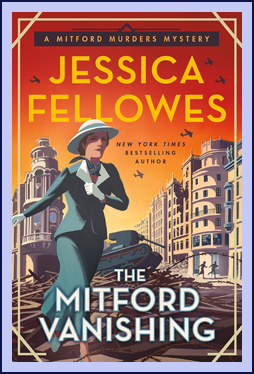
The Mitford Vanishing by Jessica Fellowes
Published by: Minotaur Books
Publication Date: January 18th, 2022
Format: Hardcover, 416 Pages
To Buy

The official patter:
"A mystery with the fascinating Mitford sisters at its heart, Jessica Fellowes's The Mitford Vanishing is the fifth installment in the Mitford Murders series, inspired by a real-life murder in a story full of intrigue...

1937. War with Germany is dawning, and a civil war already rages in Spain. Split across political lines, the six Mitford sisters are more divided than ever. Meanwhile their former maid Louisa Cannon is now a private detective, working with her policeman husband Guy Sullivan.

Louisa and Guy are surprised when a call comes in from novelist Nancy Mitford requesting that they look into the disappearance of her Communist sister Jessica in Spain. But one case leads to another as they are also asked to investigate the mysterious vanishing of a soldier.

As the two cases come together, Louisa and Guy discover that every marriage has its secrets - but some are more deadly than others. Suddenly home feels a long way away..."

Me continuing to read this series shows I'm insane because I keep expecting them to improve.

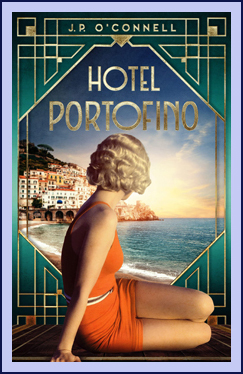
Hotel Portofino by J.P. O'Connell
Published by: Blackstone Publishing
Publication Date: January 18th, 2022
Format: Paperback, 376 Pages
To Buy

The official patter:
"For fans of Downton Abbey and The Crown...welcome to Hotel Portofino, where romance, revelry, and intrigue await.

A heady historical drama about a British family who opens an upper-class hotel on the magical Italian Riviera during the Roaring Twenties.

Hotel Portofino has been open for only a few weeks, but already the problems are mounting for its owner Bella Ainsworth. Her high-class guests are demanding and hard to please. And she's being targeted by a scheming and corrupt local politician, who threatens to drag her into the red-hot cauldron of Mussolini's Italy.

To make matters worse, her marriage is in trouble, and her children are still struggling to recover from the repercussions of the Great War. All eyes are on the arrival of a potential love match for her son Lucian, but events don't go to plan, which will have far-reaching consequences for the whole family.

Set in the breathtakingly beautiful Italian Riviera, Hotel Portofino is a story of personal awakening at a time of global upheaval and of the liberating influence of Italy's enchanting culture, climate, and cuisine on British innocents abroad."

Exotic Bright Young Things, yes please!

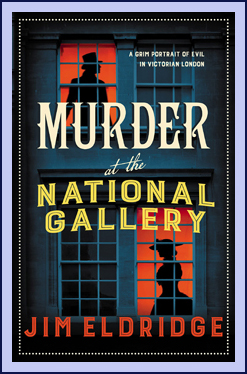
Murder at the National Gallery by Jim Eldridge
Published by: Allison and Busby
Publication Date: January 18th, 2022
Format: Hardcover, 311 Pages
To Buy

The official patter:
"1897, London. The capital is shocked to learn that the body of a woman has been found at the National Gallery, eviscerated in a manner that recalls all too strongly the exploits of the infamous Jack the Ripper.

Daniel Wilson and Abigail Fenton are contacted by a curator of the National Gallery for their assistance. The dead woman, an artist's model and lady of the night, had links to artist Walter Sickert who was a suspect during the Ripper's spree of killings. Scotland Yard have arrested Sickert on suspicion of this fresh murder but it is not the last...

Copycat murders of the Ripper's crimes implicate the artist who loves to shock but Sickert insists that he is innocent. Who would want to frame him? Wilson and Fenton have their work cut out catching an elusive and determined killer."

Jack the Ripper! Jack the Ripper! Jack the Ripper! Oh, and Sickert as the suspect! Patricia Cornwell would be pleased.

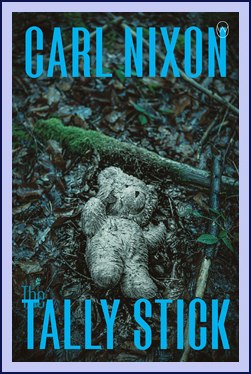
The Tally Stick by Carl Nixon
Published by: World Editions
Publication Date: January 18th, 2022
Format: Paperback, 288 Pages
To Buy

The official patter:
"Lost in the wilderness: subjugation, survival, and the meaning of family.

Up on the highway, the only evidence that the Chamberlains had ever been there was two smeared tire tracks in the mud leading into an almost undamaged screen of bushes and trees. No other cars passed that way until after dawn. By that time the tracks had been washed away by the heavy rain. After being in New Zealand for only five days, the English Chamberlain family had vanished into thin air. The date was 4 April 1978. In 2010 the remains of the eldest child are discovered in a remote part of the West Coast, showing he lived for four years after the family disappeared. Found alongside him are his father's watch and what turns out to be a tally stick, a piece of scored wood marking items of debt. How had he survived and then died in such a way? Where is the rest of the family? And what is the meaning of the tally stick?"

New Zealand disappearance? I am here for this!

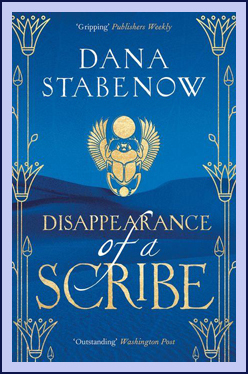
Disappearance of a Scribe by Dana Stabenow
Published by: Head of Zeus
Publication Date: January 18th, 2022
Format: Hardcover, 272 Pages
To Buy

The official patter:
"The second in the trilogy of Ancient Egyptian crime novels that began with Death of an Eye.

Two Alexandrian fishermen come across a horrifying sight - the body of a skeleton floating upright at the bottom of the sea, anchored in place by a cement weight around his feet. In Alexandria's rough-and-tumble construction trade they call that 'being fitted with a pair of Rhakotis sandals' and what's worse, he's the second such victim in two years.

Queen Cleopatra is busy rebuilding her city after the Alexandrian War and these murders are not to be allowed to interfere with this primary task, so she charges Tetisheri, her new Eye of Isis, with the task of finding out who these men were, when they were murdered, and, above all, why."

Egypt!!!

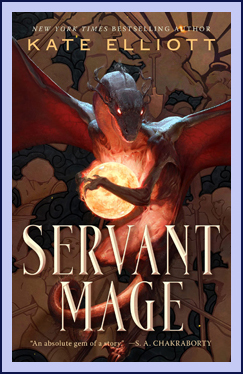
Servant Mage by Kate Elliott
Published by: Tordotcom
Publication Date: January 18th, 2022
Format: Hardcover, 176 Pages
To Buy

The official patter:
"In Kate Elliott's Servant Mage, a lowly fire mage finds herself entangled in an empire-spanning conspiracy on her way to discovering her true power.

They choose their laws to secure their power.

Fellian is a Lamplighter, able to provide illumination through magic. A group of rebel Monarchists free her from indentured servitude and take her on a journey to rescue trapped compatriots from an underground complex of mines.

Along the way they get caught up in a conspiracy to kill the latest royal child and wipe out the Monarchist movement for good.

But Fellian has more than just her Lamplighting skills up her sleeve..."

Dragons!!!

Friday, March 15, 2019

Book Review - Tasha Alexander's Dangerous to Know

Dangerous to Know by Tasha Alexander
Published by: Minotaur Books
Publication Date: October 26th, 2010
Format: Hardcover, 306 Pages
Rating: ★★★★★
To Buy

Emily is still reeling from her miscarriage in Constantinople. A happy honeymoon filled with intrigue and connubial bliss destroyed by one bullet. She must take solace in the fact that she saved a young girl's life and caught a killer and not dwell on the fact that she and Colin might never be able to have children now. Ensconced in Normandy, Emily's recuperation would be far more successful if it wasn't under the gimlet eye of her mother-in-law. The feeling of being a constant disappointment to Colin and his mother pushes Emily continually outside the four walls of the house that feel like they're closing in on her. But soon even the countryside won't offer her respite. On one of her rides she comes upon a young girl brutally murdered. So brutal that when she is finally able to lead the police back to the crime scene there are murmurs that Jack the Ripper might be calling Normandy his new home. Emily gets a little bit of celebrity with the locals for finding the body, but Colin worries if perhaps it's best if Emily's attention was drawn elsewhere. She doesn't need to investigate the most dangerous of crimes and be continually putting herself in danger.

Colin is therefore a little relieved when his mother's neighbors, George and Madeline Markham, have a diversion for Emily to occupy herself with. They are great art collectors and a new Monet painting has just appeared in their fortress like home. Emily's dear friend Cecile, arriving from Paris, recognizes the piece as one just finished and stolen from Giverny. Emily correctly comes to the conclusion that her favorite thief, Sebastian Capet, has returned to spice up her life with Greek quotations left on her pillow each night. But even Sebastian, with his laissez-faire attitude, can not deny that danger lurks near at hand for Emily. The murdered girl looked eerily like Emily and once it's discovered she wasn't the Rippers typical victim, being from a well-to-do family who had placed her in an asylum, Colin is all for Emily heading straight back to England and waiting for him there. Yet Emily can not do that. Yes, she wants to obey Colin, but never before has that meant leaving his side. But could retreating be in her best interest? She just doesn't know! She can no longer trust her mental faculties after she sees the ghostly apparition of a young child. Is this her grief over her own loss or is she on the path to the asylum like the Ripper's victim?

At the end of each adventure with Lady Emily I think to myself, the next volume couldn't possibly be better, and yet each and every time Tasha proves me wrong. This volume instantly became my favorite, but who knows what will happen when I read the next book? But I don't know how it could surpass the Gothic goodness of Dangerous to Know! This book almost felt like I was reading one of Emily's favorite authors! But could Mary Elizabeth Braddon come up with such a tale that Jack the Ripper, the Norman Heathcliff, and the ghostly apparition of a child people the pages!?! If she did I'm sure she wouldn't be able to capture the meta humor that Emily arches her eyebrows at with her love/hate relationship with Normandy's version of Wuthering Heights. But what called to me most was the Jack the Ripper angle. Long before the term Murderino came into existence I was one. I would watch all the Unsolved Mysteries I could, especially if they were historical. Therefore it shouldn't be surprising that I'm a bit of a Ripperologist. I have watched or read every movie, book, comic, TV series I can on Jack the Ripper. Therefore this inclusion in Emily's investigation made by blood sing! Oh, to combine my favorite heroine with what I find the most intriguing unsolved murders of the 1800s? How did Tasha know that this would be my wish for a perfect book!?!

Though I think the inclusion of Jack the Ripper in a story wherein Emily is dealing with the loss of her child would be significant only to a Ripperologist. What could I mean you ask? Well, let me break it down. Let's look to the canonical five. The first victim, Mary Ann Nichols suffered abdominal incisions, which were seen again in the second victim Annie Chapman. But all this was leading up to what would be done to the fifth and final victim, Mary Jane Kelly. All her internal organs from her abdomen, in particular her reproductive organs, were removed, and her breasts were cut off. While there are theories, much like with the Black Dahlia, that these wounds could have been used to cover up a botched abortion, one thing is clear, Jack the Ripper was targeting women who made their money from sex and then killed them in such a way as to destroy what made them female, the ability to reproduce, only fully succeeding with Mary Jane Kelly. And as for the theories of Mary Jane Kelly's daughter... well, all this shows that by including Jack the Ripper in Dangerous to Know Tasha was adding another level of gut punch to Emily. Not only would she be traumatized by finding the poor girl in the field mutilated to such a degree, but to then have the reminder that her miscarriage basically scooped out her insides and made them as empty as Mary Jane Kelly's... chilling.

Tasha then compounds this loss with the ghostly child who leaves behind blue ribbons. So many ghost stories of the Victorian era or written about the Victorian era deal with children and mothers who have lost their children. Wilkie Collins's The Woman in White, which Emily was sure to have read, Susan Hill's The Woman in Black, a more modern classic, and even a book that Tasha recommended to me, Angelica by Arthur Phillips, these are three books just off the top of my head that I thought of while reading Dangerous to Know. I am sure there are plethora more, even Henry James's The Turn of the Screw for example. But what Tasha does is she is smart enough to create her own mythology, first the story of the young girl who fell off a cliff, then the local gossip surrounding a young child that was killed at George and Madeline Markham's house that Madeline has conflated with her own pregnancy losses. Then there's the poor victim and what she endured... but where Tasha excels is that she draws a parallel between these stories and the loss endured by Victorian women. I believe it is Cecile who comments that she doesn't think she can think of a single one of their friends who hasn't suffered a similar loss to Emily's. Childbirth and childhood were dangerous undertakings during this time and the ghost stories are almost a way to normalize the fear these women constantly felt, even if it has the effect of unsettling them at the time.

For all that I loved there's one thing that made me go WTF!?! And that was Colin's behavior. Emily married Colin because he accepted who she was and wanted to be by his side, investigating and solving crimes, and now he's trying to wrap her up in cotton wool and let nothing bad ever happen to her again. YOU KNEW WHO SHE WAS WHEN YOU MARRIED HER YOU DUMBASS! She wouldn't have married him if she knew he was going to pull a 180 and decide to become the typical Victorian husband. She had that once and while at the time what Philip offered was what she thought she wanted, she has grown since then and become this awesome hoyden. Sure, she was badly injured and their unborn child was lost, but Dear God Colin, she doesn't need you pulling this shit when she's trying to piece her life back together. And yes, I know this is a plot device, one to destabilize Emily even more as well as show what marriages were really like during the Victorian era, but that doesn't mean it stopped my blood from boiling. Though it does actually all tie back into the killer, whose motives I did not see coming, and the idea of what we are willing to do for love. Would we break the will of our loved one if we think it's in their best interest? Would we imprison them for their safety? Would we kill for them?

Yet one thing is certain, I don't think Colin's mother would approve of his coddling of Emily. Madame Hargreaves is who I think Emily will evolve into. Yes, it's trite to say that boys marry women who remind them of their mothers, but going beyond that, Colin believes in the rights and equality of women, so it would make sense that he would find a woman he viewed as his equal to marry. At first I, like Emily, was wary of her mother-in-law, but I grew to really appreciate her, so much so that she better be returning in a later book! I love the little insights into the mind of Mrs. Hargreaves with her journal entries, a device Tasha has used from the first book in this series starting with Philip's journal and later being letters from Emily's various friends, that give us insight that Emily herself doesn't have that acts as a catalyst to the plot. What tickles me is that Mrs. Hargreaves is so hard on Emily, she just doesn't see what Colin does. But we, as readers, see that all her criticisms are because Emily has turned inward and is recovering and that the "real" Emily would perfectly match her mother-in-laws' expectations. By the end of the book they have come to an understanding, but I can't wait to meet them again now that they are on equal footing. The government of England better send out a warning, because these women want the right to vote! Long live strong women!

Friday, October 19, 2018

Book Review - Tasha Alexander's Dangerous to Know

Dangerous to Know by Tasha Alexander
Published by: Minotaur Books
Publication Date: October 26th, 2010
Format: Hardcover, 306 Pages
Rating: ★★★★★
To Buy

Emily is still reeling from her miscarriage in Constantinople. A happy honeymoon filled with intrigue and connubial bliss destroyed by one bullet. She must take solace in the fact that she saved a young girl's life and caught a killer and not dwell on the fact that she and Colin might never be able to have children now. Ensconced in Normandy, Emily's recuperation would be far more successful if it wasn't under the gimlet eye of her mother-in-law. The feeling of being a constant disappointment to Colin and his mother pushes Emily continually outside the four walls of the house that feel like they're closing in on her. But soon even the countryside won't offer her respite. On one of her rides she comes upon a young girl brutally murdered. So brutal that when she is finally able to lead the police back to the crime scene there are murmurs that Jack the Ripper might be calling Normandy his new home. Emily gets a little bit of celebrity with the locals for finding the body, but Colin worries if perhaps it's best if Emily's attention was drawn elsewhere. She doesn't need to investigate the most dangerous of crimes and be continually putting herself in danger.

Colin is therefore a little relieved when his mother's neighbors, George and Madeline Markham, have a diversion for Emily to occupy herself with. They are great art collectors and a new Monet painting has just appeared in their fortress like house. Emily's dear friend Cecile, arriving from Paris, recognizes the piece as one just finished and stolen from Giverny. Emily correctly comes to the conclusion that her favorite thief, Sebastian Capet, has returned to spice up her life with Greek quotations left on her pillow each night. But even Sebastian, with his laissez-faire attitude, can not deny that danger lurks near at hand for Emily. The murdered girl looked eerily like Emily and once it's discovered she wasn't the Rippers typical victim, being from a well-to-do family who had placed her in an asylum, Colin is all for Emily heading straight back to England and waiting for him there. Yet Emily can not do that. Yes, she wants to obey Colin, but never before has that meant leaving his side. But could retreating be in her best interest? She just doesn't know! She can no longer trust her mental faculties after she sees the ghostly apparition of a young child. Is this her grief over her own loss or is she on the path to the asylum like the Ripper's victim?

At the end of each adventure with Lady Emily I think to myself, the next volume couldn't possibly be better, and yet each and every time Tasha proves me wrong. This volume instantly became my favorite, but who knows what will happen when I read the next book? But I don't know how it could surpass the Gothic goodness of Dangerous to Know! This book almost felt like I was reading one of Emily's favorite authors! But could Mary Elizabeth Braddon come up with such a tale that Jack the Ripper, the Norman Heathcliff, and the ghostly apparition of a child people the pages!?! If she did I'm sure she wouldn't be able to capture the meta humor that Emily arches her eyebrows at with her love/hate relationship with Normandy's version of Wuthering Heights. But what called to me most was the Jack the Ripper angle. Long before the term Murderino came into existence I was one. I would watch all the Unsolved Mysteries I could, especially if they were historical. Therefore it shouldn't be surprising that I'm a bit of a Ripperologist. I have watched or read every movie, book, comic, TV series I can on Jack the Ripper. Therefore this inclusion in Emily's investigation made by blood sing! Oh, to combine my favorite heroine with what I find the most intriguing unsolved murders of the 1800s? How did Tasha know that this would be my wish for a perfect book!?!

Though I think the inclusion of Jack the Ripper in a story wherein Emily is dealing with the loss of her child would be significant only to a Ripperologist. What could I mean you ask? Well, let me break it down. Let's look to the canonical five. The first victim, Mary Ann Nichols suffered abdominal incisions, which were seen again in the second victim Annie Chapman. But all this was leading up to what would be done to the fifth and final victim, Mary Jane Kelly. All her internal organs from her abdomen, in particular her reproductive organs, were removed, and her breasts were cut off. While there are theories, much like with the Black Dahlia, that these wounds could have been used to cover up a botched abortion, one thing is clear, Jack the Ripper was targeting women who made their money from sex and then killed them in such a way as to destroy what made them female, the ability to reproduce, only fully succeeding with Mary Jane Kelly. And as for the theories of Mary Jane Kelly's daughter... well, all this shows that by including Jack the Ripper in Dangerous to Know Tasha was adding another level of gut punch to Emily. Not only would she be traumatized by finding the poor girl in the field mutilated to such a degree, but to then have the reminder that her miscarriage basically scooped out her insides and made them as empty as Mary Jane Kelly's... chilling.

Tasha then compounds this loss with the ghostly child who leaves behind blue ribbons. So many ghost stories of the Victorian era or written about the Victorian era deal with children and mothers who have lost their children. Wilkie Collins's The Woman in White, which Emily was sure to have read, Susan Hill's The Woman in Black, a more modern classic, and even a book that Tasha recommended to me, Angelica by Arthur Phillips, these are three books just off the top of my head that I thought of while reading Dangerous to Know. I am sure there are a plethora more, even Henry James's The Turn of the Screw for example. But what Tasha does is she is smart enough to create her own mythology, first the story of the young girl who fell off a cliff, then the local gossip surrounding a young child that was killed at George and Madeline Markham's house that Madeline has conflated with her own pregnancy losses. Then there's the poor victim and what she endured... but where Tasha excels is that she draws a parallel between these stories and the loss endured by Victorian women. I believe it is Cecile who comments that she doesn't think she can think of a single one of their friends who hasn't suffered a similar loss to Emily's. Childbirth and childhood were dangerous undertakings during this time and the ghost stories are almost a way to normalize the fear these women constantly felt, even if it has the effect of unsettling them at the time.

For all that I loved there's one thing that made me go WTF!?! And that was Colin's behavior. Emily married Colin because he accepted who she was and wanted to be by his side, investigating and solving crimes, and now he's trying to wrap her up in cotton wool and let nothing bad ever happen to her again. YOU KNEW WHO SHE WAS WHEN YOU MARRIED HER YOU DUMBASS! She wouldn't have married him if she knew he was going to pull a 180 and decide to become the typical Victorian husband. She had that once and while at the time what Philip offered was what she thought she wanted, she has grown since then and become this awesome hoyden. Sure, she was badly injured and their unborn child was lost, but Dear God Colin, she doesn't need you pulling this shit when she's trying to piece her life back together. And yes, I know this is a plot device, one to destabilize Emily even more as well as show what marriages were really like during the Victorian era, but that doesn't mean it stopped my blood from boiling. Though it does actually all tie back into the killer, whose motives I did not see coming, and the idea of what we are willing to do for love. Would we break the will of our loved one if we think it's in their best interest? Would we imprison them for their safety? Would we kill for them?

Yet one thing is certain, I don't think Colin's mother would approve of his coddling of Emily. Madame Hargreaves is who I think Emily will evolve into. Yes, it's trite to say that boys marry women who remind them of their mothers, but going beyond that, Colin believes in the rights and equality of women, so it would make sense that he would find a woman he viewed as his equal to marry. At first I, like Emily, was wary of her mother-in-law, but I grew to really appreciate her, so much so that she better be returning in a later book! I love the little insights into the mind of Mrs. Hargreaves with her journal entries, a device Tasha has used from the first book in this series starting with Philip's journal and later being letters from her various friends, that give us insight that Emily herself doesn't have that acts as a catalyst to the plot. What tickles me is that Mrs. Hargreaves is so hard on Emily, she just doesn't see what Colin does. But we, as readers, see that all her criticisms are because Emily has turned inward and is recovering and that the "real" Emily would perfectly match her mother-in-laws' expectations. By the end of the book they have come to an understanding, but I can't wait to meet them again now that they are on equal footing. The government of England better send out a warning, because these women want the right to vote! Long live strong women!

Wednesday, September 26, 2018

The Alienist

In these days of streaming which allow for bingeing having a series that keeps you literally on the edge of your seat for ten straight weeks instead of ten straight hours is pretty remarkable, and yet that is what The Alienist did. Of course, there were times I was tempted to pick up the book by Caleb Carr to get to the bottom of the crimes taking place in New York in the late 1800s, gruesome and ritualistic murders of young male prostitutes, but at the same time I didn't want to muddy the magnificence of the adaptation by comparing it to it's source material. This show combined so many things that I love into one production, a serial killer with a creepy bent like Jack the Ripper, bringing historical fiction to the small screen, but in a way that is believable because it fits in and around actual history, women breaking out of their expected roles, not to mention the depth of the characters with their own personal secrets that inform who they've become. When each episode ended I wanted the next one right away. This show is so fabulous that I think it might be the only show I've profiled this month that has won a coveted Emmy! When they announced just a few short weeks ago that they are adapting the second book in the series, The Angel of Darkness, I couldn't have been happier. I need Dr. Kreizler, John Moore, Sara Howard, and every single supporting character I've come to love from John's grandmother played by the incomparable Grace Zabriskie to the Isaacson brothers. One can only hope that after The Angel of Darkness they find some way to keep this series going, because I don't want, I need more Dr. Kreizler and associates in my life. Perhaps we can bribe Caleb Carr to write a third and forth installment?  

Friday, January 5, 2018

Book Review 2017 #8 - Rick Geary's Lovers' Lane

Lovers' Lane: The Hall-Mills Mystery by Rick Geary
Published by: NBM Publishing
Publication Date: July 17th, 2012
Format: Hardcover, 80 Pages
Rating: ★★★★
To Buy

On September 14th, 1922, shots rang out near an old abandoned farm used by the New Brunswick locals as lovers' lane. No one went to investigate and it wasn't until two days later that the bodies of Edward Hall, an Episcopal priest, and Eleanor Mills, a member of the church choir, were found. They were staged side-by-side with their feet facing a crab apple tree. A hat obscured Edward Hall's face so only his calling card propped against his shoe gave a hint as to who the male victim was at first. While both victims were shot, the female multiple times, besides having her hand placed on Edward Hall's thigh her throat was also slit from ear to ear, it was later discovered that her tongue and surrounding organs had been removed as well. Around them their love letters were scattered, an apparent judgment from the killer on this adulterous couple. Edward Hall was a pillar of the community and a favorite with his lady parishioners, though he ended up marrying spinster Frances Noel Stevens, an older woman who happened to be an heir to the Johnson and Johnson fortune and lived with a mentally handicapped brother. Yet most of the community knew of his affair with the talented chorister, who herself was trapped in a loveless marriage. The case soon became a media circus, yet almost everything was badly handled, like Edward Hall's calling card which was handed through the gathering crowd for scrutiny. The crab apple tree was even denuded of branches by souvenir hunters. But the crime baffled the police, who didn't even know who should investigate, the bodies being found in the next county from where the victims lived. But again and again the investigation lead back to Mrs. Hall. Could she, with the help of her wealthy family, have killed her husband just as he was ready to elope with his mistress? For now, the case remains unsolved.

It's a wonderful thing to discover a new author and realize you have their entire back catalog to work through. I was lucky enough to stumble onto Rick Geary one dreary day at the library. I wasn't feeling the best and I wasn't at my local branch, but they had such a lovely display in their graphic novel section featuring several books I'd been wanting to read, from Alison Bechdel to the history of the Carter Family. And there, in between Fun Home and The Carter Family: Don't Forget This Song was Adventures of Blanche by Rick Geary. Needless to say I actually took the whole display home with me. Geary's style seemed vaguely familiar but I was soon lost to the narrative, Geary had taken his grandmother's old letters as a starting off point and then lovingly embellished them to be more dramatic and more of their time, with murderers running rampant and famous painters walking in and out of frame. I quickly finished this slender volume and went to look up Geary online. Having worked for both National Lampoon and MAD during my childhood back when I devoured those tomes it's no wonder his style was familiar to me with his people that all look like they have cat whiskers for jawbone definition. He was a part of my past and very soon he was to become a part of my present when I realized that he had written oodles of true crime graphic novels! Nine of which I devoured last year and I can't wait to finish the remaining few.

Here's the thing about me. I LOVE true crime. I went through a period where all I watched was police procedural shows from Homicide: Life on the Street to all the iterations of Law and Order and I especially worshiped Unsolved Mysteries. Because I realized I don't really like true crime that happens now, I like true crime that happened then. I am not joking when I say that if I had a time machine I'd just go back and see who all the famous killers and kidnappers were. Who was Jack the Ripper? What really happened to James Ellroy's mother that turned him into the writer he is today? I don't just want, I NEED to know! When I was in undergrad I saw a very interesting one man play about the kidnapping of the Lindbergh Baby. With all the new speculation about what really happened and Lindbergh's Nazi leanings I decided that the first book I'd check out in Geary's Treasury of XXth Century Murder would be The Lindbergh Child. I couldn't have been happier. This book, this series, combined two things I love, true crime and art. While many people might take issue with how simple his drawing style is, nothing more than line work, there is a place for ALL kinds of graphic novels in the world and this style suits the pared down, spare, clean way he lays out the crime and methodically analyzes it. Maps and cross sections of buildings make Geary the David Maccaulay of True Crime! In each of Geary's books I've read he has told and shown the crime more succinctly than any other author I've ever read. He has a gift for distillation and visualization that is remarkable.

But all this could apply to any one of his books I picked up from The Borden Tragedy: A Memoir of the Infamous Double Murder at Fall River, Mass., 1892 to The Murder of Abraham Lincoln. Here I want to talk about his handling of the Hall-Mills double murder that happened in the fall of 1922. This book just struck me so forcibly I can't quite understand why. It's almost as if I have a weird connection to the crime. It felt familiar somehow and yet, I'm sure I'd never heard of this crime before. While it lead to a media circus what I was drawn to was the more personal nature of this story. So many of the great unsolved crimes are serial killers who were never caught, yet here it's just an adulterous couple at the center of the media firestorm. Plus, the way the crime was committed, the removal of the organs that allowed Eleanor Mills to sing, plus having her favorite song removed from every copy of every hymnal in the church, I agree with the victim's daughter, it sounds like a crime committed by a woman. In fact, that's one thing I really like about this series by Geary, he shows that despite public opinion, women are just as capable of committing really heinous crimes. While this case was never solved, and was very much muddied by an attention seeker known as "the pig lady," Edward Hall's wealthy wife and family were tried and found not guilty. And yet the tale does have a sense of closure. Because a woman had to have committed the crime, and whether it was Frances Noel Stevens or another female parishioner whose advances were spurned by the priest, you have a handle on the probability of who the culprit was. Yes, Frances could have used her money to walk away from a crime she committed, she did act very oddly over the days following her husband's disappearance. But unlike Jack the Ripper, you can clearly see the motive if not the culprit.

Wednesday, January 4, 2017

Book Review 2016 #10 - Kate Morton's The Lake House

The Lake House by Kate Morton
Published by: Atria Books
Publication Date: October 20th, 2015
Format: Hardcover, 512 Pages
Rating: ★★★★
To Buy

Midsummer has always been celebrated at Loeanneth with a grand gala. The lake house is strewn with lanterns and gondolas float on the river with fireworks dazzling the night sky above the great bonfire. While the Edevane family might enjoy their solitude in Cornwall, they still keep this tradition alive. It is 1933 and this will be the last year the family holds this celebration. Soon the house will be shuttered and it will be a time capsule of that night; the night everything changed. Young Alice Edevane would usually be reveling in these festivities, but this year is different. She no longer has time for Mr. Llewellyn, artist in resident and family friend, or her mother who wants her to help with preparations. She only has time for two things, plotting her first mystery novel and Ben. Ben is the gardener and she fancies herself in love with him. He listens raptly when she tells him about her book and talks to her like an equal. But could her book be what destroyed everything? Because in the wee hours of the night her baby brother Theo was taken from his crib. Seventy years later the case remains unsolved. Alice is now a successful mystery writer but she has never resolved what happened to her baby brother. Enter Sadie Sparrow. She's on leave from the MET with a forced vacation in Cornwall at her grandfather's house. Yet she can't sit still. Sadie stumbles on Loeanneth and the cold case consumes her. Will a fresh set of eyes find the truth of that long ago midsummer night?

There are times in your life when you just need to get away from reality and hide in a book. Sometimes it works and you fall into the story and it consumes you. Other times it backfires on you and all the troubles you were trying to escape are reflected back at you through this medium. Not only is the book too close for comfort, but once you put it down you'll be faced with reality again. Which is the situation I found myself in with Rainbow Rowell's Fangirl, leading to me not being one of the worshipful majority. But that's another story for another time. When I finally picked up The Lake House it was precisely the book I needed at just the right time. It had just enough mystery with just the right level of predictability that I wanted to stay there as long as possible. I usually devour a book in a matter of days, but here I spent a week, taking my time and having a well deserved respite from reality. I languished at Loeanneth. The book became so much a part of me that I dreamt of Cornwall. I remember quite vividly being in the half-dream state where I wasn't quite fully awake but I had already started to leave my dream behind and hearing the garbage trucks making their morning rounds. The beeps were confusing and incongruous to me. There was still a part of me that knew they were garbage trucks, but my thoughts were consumed with the fact they didn't belong. The technology didn't exist yet and they would never spoil the idyll that was the lake house, because that is where I was. I haven't had this kind of dream disassociation since years ago when I thought some crop dusters were Messerschmidt's, again another story for another time.

Kate Morton's books aren't for everyone. In fact they only occasionally work for me. They spend loving detail on atmosphere and if you are more interested in narrative, well you can feel like you are languishing in a story with no forward momentum. The mysteries Morton concocts are very pedestrian. Her own creation, Alice Edevane, would weep for their simplicity. In fact the only thing that didn't ring true to me in The Lake House is that Alice Edevane is this grand dame of mystery writers the likes of P.D. James and Ruth Rendell yet she was never able to solve this mystery in her own life. Yes, you could say it's because she didn't want to know the truth, but that seems cliched. But the truth you need to remember in Morton's book is the mystery is always secondary. Yes, she did a better job this time of spacing out the clues so just when you thought nothing would progress, bam, new evidence showed up on the scene. That doesn't mean I didn't figure it out hundreds of pages earlier, but I liked the pacing. I also liked the characters, I felt like they were more fleshed out in this tale. Morton likes to have the old lady with these wonderful stories and secrets that must be passed on or solved by younger generations. It's her thing, it's her trope. But here Alice was so alive. She was the spark that kept things together. She's a spunky old lady who plays her cards close to her chest, and I just loved that. Instead of a dead aunt, a mother on her deathbed, or an old lady in a nursing home, the elderly lady this time around was active not passive and it made a huge difference.

While having the disappearance of the one Edevane son as the fulcrum this book is really about women. Particularly the bond between mothers and daughters and all the shapes and forms these bonds come in. I liked that we had mothers who knew the best thing for their child was to let them go, while also having mothers so selfish they pushed their daughter away for the sake of their own appearance. It really cast a light on the fact that there's not just one single and simple way that mothers and daughters interact. People are so different and to assume that their relationships are all the same is folly. What is also interesting is to see how the mother daughter relationship is formed by experience and also by society's conventions and how those conventions have changed over time. The relationship between Alice's mother and grandmother, women of the previous century, was more staid and reserved, because of the time and also a tragedy Alice's grandmother endured. Going forward Alice's mother wants to have a better relationship with her own daughters but realizes that her husband stands in the way of her being the "fun" parent and therefore sadly accepts her fate. Then we look to Sadie and how her own mother threw her out because Sadie got pregnant and opted to give the baby up for adoption. Just a few women, and yet their relationships are so complex and we are given insight into each one, we get to understand if not empathize with how they lived and loved.

But if I'm honest what really intrigued me with The Lake House was the real life parallels. Theo's disappearance has parallels to the kidnapping of the Lindbergh baby, which the book doesn't shy away from pointing out. There's something about these unsolved crimes that echo down the generations and draw us in and therefore make for great inclusions in fiction. As for my Lindbergh baby obsession, it's not as bad as my Jack the Ripper obsession, though both make me wish I could time travel just to solve unsolved crime. The thing is Lindbergh went to the same university as me and I can actually see the house where he lived from my office window. As for the kidnapping, I saw a riveting one person play on the convicted kidnapper Bruno Hauptmann that has always stuck with me. Though it wasn't just the Lindbergh allusions that I loved. Mr. Llewellyn and his children's book based on Alice's mother had so much Lewis Carroll in it I could sqwee for joy. Plus Morton played with our preconceptions based on this real life connection. She threw suspicion on Mr. Llewellyn but also called into question his relationship with the family, much as Carroll's was with the Liddells. Oh, and to hark back to those great dames of detection, there's more than a little Anne Perry in Alice Edevane. Of course Anne Perry's childhood crime of murdering her best friend's mother prior to becoming a bestselling crime writer was immortalized in the wonderful film Heavenly Creatures. This crime occurred in New Zealand, a stone throws from Morton's Australia. The idea that Alice might somehow be guilty and therefore an unreliable narrator, I can't tell you how much I loved this. Also the Mitford parallels, with Deborah, Alice, and Clemmie Edevane mirroring Diana, Nancy, and Jessica Mitford respectively was just the cherry on top of the sundae.

The only real problem I had with the entire book was Sadie Sparrow. While you might think it's a hatred of her pigheadedness and her just not really listening to people, it has nothing to do with that, I could overlook that as character flaws. My problem is her name: Sadie Sparrow. I'm sure when everyone first saw the Doctor Who episode "Blink" written by Steven Moffat they all thought that Sally Sparrow was the coolest name ever and were wishing that they had thought of it first. I know I did and I'm a reviewer not a writer! In fact my handle on my knitting site actually is Sally Sparrow, I am unashamed of my geekiness and I fully admit it. It's such a unique and distinctive name that once you hear it you can't ever forget it. Now here we have Sadie Sparrow. She's like a weak imitation, a bad knock off, a wannabe Sally but alwaysbe Sadie. Why would you EVER choose this as your characters name? Why would an editor ever let you do it? Yes the name might seem perfectly acceptable to you, the author, but it's not. This name wasn't your invention. To make matters worse Sally and her friend Kathy joke about being investigators, Sparrow and Nightingale! A bit ITV, but I'd still watch it. And here's "Sadie" being all investigative and then a PI! I'm sorry. This is just unacceptable. You could argue it's coincidence, that Kate Morton has never even seen Doctor Who. Guess what? I don't care. Yes her book has lots of real life connections and allusions, but she makes them her own. If it was a original thought or Sally just became Sadie, it's too close and MUST be changed. This isn't Moffat, it's Morton. And the last thing any writer wants to be is Moffat.

Monday, November 7, 2016

Tuesday Tomorrow

Heartless by Marissa Meyer
Published by: Feiwel and Friends
Publication Date: November 8th, 2016
Format: Hardcover, 464 Pages
To Buy

The official patter:
"Long before she was the terror of Wonderland―the infamous Queen of Hearts―she was just a girl who wanted to fall in love.

Long before she was the terror of Wonderland, she was just a girl who wanted to fall in love. Catherine may be one of the most desired girls in Wonderland, and a favorite of the unmarried King of Hearts, but her interests lie elsewhere. A talented baker, all she wants is to open a shop with her best friend. But according to her mother, such a goal is unthinkable for the young woman who could be the next queen.

Then Cath meets Jest, the handsome and mysterious court joker. For the first time, she feels the pull of true attraction. At the risk of offending the king and infuriating her parents, she and Jest enter into an intense, secret courtship. Cath is determined to define her own destiny and fall in love on her terms. But in a land thriving with magic, madness, and monsters, fate has other plans.

In her first stand-alone teen novel, the New York Times-bestselling author dazzles us with a prequel to Alice's Adventures in Wonderland."

For me, Alice's Adventures in Wonderland is sacred and not to be messed with. However, Marissa Meyer has shown time and again that if there's someone who can create a new twist on an old tale and succeed it's her. Therefore this is THE MOST anticipated YA book of the fall.

The Jekyll Revelation by Robert Masello
Published by: 47North
Publication Date: November 8th, 2016
Format: Paperback, 492 Pages
To Buy

The official patter:
"A spellbinding thriller from the bestselling author of The Einstein Prophecy.

A chilling curse is transported from 1880s London to present-day California, awakening a long-dormant fiend.

While on routine patrol in the tinder-dry Topanga Canyon, environmental scientist Rafael Salazar expects to find animal poachers, not a dilapidated antique steamer trunk. Inside the peculiar case, he discovers a journal, written by the renowned Robert Louis Stevenson, which divulges ominous particulars about his creation of The Strange Case of Dr. Jekyll and Mr. Hyde. It also promises to reveal a terrible secret—the identity of Jack the Ripper.

Unfortunately, the journal—whose macabre tale unfolds in an alternating narrative with Rafe’s—isn’t the only relic in the trunk, and Rafe isn’t the only one to purloin a souvenir. A mysterious flask containing the last drops of the grisly potion that inspired Jekyll and Hyde and spawned London’s most infamous killer has gone missing. And it has definitely fallen into the wrong hands."

Yes, it sounds a little cheesy, but seriously, to combine literary icon Robert Louis Stevenson with Jack the Ripper it's a no-brainer that I'm going to read it. 

Rhythm and Clues by Sue Ann Jaffarian
Published by: Midnight Ink
Publication Date: November 8th, 2016
Format: Paperback, 312 Pages
To Buy

The official patter:
"Amateur sleuth Odelia Grey tries to get a band back together―and get her mother off the hook―in book eleven of the award-winning series.

It’s a rockin’ flashback for Odelia Grey when her mother asks her to look into the disappearance of her neighbor Bo Shank, the former lead singer for a band Odelia idolized in her youth. But when a body is found in Bo Shank’s house, everything quickly gets thrown out of tune."

Just looking at that cover I want to hang out with this sleuth!

The Princess in Black Takes a Vacation by Shannon and Dean Hale
Published by: Candlewick
Publication Date: November 8th, 2016
Format: Hardcover, 96 Pages
To Buy

The official patter:
"Even monster-battling princesses get tired sometimes! But a peaceful time away is hard to find as the humorous New York Times best-selling series continues.

After battling monsters all night, a sleepy Princess in Black decides that she needs a vacation. After all, the Goat Avenger, a new hero who looks oddly familiar, has offered to protect the goats while she takes a much needed break. The very next day Princess Magnolia rides her bicycle to the seaside, where the air is salty, the sun is shiny, and the sea is as blue as monster fur. But just as Princess Magnolia is about to take a nap on her hammock, she hears a "ROAR!" Seriously? A monster? On the perfect beach? Impossible! Could a sea monster really ruin this vacation for the Princess in Black?"

New Shannon Hale book, it's a mandatory purchase. 

Jim Henson's Labyrinth Artist Tribute by Various
Published by: Archaia
Publication Date: November 8th, 2016
Format: Paperback, 112 Pages
To Buy

The official patter:
"Get Lost in the Labyrinth as You’ve Never Seen it Before!

In the thirty years since its original release in 1986, Jim Henson’s timeless fantasy film Labyrinth has captured the minds and imaginations of authors, artists, filmmakers, and fans across the world. In honor of the film’s 30th anniversary, return to the world of Labyrinth and see the beloved characters, imaginative locations, and unforgettable moments as realized by a collection of uniquely original artistic voices in an unprecedented celebration of the cult classic thirty years in the making.

Labyrinth: Artist Gallery features illustrations and testimonials from comics luminaries and newcomers alike, including: Mike Allred, Joëlle Jones, David Mack, Rebekah Isaacs, Eric Powell, Gustavo Duarte, Jill Thompson, Mark Buckingham, Tula Lotay, Faith Erin Hicks, Ramón Perez, Dustin Nguyen, Mike Huddleston, Jeff Stokely, and many more of your favorite artists!"

Seriously, I pre-ordered this book as soon as I could. That cover alone people!

Monday, August 22, 2016

Tuesday Tomorrow

Associates of Sherlock Holmes edited by George Mann
Published by: Titan Books
Publication Date: August 23rd, 2016
Format: Paperback, 304 Pages
To Buy

The official patter:
"For the very first time, famous associates of the Great Detective – clients, colleagues, and of course, villains – tell their own stories in this collection of brand-new adventures. Follow Inspector Lestrade as he and Sherlock Holmes pursue a killer to rival Jack the Ripper; sit with Mycroft Holmes as he solves a case from the comfort of the Diogenes Club; take a drink with Irene Adler and Dr Watson in a Parisian café; and join Colonel Sebastian Moran on the hunt for a supposedly mythical creature…"

My friend George has a new Sherlock Holmes Anthology he edited out this week... which means you better go buy it if you're my friend. 

The Mammoth Book of the Adventures of Professor Moriarty edited by Maxim Jakubowski
Published by: Skyhorse Publishing
Publication Date: August 23rd, 2016
Format: Paperback, 592 Pages
To Buy

The official patter:
"The hidden life of Sherlock Holmes’s most famous adversary is reimagined and revealed by the finest crime writers today.

Some of literature’s greatest supervillains have also become its most intriguing antiheroes—Dracula, Hannibal Lecter, Lord Voldemort, and Norman Bates—figures that capture our imagination. Perhaps the greatest of these is Professor James Moriarty. Fiercely intelligent and a relentless schemer, Professor Moriarty is the perfect foil to the inimitable Sherlock Holmes, whose crime-solving acumen could only be as brilliant as Moriarty’s cunning.

While “the Napoleon of crime” appeared in only two of Conan Doyle’s original stories, Moriarty’s enigma is finally revealed in this diverse anthology of thirty-seven new Moriarty stories, reimagined and retold by leading crime writers such as Martin Edwards, Jürgen Ehlers, Barbara Nadel, L. C. Tyler, Michael Gregorio, Alison Joseph and Peter Guttridge. In these intelligent, compelling stories—some frightening and others humorous—Moriarty is brought back vividly to new life, not simply as an incarnation of pure evil but also as a fallible human being with personality, motivations, and subtle shades of humanity.

Filling the gaps of the Conan Doyle canon, The Mammoth Book of the Adventures of Professor Moriarty is a must-read for any fan of the Sherlock Holmes’s legacy.

Skyhorse Publishing, as well as our Arcade, Yucca, and Good Books imprints, are proud to publish a broad range of books for readers interested in fiction—novels, novellas, political and medical thrillers, comedy, satire, historical fiction, romance, erotic and love stories, mystery, classic literature, folklore and mythology, literary classics including Shakespeare, Dumas, Wilde, Cather, and much more. While not every title we publish becomes a New York Times bestseller or a national bestseller, we are committed to books on subjects that are sometimes overlooked and to authors whose work might not otherwise find a home."

I'm throwing this book out there because of the coincidence of two Doyle inspired books out this week... I know which one I'm most interested, but if they did have a crossover with Voldemort on Moriarty... just saying...

Friday, May 27, 2016

Book Review - Stella Gibbons's Christmas at Cold Comfort Farm

Christmas at Cold Comfort Farm by Stella Gibbons
Published by: Penguin
Publication Date: November 29th, 2011
Format: Paperback, 320 Pages
Rating: ★★★★
To Buy

The Christmas pudding at Cold Comfort Farm will foretell the doom that is to happen in the coming year. Just pray you don't get the coffin nail. In sixteen stories staring everyone from the Starkadders to a young rich girl obsessed with a dancer, to a librarian who thinks she's in love with a writer who happens to be not what she thinks, to people with double standards who ruin the lives of others, Stella Gibbons's short stories are sweet but insightful and thankfully back in print. Fans of Cold Comfort Farm will revel in this chance to finally read some of her other writing and read the long unattainable Christmas at Cold Comfort Farm.

There is nothing more frustrating to a book addict like myself but to completely fall in love with an author and then find out that basically everything else they've ever written is out of print. Also note, that if you're an Anglophile who lives stateside, this is far more common then you'd think. Almost all of Dodie Smith is out of print here, unless you really want to read 101 Dalmatians, and you'd think by her shelves at bookstores and libraries that Daphne Du Maurier only wrote two books, Rebecca and Jamaica Inn. Usually Amazon UK can rectify these problems, but not always. Some authors are out of print across the board. I read Cold Comfort Farm so long ago that I quite literally don't remember when, but I knew I instantly wanted to read more by Stella Gibbons. Was this likely to happen? No.

I pined to read the two follow up books. How dare there be sequels, yes, plural, to Cold Comfort Farm that I couldn't get my hands on! I would literally do anything to get my hands on Conference at Cold Comfort Farm and Christmas at Cold Comfort Farm, but neither trolling the used stores or the internet yielded me results. When I  finally went to college the main library had a copy of Conference at Cold Comfort Farm so part of my dreams came true. I was able to read and enjoy the story but I had to return it sadly. Interesting fact, I "forgot" to return it on time and had a $200 fine levied against me and my grades for the fall semester held because I had totally "forgot" to return it... luckily I called the library, begged forgiveness and they had the book that night. And my bedside table was a little bereft.
Because, they had the book and I didn't... Quite some time later on AbeBooks I finally found a reasonably priced copy of Conference at Cold Comfort Farm, and at least that book was now accounted for in my collection. That only left Christmas at Cold Comfort Farm. I would never even see this listed anywhere for months on end and then a copy would come up for sale for about $300 and then disappear the same day into the library of a collector with deep pockets. All this leads to the joyous day when Penguin Books decided to re-release Christmas at Cold Comfort Farm.

It was around the time of this announcement that I first realized that it was not a full book about the Starkadders but a collection of short stories. This made me actually really happy that even if I had had deep pockets that I hadn't splurged on this book. Collections of short stories are a mixed bag. When I finally picked this book up over the holidays to get into the festive mood I was even more grateful for my discretion. The truth of the matter is that the story "Christmas at Cold Comfort Farm" was a dud. I did not like it one bit. Well, maybe one bit, and that bit was the Reverend visiting on the first page, after that, straight downhill. Plus, it was a prequel! Ah, prequels, how often have you gone wrong? The answer is very.
And now you're thinking, she hated the story and yet four stars? The reason is the mixed bag theory. The story I most looked forward to was a big letdown, all the rest I had no expectations for and while all entertained, there were a few that were so sublime, so perfect, they should be up there with some of the finest short stories of Daphne Du Maurier. While some of the overtones of the stories are a little anti-feminist for today's readers, seeing that a home and a man is what makes your life settled, they still have a depth that is surprising for such short tales and it really gets you thinking.

Yet the story that just blew me away was "The Murder Mark" about two men in a town who get together and talk. One of them is a chemist and is running a failing business and happens to be obsessed with palmistry (yeah, Gibbons's characters do tend to be an obsessive lot), the other is a writer of crime fiction. The two are talking over a horrid crime that happened recently across the street and discussing the theory that murderers always come back to the scene of the crime. With a wink and a nod to crime writers and overtones of Jack the Ripper, this story made me stay up way past my bedtime to finish the tale. I would recommend you buy it just to read this one story... seriously, it is that good. "Golden Vanity" though is a strong contender for second place! Nom de plume shenanigans! But check your copy before you buy it, mine had a whole bunch of pages fall out near the end of the book. Bad Penguin, bad! You should know how to do binding right!

Wednesday, February 10, 2016

Book Review - Kate Morton's The Lake House

The Lake House by Kate Morton
Published by: Atria Books
Publication Date: October 20th, 2015
Format: Hardcover, 512 Pages
Rating: ★★★★
To Buy

Midsummer has always been celebrated at Loeanneth with a grand gala. The lake house is strewn with lanterns and gondolas float on the river with fireworks dazzling the night sky above the great bonfire. While the Edevane family might enjoy their solitude in Cornwall, they still keep this tradition alive. It is 1933 and this will be the last year the family holds this celebration. Soon the house will be shuttered and it will be a time capsule of that night; the night everything changed. Young Alice Edevane would usually be reveling in these festivities, but this year is different. She no longer has time for Mr. Llewellyn, artist in resident and family friend, or her mother who wants her to help with preparations. She only has time for two things, plotting her first mystery novel and Ben. Ben is the gardener and she fancies herself in love with him. He listens raptly when she tells him about her book and talks to her like an equal. But could her book be what destroyed everything? Because in the wee hours of the night her baby brother Theo was taken from his crib. Seventy years later the case remains unsolved. Alice is now a successful mystery writer but she has never resolved what happened to her baby brother. Enter Sadie Sparrow. She's on leave from the MET with a forced vacation in Cornwall at her grandfather's house. Yet she can't sit still. Sadie stumbles on Loeanneth and the cold case consumes her. Will a fresh set of eyes find the truth of that long ago midsummer night?

There are times in your life when you just need to get away from reality and hide in a book. Sometimes it works and you fall into the story and it consumes you. Other times it backfires on you and all the troubles you were trying to escape are reflected back at you through this medium. Not only is the book too close for comfort, but once you put it down you'll be faced with reality again. Which is the situation I found myself in with Rainbow Rowell's Fangirl, leading to me not being one of the worshipful majority. But that's another story for another time. When I finally picked up The Lake House it was precisely the book I needed at just the right time. It had just enough mystery with just the right level of predictability that I wanted to stay there as long as possible. I usually devour a book in a matter of days, but here I spent a week, taking my time and having a well deserved respite from reality. I languished at Loeanneth. The book became so much a part of me that I dreamt of Cornwall. I remember quite vividly being in the half-dream state where I wasn't quite fully awake but I had already started to leave my dream behind and hearing the garbage trucks making their morning rounds. The beeps were confusing and incongruous to me. There was still a part of me that knew they were garbage trucks, but my thoughts were consumed with the fact they didn't belong. The technology didn't exist yet and they would never spoil the idyll that was the lake house, because that is where I was. I haven't had this kind of dream disassociation since years ago when I thought some crop dusters were Messerschmidt's, again another story for another time.

Kate Morton's books aren't for everyone. In fact they only occasionally work for me. They spend loving detail on atmosphere and if you are more interested in narrative, well you can feel like you are languishing in a story with no forward momentum. The mysteries Morton concocts are very pedestrian. Her own creation, Alice Edevane, would weep for their simplicity. In fact the only thing that didn't ring true to me in The Lake House is that Alice Edevane is this grand dame of mystery writers the likes of P.D. James and Ruth Rendell yet she was never able to solve this mystery in her own life. Yes, you could say it's because she didn't want to know the truth, but that seems cliched. But the truth you need to remember in Morton's book is the mystery is always secondary. Yes, she did a better job this time of spacing out the clues so just when you thought nothing would progress, bam, new evidence showed up on the scene. That doesn't mean I didn't figure it out hundreds of pages earlier, but I liked the pacing. I also liked the characters, I felt like they were more fleshed out in this tale. Morton likes to have the old lady with these wonderful stories and secrets that must be passed on or solved by younger generations. It's her thing, it's her trope. But here Alice was so alive. She was the spark that kept things together. She's a spunky old lady who plays her cards close to her chest, and I just loved that. Instead of a dead aunt, a mother on her deathbed, or an old lady in a nursing home, the elderly lady this time around was active not passive and it made a huge difference.

While having the disappearance of the one Edevane son as the fulcrum this book is really about women. Particularly the bond between mothers and daughters and all the shapes and forms these bonds come in. I liked that we had mothers who knew the best thing for their child was to let them go, while also having mothers so selfish they pushed their daughter away for the sake of their own appearance. It really cast a light on the fact that there's not just one single and simple way that mothers and daughters interact. People are so different and to assume that their relationships are all the same is folly. What is also interesting is to see how the mother daughter relationship is formed by experience and also by society's conventions and how those conventions have changed over time. The relationship between Alice's mother and grandmother, women of the previous century, was more staid and reserved, because of the time and also a tragedy Alice's grandmother endured. Going forward Alice's mother wants to have a better relationship with her own daughters but realizes that her husband stands in the way of her being the "fun" parent and therefore sadly accepts her fate. Then we look to Sadie and how her own mother threw her out because Sadie got pregnant and opted to give the baby up for adoption. Just a few women, and yet their relationships are so complex and we are given insight into each one, we get to understand if not empathize with how they lived and loved.

But if I'm honest what really intrigued me with The Lake House was the real life parallels. Theo's disappearance has parallels to the kidnapping of the Lindbergh baby, which the book doesn't shy away from pointing out. There's something about these unsolved crimes that echo down the generations and draw us in and therefore make for great inclusions in fiction. As for my Lindbergh baby obsession, it's not as bad as my Jack the Ripper obsession, though both make me wish I could time travel just to solve unsolved crime. The thing is Lindbergh went to the same university as me and I can actually see the house where he lived from my office window. As for the kidnapping, I saw a riveting one person play on the convicted kidnapper Bruno Hauptmann that has always stuck with me. Though it wasn't just the Lindbergh allusions that I loved. Mr. Llewellyn and his children's book based on Alice's mother had so much Lewis Carroll in it I could sqwee for joy. Plus Morton played with our preconceptions based on this real life connection. She threw suspicion on Mr. Llewellyn but also called into question his relationship with the family, much as Carroll's was with the Liddells. Oh, and to hark back to those great dames of detection, there's more than a little Anne Perry in Alice Edevane. Of course Anne Perry's childhood crime of murdering her best friend's mother prior to becoming a bestselling crime writer was immortalized in the wonderful film Heavenly Creatures. This crime occurred in New Zealand, a stone throws from Morton's Australia. The idea that Alice might somehow be guilty and therefore an unreliable narrator, I can't tell you how much I loved this. Also the Mitford parallels, with Deborah, Alice, and Clemmie Edevane mirroring Diana, Nancy, and Jessica Mitford respectively was just the cherry on top of the sundae.

The only real problem I had with the entire book was Sadie Sparrow. While you might think it's a hatred of her pigheadedness and her just not really listening to people, it has nothing to do with that, I could overlook that as character flaws. My problem is her name: Sadie Sparrow. I'm sure when everyone first saw the Doctor Who episode "Blink" written by Steven Moffat they all thought that Sally Sparrow was the coolest name ever and were wishing that they had thought of it first. I know I did and I'm a reviewer not a writer! In fact my handle on my knitting site actually is Sally Sparrow, I am unashamed of my geekiness and I fully admit it. It's such a unique and distinctive name that once you hear it you can't ever forget it. Now here we have Sadie Sparrow. She's like a weak imitation, a bad knock off, a wannabe Sally but alwaysbe Sadie. Why would you EVER choose this as your characters name? Why would an editor ever let you do it? Yes the name might seem perfectly acceptable to you, the author, but it's not. This name wasn't your invention. To make matters worse Sally and her friend Kathy joke about being investigators, Sparrow and Nightingale! A bit ITV, but I'd still watch it. And here's "Sadie" being all investigative and then a PI! I'm sorry. This is just unacceptable. You could argue it's coincidence, that Kate Morton has never even seen Doctor Who. Guess what? I don't care. Yes her book has lots of real life connections and allusions, but she makes them her own. If it was a original thought or Sally just became Sadie, it's too close and MUST be changed. This isn't Moffat, it's Morton. And the last thing any writer wants to be is Moffat.

Older Posts Home