



















Showing posts with label Empathy. Show all posts

Wednesday, March 6, 2024

Book Review - Philip K. Dick's Do Androids Dream of Electric Sheep?

Do Androids Dream of Electric Sheep? by Philip K. Dick
Published by: Library of America
Publication Date: 1968
Format: Hardcover, 900 Pages
Rating: ★★★
To Buy

Earth is a radioactive wasteland. There are cities where you can eek out a life but those that can have emigrated off planet, where they've been given an android servant to help with their new life. Every once in a while an andy escapes Mars and it's indentured servitude and comes to Earth and needs to be hunted down. This is where Rick Deckard comes in. He is a bounty hunter who tracks down the androids and retires them. He gets a sizable bounty for each andy he puts down and all he wants to do with that money is replace his electric sheep. At one time he had a live one and it was everything to him, his status in society secured. But it tragically died and he secretly replaced it with a replica. With the bounties from the six escaped Nexus-6 androids he could replace his sheep or maybe even get a goat. The problem is the Nexus-6 is next to impossible to distinguish from humans, and an andy already got the drop on his senior officer. Therefore his boss thinks it's wise that he visit Rosen Associates, the creators of the Nexus-6, to make sure the test capable of determining if an android is an android short of checking their bone marrow, the Voigt-Kampff test, still works. There he meets Rachael Rosen, the heir to the company, and, surprisingly, an android. Her ability to almost pass the test and his stirring of emotions for her confuse him. Could the line between human and android be thinner than he's ever thought? At least he's able to retire his first target without a problem. The second target once again makes him question his job. Luba Luft is a famous opera singer, and an android. A clever one who turns the tables on him and gets him arrested. At the police station he starts to question everything. Who is in power? Are androids secretly among us? Is that their master plan? Could even he be an android with implanted memories? After Luba Luft is taken care of Deckard administers the Voigt-Kampff test on himself. He is human, but has empathy for the androids. But what does that matter now that he has the money to buy a goat? But will the goat satisfy Deckard and his wife? Or will he still think of Rachael. There are also three more androids to account for...

If you are not a reader of science fiction you most likely know Do Androids Dream of Electric Sheep? as the book that became the film Blade Runner. That's why I picked it up to read over twenty years ago. I read it straight through without sleep on an overnight train to New York City and it confused the hell out of me because it was nothing like the film. And I'm including all the versions of it out there. It's best to take the book on it's own terms. Because if you read it through the lens of the film you will be disappointed and confused. They are akin to each other but feel like distant cousins. In fact this is a weird instance in which both the book and the film have amazing cultural impact on their respective fields but are two disparate stories. Yet both stories can be boiled down to the question, what is it to be human? And Dick posits that what makes us human is empathy. But how do you quantify empathy and success in Dick's world? That's through the owning of an animal. If you are poor you can only afford a cheap electric imitation animal, but if you have a real animal you are not just showing that you have money, you are showing that you are a more successful human. The fact that characters painstakingly poor over the pages of Sidney's Animal and Fowl Catalogue like gambling addicts at a horse race is both amusing and tragic. They are junkies looking for their next hit of upward mobility. To prove that they are worth something. Which is why the revenge of the android Rachael is so perfect, she emasculates Deckard by taking the one thing he truly loves, his goat. Proving that it's the androids who understand what it is to be human more than the humans. Deckard wanted the goat to prove something, whereas the androids don't want anything other than to experience what it is to live. Luba Luft is the prime example of this. She's an opera singer who goes to a museum to take in the Edvard Munch exhibit. She is part of and an enthusiast of culture. If art is the purest form of the human condition Luba Luft is just as human if not more than Deckard who only wants a goat. And as for the religion? Mercerism? I'm not sure how even Dick himself felt about that. He was drawn deeply into religion and in the book it's a way to connect to other humans. It's really the one thing that the androids can't experience. And yet it is a lie. So will people willingly believe a lie to feel connected? I think as we see with Deckard and his toad that people will believe anything if they are desperate enough.
Saturday, May 28, 2022

Book Review - George Mann's Motherbridge: Seeds of Change

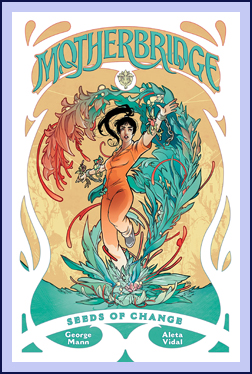
Motherbridge: Seeds of Change by George Mann and Aleta Vidal
Published by: Dark Horse Books
Publication Date: June 7th, 2022
Format: Paperback, 88 Pages
Rating: ★★★★
To Buy

Twenty years ago Mother Nature did what no human could, she united the world. The World Mother awoke and formed a bridge that spanned the globe, making borders irrelevant and migration anywhere a possibility. A "one-world nation, blind to creed or color, to allegiance or belief." Like so many others Hayley Wells used this miracle to create a new life for herself. She left England and settled in New York where she married and had two children. But then utopia failed. The World Mother went silent and the worldbridge began to die and governments used the opportunity to segregate. To bring the walls back. To make it us and them again. Haley was dragged from her bed in the middle of the night. It didn't matter that she was married to an American, she came into the country illegally as the government saw it and she was to be made an example of. With a gun to her head she was walked out beyond the walls and left to fend for herself. She was thrust into a wondrous and ruinous world. Where nature had reclaimed the constructs of man. She is surprised that there is far more life than she ever expected. She's a refugee and there are others. Haley walks into a confrontation. A group is attacking two individuals and it doesn't sit right with Haley. She tries to break up the fight and somehow the worldbridge stirs for her. This is against everything she has heard. Behind the wall they've been told that the worldbridge is dead, and yet somehow it responded to her. She hasn't just been exiled, she's been lied to. This makes her desire to be reunited with her family by bringing down the walls that separate them even stronger. With the help of Constanza and Doyle can they awaken the World Mother? Can Haley help her new friends survive the forces arrayed against them and return the world to the utopia it had become or will she forever be a refugee?

Despite being such a bookworm now I was a reluctant reader in grade school. Therefore I loved comics and graphic novels. Betty and Veronica, The Family Circus, and in particular Classics Illustrated Comics, which was basically CliffsNotes in an illustrated format and made me appear far more widely read than I really was at the time. As I got older and appreciated prose more I never turned my back on my first literary love. Which is why I'm a happy camper when authors whose prose work I love expand to other mediums. George has been working in comics for years and Motherbridge: Seeds of Change is another stellar addition to his copious output. What I really connected to was that I could appreciate it at the age I am now and as that young girl hiding behind the table in the far corner of the library so the librarian, Sister Marie, wouldn't yell at me for sneaking a peak at the comics. What I'm rather inexpertly saying is, that while this comic is written for adults it has such relevant topics that it could be read by young reluctant readers and would give them a book that is very of the moment but that doesn't talk down to you, like L. Frank Baum was notorious for. Because Motherbridge: Seeds of Change is bringing in some heavy topics; immigration, female rights, climate change, forced separation, the military industrial complex, and yet it never feels preachy or politicized, while still being political. It makes you open your eyes. And isn't that what reading is about? People who read are more empathetic and we need empathy now more than ever. It would also be nice if nature actually came along and "tried to balance the system for us," but I have a feeling we're going to have to do the work. But if more people read books like this, if more people connect to each other, what couldn't we do?

Friday, February 11, 2022

Book Review - Leigh Bardugo's The Lives of Saints

The Lives of Saints by Leigh Bardugo
Published by: Imprint
Publication Date: October 6th, 2020
Format: Hardcover, 128 Pages
Rating: ★★★★★
To Buy

The Istorii Sankt'ya, The Lives of the Saints, is given to children in Ravka to learn about the saints. When Alina was given a copy by the Apparat she brushed it aside as something meant for children. Yet she soon comes to realize that this book full of short lives and brutal deaths might be the key to defeating the Darkling and that saints might be synonymous with Grisha. All the saints are enumerated here, even Alina herself. The tales told are miraculous. Some are self-sacrificing, some are misunderstandings, but each is illuminating. And each only has a small aspect of the truth. Because truth changes over time. Truth morphs and becomes something palatable. Something that can be understood versus the true magic of what was. So even if you think you know what happened, perhaps you don't know the whole truth. Sankta Lizabeta, she of the bees and the blood red roses, she who was killed for not protecting others, she might have a dark little secret that was later revealed...Sankt Juris slayed a dragon or did he? Did he and the dragon become something more? But perhaps the most surprising saint is the Starless Saint, for those who seek salvation in the dark. The Starless Saint is none other than the Darkling. Because while a villain to all logical thinking people to some he is a hero. He did just want to keep Ravka safe and make it a haven for Grisha. If he had to kill a fair amount of Grisha to accomplish his goal, his long life could perhaps excuse his lack of empathy. His lack of understanding that every single life matters not just the welfare of the greater good. But here he is, among the pages of a children's book, there to worship and build alters too, like all the rest. And who knows, in the end maybe some of them were just as misguided as the Darkling...

This companion book to Leigh Bardugo's Grishaverse is obviously a bit of a cash grab. They had to produce the Istorii Sankt'ya for use on the Netflix show as it's so important to the plot and figured since they already had it made there had to be fans who would fork over good money for a copy. And they were right. Yet the whole commercial aspect of this book doesn't diminish the fact that it is a beautiful little volume that adds so much to your understanding of the universe Leigh Bardugo has created. We learn the stories of the saints who Inej named her knives after. We get to finally hold in our hand the painting of Ilya Morozova, Sankt Ilya in Chains, that fueled Alina's search for the third amplifier. And we get to see how Alina herself was immortalized in the pages of this book she clung to so feverishly. As she pointed out, all saints live brutal lives that end in death, but it's the ways in which Leigh changes her narrative for each saint that keeps the stories fresh. Sometimes we get a straightforward tale of what happened to them, and other times we get stories that are about the people who worshiped the saint and because of their devotion they were saved, hello Yuri! This second example is what Leigh does with Sankta Alina, therefore giving us a story that is new to our favorite heroine and saint. But this book is full of surprises. As Alina herself pointed out when she was researching Ilya Morozova, there are so many variations and iterations of tales out there that perhaps we've heard it before. And here there is one we have if you happened to have read The Language of Thorns. Sankta Ursula's tale is the tale of Ulla from "When Water Sang Fire" about the creation of the Broken Heart islands off the northern coast of Fjerda. This little callback was a wonderful parallel that shows how perfectly built Leigh's world is. Almost as perfectly built as the Ice Court...but that was a different saint altogether.

Friday, April 7, 2017

Book Review - Ursula K. Le Guin's The Tombs of Atuan

The Tombs of Atuan by Ursula K. Le Guin
Published by: Houghton Mifflin
Publication Date: 1971
Format: Hardcover, 422 Pages
Rating: ★★★★★
To Buy (different edition than one reviewed)

Tenar doesn't remember her life before. A life filled with love and apple trees. She has even forgotten her name. She is the One Priestess of the Tombs reborn in the service of The Nameless Ones. She is now Arha, "the eaten one." Her life of abnegation began at six. Lonely and cold and devoid of friends her days are filled with worship and dark rituals to The Nameless Ones, who dwell beneath the hall of the throne in the place of the tombs. Each day is much the same, passing in routine and ritual in windowless rooms. When she is fifteen, a year after crossing into womanhood and coming into her full powers, she is finally permitted into the undertomb. What should be a wonderful experience, entering her true domain of the tombs and the labyrinth that follows becomes one of her worst memories as she was brought there to punish prisoners of the Godking. Prisoners she leaves to starve to death.

This memory is like ashes in her mouth and she withdraws from the world above of petty conflicts and power struggles seeking comfort in the tombs and in the labyrinth beyond. It is there that her endless days of monotony suddenly change. For it is there she sees a Wizard! She knows instantly what he is and that he is there to steal from her, seeking the long-lost half of the Ring of Erreth-Akbe. The magical ring which, once whole, will bring peace to all of Earthsea. But for now he has brought light into the darkness, her darkness, and she traps him behind the iron door at the start of the labyrinth. Yes, the Ring is in the labyrinth but only Arha can navigate it. So the labyrinth shall be the wizard's tomb, if Arha decides to let him die. She is oddly fascinated with this man. She has lived all her life in seclusion with females all with only one point of view. Here is an outsider who has a different viewpoint and who might just open her eyes. But has Tenar lived in the dark for too long?

There are books that you struggle with initially but eventually pay off in such spectacular fashion that all that you went through was worth it. The Tombs of Atuan is just such a book. Reading the Earthsea series consecutively like I did The Tombs of Atuan is a drastic shift from A Wizard of Earthsea. It's far more formal with a dense backstory about Godkings and Nameless Ones and religion. Not to mention that Arha is hard to initially relate to. She's very standoffish. But you just have to get under her skin, get past all her training that stripped her personality away and watch as she struggles to become someone she can like. As many have pointed out, this is basically the companion story to Ged's journey to becoming a Wizard in A Wizard of Earthsea, what with shifting from a male to a female protagonist. But I think it's so much more. Yes, you could say it's because I'm a girl so that I could relate more, but I felt like Le Guin took Tenar on a greater journey than she did with Ged. Yes Ged traveled and ran from his mistake, but Tenar was there day after day facing her mistake and working out who she was. It was a far more satisfying journey. Sometimes it's about inner change more than anything that makes a story work.

What also helped was that while Ged was important, he was put on the back burner. He wasn't the focus at all just a conduit for Tenar's change. What I find fascinating with this decision of Le Guin's is that she takes a character that we know well after reading A Wizard of Earthsea and makes him mysterious again. Yes, some time has elapsed and he has aged, but he's still Sparrowhawk. Seeing him though Tenar's eyes makes you feel like you're seeing him for the first time all over again. While I do love series where I can follow the entire journey of the characters I love from beginning to end, this time lapse that Le Guin utilizes makes this second book so fresh that I actually heart it way more than the first volume. You could guess what Ged was up to down in the labyrinth and all his plans, but in the end, everything that happened to him hinged on what Tenar did. Seeing her fascinated with and then eventually coming to trust Ged makes you, as a reader, more fascinated with Ged than you ever have before. It's interesting that in stepping back you see more clearly. Personally, I didn't want this story to end. They could have stayed in that maze forever just talking.

Yet it wasn't just the change in perspective that made The Tombs of Atuan so compulsively readable, it was that the location changed and with it the style. Earthsea is basically a generic fantasy land that is predominately water. Yes, it's kind of an unfair generalization, because each island is so unique, but as a whole it's built from the blueprints of other fantasy stories. Here the basis is less fantasy and more adventure. More H. Rider Haggard and Elizabeth Peters. Dusty old cultures whose bloodthirsty customs are a danger to the more enlightened times we are now in. Once I realized and embraced this I came to adore this book. I think this was where I had problems initially connecting. This book is SO different from it's predecessor that it's kind of a culture shock. But what makes it amazing is all the ways it's different from A Wizard of Earthsea. I felt like I was reading some of my favorite Egyptian stories about gods and temples and a plucky heroine. Add to that an underground maze that is so awesome and has so many connotations from all different mythologies and made me think of everything from Labyrinth to Jim Henson's The Storyteller and this book appealed to both the child and the adult in me. I only wish I had read it sooner.

Though the reveal of the connection between Ged's and Tenar's stories is what just blew me away. I have to fully admit that I was reading these books while sick so I might have been a bit slow on the uptake, but when I realized who exactly were Tenar's Gods I was in awe. Yet again did Le Guin make the known mysterious. In A Wizard of Earthsea Ged is fighting an Unnamed force. Victory is achieved by naming it. Tenar is in service to The Nameless Ones. In other words, literally, another way of saying Unnamed. Please do not mock my inability to connect them immediately, as I said, I was sick, but also I think the way the story is written it's made to ingeniously hide something in plain sight. None of Tenar's beliefs seem evil or dangerous at first, so why would her Gods be dangerous? It's only as she grows and learns that it becomes obvious that her Gods might not be kind ones. To then learn they are the world destroying evil that Ged faced? Epic reveal. Plus, it's rather an indictment on religion. To learn that you are serving the forces of darkness? That could quite mess with your mind.

Which leads to the message of The Tombs of Atuan, the very heart of it's maze. This book is all about guilt and redemption. Tenar, in sentencing those prisoners to death set herself on a path. A path she didn't like. The way she takes care of and treats Ged, keeping her prisoner alive and eventually freeing him breaks her chains. She is able to redeem herself through doing an act of kindness, by doing good. While she didn't know that the forces she served were malign, she was able to search her own conscience and realized that what she did didn't make her feel good. Think of the power this book would have on a young reader. If you are trapped in a bad situation there is always hope. There is always a chance to make tomorrow better. I know it might be trite, but it's so true that reading opens your mind. Reading makes you more empathetic, more able to feel and understand and just get it. That's why I never trust people who say they don't like reading. They are shutting themselves off from feeling from becoming the best human being they can be. Read this book and I dare you not to be moved to be better to do better to question everything and to find the right path for yourself.

Thursday, January 12, 2017

Book Review 2016 #6 - Ursula K. Le Guin's The Tombs of Atuan

The Tombs of Atuan by Ursula K. Le Guin
Published by: Houghton Mifflin
Publication Date: 1971
Format: Hardcover, 422 Pages
Rating: ★★★★★
To Buy (different edition than one reviewed)

Tenar doesn't remember her life before. A life filled with love and apple trees. She has even forgotten her name. She is the One Priestess of the Tombs reborn in the service of The Nameless Ones. She is now Arha, "the eaten one." Her life of abnegation began at six. Lonely and cold and devoid of friends her days are filled with worship and dark rituals to The Nameless Ones, who dwell beneath the hall of the throne in the place of the tombs. Each day is much the same, passing in routine and ritual in windowless rooms. When she is fifteen, a year after crossing into womanhood and coming into her full powers, she is finally permitted into the undertomb. What should be a wonderful experience, entering her true domain of the tombs and the labyrinth that follows becomes one of her worst memories as she was brought there to punish prisoners of the Godking. Prisoners she leaves to starve to death.

This memory is like ashes in her mouth and she withdraws from the world above of petty conflicts and power struggles seeking comfort in the tombs and in the labyrinth beyond. It is there that her endless days of monotony suddenly change. For it is there she sees a Wizard! She knows instantly what he is and that he is there to steal from her, seeking the long-lost half of the Ring of Erreth-Akbe. The magical ring which, once whole, will bring peace to all of Earthsea. But for now he has brought light into the darkness, her darkness, and she traps him behind the iron door at the start of the labyrinth. Yes, the Ring is in the labyrinth but only Arha can navigate it. So the labyrinth shall be the wizard's tomb, if Arha decides to let him die. She is oddly fascinated with this man. She has lived all her life in seclusion with females all with only one point of view. Here is an outsider who has a different viewpoint and who might just open her eyes. But has Tenar lived in the dark for too long?

There are books that you struggle with initially but eventually pay off in such spectacular fashion that all that you went through was worth it. The Tombs of Atuan is just such a book. Reading the Earthsea series consecutively like I did The Tombs of Atuan is a drastic shift from A Wizard of Earthsea. It's far more formal with a dense backstory about Godkings and Nameless Ones and religion. Not to mention that Arha is hard to initially relate to. She's very standoffish. But you just have to get under her skin, get past all her training that stripped her personality away and watch as she struggles to become someone she can like. As many have pointed out, this is basically the companion story to Ged's journey to becoming a Wizard in A Wizard of Earthsea, what with shifting from a male to a female protagonist. But I think it's so much more. Yes, you could say it's because I'm a girl so that I could relate more, but I felt like Le Guin took Tenar on a greater journey than she did with Ged. Yes Ged traveled and ran from his mistake, but Tenar was there day after day facing her mistake and working out who she was. It was a far more satisfying journey. Sometimes it's about inner change more than anything that makes a story work.

What also helped was that while Ged was important, he was put on the back burner. He wasn't the focus at all just a conduit for Tenar's change. What I find fascinating with this decision of Le Guin's is that she takes a character that we know well after reading A Wizard of Earthsea and makes him mysterious again. Yes, some time has elapsed and he has aged, but he's still Sparrowhawk. Seeing him though Tenar's eyes makes you feel like you're seeing him for the first time all over again. While I do love series where I can follow the entire journey of the characters I love from beginning to end, this time lapse that Le Guin utilizes makes this second book so fresh that I actually heart it way more than the first volume. You could guess what Ged was up to down in the labyrinth and all his plans, but in the end, everything that happened to him hinged on what Tenar did. Seeing her fascinated with and then eventually coming to trust Ged makes you, as a reader, more fascinated with Ged than you ever have before. It's interesting that in stepping back you see more clearly. Personally, I didn't want this story to end. They could have stayed in that maze forever just talking.

Yet it wasn't just the change in perspective that made The Tombs of Atuan so compulsively readable, it was that the location changed and with it the style. Earthsea is basically a generic fantasy land that is predominately water. Yes, it's kind of an unfair generalization, because each island is so unique, but as a whole it's built from the blueprints of other fantasy stories. Here the basis is less fantasy and more adventure. More H. Rider Haggard and Elizabeth Peters. Dusty old cultures whose bloodthirsty customs are a danger to the more enlightened times we are now in. Once I realized and embraced this I came to adore this book. I think this was where I had problems initially connecting. This book is SO different from it's predecessor that it's kind of a culture shock. But what makes it amazing is all the ways it's different from A Wizard of Earthsea. I felt like I was reading some of my favorite Egyptian stories about gods and temples and a plucky heroine. Add to that an underground maze that is so awesome and has so many connotations from all different mythologies and made me think of everything from Labyrinth to Jim Henson's The Storyteller and this book appealed to both the child and the adult in me. I only wish I had read it sooner.

Though the reveal of the connection between Ged's and Tenar's stories is what just blew me away. I have to fully admit that I was reading these books while sick so I might have been a bit slow on the uptake, but when I realized who exactly were Tenar's Gods I was in awe. Yet again did Le Guin make the known mysterious. In A Wizard of Earthsea Ged is fighting an Unnamed force. Victory is achieved by naming it. Tenar is in service to The Nameless Ones. In other words, literally, another way of saying Unnamed. Please do not mock my inability to connect them immediately, as I said, I was sick, but also I think the way the story is written it's made to ingeniously hide something in plain sight. None of Tenar's beliefs seem evil or dangerous at first, so why would her Gods be dangerous? It's only as she grows and learns that it becomes obvious that her Gods might not be kind ones. To then learn they are the world destroying evil that Ged faced? Epic reveal. Plus, it's rather an indictment on religion. To learn that you are serving the forces of darkness? That could quite mess with your mind.

Which leads to the message of The Tombs of Atuan, the very heart of it's maze. This book is all about guilt and redemption. Tenar, in sentencing those prisoners to death set herself on a path. A path she didn't like. The way she takes care of and treats Ged, keeping her prisoner alive and eventually freeing him breaks her chains. She is able to redeem herself through doing an act of kindness, by doing good. While she didn't know that the forces she served were malign, she was able to search her own conscience and realized that what she did didn't make her feel good. Think of the power this book would have on a young reader. If you are trapped in a bad situation there is always hope. There is always a chance to make tomorrow better. I know it might be trite, but it's so true that reading opens your mind. Reading makes you more empathetic, more able to feel and understand and just get it. That's why I never trust people who say they don't like reading. They are shutting themselves off from feeling from becoming the best human being they can be. Read this book and I dare you not to be moved to be better to do better to question everything and to find the right path for yourself.

Friday, November 20, 2015

Movie Review - Mr. Holmes

Mr. Holmes
Based on the book by Mitch Cullin
Release Date: July 17th, 2015
Starring: Ian McKellen, Laura Linney, Milo Parker, Hattie Morahan, Roger Allam, Phil Davis, Patrick Kennedy, Hiroyuki Sanada, Frances de la Tour, John Sessions, Francis Barber, and Nicholas Rowe
Rating: ★★★★
To Buy

Sherlock Holmes is returning to his home in the Sussex Downs after visiting Japan. After the death of his brother Mycroft he realized that his powers of recollection were waning. He couldn't for the life of him remember his last case. The case was thirty-five years ago and involved the wife of a Mr. Kelmot and was the catalyst to his leaving his profession and moving to Sussex. Of course Watson wrote it up, as he did all Holmes's cases, but he changed it, made Holmes the hero and tacked on a happy ending in that infuriating way of his. Before he dies Holmes wants to write down the story as it happened. Truth not fiction. But he can't find the truth. He can't recollect it. Which was the reason for his recent trip to Japan. He had been in correspondence with a Masuo Umezaki who had read Holmes's treatise on the use of Royal Jelly as a memory aid and told Holmes how the jelly of the prickly ash plant that is found only in Japan is supposedly even better. Holmes and Umezaki journey to Hiroshima, where among the devastation wrought by the recent war, they amazingly find a prickly ash plant that Holmes takes with him back to England. During his absence his housekeeper's son Roger snuck into his study and read the preliminaries of Holmes's story about Mrs. Kelmot and wants Holmes to finish the story. As Holmes struggles to recall his reasons for leaving his profession an unlikely friendship develops between him and Roger and the care of Holmes's bees. But can a ninety-three year old man get back his past and change what is left of his future?

To be one of the actors with enough skill to play Sherlock Holmes you enter a rarefied category. Because, for most, you will forever be known for that role, but you will also be harshly judged. Jeremy Brett, Benedict Cumberbatch, Johnny Lee Miller, and Basil Rathbone are linked inextricably with Holmes. They have become one with Holmes and will never separate fully from this legacy. But there are other actors, those who have made a name for themselves prior to donning the deerstalker as it were; Michael Caine, Robert Downey Jr., and Rupert Everett, like McKellen, were known entities. They all successfully became Holmes to some extent, but have maintained their own identity. It is to this secondary category that McKellen belongs. One wonders at McKellen so easily taking up this signature role. For countless people McKellen is Gandalf from Tolkien's works, and for countless others he is Magneto from the Marvel comics. In other words, McKellen has never shied away from playing iconic roles. But one gets the feeling that he is tired of doing this. And yet... he became Sherlock Holmes. It is my belief that he did this because he is the only actor with the ability to realize this character as he was written here. Of all the actors who have played Holmes, McKellen is a virtuoso, wherein you never see him as himself, he is Holmes. But he doesn't just capture one Holmes, he captures two distinct iterations of the icon at two different stages of his life. He takes the character we have always known, built on it, aged it, and given it back to us in a way that is sure to get him his first Academy Award win.

The more you think on Mr. Holmes the more you realize it isn't just a movie simply about the man who solved unsolvable mysteries. The heart of the film is darker, melancholy without falling into the trap of being morose and unbearably sad. Sherlock Holmes has been a man who relied his entire life on his mind to never fail him. His mind palace, as it were, was inviolable. But as we age, our memory, our ability to recollect starts to fail. This is happening to Holmes. He is unable to remember his last case, the case that defined his life as it has become. Most people balance the life of the mind with emotions and love and heart. Relationships that are more than just business. But what happens when the mind starts to go and you have never had heart? There is no corresponding emotions to bring recollections to the light of day. And this all ties into Holmes's last case. He perfectly understood Mrs. Ann Kelmot. He analyzed her and made her secrets bare. But he lacked empathy. He could see everything but he couldn't see that even if someone is fully aware of their situation that sometimes that isn't enough. Sometimes a heart is permanently broken and the knowledge of this can never put it back together. Holmes failed Mrs. Kelmot and therefore failed himself, leading to his new bucolic life. By going back into his past, by trying to remember this case as he forges his relationship with his housekeeper Mrs. Munro and her young son Roger, Holmes is given a lesson in empathy. He finally understands not just the mystery of Mrs. Kelmot, but what he has been missing his entire life and that people sometimes need a little compassion, a little fiction to survive.

I find it interesting that over the years an aging Holmes has really captured the imagination of Sherlockians. This idea that Holmes, the ever unchanging pillar of logic, would somehow change in old age. That there is something, some event, that would somehow make him more human, more relatable. The cold analytical man is what countless generations of readers have latched onto, but in works like Chabon's The Final Solution and the inspiration for this movie, A Slight Trick of the Mind, they humanize him. While I really enjoyed this movie there's a part of me that knows it's just a "what if?" This would never be Holmes, this is an idealized hypothesis of what could, what might have happened with a fictional character. But it's an enjoyable idyl. Never to be taken too seriously, but to be enjoyed nonetheless. One wonders what Conan Doyle would think. He puts in a passing reference in one of his last Holmes stories that he is raising bees, and now that's written in stone as the only thing that Holmes may do in his old age. What would Holmes's creator think of this obsession with this one detail? With this need to humanize his legend. Holmes was never human, he came back from the dead after all! And those bees sure have stuck. Thanks to Conan Doyle and Wilkie Collins detectives can only raise bees or cultivate roses in their retirement. I personally think this is a bit boring and narrow.

One of the main reasons I was excited to see this film was because of Nicholas Rowe. He is my childhood (and current) crush from playing the starring role in The Young Sherlock Holmes. The fact that he was playing Matinee 'Sherlock' in a movie version of Holmes's last case as presented within the movie made me giddy. The fact is this film is acutely aware of the history of Holmes, not just the literary works, but also all the adaptations, as well as Conan Doyle's life itself, raised it to a special place for fans of Holmes and the meta universe he now resides in. Phil Davis, the killer cabbie of Sherlock makes an ironic appearance as a Police Inspector as well. But these casting choices are just the tip of the iceberg. What really drew me into the story and therefore the mystery was the glass harmonica and it's obvious spiritual connections. The haunting music alone coupled with Mrs. Kelmot's talking to her dead children where enough to convey the spiritualism aspect of the musical instrument, long before Holmes pointed it out. Mesmer himself even played this instrument. Spiritualism was the overriding obsession of Conan Doyle's later years. He lost friends, including Harry Houdini, because of his beliefs. Within the framework of Mr. Holmes it not only adds this meta layer, but it provides an ingenious red herring that gives the film the depth that makes you continually invested, even when it's obvious what the outcome of the case will be.

To bring this review back around to where I started, we are back once more with Ian McKellen. McKellen has reached an age where he doesn't need to work for money anymore, he does what he likes when he likes with who he likes. This can be both a boon and a burden for the audience, he has many fabulous friends who are actors. For example, take his recent foray into television with Vicious, a show clearly made to hang out with Derek Jacobi and Frances de la Tour. This Are You Being Served? throwback is tasteless and camp, in all the wrong ways. France de la Tour makes an odd appearance in Mr. Holmes as the glass harmonica instructor, Madame Schirmer. She once again proves that she can only act so far over the top that she almost derails the film with just a few lines. But the true fault of the film is Laura Linney, who would NEVER have been cast if not for her friendship with McKellen. I have no doubt that she is a nice person and she has always been an amazing advocate for LGBTQ rights for years, hence her friendship with McKellen. But she is just woefully miscast. I will admit that I have never liked her, but I was willing to be open-minded here. And the only saving grace is that she didn't have too many lines. Those lines she did have were in a dialect that appears nowhere on this earth. I think she might have been trying to do Welsh... but why they didn't just cast someone Welsh is down to Ian McKellen. He's a superb actor, and while he might know a lot of superb actors, he sometimes should know when to reign in on the nepotism.  

Older Posts Home