



















Willig Winter
 The second time I went to New York it was more than just a rushed trip tacked onto a family vacation to Washington. The second time was magical, going to all the museums and looking at all the art I'd spent years reading about. During that trip I discovered The Frick Collection, which is located right on fifth avenue and was the home of Henry Clay Frick. It's not just the art that is amazing, though seriously you will be shocked by the number of pieces you recognize from Ingres to Renoir to Vermeer to Rembrandt, but the house itself is a work of art preserved in time. It's like really cheap time travel! You feel as if Edith Wharton were about to hold court over high tea in the luxurious indoor garden. Years later when I went back to New York I discovered the Cooper Hewitt, Smithsonian Design Museum, which is located in the Andrew Carnegie Mansion. Again I was walking in another era. These homes were built by the New York upper crust as they slowly started moving to the Upper East Side. I was so pleasantly surprised when I picked up Lauren Willig's latest book, The English Wife, to slip back into this world again. A world of excess and elegance, fortunes lost and gained, and secrets, but all contained within this other time. So whether you knew about Lauren Willig's new book yet or not, I think you can feel the theme month coming on right? The English Wife is Lauren's fourth stand-alone and therefore a fourth theme month was not just necessary but vital. It's in another time and another world, but one I hope you've been wanting to explore as much as I have over the years.
But enough from me, let's hear from Lauren as we welcome in Willig Winter!
"When Miss Eliza asked me if I would recommend six or seven books I’d used in writing The English Wife for a companion read, I thought, easy peasy!
Then I looked at my bookshelf.
I’d forgotten just how much went into The English Wife. My research pile included book-length accounts of infamous murder cases in turn of the century New York (of which there were more than you would expect), oversized coffee table books with pictures of mansions and marquetry and jewels and gowns, extensive histories of Dutch New York, biographies of robber barons, sociological studies of nineteenth century women’s charitable organizations, memoirs of nineteenth century authors and socialites, unpublished dissertations about specific towns in the Hudson Valley in the mid to late nineteenth century, and books on topics that I can’t go into without giving plot twists away.
And that’s just the New York end of things. We won’t even get into all the Newport research, the gossipy accounts of past residents and glossy pictures of “cottages”. A chunk of the book takes place in England and a smaller chunk in France, so I also have shelves and shelves of books on topics like theatre in Victorian England, monographs about Paris in the Belle Epoque, and biographies of Proust. I may have gotten just a little carried away while reading up for this book....
So, in the interest of brevity, I’m sticking to the New York-centric books for this particular list and keeping it to non-fiction. With one exception at the end. You’ll see why.
At some point, I’ll try to put up a more comprehensive list on my website. If I don’t get crushed beneath a giant pile of research books along the way." - Lauren Willig
Literally the seven books Lauren has selected look beyond tempting, but in the interest of full disclosure, unlike Ashford April (The Asford Affair), This Summer (That Summer), and Jazzy July (The Other Daughter), I have been unable to read them all and write reviews because this year has been a personal as well as a global dumpster fire. But my guilt is your reward, because this means I feel obliged to do a giveaway!
Giveaway Prize:
A copy of The English Wife personalized TO YOU from Lauren's tour stop at Murder by the Book in Houston on January 17th, 2018
The Rules:
1. Open to EVERYONE (for clarification, this means international too).
2. Please make sure I have a way to contact you if your name is drawn, either your blogger profile or a link to your website/blog or you could even include your email address with your comment(s) or email me.
3. Giveaway ends Sunday, December 31st at 11:59PM CST (Yes, that's New Year's Eve folks!)
4. How to enter: Just comment on this post for a chance to win!
5. And for those addicted to getting extra entries:
- +1 for answering the question: What is your favorite house turned museum?
- +2 for becoming a follower
- +10 if you are already a follower
- +10 for each time you advertise this contest - blog post, instagram (@miss.eliza), twitter (@eliza_lefebvre), etc. (but you only get credit for the first post in each platform, so tweet all you like, and I thank you for it, but you'll only get the +10 once from twitter). Also please leave a link!
- +10 for each comment you leave on other Willig Winter posts with something other than "I hope I win!"
 So my literary love of Lauren Willig should by now be fairly obvious. Even if I didn't have two months this year devoted to her books, as well as the year long
  What I love about doing these specific theme months is that it gives me insight into Lauren's process and into her finished work. I shoot her an email and she shoots me an email back suggesting books to read that inspired or informed her newest book. I narrow the selection down, in this case a nice balance of biographical, historical, and contemporary books, and give her the final list, she writes a little something about them, and then I sit down and devour them, ending in a review. This year I decided to do something a little different. Usually I sit down, read Lauren's book, write the review, then go on to read all the other books, because I don't want any outside source tainting my reading of Lauren's book. But the last two times I did this I noticed that re-reading the book later after having read these other books gave Lauren's book even greater depth. And in the case of The Ashford Affair, I feel like I might have done the book a disservice with my review. So I had a new idea. I've read The Other Daughter, I mean, seriously, there was no waiting on reading that book. BUT as I write this I have still to write my review. I jotted down notes and have a vague outline, but so it will remain until I read all the other books for this month. I then plan on re-reading The Other Daughter and finally writing my review. Personally, I don't think in this instance my opinion is going to change, but I do feel my understanding of the world Lauren has brought back to life already expanding. This is going to be a fun month and I hope you'll join me. Flapper costume optional. Mainly because I don't think I could fit the one I have anymore.
  The Tenant of Wildfell Hall by Anne Bronte
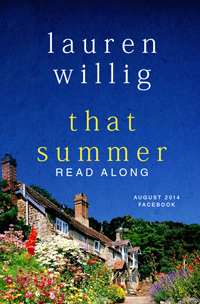
 At the beginning of last month, after a horrid June I might add, I had a wonderful email waiting for me in my inbox which made me instantly know that July was going to be a far far better month. The email was from the lovely Lauren Willig telling me about an idea that was bandied about on her website and that the St. Martin's folks liked. The idea was for a "That Summer Read Along." Read alongs are a big trend right now online, whether it's a combination re-read/read along in anticipation of the newest volume in a series, or just a virtual book club, they are très chic. What makes them better then book clubs is that you can have immediate discussions with people all over the world and by having a little structure, like with moderator, or with a certain number of chapters per week you get to read together at the same pace instead of having people skip ahead or fall behind. Which brings me to the That Summer Read Along!
 And speaking of read alongs... I met fellow That Summer moderator, book addict, and blogger Ashley through our mutual love and admiration of Lauren Willig's Pink Carnation series. Ashley started her blog,
  That Summer by Lauren Willig
 A Barricade in Hell by Jaime Lee Moyer
 Mr. Mercedes by Stephen King
 My New Friend is So Fun! by Mo Willems
 Effie: The Passionate Lives of Effie Gray, John Ruskin and John Everett Millais by Suzanne Fagence Cooper
 Mary Barton by Elizabeth Gaskell
 Middlemarch by George Eliot
 On Art and Life by John Ruskin
 As most of you know by now I have a deep abiding love for Lauren Willig's writing. For a fan this is an exciting time in her writing career. With last year's The Ashford Affair she officially branched out from her Pink Carnation series, which is sadly winding down, and has started to write stand-alones. That Summer is her new stand-alone which is coming out this summer (get the theme month title eh?) I have to say, if she wanted to hook me more then Kenya, choosing the Pre-Raphaelites was a sure way to do it. Everyone knows who the Pre-Raphaelites are even if they aren't aware of it. I remember back in high school my English classroom had the ubiquitous Pre-Raphaelite posters on the back bulletin board. There was Sir Francis Bernard Dicksee's La Belle Dame Sans Merci and John William Waterhouse's The Lady of Shalott. They never removed these posters in the four years I had classes in that room on and off. There's just something so magical about these paintings, the way they convey such detail and meaning to the written word that it captures the cross pollination of artistic mediums that the Pre-Raphaelite Brotherhood embraced and made me want to learn more versus those people who just slap the posters up on their walls.
  When I was in undergrad getting a BS in Art there was a plethora of Art History courses that were required which I took to with great zeal, even adding in such classes as German Architecture: The Modern Movements, which oddly ties into the Pre-Raphaelite Brotherhood. Because the classes covered such a wide range of time, literally from Ancient Egypt to Picasso, there wasn't as much time to dwell on each subject as I would have liked. What was interesting though is that later when I took my German Architecture Class so many of the ideologies of these German artists harked back to the Brotherhood. The Brotherhood believe in craftsmanship, romanticism, spiritualism, nature, ideas, and never forget that signature jawline. They believed in elevating art for the people while there was always the irony that they spent so much time and effort on their art that it wasn't the common man but the wealthy who could afford their work, much like the Arts and Crafts movement, but more on that later. The German's believed in this craftsmanship and this love that was put into every aspect of the work with amazing attention to detail, which Frank Lloyd Wright would later use, going so far as to design the clothes that the inhabitants of his houses wore. If you have ever had the honor to see some of the Brotherhood's work, they made the frames that houses the paintings because it was the only way to truly view the art. They were Victorian Renaissance men that were both craftsmen and artists.
 A few years back the Pre-Raphaelites got a little buzz again off the BBC Miniseries,


