Showing posts with label Emily Bronte. Show all posts

Friday, December 30, 2022

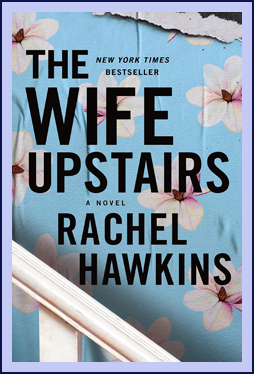
Book Review - Rachel Hawkins's The Wife Upstairs

The Wife Upstairs  by Rachel Hawkins
Published by: St. Martin's Press
Publication Date: January 5th, 2021
Format: Kindle, 227 Pages
Rating: ★
To Buy (different edition than one reviewed)

To be one of the housewives of Thornfield Estates, now that would be something. The gated community feels a world away from the apartment "Jane" begrudgingly shares with John, literally the last person she wants to share a roof with, but he is literally her last lifeline. Perhaps that's why Jane takes the odd piece of jewelry while walking the housewives' dogs, not just to help herself financially, but to feel like she's one of them. But if things go according to plan she won't be a dog walker for long. One of the houses seems different from the other McMansions. It's set back a bit from the street and Jane can't help but admire it. While she's standing in the middle of the street one day the owner of the house peels out of the driveway and almost hits her. Luckily the only thing hurt is the car. Eddie Rochester's car. The mysterious widower whose wife Bea ran the famous Southern Manors lifestyle brand and tragically disappeared with her best friend Blanche the previous year while at their lake house. Eddie Rochester who would be a catch in anyone's book. Jane knows she has to play this right. She can tell that he's interested and actually finds the "real" her funny. It's not long before she's out from under John's thumb, despite his attempts to extort her and Eddie for money, and under Eddie's roof. She even starts to ingratiate herself to the other housewives. But she has two big problems to overcome, their love of Bea and Blanche, and the fact that she's not a wife. Until Eddie puts a ring on it it seems the housewives will be friendly but still hold her at a distance because they aren't sure if she'll be sticking around. If Jane has anything to say about it she'll be there for the long haul. But the longer she's there, as soon as that ring is on her finger, she starts to wonder is this all there is? And what about the rumors about Eddie? What really happened to Bea and Blanche. Once Blanche's body is found everything changes. Will Jane lose this life she's fought so hard to get or will Bea take it all away from her?

Rachel Hawkins premise for this book is Jane Eyre deserved better than Mr. Rochester. While I disagree for a number of reasons, not the least of which is that given Jane's situation in life in the original novel her prospects were limited, I don't disagree that it's nice that Jane got the money and the dog in this version. The problem I have is this version of Jane. This isn't my Jane. This isn't anyone's Jane. Unless you like manipulative grasping assholes. Sure, she's a survivor, but does she have to be such a bitch? Rachel Hawkins clearly thinks that Mr. Rochester was below Jane and instead of elevating him she brought Jane down to his level. Why!?! I mean, really, why? I just don't get the purpose of this retelling other than the author airing her own grievances without really keeping it all in context. And she's drawing from some classic material, not only is she reinterpreting Jane Eyre, but there's also a lot of Wide Sargasso Sea folded in, and a huge helping of Rebecca, which makes a ton of sense given Daphne Du Maurier's obsession with the Brontes. But that's where so many of my issues then come from. These three books are classics, they are beautiful and lyrically written, and this, this is just workman language. Therefore whenever Rachel Hawkins actually uses a line from the source material, for example when she says that "[w]hatever souls were made of, mine and Jane’s were the same - or at least similar enough" dragging Emily Bronte and Wuthering Heights to the table, you are just gobsmacked by how basic this book's writing really is. But when Bea declares that "[r]eader, I fucked him" I'm sure my groan was audible for many miles. If I wasn't reading on my Kindle, well, the book would have been hurled. Much as I felt like doing. I'm sorry, that's not a funny joke and the fact that Rachel Hawkins thinks it is is a true sign as to why I would never have liked this book. I am so wary of retellings and yet, despite everything in me saying, oh, this could be different, this could be good, reader, I hated it.

Wednesday, May 15, 2019

Book Book of 2014 - Anne Bronte's The Tenant of Wildfell Hall

The Tenant of Wildfell Hall by Anne Bronte
Published by: Oxford University Press
Publication Date: 1848
Format: Hardcover, 486 Pages
Rating: ★★★★★
To Buy (different edition than one reviewed)

Wildfell Hall has a new resident. A mysterious widow and her young son who want nothing to do with the outside world. The outside world disagrees. The nosey neighbors must know everything they can about the mysterious Mrs. Graham. Young Gilbert Markham wants to know everything but for a very different reason, he is inexorably drawn to the young widow and cannot understand why she remains aloof and detached, craving solitude over companionship and love. Gilbert Markham's attentions to the young widow do not go unnoticed by others and leads his spurned ex, Eliza Millward, to spread malicious gossip throughout the small community about the widow. The whispers combined with Helen Graham's feelings for Gilbert lead her to make a decision she might regret. She decides she must disclose her past so that he can move on and realize their love is doomed, and not just because her husband isn't dead, but because he doesn't really know who she is. To that extent she gives him her diaries. All her inner feelings and thoughts and all her secrets bound forever between the pages of a book.

Mrs. Helen Graham is really Mrs. Helen Huntington, the wife of a cruel man who has more vices than she could enumerate and surrounds himself with the worst of humanity at their home, Grassdale. Though their marriage wasn't destined to debauchery. At first Arthur Huntingdon was witty and pretty and Helen in her naivete thought she could reform this bad boy. At the birth of their son though things changed. Arthur didn't like his son and heir getting all of Helen's attention and set out to form the boy in his own image. Helen fled her husband because he was trying to imprint their your son with his own dubious morals. She could have suffered anything if it was just herself that was the target of Huntington's malice, she stubbornly married him after all, but their son is another matter. Her brother helped her escape the life she trapped herself in only to find herself wanting that which she can not have due to her circumstances. But after years of feeling hunted in her own home can she remake her life? Is freedom enough without Gilbert Markham? Or will her old life haunt her until she or Huntington is dead?

Sometimes I am a very contrary person, The Tenant of Wildfell Hall is a case in point. Instead of reading the book before watching the miniseries I decided to watch the miniseries first which then put me off the book. I know, it has Toby Stephens and James Purefoy in it so how could it be bad? But I watched it prior to Sherlock partially redeeming Rupert Graves in my eyes and my hate of Rupert Graves has been a long standing issue. My hate is also a hard thing to put my finger on, was it The Forsyte Saga or Take a Girl Like You, both where he played cheating cads, that made me want to forever punch him in the face? I think I might never know. Putting the Rupert rant behind us my steadfast rule of reading the book prior to watching any adaptation for some reasons is exempt when it has to do with the Brontes. I had seen so many adaptations of their books prior to ever picking one up that they are grandfathered into my weird reading habits with this clause. Yet I still question how this adaptation failed with that cast! It was dull and lifeless and I remember barely being able to finish it and this from a girl who finished the Jane Eyre adaptation with Ciaran Hinds. PS I hate Ciaran Hinds more than I've ever hated Rupert Graves.

The miniseries turned me off the book and because of this the book languished for years waiting for the time when I would pick it up and love it. I seriously can not think of any reasonable excuse why it took me this long to read The Tenant of Wildfell Hall. I was under so many misconceptions about this book that I should have just trusted my gut which tells me that Anne Bronte is awesome. I am serious when I say that I think Anne might just be my favorite Bronte. This isn't just me rooting for the underdog, though she is the least embraced of the sisters, this is totally to do with how awesome her books are. Let me brake it down for you. Charlotte is the most famous, I mean, Jane Eyre, while Emily is the one the more malcontent readers are drawn to with her sole writing credit, Wuthering Heights, and that leaves Anne kind of stuck in the middle with her two books, The Tenant of Wildfell Hall and Agnes Grey. And I call foul! To all the readers and especially English teachers out there the world over who gravitate towards the two ends of the Bronte spectrum and fail to educate others that Anne is the best of both worlds! She has the darkness of Emily with the narrative structure of Charlotte. I think I need to form an Anne support group...

But what's so interesting about Anne is that in her work she is in some ways responding to her own siblings as people and writers. Anne's desire for "truth" in this novel comes from a desire to counter the pro bad boy image her sisters had created in their works. But there's a deeper part of me that wonders if she's not just messing with Charlotte and Emily a little. Who, given the chance, wouldn't try to mess with their siblings a little? Her sisters did everything to make this bad boy redeemable by love trope and then in comes Anne and blasts them out of the water. Huntington is a bad boy to equal Heathcliff and Rochester, but love is unable to sway him. He even wants to corrupt his own child! The Tenant of Wildfell Hall is an opus to the irredeemable. I can just picture the sisters sitting around their fireplace on a cold night in Haworth talking about their dream men and Anne just looking askance at them and plotting how to prove them wrong, preferably in three volumes, she was, after all, a silent plotter. I don't think anyone has ever summed this up better than Kate Beaton in her "Hark, a Vagrant" comic, "Dude Watchin' with The Brontes," so I won't attempt to and move onto other things. Though I will mention I have this piece framed in my library I love it so much.

Moving on... What I find amazing in this book, and in fact all the work by the Brontes, is how they were able to capture an entire outside world while living their cloistered lives and put it on the page. It just goes to show that sometimes writing what you know isn't the only answer, but writing what you feel is. Over a hundred and fifty years later this book pulses with life. It was criticized at the time for being too repulsive and scandalous, but that is why it resonates till this day. It is the truth of human nature and fallibility that Anne sought out to capture and did. Infidelity, adultery, drugs, drink, games of chance, everything not written about in literature of it's day that still causes so much heartbreak. Yes, you could argue that Anne was filtering this all through the lens of the hedonist lifestyle her brother Branwell lived. But you can't say that dealing with Branwell's multiplicity of addictions and personality defects didn't bring the darker aspects of humanity right to Anne's front door. So, arguing against myself, maybe she was writing what she knew? Either way, The Tenant of Wildfell Hall shows that no matter how you live your life it gives you an understanding of the world at large and it's degradation's.

The degraded life that Helen lives made me connect to her because, not only did I pity her, I worried that she wouldn't make it out of this situation, ironic because having watched the miniseries I knew the outcome, but still I worried. But as to the debauchery, one problem I have always had and mention repeatedly in literature set during this time is the overuse of the Hellfire Club. It seems if you are debauched during the Regency or early Victorian eras you therefore have to belong to some incarnation of said Hellfire Club. But here I make an exception. Usually the Hellfire Club is just a trope used by modern writers, as in those still currently writing, as a basic touchstone for debauchery that modern readers will latch onto. Think of the spunk it took for a little ex-governess to allude to the Hellfire Club in a book written in 1848! You Anne Bronte are the exception that proves the rule! When you wrote those few lines alluding to fire and brimstone it was not yet hackneyed, it was controversial. I wish I could tell you how much you mean to me and literature. This poorly written review will have to suffice.

Friday, February 16, 2018

Book Reveiw - Emily Brontë's Wuthering Heights

Wuthering Heights by Emily Brontë
Published by: Modern Library
Publication Date: 1847
Format: Hardcover, 400 Pages
Rating: ★★
To Buy (different edition than one reviewed)

Mr. Lockwood has rented Thrushcross Grange in Yorkshire as an escape from his hectic London life. Being an amiable man he is perplexed by his landlord, Heathcliff, who is standoffish and lives a remote life with an odd household at Wuthering Heights. After being trapped the night at Wuthering Heights Lockwood beseeches his housekeeper at Thrushcross Grange, Nelly Dean, to tell him the tale of Heathcliff and the other residents of Wuthering Heights. Nelly agrees, because she remembers it all, starting thirty years earlier when Mr. Earnshaw lived at Wuthering Heights with his son Hindley and his daughter Catherine. After a trip to Liverpool he returned with Lockwood's landlord, Heathcliff, a foundling to incite the jealousy of Hindley and the love of Cathy. When Mr. Earnshaw finally died and Hindley returned home with his new wife it was time to enact his revenge on Heathcliff, banishing him to the stables as a lowly servant. Before Hindley's return Cathy thought that she and Heathcliff would never be parted, but soon she is betrothed to Edgar Linton of Thrushcross Grange claiming she could never marry Heathcliff because it would degrade her. Heathcliff leaves Wuthering Heights and only returns once he is a wealthy man and seduces Edgar's sister for revenge. Death soon claims Cathy and then Hindley and the feud goes to the next generation fueled by Heathcliff. But can love come back to a place where hate has flourished?

The problem with reading a book like Wuthering Heights is that this is a book that has been adapted to death, and I've watched them all. From the Laurence Olivier adaptation that eliminated the second generation for expediency and a stab at a happy ending, to the 1998 version solely watched for Matthew Macfadyen as Hereton Earnshaw, to the badly bewigged Tom Hardy in the only version I actually like. I've seen them all. Each one brought a new perspective and a twist with their interpretation of the text, so that going back to the source I found that nothing new was brought to the table. I'd seen it all and not to throw too much shade at Emily Brontë, but her framing device of narrators within narrators akin to Mary Shelley's Frankenstein feels a bit forced. But yet I needed to read it. The reason I finally decided to read Wuthering Heights was that I had been meaning to for so long it seemed like a glaring oversight and might be considered as the book in longest residence on my "to be read" pile. I had years earlier picked up the book and made it through a few chapters of Lockwood's overwrought rambling only to put it down and forget about it. In the intervening years I had read all of Anne Brontë's work, re-read Jane Eyre more times than I can count, and started viewing Anne as the most talented of the Brontës, but I couldn't secure her the title without finally giving in to a reading of Emily's one prose piece. PS, if the star rating didn't tip you off, Anne wins.

The main problem with Wuthering Heights is that you quite literally hate everyone. These are not nice people. I mean they are SERIOUSLY NOT NICE PEOPLE! They are threatening to murder each other daily and that's what, OK? Is that supposed to show the strength of their attachments? And that is somehow supposed to translate into one of the greatest love stories ever? Hell no. It's dysfunction city. There's a reason why when Thursday Next is assigned to help council the characters in Wuthering Heights in her third adventure, The Well of Lost Plots, that it is a comedic highlight, because these people SERIOUSLY need counseling. All books need you to have someone worth rooting for, and I can't think of a single character I would like to spend one minute with. Even the "nicer" characters at Thrushcross Grange are lured into Heathcliff's world of revenge and hate and tainted by association. The second generation doesn't get a pass either, they are so passive that by letting this happen they are continuing the cycle. Yes, with Heathcliff eventually gone there's a tiny little ray of hope at the end. But is it really hope? Hundreds of pages of hate and rage and passion, because I don't think we can call it love, and once the house has been exorcised of Heathcliff everything can be fine? Nope. Burn that house to the ground and move far far away.

Yet there is a reason this is a classic. And no, I don't think it's because of anything to do with the characters or the plot. It might have to do with the passion, because it was rare for a book then to show such cruelity and be so harsh while in the throes of so-called love. But I think the only real reason it survives is two fold, one is the connection to this great literary dynasty that is the Brontës, but secondly, in among the dross, there are lines of sheer beauty. Emily was a poet, she was not a prose writer, so it makes sense that she can capture beauty and emotion in a single line that she couldn't accomplish with chapters and chapters of storytelling. In chapter nine is perhaps the best example of what Emily could do when giving full reign to her powers: "It would degrade me to marry Heathcliff now; so he shall never know how I love him: and that, not because he's handsome, Nelly, but because he's more myself than I am. Whatever our souls are made of, his and mine are the same; and Linton's is as different as a moonbeam from lightning, or frost from fire... I cannot express it; but surely you and everybody have a notion that there is or should be an existence of yours beyond you. What were the use of my creation, if I were entirely contained here? My great miseries in this world have been Heathcliff's miseries, and I watched and felt each from the beginning: my great thought in living is himself. If all else perished, and he remained, I should still continue to be; and if all else remained, and he were annihilated, the universe would turn to a mighty stranger: I should not seem a part of it.—My love for Linton is like the foliage in the woods: time will change it, I'm well aware, as winter changes the trees. My love for Heathcliff resembles the eternal rocks beneath: a source of little visible delight, but necessary. Nelly, I am Heathcliff! He's always, always in my mind: not as a pleasure, any more than I am always a pleasure to myself, but as my own being"

Though for all the beauty, all the evocation of emotions in this one section, easily the most quoted of all, there are pages and pages of limp prose. Just unintelligible horrible writing. In particular there is Joseph; an elderly servant who lacks all humanity and is therefore very religious. The problem with Joesph is his stupid dialect. Yes, dialect is important, it gives the reader a feeling for the time, the place, and the character. But bad dialect, or dialect used improperly can ruin a novel. Look to The Secret Garden, the children use the broad local dialect to mock the servants cruelly, yet for some bizarre reason we're supposed to view this as cute. I don't. It made me hate that book. Joseph's dialect is 100% unintelligible. I quite literally have no idea what he was saying. A dialect should be a compromise to some extent. You need to capture all that I said above, time, place, BUT you have to make it accessible to readers. If you've seen the Red Riding Trilogy you'll understand where I'm going here. Like Wuthering Heights, these are films set in Yorkshire. Now some of the actors went too far with their accents, making them too heavy and unintelligible, then there was Sean Bean, who knows the acting business and made a nice compromise between accent and accessibility. Look to Sean Bean! Because really, Joseph became a joke, like in Hot Fuzz where Karl Johnson as PC Bob Walker is pretty unintelligible and needs a translator, usually Nick Frost's Danny Butterman, but there's the one scene where Bob has to translate for David Bradley as a local farmer because even Danny can't understand him. That's what it felt like here! But it wasn't meant to be funny!

Yet even without all this, even if I hadn't watched all the adaptations and hadn't hated all the characters there is one thing that this book lacked, and that was the element of surprise. At the beginning of the book there is a family tree. This tree gives everyone's birth and death and a quick perusal shows you, wow, yes it shows you everything. All their kids and the marriages, everything. I'm like Patrick Stewart on Extras. Yes, genealogy is to me interesting in books, especially when you start going Game of Thrones epic, but here, with such a small cast of characters, the book is spoiled from page one. Which makes me wonder, was this in the first printing? Because this comes after Charlotte's introduction to the book, so did she maybe add it for spite? Everyone knows Charlotte wasn't a fan of Emily's writing, with rumors being that Emily actually had another finished manuscript that Charlotte burned... so was Charlotte trying to just alienate the readers? Or was it Emily who just felt like everything was a foregone conclusion and that we should know from the start we're in for death and misery... because that's what this book is, death and misery. It has become a classic just by proximity to other great works and really, classics do need to be challenged and re-evaluated, because a hundred plus years later I don't think this book has anything left to give us whereas Jane Eyre and even The Tenant of Wildfell Hall are constantly surprising.

Wednesday, February 7, 2018

Book Review - Daphne Du Maurier's Rebecca

Rebecca by Daphne Du Maurier
Published by: Virago Press
Publication Date: 1938
Format: Paperback, 448 Pages
Rating: ★★★★★
To Buy (different edition than one reviewed)

"Last night I dreamt I went to Manderley again. It seemed to me I stood by the iron gate leading to the drive, and for a while I could not enter, for the way was barred to me. There was a padlock and chain upon the gate... Then, like all dreamers, I was possessed of a sudden with supernatural powers and passed like a spirit through the barrier before me. The drive wound away in front of me, twisting and turning as it had always done."

As she looks back on the twists and turns that brought her to Manderley, the second Mrs. de Winter can't help but wonder how her life ended up as it did. She had resigned herself to an existence as a paid companion trailing behind whomever had hired her, the reprehensible Mrs. Van Hoppper being her employer at the beginning of her story. That all changed when Maxim de Winter entered her life in his fast car. He was in the south of France fleeing the memories of his dead wife Rebecca and the one thing that blotted her out was the young girl who would become his second wife. Yet perhaps their union was foolish, or Maxim's dream to return to Manderley was unwise. Because back in England their life is haunted by the memories of his first wife, Rebecca. The specter that is hallowed by the housekeeper, Mrs. Danvers, and is a constant comparative presence for the new wife. Could Rebecca destroy their happiness from beyond the grave? Or will Rebecca need a little assistance from Mrs. Danvers?

When I was young my mother subscribed to The Franklin Library Mystery Masterpieces. Each month a new book would arrive and we'd set it in pride of place on our console bookshelf that housed our most prized possessions, this being the eighties it mainly housed records and our record player. The little nine year old that I was loved that each month another volume would come and expand the display on that orangey wood that just glowed with an inner light. Then one day The Franklin Library sent us the biggest box I had ever seen. They were discontinuing the Mystery Masterpieces and they sent us the remaining volumes all at once. At this time we probably had only ten volumes, so forty-two books showed up one day to our great astonishment and delight.

Until recently these books have been packed away as self space was scare; all but a few choice volumes which I had secreted away. When I was young I loved to spend time reading the spines and looking at the pictures and wondering what the books were about and making up my own stories, especially about The Thirty-Nine Steps, which really disappointed me when I found out what it was really about. When they first arrived I was too young to read most of the titles, and when I was older I was too into movies to bother with books. That all changed. Obviously. But Rebecca, the movie, was like a gateway drug. I adored the film and then I looked on our shelf. There was Rebecca by Daphne Du Maurier, one of the first books we'd gotten in this series, after the obligatory Agatha Christie volume that is. This particular edition would make it's way into my library and my heart.

Rebecca is that rare book that cries out to be read and re-read over and over again, each time a different interpretation and meaning unearthed. The opening line that transports you, like a dream, to Manderley. You can get lost in the happy valley among the flowers and never want to return from those magical pages. But I don't think that you truly get the book's greatness without knowing the context of Du Maurier's world, mainly her obsession with the Brontes. This is much in the vein of why people don't realize the genius of Northanger Abbey, which is a parody of the Gothic genre, not "serious" like Austen's other books! Du Maurier's first book, The Loving Spirit, takes it's name from a poem by Emily Bronte. More then twenty years after writing Rebecca her misguided biography on Branwell Bronte was published and forever secured her connection to them. Therefore the echoes of Jane Eyre that haunt Rebecca should not be thought a surprise or the least bit unintentional. Du Maurier was writing a new classic that would pay homage to and reflect Jane Eyre. A Jane Eyre for modern sensibilities, if you will.

Just as Jamaica Inn is to Wuthering Heights, so is Rebecca to Jane Eyre, just look at the similarities. The naive young girl ready for love, the misanthropic hero, the crazy wife, the destructive fire. What amazes me is that if you look at just the building blocks of these books they should be eerily similar, yet they aren't. Each book is a classic in it's own right, but the ghost of Jane Eyre isn't the only ghost that Rebecca tackles, after all there is Rebecca herself. While there is that chilling line delivered by Mrs. Danvers "Do you think the dead come back and watch the living?" What we think of as ghosts can take many forms. There are no spectral apparitions here, no things that go bump in the night, but that doesn't mean Rebecca doesn't haunt Manderley.

Rebecca recurs persistently in the consciousness of the second Mrs. de Winter causing her distress and anxiety, but she is also the bosom friend of Mrs. Danvers. Mrs. Danvers, more then anyone, works to keep Rebecca alive and in doing so makes her specter part of the foundation of Manderley itself. This is an interesting conceit on Du Maurier's part, because really, this is a ghost story without a ghost. The memory and emotion left behind is what haunts us, and if anyone could do this, it's Rebecca. As Captain Jack Harkness said on Torchwood, "Human emotion is energy. You can't always see it or hear it, but you can feel it. Ever had deja vu? Felt someone walk over your grave? Ever felt someone behind you in an empty room? Well there was. There always is."

Yet Rebecca isn't the only ghost. There's another person who haunts Manderley, she is always there, ever present, but in the shadow of Rebecca. I am of course talking about the second Mrs. de Winter. She is but mere shadow, a trace, a semblance of a person. She in fact has no name but that which Rebecca had, Mrs. de Winter. This is the most fascinating aspect of the book and many others have discussed it's importance, that the heroine has no name. One result of this namlessness is that she is a ghost, a cipher, a way to tell Rebecca's story through new eyes but without complicating the matter by creating a character with backbone.

Of course this is a two edged sword, on the one hand Du Maurier is pushing the second Mrs. de Winter into the background, but on the other hand by creating a blank slate, a character who has no real "character" we are able to put ourselves more easily into her shoes. This literary trick, I mean, really, I want to stand and applaud Du Maurier. By giving use this conduit there are so many ramifications to the narrative. By being one with the second Mrs. de Winter you therefore embrace Maxim, her husband, and therefore not just identify but condone his actions. The genius of Rebecca is that Daphne Du Maurier has made you complicit in murder and you loved every second of it.

Wednesday, March 8, 2017

Book Reveiw - Emily Brontë's Wuthering Heights

Wuthering Heights by Emily Brontë
Published by: Modern Library
Publication Date: 1847
Format: Hardcover, 400 Pages
Rating: ★★
To Buy (different edition than one reviewed)

Mr. Lockwood has rented Thrushcross Grange in Yorkshire as an escape from his hectic London life. Being an amiable man he is perplexed by his landlord, Heathcliff who is standoffish and lives a remote life with an odd household at Wuthering Heights. After being trapped the night at Wuthering Heights Lockwood beseeches his housekeeper at Thrushcross Grange, Nelly Dean, to tell him the tale of Heathcliff and the other residents of Wuthering Heights. Nelly agrees, because she remembers it all, starting thirty years earlier when Mr. Earnshaw lived at Wuthering Heights with his son Hindley and his daughter Catherine. After a trip to Liverpool he returned with Lockwood's landlord, Heathcliff, a foundling to incite the jealousy of Hindley and the love of Cathy. When Mr. Earnshaw finally died and Hindley returned home with his new wife it was time to enact his revenge on Heathcliff, banishing him to the stables as a lowly servant. Before Hindley's return Cathy thought that she and Heathcliff would never be parted, but soon she is betrothed to Edgar Linton of Thrushcross Grange claiming she could never marry Heathcliff because it would degrade her. Heathcliff leaves Wuthering Heights and only returns once he is a wealthy man and seduces Edgar's sister for revenge. Death soon claims Cathy and then Hindley and the feud goes to the next generation fueled by Heathcliff. But can love come back to a place where hate has flourished?

The problem with reading a book like Wuthering Heights is that this is a book that has been adapted to death, and I've watched them all. From the Laurence Olivier adaptation that eliminated the second generation for expediency and a stab at a happy ending, to the 1998 version solely watched for Matthew Macfadyen as Hereton Earnshaw, to the badly bewigged Tom Hardy in the only version I actually like. I've seen them all. Each one brought a new perspective and a twist with the interpretation of the text, so that going back to the source I found that nothing new was brought to the table. I'd seen it all and not to throw too much shade at Emily Brontë, but her framing device of narrators within narrators akin to Mary Shelley's Frankenstein feels a bit forced. But yet I needed to read it. The reason I finally decided to read Wuthering Heights was that I had been meaning to for so long it seemed like a glaring oversight and might be considered as the book in longest residence on my "to be read" pile. I had years earlier picked up the book and made it through a few chapters of Lockwood's overwrought rambling only to put it down and forget about it. In the intervening years I had read all of Anne Brontë's work, re-read Jane Eyre more times than I can count, and started viewing Anne as the most talented of the Brontës, but I couldn't secure her the title without finally giving in to a reading of Emily's one prose piece. PS, if the star rating didn't tip you off, Anne wins.

The main problem with Wuthering Heights is that you quite literally hate everyone. These are not nice people. I mean they are SERIOUSLY NOT NICE PEOPLE! They are threatening to murder each other daily and that's what, OK? Is that supposed to show the strength of their attachments? And that is somehow supposed to translate into one of the greatest love stories ever? Hell no. It's dysfunction city. There's a reason why when Thursday Next is assigned to help council the characters in Wuthering Heights in her third adventure, The Well of Lost Plots, that it is a comedic highlight, because these people SERIOUSLY need counseling. All books need you to have someone worth rooting for, and I can't think of a single character I would like to spend one minute with. Even the "nicer" characters at Thrushcross Grange are lured into Heathcliff's world of revenge and hate and tainted by association. The second generation doesn't get a pass either, they are so passive that by letting this happen they are continuing the cycle. Yes, with Heathcliff eventually gone there's a tiny little ray of hope at the end. But is it really hope? Hundreds of pages of hate and rage and passion, because I don't think we can call it love, and once the house has been exorcised of Heathcliffe everything can be fine? Nope. Burn that house to the ground and move far far away.

Yet there is a reason this is a classic. And no, I don't think it's because of anything to do with the characters or the plot. It might have to do with the passion, because it was rare for a book then to show such cruelity and be so harsh while in the throes of so-called love. But I think the only real reason it survives is two fold, one is the connection to this great literary dynasty that is the Brontës, but secondly, in among the dross, there are lines of sheer beauty. Emily was a poet, she was not a prose writer, so it makes sense that she can capture beauty and emotion in a single line that she couldn't accomplish with chapters and chapters of storytelling. In chapter nine is perhaps the best example of what Emily could do when giving full reign to her powers: "It would degrade me to marry Heathcliff now; so he shall never know how I love him: and that, not because he's handsome, Nelly, but because he's more myself than I am. Whatever our souls are made of, his and mine are the same; and Linton's is as different as a moonbeam from lightning, or frost from fire... I cannot express it; but surely you and everybody have a notion that there is or should be an existence of yours beyond you. What were the use of my creation, if I were entirely contained here? My great miseries in this world have been Heathcliff's miseries, and I watched and felt each from the beginning: my great thought in living is himself. If all else perished, and he remained, I should still continue to be; and if all else remained, and he were annihilated, the universe would turn to a mighty stranger: I should not seem a part of it.—My love for Linton is like the foliage in the woods: time will change it, I'm well aware, as winter changes the trees. My love for Heathcliff resembles the eternal rocks beneath: a source of little visible delight, but necessary. Nelly, I am Heathcliff! He's always, always in my mind: not as a pleasure, any more than I am always a pleasure to myself, but as my own being"

Though for all the beauty, all the evocation of emotions in this one section, easily the most quoted of all, there are pages and pages of limp prose. Just unintelligible horrible writing. In particular there is Joseph; an elderly servant who lacks all humanity and is therefore very religious. The problem with Joesph is his stupid dialect. Yes, dialect is important, it gives the reader a feeling for the time, the place, and the character. But bad dialect, or dialect used improperly can ruin a novel. Look to The Secret Garden, the children use the broad local dialect to mock the servants cruelly, yet for some bizarre reason we're supposed to view this as cute. I don't. It made me hate that book. Joseph's dialect is 100% unintelligible. I quite literally have no idea what he was saying. A dialect should be a compromise to some extent. You need to capture all that I said above, time, place, BUT you have to make it accessible to readers. If you've seen the Red Riding Trilogy you'll understand where I'm going here. Like Wuthering Heights, these are films set in Yorkshire. Now some of the actors went too far with their accents, making them too heavy and unintelligible, then there was Sean Bean, who knows the acting business and made a nice compromise between accent and accessibility. Look to Sean Bean! Because really, Joseph became a joke, like in Hot Fuzz where Karl Johnson as PC Bob Walker is pretty unintelligible and needs a translator, usually Nick Frost's Danny Butterman, but there's the one scene where Bob has to translate for David Bradley as a local farmer because even Danny can't understand him. That's what it felt like here! But it wasn't meant to be funny!

Yet even without all this, even if I hadn't watched all the adaptations and hadn't hated all the characters there is one thing the this book lacked, and that was the element of surprise. At the beginning of the book there is a family tree. This tree gives everyone's birth and death and a quick perusal shows you, wow, yes it shows you everything. All their kids and the marriages, everything. I'm like Patrick Stewart on Extras. Yes, genealogy is to me interesting in books, especially when you start going Game of Thrones epic, but here, with such a small cast of characters, the book is spoiled from page one. Which makes me wonder, was this in the first printing? Because this comes after Charlotte's introduction to the book, so did she maybe add it for spite? Everyone knows Charlotte wasn't a fan of Emily's writing, with rumors being that Emily actually had another finished manuscript that Charlotte burned... so was Charlotte trying to just alienate the readers? Or was it Emily who just felt like everything was a foregone conclusion and that we should know from the start we're in for death and misery... because that's what this book is, death and misery. It has become a classic just by proximity to other great works and really, classics do need to be challenged and re-evaluated, because a hundred plus years later I don't think this book has anything left to give us whereas Jane Eyre and even The Tenant of Wildfell Hall are constantly surprising.

Friday, January 6, 2017

Book Review 2016 #8 - Daphne Du Maurier's Rebecca

Rebecca by Daphne Du Maurier
Published by: Virago Press
Publication Date: 1938
Format: Paperback, 448 Pages
Rating: ★★★★★
To Buy (different edition than one reviewed)

"Last night I dreamt I went to Manderley again. It seemed to me I stood by the iron gate leading to the drive, and for a while I could not enter, for the way was barred to me. There was a padlock and chain upon the gate... Then, like all dreamers, I was possessed of a sudden with supernatural powers and passed like a spirit through the barrier before me. The drive wound away in front of me, twisting and turning as it had always done."

As she looks back on the twists and turns that brought her to Manderley, the second Mrs. de Winter can't help but wonder how her life ended up as it did. She had resigned herself to an existence as a paid companion trailing behind whomever had hired her, the reprehensible Mrs. Van Hoppper being her employer at the beginning of her story. That all changed when Maxim de Winter entered her life in his fast car. He was in the south of France fleeing the memories of his dead wife Rebecca and the one thing that blotted her out was the young girl who would become his second wife. Yet perhaps their union was foolish, or Maxim's dream to return to Manderley was unwise. Because back in England their life is haunted by the memories of his first wife, Rebecca. The specter that is hallowed by the housekeeper, Mrs. Danvers, and is a constant comparative presence for the new wife. Could Rebecca destroy their happiness from beyond the grave? Or will Rebecca need a little assistance from Mrs. Danvers?

When I was young my mother subscribed to The Franklin Library Mystery Masterpieces. Each month a new book would arrive and we'd set it in pride of place on our console bookshelf that housed our most prized possessions, this being the eighties it mainly housed records and our record player. The little nine year old that I was loved that each month another volume would come and expand the display on that orangey wood that just glowed with an inner light. Then one day The Franklin Library sent us the biggest box I had ever seen. They were discontinuing the Mystery Masterpieces and they sent us the remaining volumes all at once. At this time we probably had only ten volumes, so forty-two books showed up one day to our great astonishment and delight.

Until recently these books have been packed away as self space was scare; all but a few choice volumes which I had secreted away. When I was young I loved to spend time reading the spines and looking at the pictures and wondering what the books were about and making up my own stories, especially about The Thirty-Nine Steps, which really disappointed me when I found out what it was really about. When they first arrived I was too young to read most of the titles, and when I was older I was too into movies to bother with books. That all changed. Obviously. But Rebecca, the movie, was like a gateway drug. I adored the film and then I looked on our shelf. There was Rebecca by Daphne Du Maurier, one of the first books we'd gotten in this series, after the obligatory Agatha Christie volume that is. This particular edition would make it's way into my library and my heart.

Rebecca is that rare book that cries out to be read and re-read over and over again, each time a different interpretation and meaning unearthed. The opening line that transports you, like a dream, to Manderley. You can get lost in the happy valley among the flowers and never want to return from those magical pages. But I don't think that you truly get the book's greatness without knowing the context of Du Maurier's world, mainly her obsession with the Brontes. This is much in the vein of why people don't realize the genius of Northanger Abbey, which is a parody of the Gothic genre, not "serious" like Austen's other books! Du Maurier's first book, The Loving Spirit, takes it's name from a poem by Emily Bronte. More then twenty years after writing Rebecca her misguided biography on Branwell Bronte was published and forever secured her connection to them. Therefore the echoes of Jane Eyre that haunt Rebecca should not be thought a surprise or the least bit unintentional. Du Maurier was writing a new classic that would pay homage to and reflect Jane Eyre. A Jane Eyre for modern sensibilities, if you will.

Just as Jamaica Inn is the Wuthering Heights, so is Rebecca to Jane Eyre, just look at the similarities. The naive young girl ready for love, the misanthropic hero, the crazy wife, the destructive fire. What amazes me is that if you look at just the building blocks of these books they should be eerily similar, yet they aren't. Each book is a classic in it's own right, but the ghost of Jane Eyre isn't the only ghost that Rebecca tackles, after all there is Rebecca herself. While there is that chilling line delivered by Mrs. Danvers "Do you think the dead come back and watch the living?" What we think of as ghosts can take many forms. There are no spectral apparitions here, no things that go bump in the night, but that doesn't mean Rebecca doesn't haunt Manderley.

Rebecca recurs persistently in the consciousness of the second Mrs. de Winter causing her distress and anxiety, but she is also the bosom friend of Mrs. Danvers. Mrs. Danvers, more then anyone, works to keep Rebecca alive and in doing so makes her specter part of the foundation of Manderley itself. This is an interesting conceit on Du Maurier's part, because really, this is a ghost story without a ghost. The memory and emotion left behind is what haunts us, and if anyone could do this, it's Rebecca. As Captain Jack Harkness said on Torchwood, "Human emotion is energy. You can't always see it or hear it, but you can feel it. Ever had deja vu? Felt someone walk over your grave? Ever felt someone behind you in an empty room? Well there was. There always is."

Yet Rebecca isn't the only ghost. There's another person who haunts Manderley, she is always there, ever present, but in the shadow of Rebecca. I am of course talking about the second Mrs. de Winter. She is but mere shadow, a trace, a semblance of a person. She in fact has no name but that which Rebecca had, Mrs. de Winter. This is the most fascinating aspect of the book and many others have discussed it's importance, that the heroine has no name. One result of this namlessness is that she is a ghost, a cipher, a way to tell Rebecca's story through new eyes but without complicating the matter by creating a character with backbone.

Of course this is a two edged sword, on the one hand Du Maurier is pushing the second Mrs. de Winter into the background, but on the other hand by creating a blank slate, a character who has no real "character" we are able to put ourselves more easily into her shoes. This literary trick, I mean, really, I want to stand and applaud Du Maurier. By giving use this conduit there are so many ramifications to the narrative. By being one with the second Mrs. de Winter you therefore embrace Maxim, her husband, and therefore not just identify but condone his actions. The genius of Rebecca is that Daphne Du Maurier has made you complicit in murder and you loved every second of it.

Wednesday, December 21, 2016

Book Review - Daphne Du Maurier's Rebecca

Rebecca by Daphne Du Maurier
Published by: Virago Press
Publication Date: 1938
Format: Paperback, 448 Pages
Rating: ★★★★★
To Buy (different edition than one reviewed)

"Last night I dreamt I went to Manderley again. It seemed to me I stood by the iron gate leading to the drive, and for a while I could not enter, for the way was barred to me. There was a padlock and chain upon the gate... Then, like all dreamers, I was possessed of a sudden with supernatural powers and passed like a spirit through the barrier before me. The drive wound away in front of me, twisting and turning as it had always done."

As she looks back on the twists and turns that brought her to Manderley, the second Mrs. de Winter can't help but wonder how her life ended up as it did. She had resigned herself to an existence as a paid companion trailing behind whomever had hired her, the reprehensible Mrs. Van Hoppper being her employer at the beginning of her story. That all changed when Maxim de Winter entered her life in his fast car. He was in the south of France fleeing the memories of his dead wife Rebecca and the one thing that blotted her out was the young girl who would become his second wife. Yet perhaps their union was foolish, or Maxim's dream to return to Manderley was unwise. Because back in England their life is haunted by the memories of his first wife, Rebecca. The specter that is hallowed by the housekeeper, Mrs. Danvers, and is a constant comparative presence for the new wife. Could Rebecca destroy their happiness from beyond the grave? Or will Rebecca need a little assistance from Mrs. Danvers?

When I was young my mother subscribed to The Franklin Library Mystery Masterpieces. Each month a new book would arrive and we'd set it in pride of place on our console bookshelf that housed our most prized possessions, this being the eighties it mainly housed records and our record player. The little nine year old that I was loved that each month another volume would come and expand the display on that orangey wood that just glowed with an inner light. Then one day The Franklin Library sent us the biggest box I had ever seen. They were discontinuing the Mystery Masterpieces and they sent us the remaining volumes all at once. At this time we probably had only ten volumes, so forty-two books showed up one day to our great astonishment and delight.

Until recently these books have been packed away as self space was scare; all but a few choice volumes which I had secreted away. When I was young I loved to spend time reading the spines and looking at the pictures and wondering what the books were about and making up my own stories, especially about The Thirty-Nine Steps, which really disappointed me when I found out what it was really about. When they first arrived I was too young to read most of the titles, and when I was older I was too into movies to bother with books. That all changed. Obviously. But Rebecca, the movie, was like a gateway drug. I adored the film and then I looked on our shelf. There was Rebecca by Daphne Du Maurier, one of the first books we'd gotten in this series, after the obligatory Agatha Christie volume that is. This particular edition would make it's way into my library and my heart.

Rebecca is that rare book that cries out to be read and re-read over and over again, each time a different interpretation and meaning unearthed. The opening line that transports you, like a dream, to Manderley. You can get lost in the happy valley among the flowers and never want to return from those magical pages. But I don't think that you truly get the book's greatness without knowing the context of Du Maurier's world, mainly her obsession with the Brontes. This is much in the vein of why people don't realize the genius of Northanger Abbey, which is a parody of the Gothic genre, not "serious" like Austen's other books! Du Maurier's first book, The Loving Spirit, takes it's name from a poem by Emily Bronte. More then twenty years after writing Rebecca her misguided biography on Branwell Bronte was published and forever secured her connection to them. Therefore the echoes of Jane Eyre that haunt Rebecca should not be thought a surprise or the least bit unintentional. Du Maurier was writing a new classic that would pay homage to and reflect Jane Eyre. A Jane Eyre for modern sensibilities, if you will.

Just as Jamaica Inn is the Wuthering Heights, so is Rebecca to Jane Eyre, just look at the similarities. The naive young girl ready for love, the misanthropic hero, the crazy wife, the destructive fire. What amazes me is that if you look at just the building blocks of these books they should be eerily similar, yet they aren't. Each book is a classic in it's own right, but the ghost of Jane Eyre isn't the only ghost that Rebecca tackles, after all there is Rebecca herself. While there is that chilling line delivered by Mrs. Danvers "Do you think the dead come back and watch the living?" What we think of as ghosts can take many forms. There are no spectral apparitions here, no things that go bump in the night, but that doesn't mean Rebecca doesn't haunt Manderley.

Rebecca recurs persistently in the consciousness of the second Mrs. de Winter causing her distress and anxiety, but she is also the bosom friend of Mrs. Danvers. Mrs. Danvers, more then anyone, works to keep Rebecca alive and in doing so makes her specter part of the foundation of Manderley itself. This is an interesting conceit on Du Maurier's part, because really, this is a ghost story without a ghost. The memory and emotion left behind is what haunts us, and if anyone could do this, it's Rebecca. As Captain Jack Harkness said on Torchwood, "Human emotion is energy. You can't always see it or hear it, but you can feel it. Ever had deja vu? Felt someone walk over your grave? Ever felt someone behind you in an empty room? Well there was. There always is."

Yet Rebecca isn't the only ghost. There's another person who haunts Manderley, she is always there, ever present, but in the shadow of Rebecca. I am of course talking about the second Mrs. de Winter. She is but mere shadow, a trace, a semblance of a person. She in fact has no name but that which Rebecca had, Mrs. de Winter. This is the most fascinating aspect of the book and many others have discussed it's importance, that the heroine has no name. One result of this namlessness is that she is a ghost, a cipher, a way to tell Rebecca's story through new eyes but without complicating the matter by creating a character with backbone.

Of course this is a two edged sword, on the one hand Du Maurier is pushing the second Mrs. de Winter into the background, but on the other hand by creating a blank slate, a character who has no real "character" we are able to put ourselves more easily into her shoes. This literary trick, I mean, really, I want to stand and applaud Du Maurier. By giving use this conduit there are so many ramifications to the narrative. By being one with the second Mrs. de Winter you therefore embrace Maxim, her husband, and therefore not just identify but condone his actions. The genius of Rebecca is that Daphne Du Maurier has made you complicit in murder and you loved every second of it.

Wednesday, May 25, 2016

Book Reveiw - Emily Brontë's Wuthering Heights

Wuthering Heights by Emily Brontë
Published by: Modern Library
Publication Date: 1847
Format: Hardcover, 400 Pages
Rating: ★★
To Buy (different edition than one reviewed)

Mr. Lockwood has rented Thrushcross Grange in Yorkshire as an escape from his hectic London life. Being an amiable man he is perplexed by his landlord, Heathcliff who is standoffish and lives a remote life with an odd household at Wuthering Heights. After being trapped the night at Wuthering Heights Lockwood beseeches his housekeeper at Thrushcross Grange, Nelly Dean, to tell him the tale of Heathcliff and the other residents of Wuthering Heights. Nelly agrees, because she remembers it all, starting thirty years earlier when Mr. Earnshaw lived at Wuthering Heights with his son Hindley and his daughter Catherine. After a trip to Liverpool he returned with Lockwood's landlord, Heathcliff, a foundling to incite the jealousy of Hindley and the love of Cathy. When Mr. Earnshaw finally died and Hindley returned home with his new wife it was time to enact his revenge on Heathcliff, banishing him to the stables as a lowly servant. Before Hindley's return Cathy thought that she and Heathcliff would never be parted, but soon she is betrothed to Edgar Linton of Thrushcross Grange claiming she could never marry Heathcliff because it would degrade her. Heathcliff leaves Wuthering Heights and only returns once he is a wealthy man and seduces Edgar's sister for revenge. Death soon claims Cathy and then Hindley and the feud goes to the next generation fueled by Heathcliff. But can love come back to a place where hate has flourished?

The problem with reading a book like Wuthering Heights is that this is a book that has been adapted to death, and I've watched them all. From the Laurence Olivier adaptation that eliminated the second generation for expediency and a stab at a happy ending, to the 1998 version solely watched for Matthew Macfadyen as Hereton Earnshaw, to the badly bewigged Tom Hardy in the only version I actually like. I've seen them all. Each one brought a new perspective and a twist with the interpretation of the text, so that going back to the source I found that nothing new was brought to the table. I'd seen it all and not to throw too much shade at Emily Brontë, but her framing device of narrators within narrators akin to Mary Shelley's Frankenstein feels a bit forced. But yet I needed to read it. The reason I finally decided to read Wuthering Heights was that I had been meaning to for so long it seemed like a glaring oversight and might be considered as the book in longest residence on my "to be read" pile. I had years earlier picked up the book and made it through a few chapters of Lockwood's overwrought rambling only to put it down and forget about it. In the intervening years I had read all of Anne Brontë's work, re-read Jane Eyre more times than I can count, and started viewing Anne as the most talented of the Brontës, but I couldn't secure her the title without finally giving in to a reading of Emily's one prose piece. PS, if the star rating didn't tip you off, Anne wins.

The main problem with Wuthering Heights is that you quite literally hate everyone. These are not nice people. I mean they are SERIOUSLY NOT NICE PEOPLE! They are threatening to murder each other daily and that's what, OK? Is that supposed to show the strength of their attachments? And that is somehow supposed to translate into one of the greatest love stories ever? Hell no. It's dysfunction city. There's a reason why when Thursday Next is assigned to help council the characters in Wuthering Heights in her third adventure, The Well of Lost Plots, that it is a comedic highlight, because these people SERIOUSLY need counseling. All books need you to have someone worth rooting for, and I can't think of a single character I would like to spend one minute with. Even the "nicer" characters at Thrushcross Grange are lured into Heathcliff's world of revenge and hate and tainted by association. The second generation doesn't get a pass either, they are so passive that by letting this happen they are continuing the cycle. Yes, with Heathcliff eventually gone there's a tiny little ray of hope at the end. But is it really hope? Hundreds of pages of hate and rage and passion, because I don't think we can call it love, and once the house has been exorcised of Heathcliffe everything can be fine? Nope. Burn that house to the ground and move far far away.

Yet there is a reason this is a classic. And no, I don't think it's because of anything to do with the characters or the plot. It might have to do with the passion, because it was rare for a book then to show such cruelity and be so harsh while in the throes of so-called love. But I think the only real reason it survives is two fold, one is the connection to this great literary dynasty that is the Brontës, but secondly, in among the dross, there are lines of sheer beauty. Emily was a poet, she was not a prose writer, so it makes sense that she can capture beauty and emotion in a single line that she couldn't accomplish with chapters and chapters of storytelling. In chapter nine is perhaps the best example of what Emily could do when giving full reign to her powers: "It would degrade me to marry Heathcliff now; so he shall never know how I love him: and that, not because he's handsome, Nelly, but because he's more myself than I am. Whatever our souls are made of, his and mine are the same; and Linton's is as different as a moonbeam from lightning, or frost from fire... I cannot express it; but surely you and everybody have a notion that there is or should be an existence of yours beyond you. What were the use of my creation, if I were entirely contained here? My great miseries in this world have been Heathcliff's miseries, and I watched and felt each from the beginning: my great thought in living is himself. If all else perished, and he remained, I should still continue to be; and if all else remained, and he were annihilated, the universe would turn to a mighty stranger: I should not seem a part of it.—My love for Linton is like the foliage in the woods: time will change it, I'm well aware, as winter changes the trees. My love for Heathcliff resembles the eternal rocks beneath: a source of little visible delight, but necessary. Nelly, I am Heathcliff! He's always, always in my mind: not as a pleasure, any more than I am always a pleasure to myself, but as my own being"

Though for all the beauty, all the evocation of emotions in this one section, easily the most quoted of all, there are pages and pages of limp prose. Just unintelligible horrible writing. In particular there is Joseph; an elderly servant who lacks all humanity and is therefore very religious. The problem with Joesph is his stupid dialect. Yes, dialect is important, it gives the reader a feeling for the time, the place, and the character. But bad dialect, or dialect used improperly can ruin a novel. Look to The Secret Garden, the children use the broad local dialect to mock the servants cruelly, yet for some bizarre reason we're supposed to view this as cute. I don't. It made me hate that book. Joseph's dialect is 100% unintelligible. I quite literally have no idea what he was saying. A dialect should be a compromise to some extent. You need to capture all that I said above, time, place, BUT you have to make it accessible to readers. If you've seen the Red Riding Trilogy you'll understand where I'm going here. Like Wuthering Heights, these are films set in Yorkshire. Now some of the actors went too far with their accents, making them too heavy and unintelligible, then there was Sean Bean, who knows the acting business and made a nice compromise between accent and accessibility. Look to Sean Bean! Because really, Joseph became a joke, like in Hot Fuzz where Karl Johnson as PC Bob Walker is pretty unintelligible and needs a translator, usually Nick Frost's Danny Butterman, but there's the one scene where Bob has to translate for David Bradley as a local farmer because even Danny can't understand him. That's what it felt like here! But it wasn't meant to be funny!

Yet even without all this, even if I hadn't watched all the adaptations and hadn't hated all the characters there is one thing the this book lacked, and that was the element of surprise. At the beginning of the book there is a family tree. This tree gives everyone's birth and death and a quick perusal shows you, wow, yes it shows you everything. All their kids and the marriages, everything. I'm like Patrick Stewart on Extras. Yes, genealogy is to me interesting in books, especially when you start going Game of Thrones epic, but here, with such a small cast of characters, the book is spoiled from page one. Which makes me wonder, was this in the first printing? Because this comes after Charlotte's introduction to the book, so did she maybe add it for spite? Everyone knows Charlotte wasn't a fan of Emily's writing, with rumors being that Emily actually had another finished manuscript that Charlotte burned... so was Charlotte trying to just alienate the readers? Or was it Emily who just felt like everything was a foregone conclusion and that we should know from the start we're in for death and misery... because that's what this book is, death and misery. It has become a classic just by proximity to other great works and really, classics do need to be challenged and re-evaluated, because a hundred plus years later I don't think this book has anything left to give us whereas Jane Eyre and even The Tenant of Wildfell Hall are constantly surprising.

Friday, February 13, 2015

Book Review - Barbara Taylor Bradford's Cavendon Hall

Cavendon Hall by Barbara Taylor Bradford
Published by: St. Martin's Press
Publication Date: April 1st, 2014
Format: Hardcover, 416 Pages
Rating: ★★★★
To Buy

The Inghams and the Swanns are inseparable. For hundreds of years the Swanns have served their noble lieges becoming more like family then staff. Their children are brought up together and their bonds are unbreakable. Those bonds will be tested when a horrific attack on the Earl's most precious daughter, Lady Daphne, brings danger to the very heart of Cavendon. The Swanns close ranks to protect Lady Daphne from any further threats, even her own family if necessary. But danger doesn't just circle the family, the world is on the brink of war. Can these two families in crisis come together to help each other through the horrors they have to face and the dangers to come? Or will their bonds start to fray?

Sometimes you need to go to a happy, if unbelievable place, where the moon is always full and servants are like family, just to take you away from your cares. Where everyone loves everyone else, though perhaps a little too much with the incestuous nature between the Inghams and the Swanns. I almost expected them to start quoting that other famous resident of Yorkshire, Emily Brontë, by saying of the Inghams and the Swanns, "whatever our souls are made of, his and mine are the same." This isn't high art or great literature like Emily, this is pure fun, like Downton Abbey on crack, without the constant threat of one of the Bateses ending up in the clink. These magical happy pills make even the worst situation not only bearable, but work for everyones benefit and eventual happiness. Though seriously, I would like to know how there's always a full moon.

Cavendon Hall does suffer from an unevenness. Most of this has to do with pacing, but also how it's stylistically written and sometimes falls prey to self aggrandisement. Tackling the later, I really would like other authors opinions on quoting yourself. Each part of the book begins with a series of quotes from Shakespeare to Tennyson to Emma Harte. Emma Harte? As in A Woman of Substance Emma Hart? Yes, Barbara Taylor Bradford just quoted herself. By placing this quote with actual quotable greats I can't tell if she's just using something to hand that she thinks works or is trying to elevate her art to a new level? Either way, it seems a bit shady to quote your own characters in a setting that isn't tongue-in-cheek. Makes me think she's more then a little full of herself... but if any of my author friends would like to weigh in I would love to hear what they have to say.

As for the unevenness, it's not just that she occasionally switches up her writing style to be hyper sexual for a paragraph only to revert to her staid writing style of every other page, but the way time is handled is troublesome. Two years take up the first 279 pages while the final 126 pages is six years. So there's this nice introduction, we get to know everyone and become a part of their daily lives to have it all then whoosh past us at light speed. I'm not sure if it's that Barbara Taylor Bradford just didn't want to handle WWI in detail or what. I would say it almost felt as if she was sick of telling her story, but seeing as this is a series with the next book coming out in March, she couldn't be sick of her characters already if she's writing even more about them? But I think this can be a universal gripe to all authors, don't make us fall in love with your characters and then shift focus and gloss over things. Stay consistent within the narrative. All your books don't have to be the same, just the one you're currently writing should be consistent. And if it ends up a doorstop of a novel, so be it, I'll read it.

What I feel is the driving narrative of the book is also in my mind one of the biggest issues. This is, of course, Lady Daphne's rape at the very beginning of the book. Rape is a hard issue to deal with sensitively and properly. Just look at last season of Downton Abbey where Anna's rape split the audience with those who just didn't want more misery for Anna to those who thought the rape storyline was brave, and finally to those who thought the storyline was just handled insensitively. With such a hot button topic it has become rather inappropriately in my mind a way to add drama and spice to a story. When in doubt have your strong female character attacked and assaulted. To me this just seems like a convenience versus a real desire to tackle the issue.

Even in writing about the events in the book I feel uncertain as to how to describe the event critically. The attack and the cover up that surrounds it to me smacks of not wanting to confront something horrible, but wanting to make it like it never happened. This is where my problem lies. The stigma of speaking out. Yes, this was a different time period and "reputation" was the be all end all, but still... this is a problem that still exists and even "period" literature that holds this opinion of silence being the best solution just adds to the problem.

And while the rape and it's repercussions does drive the story, it's how Barbara Taylor Bradford built off this to create a greater atmosphere of fear that kept me reading. Taking the "pervert in the woods" and expanding his reach, showing the terror and fear his other sightings added to the story, this took the book further. I can't help thinking though that if this fear is removed, how will the next book have any tension or jeopardy to keep the spark of interest going in the reader. I also can't help but think if Lady Daphne had told all after her attack that a lot of other bad situations would have been avoided... perhaps Barbara Taylor Bradford was subtly saying that silence isn't the solution... then again, she could have just wanted to scare us and keep reading her book. Anything for the story right?

Friday, February 6, 2015

Book Review - Kate Morton's The Distant Hours

The Distant Hours by Kate Morton
Published by: Atria
Publication Date: November 9th, 2010
Format: Hardcover, 576 Pages
Rating: ★★
To Buy

Edie Burchill has never had much of a connection with her mother, Meredith. They don't have a special bond or share the deepest secrets of their lives, in fact Edie hasn't told her mom yet that she and Jamie have split up months previously. Therefore it shouldn't come as a surprise that her mom has kept secrets from her as well. One of those secrets is that she was evacuated to Milderhurst Castle during WWII. There she was looked after by the Blythe sisters, the twins, Percy and Saffy, and their much younger sister Juniper, who was like a sister to Meredith. A long lost letter brings this one revelation of Meredith's past out into the open and Edie can't help but be fascinated.

After visiting a prospective author for the publishing company she works for, Edie gets lost on her way home and stumbles on Milderhurst Castle. It seems as if fate has brought her to these gates all these years after her mother entered them. She soon learns that all the sisters are still in residence, older, and in Juniper's case, insane. Juniper lost her mind the night her fiance jilted her in 1941. Edie also learns that the sisters are the daughters of Raymond Blythe, the author of The True History of the Mud Man, a classic and Edie's favorite book growing up. Astounded by all these coincidences Edie ventures into Milderhurst, not telling the siblings that she is Meredith's daughter. The secrets of the past start to unravel with Edie's arrival and the time has come for the truth to be told, especially about what really happened that stormy night in 1941.

I have come to the conclusion that Kate Morton is a writer that I love in theory but not in practice. I see these big doorstop novels about secrets and lies, where the truth about the past is teased out and revealed to us in the present and think, yes please, I'd like to read that. But expectation and reality have never met in this case of all of Morton's books save one, I did begrudgingly like The Secret Keeper to an extent. The problem is I keep thinking about what might have been, how things might have twisted and turned to make a tauter story, one that didn't leave me thinking a couple of hundred pages in why exactly was it that I picked up this book in the first place and then heroically pushing on to the finish. A finish that I have long ago seen coming.

My main problem I think is that all Morton's books seem to be slightly different stories told with the same building blocks. Older person who may be dying has secret that will change younger person's outlook on life. Commence the lugubrious ferreting out of the truth that has a fifty fifty chance of being hidden in a children's book and will definitely have a nice house in it, even if at this present time it's gone to rack and ruin. Peeling wallpaper, forgotten childhood memories, love where you least expect it. Sound familiar? It should if you've read any of Morton's books. Yes, the books tap into a common zeitgeist of wanting to look into our past and our ancestry to find answers to our lives, but there's only so many ways to tell this story and unless Morton starts to radically change her tune she will be stuck in this rut forever. I can oddly see her writing a book about her own predicament in fact...

Aside from constantly rewriting the same story in different ways The Distant Hours suffers not from comparison to Morton's other works but by the sheer bleakness of the story. This is not a happy story folks. This story will leave you a sad sack just thinking about wasted opportunities and how potential can just wither and die on the vine. Those poor Blythe sisters! I wonder if Morton set out to see just how Brontësque she could make her book with lost loves and ravaging fires and didn't pull back from the manuscript at any time and think, hey, maybe I should temper this Emily vibe I've got going with a little Charlotte? So while this book is Brontës to the max, it's just too depressing. Therefore, unless you've some masochistic desire to wallow in despair, just let me slap this book out of your hands right now.

Though in fairness, it isn't all unremitting horror and despair. We have Edie to counter that. Edie, the idiot. First I want to do a mini rant on the avatar of the reader in a book, so bare with. As readers, there is usually someone we connect to, someone who is our conduit into the narrative. A hero, heroine, antihero, whomever it is, it's someone to be our guide. Now the guide can be a little guileless, because, like them, we are coming into the story for the first time. We are just as clueless as they are, unless they are messing with us in the "unreliable narrator" trope, but that's a different kettle of fish. You, as the writer, want us, the reader, to be able to connect with your narrator and with your story. One way to guarantee that this will never happen is to have a self amused imbecile as our avatar. Writing her thoughts in a cutesy self referential way all the while showing herself to have a cranium full of nothing.
In fact, Edie's brainpan might be filled with less then nothing. Her head is a vacuum that sucks in information that promptly disappears forever. She is oblivious of the world around her. She has a totally unrealistic and fantastical job that only the true idiot heroine can get because she couldn't survive in the real world. Blindingly obvious deductions come as revelations to her hundreds of pages too late. And of course those hundreds of pages are filled with nothing but deathly boring prologue to the events of the evening of October 29th, 1941.
If it wasn't so obvious that Edie was an idiot I'd put down her lack of deductive reasoning to the plodding pace of the narrative, maybe she just fell asleep? In fact, sleeping might have been a better use of my time. As I finish my rant there's just so much in my brain that I want to scream at Morton, show don't tell, Mud Man, ugh, just no. Too many thoughts verses Edie's too few. But the final nail in the stupidity coffin for me was that somehow Edie got her hands on a first edition of Jane Eyre, retail about $50,000, and what does she do with this sacred book? She takes it on a coffee date!?! Excuse me!?! She did what? There's not hope for her. No more. Begone foul spirit!

Friday, January 30, 2015

Book Review 2014 #1 - Anne Bronte's The Tenant of Wildfell Hall

The Tenant of Wildfell Hall by Anne Bronte
Published by: Oxford University Press
Publication Date: 1848
Format: Hardcover, 486 Pages
Rating: ★★★★★
To Buy (different edition than one reviewed)

Wildfell Hall has a new resident. A mysterious widow and her young son who want nothing to do with the outside world. The outside world disagrees. The nosey neighbors must know everything they can about the mysterious Mrs. Graham. Young Gilbert Markham wants to know everything but for a very different reason, he is inexorably drawn to the young widow and cannot understand why she remains aloof and detached, craving solitude over companionship and love. But soon Helen Graham realizes that her feelings for Gilbert mean that she must disclose her past so that he can move on and realize their love is doomed, and not just because her husband isn't dead.

Mrs. Helen Graham is really Mrs. Helen Huntington, the wife of a cruel man who has more vices then she could enumerate. She has fled her husband because he was trying to imprint their your son with his own dubious morals.  Helen could have suffered anything if it was just herself that was the target of Huntongton's malice, she stubbornly married him after all, but their son is another matter. After years of feeling trapped and hunted in her own home, can she remake her life, or will the old one haunt her?

Sometimes I am a very contrary person, The Tenant of Wildfell Hall is a case in point. Instead of reading the book before watching the miniseries I decided to watch the miniseries first which then put me off the book. For some reason I view the steadfast rule of reading the book first not applying to the Brontes. I had seen so many adaptations of their books prior to ever picking one up that they are grandfathered into my weird reading habits with this clause. Yet I still question how an adaptation with Toby Stephens and James Purefoy, not to mention Rupert Graves, Pam Ferris, and Paloma Baeza, could be so bad. It was dull and lifeless and I remember barely being able to finish it.

The miniseries turned me off the book and because of this the book has languished for years waiting for the time when I would pick it up and love it. I seriously can not think of any reasonable excuse why it took me this long to read it. I was under so many misconceptions about this book that I should have just trusted to my gut which tells me that Anne Bronte is awesome. I am serious when I say that I think Anne might just be my favorite Bronte. This isn't just me routing for the underdog, though she is the least embraced of the sisters, this is totally to do with how awesome her books are.

There's a part of me that knows Anne's desire for "truth" in this novel comes from a desire to counter the pro bad boy image her sisters had created in their works. But there's a deeper part of me that wonders if she's not just messing with Charlotte and Emily a little. Who, given the chance, wouldn't try to mess with their siblings a little? Her sisters did everything to make this bad boy redeemable by love trope and then in comes Anne and blasts them out of the water. Huntington is a bad boy to equal Heathcliff and Rochester, but love is unable to sway him. The Tenant of Wildfell Hall is an opus to the irredeemable. I can just picture the sisters sitting around their fireplace on a cold night in Haworth talking about their dream men and Anne just looking askance at them and plotting how to prove them wrong, preferably in three volumes, she was, after all, a silent plotter. I don't think anyone has ever summed this up better then Kate Beaton in her "Hark, a Vagrant" comic, "Dude Watchin' with The Brontes" so I won't attempt to and move onto other things.

So, other things! What I find amazing in this book, and in fact all the work by the Brontes, is how they were able to capture an entire world from outside their cloistered lives and put it on the page. It just goes to show that sometimes writing what you know isn't the only answer, but writing what you feel is. Over a hundred and fifty years later this book pulses with life. It was criticized at the time for being too repulsive and scandalous, but that is why it resonates till this day. It is the truth of human nature and fallibility that Anne sought out to capture and did. Infidelity, adultery, drugs, drink, games of chance, everything not written about in literature of it's day that still causes so much heartbreak.

The degraded life that Helen lives made me connect to her because, not only did I pity her, I worried that she wouldn't make it out of this situation, ironic because having watched the miniseries I knew the outcome, but still I worried. But as to the debauchery, one problem I have always had and mentioned repeatedly in literature set during this time is the overuse of the Hellfire Club. It seems if you are debauched during the Regency or early Victorian eras you therefore have to belong to some incarnation of said Hellfire Club. But here I make an exception. Usually the Hellfire Club is just a trope used by modern writers, as in those still currently writing. Think of the spunk it took for a little ex governess to allude to the Hellfire Club in a book written in 1848! You Anne Bronte are the exception that proves the rule! When you wrote those few lines alluding to fire and brimstone it was not yet hackneyed, it was controversial. I wish I could tell you how much you mean to me and literature, this poorly written review will have to suffice.
Wednesday, January 28, 2015

Book Review 2014 #2 - Daphne Du Maurier's Rebecca

Rebecca by Daphne Du Maurier
Published by: Virago Press
Publication Date: 1938
Format: Paperback, 448 Pages
Rating: ★★★★★
To Buy (different edition than one reviewed)

"Last night I dreamt I went to Manderley again. It seemed to me I stood by the iron gate leading to the drive, and for a while I could not enter, for the way was barred to me. There was a padlock and chain upon the gate... Then, like all dreamers, I was possessed of a sudden with supernatural powers and passed like a spirit through the barrier before me. The drive wound away in front of me, twisting and turning as it had always done."

As she looks back on the twists and turns that brought her to Manderley, the second Mrs. de Winter can't help but wonder how her life ended up as it did. She had resigned herself to an existence as a paid companion trailing behind whomever had hired her, the reprehensible Mrs. Van Hoppper being her patron at the time. That all changed when Maxim de Winter entered her life in his fast car. He was in the south of France fleeing the memories of his dead wife Rebecca and the one thing that blotted her out was the young girl who would become his second wife. Yet perhaps their union was foolish, or Maxim's dream to return to Manderley was unwise. Because their life is haunted by the memories of his first wife, Rebecca. The spectre that is hallowed by the housekeeper, Mrs. Danvers, and is a constant comparative presence for the new wife. Could Rebecca destroy their happiness from beyond the grave? Or will it need a little assistance from Mrs. Danvers?

When I was young my mother subscribed to The Franklin Library Mystery Masterpieces. Each month a new book would arrive and we'd set it in pride of place on our console bookshelf that housed our most prized possessions, this being the eighties it mainly housed records and our record player. The little nine year old that I was loved that each month another volume would come and expand the display on that orangey wood that just glowed with an inner light. Then one day The Franklin Library sent us the biggest box I had ever seen. They were discontinuing the Mystery Masterpieces and they sent us the remaining volumes all at once. At this time we probably had only ten volumes, so forty-two books showed up one day to our great astonishment and delight.

Until this past summer these books have been packed away as space was scare; all but a few choice volumes. But when I was young I loved to spend time reading the spines and looking at the pictures and wondering what the books were about and making up my own stories, especially about The Thirty-Nine Steps, which really disappointed me when I found out what it was really about. When they first arrived I was too young to read most of the titles, and when I was older I was too into movies to bother with books. That all changed. Obviously. But Rebecca, the movie, was like a gateway drug. I adored the film and then I looked on our shelf. There was Rebecca by Daphne Du Maurier, one of the first books we'd gotten in this series, after the obligatory Agatha Christie volume that is. This particular edition would make it's way into my library and my heart.

Rebecca is that rare book that cries out to be read and re-read over and over again. The opening line that transports you, like a dream, to Manderley. You can get lost in the happy valley among the flowers and never want to return from those magical pages. But I don't think that you truly get the book's greatness without knowing the context of Du Maurier's world, mainly her obsession with the Brontes. This is much in the vein of why people don't realize the genius of Northanger Abbey, which is a parody of the Gothic genre, not "serious" like Austen's other books! Du Maurier's first book, The Loving Spirit, takes it's name from a poem by Emily Bronte. More then twenty years after writing Rebecca her misguided biography on Branwell Bronte was published and forever secured her connection to them. Therefore the echoes of Jane Eyre that haunt Rebecca should not be thought a surprise or the least bit unintentional. Du Maurier was writing a new classic that would pay homage to and reflect Jane Eyre. A Jane Eyre for modern sensibilities, if you will.

Just look at the similarities. The naive young girl ready for love, the misanthropic hero, the crazy wife, the destructive fire. What amazes me is that if you look at just the building blocks of these books they should be eerily similar, yet they aren't. Each book is a classic in it's own right, but the ghost of Jane Eyre isn't the only ghost that Rebecca tackles, after all there is Rebecca herself. While there is that chilling line delivered by Mrs. Danvers "Do you think the dead come back and watch the living?" What we think of as ghosts can take many forms. There are no spectral apparitions here, no things that go bump in the night, but that doesn't mean Rebecca doesn't haunt Manderley.

Rebecca recurs persistently in the consciousness of the second Mrs. de Winter causing her distress and anxiety, but she is also the bosom friend of Mrs. Danvers. Mrs. Danvers, more then anyone, works to keep Rebecca alive and in doing so makes her spectre part of the foundation of Manderley itself. This is an interesting conceit on Du Maurier's part, because really, this is a ghost story without a ghost. The memory and emotion left behind is what haunts us, and if anyone could do this, it's Rebecca. As Captain Jack Harkness said on Torchwood, "Human emotion is energy. You can't always see it or hear it, but you can feel it. Ever had deja vu? Felt someone walk over your grave? Ever felt someone behind you in an empty room? Well there was. There always is."

Yet Rebecca isn't the only ghost. There's another person who haunts Manderley, she is always there, ever present, but in the shadow of Rebecca. I am of course talking about the second Mrs. de Winter. She is but mere shadow, a trace, a semblance of a person. She in fact has no name but that which Rebecca had, Mrs. de Winter. This is the most fascinating aspect of the book and many others have discused it's importance, that the heroine has no name. One result of this namlessness is that she is a ghost, a cipher, a way to tell Rebecca's story through new eyes but without complicating the matter by creating a character with backbone.

Of course this is a two edged sword, on the one hand Du Maurier is pushing the second Mrs. de Winter into the background, but on the other hand by creating a blank slate, a character who has no real "character" we are able to put ourselves more easily into her shoes. This literary trick, I mean, really, I want to stand and applaud Du Maurier. By giving use this conduit there are so many ramifications to the narrative. By being one with the second Mrs. de Winter you therefore embrace Maxim, her husband, and therefore not just identify but condone his actions. The genius of Rebecca is that Daphne Du Maurier has made you complicit in murder and you loved every second of it.

Wednesday, December 3, 2014

Book Review - Daphne Du Maurier's Rebecca

Rebecca by Daphne Du Maurier
Published by: Virago Press
Publication Date: 1938
Format: Paperback, 448 Pages
Rating: ★★★★★
To Buy (different edition than one reviewed)

"Last night I dreamt I went to Manderley again. It seemed to me I stood by the iron gate leading to the drive, and for a while I could not enter, for the way was barred to me. There was a padlock and chain upon the gate... Then, like all dreamers, I was possessed of a sudden with supernatural powers and passed like a spirit through the barrier before me. The drive wound away in front of me, twisting and turning as it had always done."

As she looks back on the twists and turns that brought her to Manderley, the second Mrs. de Winter can't help but wonder how her life ended up as it did. She had resigned herself to an existence as a paid companion trailing behind whomever had hired her, the reprehensible Mrs. Van Hoppper being her patron at the time. That all changed when Maxim de Winter entered her life in his fast car. He was in the south of France fleeing the memories of his dead wife Rebecca and the one thing that blotted her out was the young girl who would become his second wife. Yet perhaps their union was foolish, or Maxim's dream to return to Manderley was unwise. Because their life is haunted by the memories of his first wife, Rebecca. The spectre that is hallowed by the housekeeper, Mrs. Danvers, and is a constant comparative presence for the new wife. Could Rebecca destroy their happiness from beyond the grave? Or will it need a little assistance from Mrs. Danvers?

When I was young my mother subscribed to The Franklin Library Mystery Masterpieces. Each month a new book would arrive and we'd set it in pride of place on our console bookshelf that housed our most prized possessions, this being the eighties it mainly housed records and our record player. The little nine year old that I was loved that each month another volume would come and expand the display on that orangey wood that just glowed with an inner light. Then one day The Franklin Library sent us the biggest box I had ever seen. They were discontinuing the Mystery Masterpieces and they sent us the remaining volumes all at once. At this time we probably had only ten volumes, so forty-two books showed up one day to our great astonishment and delight.

Until this past summer these books have been packed away as space was scare; all but a few choice volumes. But when I was young I loved to spend time reading the spines and looking at the pictures and wondering what the books were about and making up my own stories, especially about The Thirty-Nine Steps, which really disappointed me when I found out what it was really about. When they first arrived I was too young to read most of the titles, and when I was older I was too into movies to bother with books. That all changed. Obviously. But Rebecca, the movie, was like a gateway drug. I adored the film and then I looked on our shelf. There was Rebecca by Daphne Du Maurier, one of the first books we'd gotten in this series, after the obligatory Agatha Christie volume that is. This particular edition would make it's way into my library and my heart.

Rebecca is that rare book that cries out to be read and re-read over and over again. The opening line that transports you, like a dream, to Manderley. You can get lost in the happy valley among the flowers and never want to return from those magical pages. But I don't think that you truly get the book's greatness without knowing the context of Du Maurier's world, mainly her obsession with the Brontes. This is much in the vein of why people don't realize the genius of Northanger Abbey, which is a parody of the Gothic genre, not "serious" like Austen's other books! Du Maurier's first book, The Loving Spirit, takes it's name from a poem by Emily Bronte. More then twenty years after writing Rebecca her misguided biography on Branwell Bronte was published and forever secured her connection to them. Therefore the echoes of Jane Eyre that haunt Rebecca should not be thought a surprise or the least bit unintentional. Du Maurier was writing a new classic that would pay homage to and reflect Jane Eyre. A Jane Eyre for modern sensibilities, if you will.

Just look at the similarities. The naive young girl ready for love, the misanthropic hero, the crazy wife, the destructive fire. What amazes me is that if you look at just the building blocks of these books they should be eerily similar, yet they aren't. Each book is a classic in it's own right, but the ghost of Jane Eyre isn't the only ghost that Rebecca tackles, after all there is Rebecca herself. While there is that chilling line delivered by Mrs. Danvers "Do you think the dead come back and watch the living?" What we think of as ghosts can take many forms. There are no spectral apparitions here, no things that go bump in the night, but that doesn't mean Rebecca doesn't haunt Manderley.

Rebecca recurs persistently in the consciousness of the second Mrs. de Winter causing her distress and anxiety, but she is also the bosom friend of Mrs. Danvers. Mrs. Danvers, more then anyone, works to keep Rebecca alive and in doing so makes her spectre part of the foundation of Manderley itself. This is an interesting conceit on Du Maurier's part, because really, this is a ghost story without a ghost. The memory and emotion left behind is what haunts us, and if anyone could do this, it's Rebecca. As Captain Jack Harkness said on Torchwood, "Human emotion is energy. You can't always see it or hear it, but you can feel it. Ever had deja vu? Felt someone walk over your grave? Ever felt someone behind you in an empty room? Well there was. There always is."

Yet Rebecca isn't the only ghost. There's another person who haunts Manderley, she is always there, ever present, but in the shadow of Rebecca. I am of course talking about the second Mrs. de Winter. She is but mere shadow, a trace, a semblance of a person. She in fact has no name but that which Rebecca had, Mrs. de Winter. This is the most fascinating aspect of the book and many others have discused it's importance, that the heroine has no name. One result of this namlessness is that she is a ghost, a cipher, a way to tell Rebecca's story through new eyes but without complicating the matter by creating a character with backbone.

Of course this is a two edged sword, on the one hand Du Maurier is pushing the second Mrs. de Winter into the background, but on the other hand by creating a blank slate, a character who has no real "character" we are able to put ourselves more easily into her shoes. This literary trick, I mean, really, I want to stand and applaud Du Maurier. By giving use this conduit there are so many ramifications to the narrative. By being one with the second Mrs. de Winter you therefore embrace Maxim, her husband, and therefore not just identify but condone his actions. The genius of Rebecca is that Daphne Du Maurier has made you complicit in murder and you loved every second of it.

Older Posts Home