Showing posts with label Downton Denial. Show all posts

Wednesday, February 1, 2017

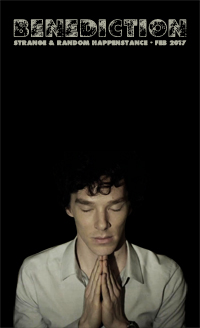
Benediction

February is a tricky month. People just really don't feel like doing anything. We're sick of winter, we're sick of holidays, we just want to ignore whatever the groundhog says and just keep hibernating. With this in mind I've tried to make February on my blog about comforting reads and what makes me happy. For three years now that's been Downton Abbey. While I could continue this tradition, I feel that with the end of Downton Abbey* I should likewise end this tradition and move onto something new. But I still had a need to make it British, because this is the season of Masterpiece No Longer Theater... and this is where Benedict Cumberbatch comes in. Unlike most of the world who hadn't heard of Benedict until Sherlock popped up on our screens in 2010, I was a fan for many years previously. Of course being the omnivorous Anglophile that I am I had seen many things with Benedict for years and years without knowing who he was, he is a chameleon, Atonement anyone?

That all changed in 2006 when I watched To the Ends of the Earth. It was raw, it was gritty, but it also had the most magical ball scene I've ever watched. I was sold. Benedict Cumberbatch was were it's at. What's great about him, aside from his sense of humor and his celebrity impersonations and his ability to morph into any character and his looking occasionally like an otter, is that he stars in so many movies, television shows, plays, and miniseries, that are adapted from fiction. This is perfect for my purposes! This could go on for years! (Though seriously, someone stop me if I start reading Hamlet for fun.) I LOVE reviewing adaptations, and therefore I have an excuse to read books I haven't gotten around to AND watch Benedict Cumberbatch movies. It's win win in my mind and I hope it is in yours as well; because February is now all about Benedict. He's here to bless us with his presence. We're getting a Benediction!

*Please, under no circumstances make a Downton Abbey movie! Everything ended perfectly and all a movie would do would muck things up, complicating our beloved characters lives only to have to uncomplicate them. What's wrong with leaving well enough alone! Downton Abbey movie rant end.

Thursday, December 1, 2016

Du Maurier Decemeber Deux

My opinion is, with regards to most things, if you enjoyed it once why not try it again. This has happened with several theme months on my blog, from Downton Denial to Mitford March to Regency Magic. I view these theme months as a kind of institution, but more, a time to read books I love. Though really, I do attempt to make my blog all about books I love because I want to love ALL books, but nothing ever turns out as you expect. Therefore I'm bringing back a theme month I loved doing; Du Maurier December. As I've said before, the ambiance of Du Maurier's books is perfect for this time of year, in fact from October onwards you're pretty good but the alliteration works so much better in December. As for her lack of celeb status this side of the pond, it is tragic. Everyone should know who she is if just because of Alfred Hitchcock! In fact, it's thanks to a Hitchcockian themed month early in my blog's history, A Hitchcockian Hoot'nanny, that was middling in it's success that first brought about my comparing Du Maurier's written work with the adaptations that were to follow. In fact, I might just happen to be revisiting one of those adaptations... and no, it's not going to be the 1939 version of Jamaica Inn, I can NEVER go there again. So sit back, grab a book and a remote, it's time to dwell with Du Maurier!

Wednesday, February 24, 2016

Book Review - Katherine Longshore's Manor of Secrets

Manor of Secrets by Katherine Longshore
ARC Provided by the Publisher
Published by: Point
Publication Date: January 28th, 2014
Format: Hardcover, 320 Pages
Rating: ★★
To Buy

The garden party is stifling and Lady Charlotte would give anything to break free of the watchful eye of her mother, Lady Diane. She spies a servant sneaking off into the woods and daringly she follows. Janie is nothing more than a kitchen maid but as Charlotte watches her servant reveling in the shallows of the lake she wishes for such freedom. Charlotte has so many dreams and ambitions that are unacceptable for lady. She wishes for nothing more then to write and marry for love. But fantasizing about the footman is one thing, actually acting on those impulses are another, though kissing a servant might not be as alien to Charlotte's mother as Charlotte thinks. With the arrival of Charlotte's Aunt Beatrice hours before the shooting party The Manor has been turned on it's head. Yet Charlotte can not understand why the return of a relative she never knew of is causing such chaos. She needs information and everyone knows that servants know everything. Turning to Janie Charlotte breaches the rigid divide between upstairs and down. The two forge a tenuous friendship confined by societal expectations, but even trying to work within these strictures they are both jeopardizing more than they know. Can Charlotte find a way to live within her world and find love where she least expects it? Can Janie hold onto her position and her home with Charlotte undermining her? And what does a secret pregnancy from the past hold in store for these two girls divided by more then a baize door?

Manor of Secrets is an odd little book because it comes across that it doesn't quite know what it wants to be when it grows up. Much like the upstairs heroine Charlotte this book is in the midst of an identity crisis. The main issue I take is I don't know who the audience for this book is. It claims to be YA yet it feels Middle Grade. The simplistic writing, the laughable "secret," the overly large font used to bump up the page count, if there was a category somewhere between YA and Middle Grade, it might just fit there, but towards the Middle Grade end of the spectrum. While as a reader categorization doesn't matter to me so much as a good story, I will read anything, but knowing the intended audience sometimes helps you with your expectations. Especially if the story isn't catching you perhaps it's because of the author "writing down" to her audience, which in my mind is never acceptable, but alas, happens quite frequently. While I have bemoaned another "secrets" series I can't help feeling that for how much I disliked that series the characters actually had a little more depth, and that is a sentence I never thought I'd write.

The simplistic writing causes merry havoc with the story, dragging it down to a flat and superficial level. The lack of depth and detail is astounding considering that this book runs to over three hundred pages, see previous mention of font size. The great manor house that everyone lives in is literally called "The Manor." Um, could you think of a more generic and bland name oh author? I mean seriously, you couldn't come up with, oh, I don't know, anything more original than using the word that actually describes what kind of house it is? Heck, your last name "Longshore" could have been a better name than "The Manor." This lack of originality actually shines light onto the stupidity of Charlotte and her inability to see beneath the surface of someone. This "teaching moment" that smacks of moralizing Middle Grade reads isn't hard to understand when you look at the bigger picture. Charlotte lives in a simplistic two-dimensional world, it makes sense that she wouldn't be able to grasp three-dimensionality, it's beyond her ken. She doesn't get that people have depth and that you shouldn't judge a book by it's cover because in her world depth doesn't exist!

Continuing on to the upstairs/downstairs dynamic, the simplicity remains and makes this dynamic off. You have the "good" servants and the "bad" servants and no one can reside in a grey area. I SAY NO ONE! And the upstairs and downstairs people must be completely ignorant of each other because never the twain shall meet! Yet within their realms everything is just peachy and keen because everyone knows their place. Yes, they natter on about this radical concept of "change" but does anyone actually change? Oh no, that would be too radical and too multidimensional! When you look at what is really going on, the love affairs, the relationship dynamics, you should have a drama on the scale of Gosford Park with someone meeting the pointy end of a knife! Instead you get snide comments, from the bad, reassurances, from the good, and everything working out. Seriously? I really kept dwelling on Gosford Park and how the upstairs/downstairs dynamic when concerning a pregnancy shows the class iniquities and the abuse of power but here that isn't even addressed. With the world apparently changing, or so the rumors go, shouldn't this stop the culture of silence that is pervasive in this class system?

But then again, the truth of Charlotte's parentage isn't even viewed in a negative light except by those "bad" people. This is what, 1910 or so, the Titanic is under construction, and yet the heroine is all, "Hey everything is awesome, I have a sister." Once again pointing out how dim her world view is. She would be ostracized from society, she would be ruined, and instead she gets everything she wants! Perhaps living in a two-dimensional world has it's benefits, like being to totally ignore the reality of a situation? Yet there's something distinctly off in my mind about what the friendship between Lanie and Charlotte really says. Yes they are friends, but it only seems to be condoned because it turns out they are half-sisters. Would this class and rank defying friendship been accepted if they were just friends? If they had no blood ties at all? While the book would like you to think so, I don't think that's the actual truth. I think this is the one aspect where the book is right and is hiding a darker secret in plain sight. Their relationship is unconventional, yet somehow allowable because of this familial bond. While the "bad" people might still frown upon it, it is not as shocking as it could be and therefore fine.

In the end what everything boils down to is Beatrice. She is the catalyst for change. She represents the force of the future. Yet it is ironic that a person who went to such lengths to hide their sin would then be the one trying to destroy the system she bowed down to... but perhaps that's why she's doing it? One would hope, but again, two-dimensional shallows are being waded in here so that might be asking too much. Plus it's not like anyone likes her until the last ten pages. Throughout the book there's the theme of the world changing, but it's all talk and no action until the very end when Beatrice is like, I'm a suffragette, let's go be the change we want to see in the world. All while everyone is like, yeah, we're not sure about you and this whole actually standing for something thing. And then there's her household run completely by women. This makes you think two things, one she's removed temptation and therefore can't get pregnant again or two that she's a lesbian now. The whole women's suffrage doesn't even get on the radar until they're half-way out the door and on the way to Italy. Plus, just a question, the whole idea of woman's suffrage is equality. They want to be equal to men so shouldn't her household be staffed by the best no matter their gender? Equality NOT segregation. But that would require the book to actually look into causes and motivations and there is nothing here but surface.

Wednesday, February 17, 2016

#ExerciseWithBuffy

Buffy the Vampire Slayer and Downton Abbey don't really seem the least connected, and they're not. Well, I'm sure I could find some justification to connect the two other than my love for both, but that isn't what this post is about. This isn't about Downton Denial, this is about something that's been going on now for almost six months which I've been meaning to talk about. If you follow me on twitter or look over at my twitter feed in the right sidebar you've probably noticed my daily use of the hashtag #ExerciseWithBuffy. This is a thing I've created to motivate myself. Being a graphic designer and reviewer kind of chain me to my computer. Seeing as my "hobby" (really it's more of a calling) is reading, well, there's not much get up and go. There's a lot of the sedentary about my lifestyle.

Sedentary can be good in moderation, anything is good in moderation, but the fact is, I needed to get up and go. I like to walk. In fact it's the only form of exercise I like. I've tried to integrate it into my life a little at a time, but it's never stuck, and once winter sets in, I don't want to leave the house. I even joined a health club once only to get so sick on two separate occasions due to the filth of the facility that I had to stop going. So this past fall I decided enough was enough. I want a long time to live on this planet to read books and have a good life. I don't care about weight loss, I care about fitness and my health. I don't want to get diabetes and die young. So I got a treadmill and I told myself it's all or nothing, so I haven't skipped a single day, though there is the rare occurrence of exercise taken not on my treadmill.

But how did I motivate myself to get onto that treadmill everyday? The answer was simple, TV. I love TV and there are some shows I love more than others. There are some shows that are a part of my DNA. Buffy the Vampire Slayer is one of them. I remember the first time I saw it. I remember sitting up in my friend Jess's bedroom watching season six, with her room rearranged for the best possible viewing experience on a very tiny TV. I remember that by season seven we had her whole co-op watching so we moved into the TV room in the basement that was always cold and a little dungeon like. I remember the first Buffy convention I went to and all the ones after that. Buffy has been a part of my life for so long it helped form it. I've meet about fifteen actors from the show, more if I counted Angel, and been impressed that the people Joss Whedon surrounds himself with are so nice. I've met Joss Whedon. Seriously, I HAVE MET JOSS WHEDON! (Photographic proof provided because I'm that geeky.)

This show changed my life so I thought, maybe it could change it again. And it totally has. When I started I couldn't walk half a mile without feeling like I was going to die, I can now walk 1.70 miles for 43 minutes every day without dropping down dead; I would say without breaking a sweat, but that would be a lie, and seriously, it's good to sweat. I have lost five pounds and though it's not about that, the serious toning that has happened as well as the weight loss, well, it gives me visible proof of my hard work. But why am I telling you about this now? Because yesterday I watched the last episode of Buffy the Vampire Slayer and now it's time to move on. To Angel. So please join me for #AngelAerobics! I'm starting today! And if there's one takeaway from rewatching Buffy? It's that the show needed Anthony Stewart Head desperately. The decline started as soon as he boarded that plane back to England and Manchild.

Friday, February 12, 2016

Book Review - Barbara Taylor Bradford's The Cavendon Women

The Cavendon Women by Barbara Taylor Bradford
Published by: St. Martin's Press
Publication Date: March 24th, 2015
Format: Hardcover, 448 Pages
Rating: ★★★
To Buy

Last we saw the Inghams and Swanns they were drifting apart, especially Miles and Cecily. Miles had just told Cecily that despite their plans he must marry for duty, not love, as the unexpected heir of Cavendon. In the intervening years Miles has grown more unhappy in a marriage that is a sham, and the chances of an heir with his wife are now nonexistent. Meanwhile Cecily Swann has made herself a household name with her sense of style and her line of clothes and accessories. But the time has come for the disparate members of these two intertwining clans to come together. Miles's father, the Earl of Mowbray, has called the family back to the ancestral pile under the auspices of a family reunion, when in fact it's for his wedding. For all the years the Swanns have served the Inghams there has never been an officially sanctioned romantic alliance between the two; that is about to change. The Earl is set to marry Charlotte Swann, the love of his life.

From Miles and Cecily's point of view this marriage changes everything. Perhaps with the removal of a certain unwanted wife they might get their happily ever after? But Miles and Cecily aren't the only ones looking for love, three of the four Cavendon Dees have not had the best of luck with their love lives and hopefully that is about to change. Dierdre has caught the eye of the American business partner of her brother-in-law, Dulcie has a thing with England's most famous actor, while DeLacy, still licking her wounds from her divorce, has aroused the interest of her mother's sexually voracious husband as well as a famous painter he commissioned to paint her. But sorting out their love lives is one thing, sorting out the financial crisis facing Cavendon and the world is another. Can the Cavendon luck hold out with the help of the faithful Swanns?

When I finished the first book in this series, Cavendon Hall, I openly questioned whether a second volume would work given that what drove the first book was resolved. I of course speak of the continuing danger posed to Lady Daphne from her rapist, who was subsequently killed in World War I. The book worked because of the danger, not to the house, but the menace in the woods that threatened the womenfolk and virtually emanated off the page. I'm sorry, but worrying about the roof of the north wing collapsing or a burst pipe in a bathroom doesn't offer the same sort of tension. Bradford tried to recapture some of this feeling with the Dees's step-father, Dr. Lawrence Pierce. While Pierce had great potential with his womanizing ways and his lust for making DeLacy his conquest, he never became as dangerous as he could have been. I can see him as a Jack the Ripper type character that offs his paramours after he is finished with them, but instead we have only one lackluster murder to lay at his door. And he even made it look like a heart attack. How lame is that?

But this volume seemed more concerned with everyone overcoming the odds and being happy and beautiful with everything working out just right because that's how it's supposed to be instead of creating a plot or any driving force to the narrative. This is like Downton Abbey on happy pills where everyone sits around in a luxuriously appointed room complimenting each other on how pretty and lucky they are. "I'm so pretty and happy! How are you, oh the same darling? Fabulous." It's not that it's not a happy getaway from any semblance of reality, because there is that aspect, it's just that after awhile it's so much sameness that you, as the reader, could be writing it. Sip some tea, comment on how talented they all are, have a false alarm about loosing the house, and back to fabulous. This sameness is problematic when it comes to differentiating the Dees. Firstly, naming all your daughters with "D" names is so very lame I want to puke. But more than that, it's hard to distinguish them because they are pretty much the same. I actually created new names for them all, and I don't think Bradford would like her characters being labelled by their character traits, I know lesbian, I mean Dierdre, would probably agree.

What I found worrying about the characters in this volume was that while the Inghams and the Swanns have this immutable bond the rest of the world can go to hell in their eyes. They ruthlessly fire any staff that isn't a Swann by birth or by marriage. I'm sorry, but is it just me who views this as rather heartless? They really aren't that badly off and manage to come through everything OK but during this time of economic depression they close ranks and push people, whose only fault is that they aren't a Swann, out into the cold cruel world. What with their love of their looks and their exclusivity these two families aren't coming across as people you'd want to spend your time with, they're coming across as "mean girls." They are totally the rich clique at school wearing Lacoste who you avoided because they were so mean and vicious about everything from your hair to your clothes. In fact, getting onto that whole clothes angle... Cecily is setting all the trends and making sure her friends have the best clothes while customers have to wait. Yeah, they really are an evil clique. So why do we like reading about them? Is it because we always wanted to be on the inside looking out? Oh dear, I'm really starting to question why I like this book.   

Getting away from the characters and onto Bradfords writing style, I find it very haphazard. She's SO SPECIFIC about certain things but can't be bothered about others. Yes, she might have her knowledge base she's drawing on, but the least she could do is try right? You've by now guessed that there has to be one specific moment that made this dawn on me, and oh yes, there was. Bradford luxuriates in her details about the clothes Cecily designs, lavishing detail on everything from Juliet caps, which Cecily made popular, to the fur edging on a cape, so white and warm! So what happens when another artistic field is ventured into? Say painting. Let's tackle Travers Merton shall we? He's the artist Lawrence Pierce hires to paint DeLacy in his ongoing seduction only to have Merton steal DeLacy from his grasp. So Merton obviously has a studio, "the studio was a spacious room with big windows at one end, and filled with with perfect light." So what is perfect light? "Just the kind of light a painter required, and couldn't work without." Oh? So is that North facing windows or what? Cause I'd really like to recreate this perfection in my own studio space. Gaw. If you're going to be that vague just don't even mention the light at all. Or at least tone down the descriptions of the clothes to even it out.

The clothes and Cecily are actually a problem for me. The kind of big problem that keeps getting bigger. Her success is just booming. Like incomprehensibly booming. Yes, she's a smart business woman to capitalize on her success, much like Brandford's other famous heroine and Cecily's friend, Emma Harte, has done. But there comes a point when how much is too much? She has bags that are more coveted than Birkin, a wedding boutique, and a whole line of Cavendon knock-off jewellery. In fact, it's at the jewellery that I really went, enough is enough. It's like Cecily is trying to capitalize on her success like PBS off Downton Abbey. There's just a tipping point, and with the merchandising of Downton Abbey for me it was when they started doing jewellery. Since then they have expanded to cooking kits, wrapping paper, teas, hats, you name it. There's such a thing as oversaturation and while I've totally reached that point with the Downton Abbey merchandising, I have also reached that point with the glittering career of Cecily Swann. I'm actually looking forward to the next installment, seeing as this book ended with the stock market crash that triggered the great depression. How will her jewellry go over with the masses when there's not enough money to put bread on the table? I just want her to be knocked down to earth. Just a little. Because perfection isn't perfection without a little flaw to set it off. I want to see Cecily's flaw.

Monday, February 1, 2016

Downton Denial Denouement

And now, the end is near, and so I face the final curtain... Yes the time has come. The ultimate denial is about to set in. Because after that last gathering around the Christmas Tree while Thomas aids Carson (and no, I wouldn't count that as a spoiler she says with shifty eyes), the doors to the Abbey will close forever. Unless they need the money and do a movie, but still, it looks like the end and they're making all that money off the costumes touring, which is fabulous by the way so you should go. Back to previous train of thought, the end was so good that it should be the end. So let's say it is the end, big ominous capital letters and all, The End. Therefore you need something to fill that gaping void more than ever. I am here to fill that void, and no, stop with the naughty thoughts. Stop it. I know how you feel and I have tried to find solace in books to take away the pangs. Therefore, for the last time, unless I'm desperate come next February, which let's face it, I probably will be, I give you the denouement of Downton Denial! A month full of books I've read and some of which you should read if just to capture that elusive magic that Downton Abbey brought into our lives every Sunday night for the last six years. Here's to Downton!

Monday, December 28, 2015

Tuesday Tomorrow

The Song of Hartgrove Hall by Natasha Solomons
Published by: Plume
Publication Date: December 29th, 2015
Format: Paperback, 416 Pages
To Buy

The official patter:
"A captivating novel that evokes the author’s New York Times bestseller The House at Tyneford .

Natasha Solomons’s breathtaking new novel has it all: a love triangle, family obligations, and rediscovering joy in the face of grief, all set against the alluring backdrop of an English country estate perfect for fans of Downton Abbey.

It's a terrible thing to covet your brother’s girl.

New Year’s Eve, Dorset, England, 1946. Candles flicker, a gramophone scratches out a tune as guests dance and sip champagne— for one night Hartgrove Hall relives better days. Harry Fox-Talbot and his brothers have returned from World War II determined to save their once grand home from ruin. But the arrival of beautiful Jewish wartime singer Edie Rose tangles the threads of love and duty, and leads to a devastating betrayal.

Fifty years later, now a celebrated composer, Fox reels from the death of his adored wife, Edie. Until his connection with his four-year old grandson - a music prodigy – propels him back into life, and ultimately to confront his past. An enthralling novel about love and treachery, joy after grief, and a man forced to ask: is it ever too late to seek forgiveness?"

Yes please! Also, it may just be a part of 'Downton Denial" next year...

The Rogue Not Taken by Sarah MacLean
Published by: Avon
Publication Date: December 29th, 2015
Format: Paperback, 432 Pages
To Buy

The official patter:
"Lady Sophie’s Society Splash.

When Sophie, the least interesting of the Talbot sisters, lands her philandering brother-in-law backside-first in a goldfish pond in front of all society, she becomes the target of very public aristocratic scorn. Her only choice is to flee London, vowing to start a new life far from the aristocracy. Unfortunately, the carriage in which she stows away isn’t saving her from ruin . . . it’s filled with it.

Rogue’s Reign of Ravishment!

Kingscote, “King,” the Marquess of Eversley, has never met a woman he couldn’t charm, resulting in a reputation far worse than the truth, a general sense that he’s more pretty face than proper gentleman, and an irate summons home to the Scottish border. When King discovers stowaway Sophie, however, the journey becomes anything but boring.

War? Or More?

He thinks she’s trying to trick him into marriage. She wouldn’t have him if he were the last man on earth. But carriages bring close quarters, dark secrets, and unbearable temptation, making opposites altogether too attractive . . ."

Oh, new series, yes please!

Murder Most Malicious by Alyssa Maxwell
Published by: Kensington
Publication Date: December 29th, 2015
Format: Hardcover, 304 Pages
To Buy

The official patter:
"In post–World War I England, Lady Phoebe Renshaw and her lady's maid, Eva Huntford, step outside of their social roles and put their lives at risk to apprehend a vicious killer. . .

December 1918: As a difficult year draws to a close, there is much to celebrate for nineteen-year-old Phoebe Renshaw and her three siblings at their beloved family estate of Foxwood Hall. The dreadful war is finally over; eldest daughter Julia's engagement to their houseguest, the Marquis of Allerton, appears imminent; and all have gathered to enjoy peace on earth, good will toward men.

But the peace of Foxwood Hall is shattered on the morning of Boxing Day, when the Marquis goes missing. Not entirely missing, however, as macabre evidence of foul play turns up in gift boxes given to lady's maid Eva Huntford and a handful of others. Having overheard her sister and the Marquis in a heated exchange the night before, Lady Phoebe takes a personal interest in solving the mystery.

As the local constable suspects a footman at Foxwood Hall, Phoebe and Eva follow the clues to a different conclusion. But both young women will need to think outside the box to wrap up this case--before a cornered killer lashes out with ill will toward them. . ."

And another new series that looks like such fun! Murder, mayhem, a country estate! So yes, maybe I'm a bit country house obsessed... but all these books can fill that void.

Wednesday, February 18, 2015

Book Review - Colleen McCullough's Bittersweet

Bittersweet by Colleen McCullough
ARC Provided by the Publisher
Published by: Simon and Schuster
Publication Date: August 19th, 2014
Format: Hardcover, 352 Pages
Rating: ★
To Buy

Edda and Grace, Tufts and Kitty, two sets of twins and all inseparable sisters. While they appear to have a perfect life they are thwarted by conventions and by expectations from their dear mama. Kitty has suffered the worst, being the beauty of the family her outward appearance clashed with her inner retiring nature resulting in several suicide attempts. Edda views it as imperative that they get out from under the thumb of their mother in order that they can have fulfilling lives. Women in Australia can now train to be nurses and the local hospital in Corunda, with the encouragement of the girl's father, is willing to take on the four sisters. It's hard but satisfying work, with all the sisters, save Grace, finding that this could be their true calling. Grace is the first to get married and leave the hospital. It was love at first sight for her and Bear. Soon the girls have to choose between love and a career, or a precarious balance of both. Times are tough and nothing is easy, especially in a world made for men, not women.

I can't remember a time in my life when I didn't know who Colleen McCullough was. Her book The Thorn Birds was not only a phenomenal bestseller, but the miniseries adaptation was one of my late Uncle's favorite shows ever. This is, of course, the man who bragged my entire life that the last movie he paid to see in theaters was The Name of the Rose and decided that nothing could compare after that so he closed his mind. Despite being a fan of The Name of the Rose, his seal of approval actually had me avoiding The Thorn Birds in any form for my entire life. So, despite knowing all about her, Colleen McCullough has been a part of my life without really being a part of it. Until now. I should have left well enough alone.

Don't let the talented graphic designers fool you by their pretty cover, this book is painfully bad. Rage reading bad. Full of bad cliched writing and stereotypes. Repetitive to the point where I wanted to pull out my hair. Did Colleen ever learn that you shouldn't keep repeating the same words in a paragraph? No she didn't. Or maybe she just has a very tiny vocabulary to go with her tiny mindset on the place of women, more on that to come! Oh, and all love is love at first sight? Seriously? Yet the pinnacle of this atrocious writing is that I got to know the sisters moods very intimately by the color of their eyes. Blurg. Every five seconds it's Kitty's eyes are now sparking violet, Edda's eyes are going green. Are their eyes freaking psychedelic rainbows? In fact, in this relatively short book (despite how long it felt, 352 pages is relatively short) eyes are mentioned 236 times! Eyes are mentioned on 67% of the pages! Just no.

Yet what just got under my skin like an immovable tick was that despite starting this book out with four independent women and an apparent feminist bent it very quickly went on to show that women need men and can rarely handle hard thinking and need a husband to complete them. WTF! Why would you destroy such a strong and powerful message by having each character only find happiness once she was married? These women were trailblazers, fighting to have their own lives away from parents, learning skills often reserved only for men, to then give it all up for what? Men who weren't nice and controlled them? Seriously, what's going on here? Why did this book go to cliches and limp-wristed writing? How can anyone justify saying this to an amazing and competent nurse: "Kitty, life never meant you to be a children's nurse. Your life means you to have children of your own!" Gag me now.

But Kitty's domestic fate isn't the worst held in store for the sisters. Oh no, not by a long shot. That fate belongs to Edda. Edda the invincible. Edda who wanted to be a doctor. Edda who wants to travel and be amazing. What becomes of Edda? She becomes a fag hag. Now I don't mean this derogatorily I'm just saying what is true, this is what Colleen McCullough did to her most powerful character, she made her need a man, but because Edda wanted more she needed a man who wouldn't threaten her sexuality or ambitions. Edda was at a point in her nursing career where she was at the top of her field and was scared to take that leap to be a doctor, despite wanting that originally and being thwarted by an evil step-mother. So truthfully, she could have become a doctor on her own impetus. But it takes her finding a gay politician in need of a wife for her to get to medical school. Seriously, WTF. Even worse, at the end she's obviously fallen in love with her husband and is now trapped in a marriage to a man whose nature can never give her what she now wants. Thanks for destroying the independent Edda in the most vicious and heartbreaking way possible Colleen.

From idiot girls to politics, this book doesn't just go downhill fast, it plunges itself off a cliff. I'm not the biggest fan of politics as it is, Australian politics during the depression? There is no way in hell this will ever interest me that I can think of. What is worse though is by aligning the politics with the most hated character in the book even if the politics didn't bore you to tears you'd grow to hate them because of Charles Henry Burdum. Charlie, I'm going to call him Charlie because he hates it, is the most controlling, possessive, jealous dumb ass with a Napoleon complex to ever be written. I am still baffled that Kitty was somehow bamboozled into marriage with him because from his first appearance in this book I wanted to throw him under the train he road in on. He isn't an anti hero, he is a douche. And in true douche manner he came in and took over the book and what little ray of feeble light that was trying to shine through was blocked out by this diminutive dumbass. But in the end, I hated all the characters, I hated the message, and I definitely hated this book, so I think I should just move on. When's the next boat out of Melbourne?

Friday, February 13, 2015

Book Review - Barbara Taylor Bradford's Cavendon Hall

Cavendon Hall by Barbara Taylor Bradford
Published by: St. Martin's Press
Publication Date: April 1st, 2014
Format: Hardcover, 416 Pages
Rating: ★★★★
To Buy

The Inghams and the Swanns are inseparable. For hundreds of years the Swanns have served their noble lieges becoming more like family then staff. Their children are brought up together and their bonds are unbreakable. Those bonds will be tested when a horrific attack on the Earl's most precious daughter, Lady Daphne, brings danger to the very heart of Cavendon. The Swanns close ranks to protect Lady Daphne from any further threats, even her own family if necessary. But danger doesn't just circle the family, the world is on the brink of war. Can these two families in crisis come together to help each other through the horrors they have to face and the dangers to come? Or will their bonds start to fray?

Sometimes you need to go to a happy, if unbelievable place, where the moon is always full and servants are like family, just to take you away from your cares. Where everyone loves everyone else, though perhaps a little too much with the incestuous nature between the Inghams and the Swanns. I almost expected them to start quoting that other famous resident of Yorkshire, Emily Brontë, by saying of the Inghams and the Swanns, "whatever our souls are made of, his and mine are the same." This isn't high art or great literature like Emily, this is pure fun, like Downton Abbey on crack, without the constant threat of one of the Bateses ending up in the clink. These magical happy pills make even the worst situation not only bearable, but work for everyones benefit and eventual happiness. Though seriously, I would like to know how there's always a full moon.

Cavendon Hall does suffer from an unevenness. Most of this has to do with pacing, but also how it's stylistically written and sometimes falls prey to self aggrandisement. Tackling the later, I really would like other authors opinions on quoting yourself. Each part of the book begins with a series of quotes from Shakespeare to Tennyson to Emma Harte. Emma Harte? As in A Woman of Substance Emma Hart? Yes, Barbara Taylor Bradford just quoted herself. By placing this quote with actual quotable greats I can't tell if she's just using something to hand that she thinks works or is trying to elevate her art to a new level? Either way, it seems a bit shady to quote your own characters in a setting that isn't tongue-in-cheek. Makes me think she's more then a little full of herself... but if any of my author friends would like to weigh in I would love to hear what they have to say.

As for the unevenness, it's not just that she occasionally switches up her writing style to be hyper sexual for a paragraph only to revert to her staid writing style of every other page, but the way time is handled is troublesome. Two years take up the first 279 pages while the final 126 pages is six years. So there's this nice introduction, we get to know everyone and become a part of their daily lives to have it all then whoosh past us at light speed. I'm not sure if it's that Barbara Taylor Bradford just didn't want to handle WWI in detail or what. I would say it almost felt as if she was sick of telling her story, but seeing as this is a series with the next book coming out in March, she couldn't be sick of her characters already if she's writing even more about them? But I think this can be a universal gripe to all authors, don't make us fall in love with your characters and then shift focus and gloss over things. Stay consistent within the narrative. All your books don't have to be the same, just the one you're currently writing should be consistent. And if it ends up a doorstop of a novel, so be it, I'll read it.

What I feel is the driving narrative of the book is also in my mind one of the biggest issues. This is, of course, Lady Daphne's rape at the very beginning of the book. Rape is a hard issue to deal with sensitively and properly. Just look at last season of Downton Abbey where Anna's rape split the audience with those who just didn't want more misery for Anna to those who thought the rape storyline was brave, and finally to those who thought the storyline was just handled insensitively. With such a hot button topic it has become rather inappropriately in my mind a way to add drama and spice to a story. When in doubt have your strong female character attacked and assaulted. To me this just seems like a convenience versus a real desire to tackle the issue.

Even in writing about the events in the book I feel uncertain as to how to describe the event critically. The attack and the cover up that surrounds it to me smacks of not wanting to confront something horrible, but wanting to make it like it never happened. This is where my problem lies. The stigma of speaking out. Yes, this was a different time period and "reputation" was the be all end all, but still... this is a problem that still exists and even "period" literature that holds this opinion of silence being the best solution just adds to the problem.

And while the rape and it's repercussions does drive the story, it's how Barbara Taylor Bradford built off this to create a greater atmosphere of fear that kept me reading. Taking the "pervert in the woods" and expanding his reach, showing the terror and fear his other sightings added to the story, this took the book further. I can't help thinking though that if this fear is removed, how will the next book have any tension or jeopardy to keep the spark of interest going in the reader. I also can't help but think if Lady Daphne had told all after her attack that a lot of other bad situations would have been avoided... perhaps Barbara Taylor Bradford was subtly saying that silence isn't the solution... then again, she could have just wanted to scare us and keep reading her book. Anything for the story right?

Wednesday, February 11, 2015

Book Review - Elizabeth Wilhide's Ashenden

Ashenden by Elizabeth Wilhide
Published by: Simon and Schuster
Publication Date: January 8th, 2013
Format: Hardcover, 339 Pages
Rating: ★
To Buy

Time and neglect have been brought to bear on Ashenden Park. Occasionally loved and cared for, the great estate has fallen into the hands of two siblings after the death of their aunt. They don't know what they should do with this giant white elephant they have inherited. Going back through time to the houses beginning in 1775, James Woods is finishing the architectural touches for his new masterpiece to be wrought in Bath stone, though little does he know that tragedy will personally strike him and his employers will never finish the house. It's 1844 and a new family cares for and loves Ashenden, it is the home of their dreams and their children love it well, but their grandson is feckless. 1938, the house is once again in disrepair, cut up and sold for whatever money the current owner can get for a ceiling or a mantelpiece. 1946, the war arrives and a man who is a prisoner lives where one day he will return a house to lost glory for the aunt of two siblings. Ever rising and falling in it's luck will Ashenden Park be glorious ever again?

It takes a lot to make a house memorable in literature. I don't think it's something that you can set out to do, it's something that happens over time. Manderley, Number Four Privet Drive, Tara, Pemberley, all these places are held in the hearts of readers. We imagine what it would be like to go there, to walk through the woods, to gaze at the family portraits, to be immersed in the world of our favorite story. To us readers these are tangible places that we can visit, if only in our imaginations or between the covers of our favorite book. To have the conceit of following a house through time is at once intriguing and sheer folly. If Ashenden proves anything it's that the engendering of a house in literature can not be forced on us.

In order to fall for a literary house you have to fall for the story. A house itself isn't a story unless it's peopled. Would Hill House be evil and menacing without inhabitants? No, it couldn't be because there's no one to interact with it's bricks and mortar, there's no Eleanor. The house just sits there waiting for occupants. Why yes, Asheden does become occupied, but by having the narrative spread out decades apart over a hundred plus years with different characters there is no way to become invested in the story. The house is an empty vessel and here are some people who occupy it, but don't bother getting too invested in them, they'll be gone soon enough. If there had only been some overarching plot separate from the house itself, like in Mark Gatiss's Crooked House that weaves together hauntings of Geap Manor over a two hundred year period to a conclusive denouement, well, that might have been something I could have worked with, but sadly there wasn't.

As for these people who flit through Ashenden over time. I couldn't have cared less about them. Rarely were they nice or kind, usually they were self centered jack-offs. The way the book is written it's really just intertwined short stories. I'm not the biggest fan of short stories. I like scope. I like having a beautifully built world that I can immerse myself in, which is why I like television and miniseries more then movies.  Short stories are hard to invest in unless they are perfectly crafted little jewels that can stand on their own. By having the stories linked through Ashenden this is never possible. Each story with a jerk and a bump leads to the next and the next, with ever more unlikable characters that I didn't want to invest my time in.

But the short narratives weren't the most annoying thing. What really got me was this fine breadcrumb trail of characters and even objects that Wilhide wove through the book. So to recap, lots of unlikable characters I don't like and don't care to remember are peppered throughout the history of Ashenden like little Easter Eggs. Somebody hold me back. Sure, it's a cute idea, a way to link past and present, but sometimes cute ideas should not be employed because they annoy the heck out of your readers. It's gimmicky and gets maddening real fast. That stupid brown cow pitcher, and I have to say, I actually liked a pitcher of a brown cow more then anything else in this book. I liked an inanimate object more then the people. Um, that's a problem.

This is Wilhide's first fiction book, having written a plethora of books on design and architecture, and I have to say it shows. She was unable to create an engaging book. If her goal was to show the "living history" of the house, well, I guess she did that. Wilhide was able to show how the house changed and adapted over time from it's construction to it's current state of dilapidation, but it was a depressing show and tell that felt like I was reading about the slow death of the house sinking further into despair. Never did it feel like she was exulting the house, never once giving it the people it deserved. A pop star? Please no. Anyone who was nice to the house was skimmed over. One of those nice persons was name Florence Henderson, and I hope that this was historical, because otherwise, WTF Wildhide! No.

Houses all have stories to tell. But does this mean that the stories should be told? No it doesn't. What got me most was that anytime you almost felt invested the story would shift, much in the way Jeffery Eugenides Middlesex did, and you were back at square one, usually with an even more unsavory cast of characters. If you set out to do something unique and different go all in. Go epic, go centuries of detail and dirt. Don't reign yourself in, and don't under any circumstance ellipses over time with little introductory paragraphs at the start of each chapter that are ethereal and dreamlike but are really the type of amateurish and indulgent writing that should have been cut.

Friday, February 6, 2015

Book Review - Kate Morton's The Distant Hours

The Distant Hours by Kate Morton
Published by: Atria
Publication Date: November 9th, 2010
Format: Hardcover, 576 Pages
Rating: ★★
To Buy

Edie Burchill has never had much of a connection with her mother, Meredith. They don't have a special bond or share the deepest secrets of their lives, in fact Edie hasn't told her mom yet that she and Jamie have split up months previously. Therefore it shouldn't come as a surprise that her mom has kept secrets from her as well. One of those secrets is that she was evacuated to Milderhurst Castle during WWII. There she was looked after by the Blythe sisters, the twins, Percy and Saffy, and their much younger sister Juniper, who was like a sister to Meredith. A long lost letter brings this one revelation of Meredith's past out into the open and Edie can't help but be fascinated.

After visiting a prospective author for the publishing company she works for, Edie gets lost on her way home and stumbles on Milderhurst Castle. It seems as if fate has brought her to these gates all these years after her mother entered them. She soon learns that all the sisters are still in residence, older, and in Juniper's case, insane. Juniper lost her mind the night her fiance jilted her in 1941. Edie also learns that the sisters are the daughters of Raymond Blythe, the author of The True History of the Mud Man, a classic and Edie's favorite book growing up. Astounded by all these coincidences Edie ventures into Milderhurst, not telling the siblings that she is Meredith's daughter. The secrets of the past start to unravel with Edie's arrival and the time has come for the truth to be told, especially about what really happened that stormy night in 1941.

I have come to the conclusion that Kate Morton is a writer that I love in theory but not in practice. I see these big doorstop novels about secrets and lies, where the truth about the past is teased out and revealed to us in the present and think, yes please, I'd like to read that. But expectation and reality have never met in this case of all of Morton's books save one, I did begrudgingly like The Secret Keeper to an extent. The problem is I keep thinking about what might have been, how things might have twisted and turned to make a tauter story, one that didn't leave me thinking a couple of hundred pages in why exactly was it that I picked up this book in the first place and then heroically pushing on to the finish. A finish that I have long ago seen coming.

My main problem I think is that all Morton's books seem to be slightly different stories told with the same building blocks. Older person who may be dying has secret that will change younger person's outlook on life. Commence the lugubrious ferreting out of the truth that has a fifty fifty chance of being hidden in a children's book and will definitely have a nice house in it, even if at this present time it's gone to rack and ruin. Peeling wallpaper, forgotten childhood memories, love where you least expect it. Sound familiar? It should if you've read any of Morton's books. Yes, the books tap into a common zeitgeist of wanting to look into our past and our ancestry to find answers to our lives, but there's only so many ways to tell this story and unless Morton starts to radically change her tune she will be stuck in this rut forever. I can oddly see her writing a book about her own predicament in fact...

Aside from constantly rewriting the same story in different ways The Distant Hours suffers not from comparison to Morton's other works but by the sheer bleakness of the story. This is not a happy story folks. This story will leave you a sad sack just thinking about wasted opportunities and how potential can just wither and die on the vine. Those poor Blythe sisters! I wonder if Morton set out to see just how Brontësque she could make her book with lost loves and ravaging fires and didn't pull back from the manuscript at any time and think, hey, maybe I should temper this Emily vibe I've got going with a little Charlotte? So while this book is Brontës to the max, it's just too depressing. Therefore, unless you've some masochistic desire to wallow in despair, just let me slap this book out of your hands right now.

Though in fairness, it isn't all unremitting horror and despair. We have Edie to counter that. Edie, the idiot. First I want to do a mini rant on the avatar of the reader in a book, so bare with. As readers, there is usually someone we connect to, someone who is our conduit into the narrative. A hero, heroine, antihero, whomever it is, it's someone to be our guide. Now the guide can be a little guileless, because, like them, we are coming into the story for the first time. We are just as clueless as they are, unless they are messing with us in the "unreliable narrator" trope, but that's a different kettle of fish. You, as the writer, want us, the reader, to be able to connect with your narrator and with your story. One way to guarantee that this will never happen is to have a self amused imbecile as our avatar. Writing her thoughts in a cutesy self referential way all the while showing herself to have a cranium full of nothing.

In fact, Edie's brainpan might be filled with less then nothing. Her head is a vacuum that sucks in information that promptly disappears forever. She is oblivious of the world around her. She has a totally unrealistic and fantastical job that only the true idiot heroine can get because she couldn't survive in the real world. Blindingly obvious deductions come as revelations to her hundreds of pages too late. And of course those hundreds of pages are filled with nothing but deathly boring prologue to the events of the evening of October 29th, 1941.

If it wasn't so obvious that Edie was an idiot I'd put down her lack of deductive reasoning to the plodding pace of the narrative, maybe she just fell asleep? In fact, sleeping might have been a better use of my time. As I finish my rant there's just so much in my brain that I want to scream at Morton, show don't tell, Mud Man, ugh, just no. Too many thoughts verses Edie's too few. But the final nail in the stupidity coffin for me was that somehow Edie got her hands on a first edition of Jane Eyre, retail about $50,000, and what does she do with this sacred book? She takes it on a coffee date!?! Excuse me!?! She did what? There's not hope for her. No more. Begone foul spirit!

Sunday, February 1, 2015

Downton Denial Deux

You are back here yet again. You might actually have been really bad and bought the DVD last week and glutted yourself on Downton Abbey and now you have no more. Or you are being good and watching each episode as they air, waiting till March 1st when you truly will have no more Downton and are hoping you'll find some way to cauterize the wound. I am here to help. I have been there. I have railed against Jullian Fellowes as he messes with us and poor Anna and Bates once more. I have done dances of joy because Anthony is ending up where I want him, in Mary's rear view mirror. Oh, and the Russians, can't get enough of the surliness and their secrets!

You don't want this roller coaster ride to stop, but it will, and all too soon. And this is where I waltz in, hopefully in a beautiful dress worthy of Lady Mary, but more likely in PJ's covered in cat hair. I am here to help you cope with the bereft feeling that will overtake you in the weeks to come. While Downton Abbey is unique in it's own way, it's not so unique that you can't find books to fill the void. Once again for the month of February I will have a plethora of Downtonesque reading suggestions to help you through the loss to come. It's the least I can do for my fellow sufferers of Downton Denial.

Friday, February 28, 2014

Book Review - Evelyn Waugh's Brideshead Revisited

Brideshead Revisited by Evelyn Waugh
Published by: Back Bay Books
Publication Date: 1945
Format: Paperback, 351 Pages
Rating: ★★★★★
To Buy (different edition than one reviewed)

"If it could only be like this always – always summer, always alone, the fruit always ripe and Aloysius in a good temper." 

Vomiting through a window doesn't seem like the most promising start to a friendship, yet that is how Charles Ryder first meets a rather inebriated Sebastian Flyte. Charles is swept up in Sebastian's wake of luxury, decadence, eccentricities, and alcohol vapors. Throwing off his rather mundane life, Charles is wooed by the world of privilege that Sebastian belongs to. Charles falls not just for this sot with a teddy bear, but for his whole life; the family, the house, everything. Looking back on those halcyon days while mired in the WW II, Charles lovingly thinks of the world that has been lost forever. Yet Charles lost entre into that world earlier then the announcement on the wireless that England is at war. His love affair with the Flytes had soured over the years, moving from Sebastian to his sister Julia, Charles took whatever he could of this family, but it the end, it was something deep in the family that made certain he was never one of them, and never could be.

Before I became an avid reader Brideshead Revisited was one of those books that my father kept saying I had to read. I won't say that it's his favorite book, because the author is Evelyn Waugh and not Sherwood Anderson and the book's title isn't Winesburg Ohio, but Brideshead Revisited is firmly in place as one of his favorite books. Much like this little old lady I met at a Rembrandt show in New York who was insistent on how memorable his work would be when seen in it's original setting (ie Amsterdam), my Dad has the same tenacity and insistence of how the language of Brideshead Revisited would capture me and not let me go. Many conversations with him start "I remember how the language captured me the fist time I read..." insert any of his favorite classic books here, usually Jude the Obscure, but for this instance, Brideshead Revisited. Though, for Brideshead Revisited the refrain is more "when Lord Marchmain comes home to die..." or anything to do with Edward Ryder, Charles's father. Still, despite the copious copies of the book laying about the house, I just didn't pick it up.

When I started to hone myself into the Anglophile that I am today I watched as many miniseries as I could lay my hands to, and Brideshead Revisited finally entered into my life officially in at least one form. At this point my father had already worn out his old VHS copy and for his birthday I had upgraded him to the DVD set which I now watched. Brideshead Revisited is literally THE definition of a miniseries, and it set the standard for what we expect in our miniseries today. Mainly it was the first to be shot entirely on location. I loved all the houses and scenery, and Anthony Andrews, such a perfect actor, as are every other actor save one, I didn't love Jeremy Irons. There's something about Jeremy Irons that bothers me. He has a wonderful voice, but I think his voice has led people to ignore the fact that he seriously can't act. I am 100% anti-Jeremy Irons. So watching the miniseries all I could think was, ok, I've had enough of this for quite awhile now (except the John Gielgud lunch scene, that can NEVER be watched enough), I don't think I'll read the book right now... and so, until this month, I had never realized how right my father was in this instance.

Evelyn Waugh's writing is like a palate cleanser, everything that you read before was lugubrious and everything that you read after is sub par. Brideshead Revisited shows how fast a book that is well written goes. Time disappears, the words just flow, except for the occasional drunken tumble over a word or phrase that is now out of it's time. The lunch between Anthony Blanche and Charles, where Anthony dominates the conversation, felt just as if you were sitting opposite him in that restaurant and were being overwhelmed by his torrent of words and your inability to get a word in edgewise, a sensation that I am sure we have all experienced with certain of our own friends and were vividly reliving while reading this passage. And even while I didn't necessarily like or relate to any of the characters, the language usage is so lush that you can't help but agree with the little quote on the cover that calls the book "[h]eartbreakingly beautiful... The 20th century's finest English novel." To write a story that is so of it's time and so unrelatable to a certain extent, yet to have it forge a connection with me, well that is wondrous writing.

Even if the world of the novel is unrelatable to a certain extent, except in our daydreams, it's the themes of the book we relate to. Waugh wrote this book looking back on a golden age that was gone, destroyed by war and an ever changing world. The Flytes embody this full stop. They lived at the height of decadence but look what happens to them. Their world ends and they are literally a dead end gene pool. Look to the four Flyte children, Brideshead has married a woman too old to bear children, Julia is living apart from her husband and due to her previous miscarriage on top of the fact a reconciliation is unlikely she will never have a child, Cordelia lives as a nun, and well, Sebastian, even if he wasn't homosexual, he's basically living a monastic life now. They are the world that has come to an end, so it is only right that they too have come to an end. This mourning for what is lost and can not be had again, their youth, this golden age, this innocence... the light snuffed out on the bright young things is the spine of this book. The world keeps turning, and while the story of the Flytes is a bit fatalist, we can relate to the loss, because as we age and move on we lose all the time.

Now I do have to address one thing. The Catholic question. Does it really matter? Yes and no. While I do find it ironic that a catholic wrote what might be the most anti-catholic book out there, the religion aspect is more a signifier then an actual physical thing. We are like Charles Ryder, we are on the outside looking in at this world of popery that we don't quite understand, even if some of us were even raised Catholics. But I really think that it's not a question of religion, but more a symbol of something in your life that you don't necessarily want but still you need it and it is all consuming to your detriment. So am I basically saying that Catholicism is a form of addiction like Sebastian's drinking? Now that I think on it, yes I am... Now I'm not saying that it is like this for anyone other then the Flyte's, but their relationship with God is unhealthy and not only brings down their lives but takes away their happiness and fills it with guilt and remorse. It's this dogged insistence that they stick to the old ways that links back into the fact that their time on earth is done. We must adapt in order to survive. At least Waugh was able to give us this loving eulogy to a world now lost.

Friday, February 21, 2014

Downton Abbey Ice Capades - Will Ferrell Style

Because it fits this month and I'm more then a little addicted to the Olympic figure skating...

Book Review - Jane Sanderson's Eden Falls

Eden Falls by Jane Sanderson
Published by: Sphere
Publication Date: September 12th, 2013
Format: Paperback, 384 Pages
Rating: ★★
To Buy

Eve's brother Silas is trying to make a go of his luxury hotel in Jamaica. He even has his nephew Seth working for him as his second in command. But things aren't going well. The staff is surly, the customers are fleeing, and Silas is desperate. He thinks that perhaps his sister Eve could help him, but it's not like he's going to ask her, that would be demeaning. Instead Silas writes a letter for Seth to send to his mother, pulling on her heartstrings, and she inevitably agrees to come, despite her husband pointing out the fact that the letter was obviously penned by her own brother and not her son. Yet Eve goes to Seth and tries to fix Silas's problems... though she will fix them in her way not his, which causes yet more strife.

While back in England Eve's family misses her so much it hurts. Even her dear friends miss her. Anna and Amos are at loggerheads. He, as an elected MP for Labour, doesn't view it right that his wife should not only befriend, but work for the upper classes. Their honeymoon is certainly over. While the Earl of Netherwood, Tobias, and his faithless wife Thea are actually coming back together, having a second honeymoon. But the one person making the most news is Lady Henrietta Hoyland, Tobias's elder sister, who is making headlines for her work with the suffrage movement, and for her attack on Downing Street that has lead to her imprisonment. This is just what the youngest Hoyland, Isabella, didn't need when she's coming out; her family in tatters. Yet through the tribulation and strife, the things that really matter, family, love, will be all that remains at the end of the day.

What I have loved most about this series is the minutiae, the day to day details of these characters lives and how from the lowliest pit ponies to the Countess herself, they all flitted in and out of each others lives in Netherwood. This book is completely different from the two proceeding volumes, instead painting the lives we have come to love in broad strokes with the result being that rich, deep characters, have become one note caricatures. Whereas before we were treated to the insights of the Dowager Countess's maid, Flytton, she gets one measly mention in this installment. I'm not sure if this tone shift is because Jane wants to take the books in a different direction, perhaps to lure in more readers, or if she has reached the point wherein she has so many characters that she is unable to successfully juggle them. My money is on the later, mainly because for this volume we were given four pages of dramatis personae, poor Flytton is even excluded there. But I will not discount the "new readers" because there seemed to be a bit too much explaining of people and situations that readers of the series would easily remember.

The narrative has always been linked by a common location, Netherwood, so that people flowed in and out of each others stories easily. By pushing them so far apart distance wise, it seems like when they do show up it's not natural but fate forced to make the story still work as before but within this new rickety framework. The narrative style needs to change if the characters are going to continue to be so geographically dispersed. Maybe the answer is individual books for certain characters. Or being willing to let some characters go or take a backseat for a book or two. Because the lack of detail, the willingness to gloss over things and speed ahead, made this a messy book that left me dissatisfied and wanting more. Plus, if we are to follow every character and then Eliza's journey to France is just mentioned in a sentence or two... well, either you stick to your new style completely, or just abandon it as the failed experiment it obviously is.

One thing that was really missing from this novel was the food. In the previous volumes Jane has lavished attention on the food, making my mouth water and making me wish I had a cook to bake those ambitious recipes in the back of the book for me, or at least Eve's shop around the corner to visit. Gone even are the recipes, and gone is the heart and soul of this book. While food is still important, much like many of the characters, it's just mentioned quickly and pushed aside. This I think is symbolic of what has really happened with this series. As Eve says, you have to put love into your cooking. The ritual of making the humblest pie to the most elaborate feast all comes down to the love put in. I felt like the love was gone, in some cases, like Amos and Anna's bickering, literally gone. 

But what ripped out my heart and jumped on it was that I still love these characters, and all the new ones as well. To see them so briefly and in such circumstances hurt me more then if I hadn't seen them at all. Unlikeable characters ran riot, with Silas becoming so horrid it was almost unreadable. And likable characters like Amos who were complex and many sided became one dimensional and mean. Plus Seth! What the hell! There was such progress with Seth at the end of Ravenscliffe and then it's not just two steps back but who the hell is this evil little Silas wannabe, he's a shit. Everything was cookie cutter without the joy of making the cookies. The plot was predictable, Henrietta's being literally an episode of Upstairs, Downstairs, while Silas and his Jamaicans... that wasn't obvious... not in the least (rolls eyes and sighs). I'm just exasperated. A book that I had so looked forward to picking up has basically broken my heart.

I also wonder, at the end of the day, if Jane was trying to thrust some "morality play" into this mess. With the very vehement hatred of the government from the likes of Amos and Henry, to the dissatisfaction with the monarchy, and then the brouhaha with the Tsar, all on top of which men like Silas, who embody all that is wrong with the empire... was Jane being heavy handed with the war is inevitable to fix this broken world? That revolt is not just coming but inevitable? With our foreknowledge of what is in store, the upheaval and insurrection, she is lending all events portents of doom. I kind of hate this in books. Yes, we know where all this leads, but you know what, people at the time didn't know exactly where it was going. To be basically giving them prophetic abilities seems too much to take in. Plus, if the next book is anything like this one, well, I don't know if the series can even make it to the outbreak of war if it continues this rabid downward trajectory... unless Jane does another time jump...   

Wednesday, February 19, 2014

Book Review - Jane Sanderson's Ravenscliffe

Ravenscliffe by Jane Sanderson
Published by: Sphere
Publication Date: September 30th, 2012
Format: Paperback, 534 Pages
Rating: ★★★★★
To Buy (different edition then one reviewed)

Eve Williams can hardly credit that she is living the life she is. Mere months before she was on her way to destitution as a widow with three children, but now she's engaged to be married to Daniel MacLeod, the head gardener at Netherwood, has a thriving business, and is moving into the substantially larger Ravenscliffe house on Netherwood Common. Much of these successes are thanks to the indomitable Anna, her best friend and co-conspirator. Though not every life is perfect. Eve's son Seth is rebelling against all the changes that he feels are disrespecting the memory of his father. To Eve's horror, after his twelfth birthday Seth signs on at the colliery that his father Arthur loved, but which killed him nonetheless. She wants Seth to realize that their new station in life has opened up vast opportunities for him as well. He doesn't have to live the life his father lived. Arthur would want a better life for his son, but Anna counsels Eve that Seth has to learn this for himself.

Though the biggest change in Eve's life is the return of her little brother Silas. She hasn't seen him since her wedding to Arthur when he was a scraggly youth and left saying that one day he would send Eve bananas. One day the bananas arrive and a few days later so does Silas. Silas has made an astounding success of his life as a shipping magnate specializing in the importing of bananas to England. He plans on expanding his shipping line out of Bristol and is working on making a luxury hotel in Kingston, Jamaica, and is looking to acquire a coal mine near Netherwood. Silas, unaware of the upheaval in Eve's life, is overly zealous at the success she too has made of her life and starts to encourage her to think bigger, to expand, to grab at every opportunity she is given. Much of these opportunities are connected with the family at Netherwood. After she helps them out of a tight spot when the King comes to visit, Lord Netherwood, following a reassessment of his life, is inclined to give Eve her company outright as a wedding present, relinquishing his share. Yet Lord Netherwood dies before he can commit this to paper. Silas's desire to force the Hoylands hand and get Eve what she deserves creates conflict in Netherwood, with Silas on one side, Anna and Amos on the other, and Eve stuck in the middle. Eve's life might be better, but it is far from perfect.

When the first book in a series is wonderful and perfect I can only imagine the pressure this puts on the author. Jane Sanderson had less time and more expectations with her followup to Netherwood. Thankfully Ravenscliffe exceeded all my expectations. With the expanding of this little microcosm of Edwardian England with new characters and new situations, Jane was able to stay true to the gritty and glamorous world of her first novel, yet infuse it with even more humor and humanity. Throwing us headlong into the upheaval at the great hall with the remodelling and redecorating for the King's arrival made me fall right into this book and not want to leave. The cook dropping dead hours before the first big dinner and having Eve step in was a situation of such absurdity combined with the feeling of her walking a tightrope, led to such suspense I didn't want to go to sleep. In that moment I had such a connection with Eve, I had so much invested, I felt that I was there with her. Jane just has this knack of creating characters that you connect with on so many levels, that you become invested in their lives and just need to know what happens next. Yet, Ravenscliffe isn't just a character piece with historical figures popping up, there are real and relevant issue that ring true to this day, giving the book a depth that most literature today lacks.

In the first book, Netherwood, we see Eve make a huge success out of the ruin of her life. Eve's restaurant becomes not only a place that locals visit, but a destination in Yorkshire for a day out. Her pies are even a hit with the King, who loves food reminiscent of his days in the nursery. Well maybe we should just say he loves food period, and he really loves Eve's puddings and pies. Yet with the arrival of Silas we see someone who has made a real success of his life. He is quite literally a millionaire. Eve and him had the same life, the same start in the world. On that day she married Arthur, Silas set out to make something of himself, and boy did he ever. When compared side by side, Eve's "huge" success in the first book is a pittance when compared to what her brother has achieved. This is the crux of what is a politically charged issue. The situation here is an interesting take on the dynamic of a woman's place in society. The little success Eve has carved out for herself is lauded because she is a woman and any success is amazing in this male dominated society. Yet what could Eve have done if she was male? Would Eve have been as or even more successful then her brother? I think she would have!

Lady Henrietta is the more vocal proponent of women's equality and suffrage in Ravenscliffe. Not only does she run the estate after her father's passing, but she institutes reforms in the collieries that will save lives, as well as becoming political and taking up the banner with the likes of Mrs. Pankhurst! The book shows quite clearly the injustices, but then it shows us that forward thinking women can help effect change. They are just as, if not more capable then the men in their lives, this is especially true of Henry and her inept brother Tobias. This time in history was the true beginning of women demanding the equality they deserved. While it would be another fourteen years from the events of this book till some women got the vote and a further ten years till it was more universal, it was a time of change and this book shows us, more then a dry history textbook, why it was needed and how the change was effected. Is equality for women such a hard concept to grasp even in this day and age? It is a basic human right.

Having the characters that we have known and loved as our friends incorporated into real history and real struggles makes not just their own stories come alive, but makes history come alive. Also, what did I say about historical figures popping up? Well, of course they do, but they aren't what the book is about, they are woven into the plot making it relevant to the story, not just a cameo. The introduction of Mrs. Pankhurst, Churchill, Keir Hardie, and the King, forward the story but also place it in the bigger picture. Jane Sanderson's story coupled with living breathing history makes her plea of suffrage and women's rights more urgent, more real. The only thing I would ask is that she drop the cliche of suffragists all having lesbian leanings... it's ok if it's character driven, just not ok if it's politically driven. Suffragists are all spectrums of women, don't pigeon hole them after writing a book that embraces the trail blazers and the pioneers of equality.
Friday, February 14, 2014

Book Review - Jane Sanderson's Netherwood

Netherwood by Jane Sanderson
Published by: Sphere
Publication Date: September 29th, 2011
Format: Paperback, 455 Pages
Rating: ★★★★★
To Buy (different edition then one reviewed)

Eve Williams and her husband Arthur live a hard but satisfying life. When Eve was growing up in Grangely never did she think that she would end up in Netherwood, married to a good man who worked hard in Lord Netherwood's mines, with three beautiful children, where a good meal on the table and a clean house would be her pride and joy. Though her life is about to be tested in many ways. The miners in Grangely have been trying to improve their conditions by unionizing and instead have been given the boot. Eve feels it's her duty to help those who haven't been given the opportunities she has. Eve and Arthur agree to take in a refuge, Anna, and her baby. Anna's husband has recently died and Anna is far from home, having fled disapproving parents in Eastern Europe. When Eve's world comes crashing down with the cave-in that kills Arthur, it is Anna who gives her the impetus to go on.

Anna tells Eve that she must do something. Eve must find a way to make money and save her family from penury, because there is no one else to do it. Buoyed by her family and friends, Eve opens up a pie shop in her front parlor, catering to simple Yorkshire fare. Drop scones, Yorkshire pudding, raised pork pies, the food of the common man cooked uncommonly well. And Anna and Eve do uncommonly well. They have a steady income and they are financially secure. But Anna, she has ambitions, she sees a bigger shop, a tea room, she has the entrepreneur in her bones and without Anna, Eve wouldn't be grabbing at life with both hands. Soon Eve's cooking comes to the attention of the great house and Lord Netherwood asks for Eve to cook for his son's coming of age party. This one job is the beginning of a life Eve could never have imagined. Cooking for the aristocracy and even the King! She might have lost everything when she lost Arthur, but if Arthur could only see her now, she hopes he'd be proud.

While, I won't disagree with the books claim to be "Perfect for fans of Downton Abbey," I am after all a fan of Downton and thought this book was perfect, but I will also say that it is a little misleading. This is like a gritter Yorkshire version of Upstairs, Downstairs, where the "downstairs" encompasses not just those physically in the grand estate, but those under the protection and sufferance of the grand family in the village, especially those working for the family under dangerous conditions mining their coal seam. It took me awhile to get into Netherwood because of my erroneous expectations, but once I started to expand my view beyond the grand house I kept expecting to take center stage I realized how much more interesting a book about all these interconnected lives surrounding the house was. This gulf between the haves and the have-nots is more prominent because of the lower classes being not just downstairs, but down the mines. It expanded the traditional narrative of this type of manor house book and gave me a broader and more interesting canvas then I would have expected. From labor disputes to unions to downstairs skirmishes, this book was willing to not shy away from unsavory topics, much like Upstairs, Downstairs did in it's time with addressing real issues while also being entertainment, unlike a show like Downton, which only seems to cover issues like suffrage because it's a "period detail" versus an important issue.

There was hardly a character in this book I disliked, even the villains are perfectly villainous and therefore beyond censure. Even the young lordling who will one day be Lord Netherwood was lovable in his own drunken misspent youthful way. While Eve is the cooking virtuoso, I think Anna is the real genius, she sees the opportunities that others don't. You'd expect her to be this meek little widow caring for a newborn, instead she is like a general on a battlefield issuing commands, more pies here, tea room here, expand there, move move move. Each and every character is so vibrant and alive they become your friends and you don't want to leave them, luckily for me there are already two more books in the series. All my fictional friends in this book lead me to worry about them. I fretted about the dynamic between the family and the workers, because you see that there isn't any malice between the two, just misunderstandings. The uniqueness of the characters and their complicated lives made this book just stand out amongst others of its ilk as the pinnacle to which you must strive. In layman's terms, read this book now!

Though be warned, you will be hungry. And not just a little peckish, oh dear no, this book will make you so freakin' hungry you'll be wondering if you have a chance to find a place with pies nearby. Oddly enough I do have a sweet and savory pie shop less then a block away, but it is of dubious repute, so hungry I remained. You know, in some books, the talent or special quality that the hero or heroine has is so ill defined that you just aren't able to connect. That was so not the case here. Jane Sanderson described the cooking and Eve's abilities so well you just wanted to go to her house and eat. Plus, with all the food, this book certainly qualifies as a comfort read. There is something about comfort food and the safety of a kitchen that makes you feel safe and loved. Shows like Pushing Daisies or The Duchess of Duke Street knew this, as do Mrs. Bridges and Mrs. Patmore, by welcoming us into their kitchens, they welcome us into their hearts and they into ours. But the one thing in the entire book that entertained me more then anything else? The lovely idea of "Duchess sized servings!" The idea of basic pies and food but made as finger food so that it wouldn't be off-putting to those of delicate sensibilities and palettes. Too perfect, much like everything in this book. I gotta dash now, Ravenscliffe is calling me!

Wednesday, February 12, 2014

Book Review - Kate Morton's The House at Riverton

The House at Riverton by Kate Morton
Published by: Atria Books
Publication Date: January 1st, 2006
Format: Hardcover, 473 Pages
Rating: ★
To Buy (different edition then one reviewed)

Grace is dying. In her life she has done many things. From being a Doctor in archaeology, a nurse in a field hospital during WWII, to the grandmother of a famous writer, she has lived a full life. Yet it's the time she worked in the great house at Riverton that everyone wants to know about. The tragedies of the family she served, but most importantly, the fateful night when the poet Robbie Hunter blew his brains out during a party. The story everyone knows isn't the truth. There's a movie being made at the house about that night... Grace is relieved when she realizes that they got it wrong. They don't know. They haven't guessed. But even thinking about that time she so easily slips into the past. Grace is there watching fate unfold once again. Grace is the only one alive who knows what happened that night and she has to decide if she is going to take the secret with her to the grave or not. Time is running out.
The House at Riverton, or by it's original and far more apt title, The Shifting Fog, is a painful and laborious read from a first time author. I spent hundreds and hundreds of pages waiting for something, anything, to happen, but alas this hope was in vain. Having read two of Kate Morton's later books I felt like I could feel her struggling with The House at Riverton. She hadn't yet developed the knack of creating narrative and likable characters that fill her world of gently peeling wallpaper and mysterious houses. There's also the issue that she seems to have a fixed set of themes that she uses, which could form any of her books basic premise, and then she builds from there. As a reader, there is only so many times you can read about the Grandmother/Mother figure dying with a secret about where they really come from, paternity/maternity, and those left behind finding out the truth. Yes, you can spin this "time slip" framework differently and have a great read, but in all seriousness, you are best left skipping this installment.

The boredom though was nothing compared to the lack of originality displayed here. In fact, if you just skip to the end and read Kate Morton's "Author's Note" she handily writes out all the things she's "borrowing" to write The House at Riverton. So if I were you, I'd not read the book and read her sources instead. Firstly, I seriously want to know, when did it become standard that all cooks and all butlers had to be Mrs. Bridges and Hudson from Upstairs, Downstairs? I mean, there was a time prior to Upstairs, Downstairs, I know that might come as a surprise to many, but there was. During this era where there books of this type? I really want to know, because Upstairs, Downstairs has become the seminal work in this class system based writings and has influenced so many other works that I really would like to know if there's perhaps someone else these writers could emulate once in awhile if they are unable to summon any originality? Yes, it's cool that Mrs. Bridges and Hudson have become the standard archetypes, but seriously Kate, when you even copy their mannerisms, their physical presence, even down to Mrs. Bridges's topknot... well... it makes me want to watch Upstairs, Downstairs, and not read your book.

Let's get to the "borrowing" that bothered me the most. For, oh, I don't know, 199 pages, there is no plot. Nothing at all. Zip, nadda, zilch. Then with the appearance of Teddy Luxton I noticed a plot kind of faintly in the background... a familiar plot... in fact, the plot to The Pursuit of Love by Nancy Mitford. That's right, Hannah became Linda and Teddy is 100% Tony Kroesig! The fact that she fell for him because he did the one romantic gesture of his life at the right time, the fact he's a banker! Oh, and then later the whole German angle. It's ok to make a reference here or there to Nancy Mitford, I mean, modern literature set during the 20s does look back and is strongly influenced by the writing of that time period, mainly Nancy Mitford and Evelyn Waugh, but come on Kate! You seriously couldn't take it further, that it to the next step? Take it anywhere then the boring predictability of where this book went. At least Nancy Mitford had the sparkle and wit to embody these bright young things, you just built a book around the most boring character ever to exist, Grace. 

And Grace is where the book falls completely to tatters. To have the most boring, the most ineffectual lead ever be the narrator of your book, well, there was no chance that The House at Riverton could work. Grace is so dense and naive and a "yes man" that the book's lack of forward momentum is obvious. An object in motion will stay in motion while an object at rest will stay at rest, and Grace is a giant lump of immovable object. She sits, observes, and does as she's told. In fact, I have such a hard time rectifying this boring individual to the old lady that everyone heralds for having such an interesting life that I don't believe they are the same person, they just couldn't be. A throw away line quoting Agatha Christie about Poirot having the ability to be a great archaeologist and Grace's love of Poirot making her become an archaeologist doesn't make sense of the intervening years! Yes, Grace's naivety and stupidity meant that in the past her actions lead to horrific consequences, but seriously, doing something stupid doesn't make you smart. It may fundamentally change you but it can't up your IQ. I flat out refuse to believe that this dumb little maid ended up a Doctor. There is nothing in the narrative to support this change and so it is my belief that they are just humoring the old lady because they don't think she's right in the head, being the simpleton we have been given tons of evidence in support of. Yes Grace, you were a great "Doctor" you really really were. And your life story, oh, so fascinating, tell it to the tape recorder so I can listen to it over and over again. Um, no.

Older Posts Home