



















Book Review - Jessica Fellowes's The Mitford Secret
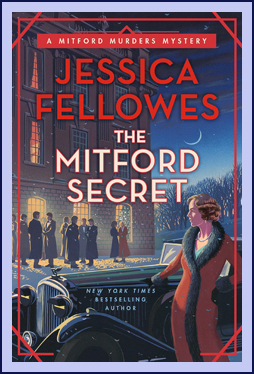 The Mitford Secret by Jessica Fellowes
Published by: Minotaur Books
Publication Date: January 17th, 2023
Format: Hardcover, 384 Pages
Rating: ★★
To Buy
Deborah Mitford is now Lady Andrew Cavendish and she is determined to make her first Christmas as a newlywed a success. It doesn't matter that menus will have to be creative due to rationing, or that Andrew won't be there to celebrate, or that their hoped for child was stillborn, because her in-laws have given her free range of Chatsworth. Her first house party must be a success, and this is quite the house. Even if it's a bit of a mess what with it being used as a school now and the rest of the house being practically shut up, she's sure she can make one or two rooms comfortable and brimming with Christmas cheer. She needs a win. Even if it's small and might seem silly to anyone else, this is her chance to shine. From the Cavendish side, Andrew's grandmother, parents, brother, future sister-in-law, aunt, and uncle will all be in attendance. From the Mitford side, less of a showing what with Tom in Burma and Diana in prison, but Deborah's parents, Unity, and Nancy are all coming. As is Louisa Sullivan. Nancy, knowing her family, thinks a buffer would be a good idea and this way Louisa and her darling daughter Maisie get away from the constant bombing of London and get to have an actually restful holiday. Or that's the plan. Because as soon as Lord Redesdale sees Louisa he's convinced that a dead body will show up any minute. And while one would hope that he is wrong, he's not. One night before dinner a strange villager shows up at the door demanding entrance. A Mrs. Hoole. She has a message for Lady Andrew from, well, she can't really say from where, but they come to her. And the message is to "look in the vestibule." This is all a bit much and cook will be furious if dinner gets cold, but between them all they figure out exactly where in this enormous house there is a vestibule and there they find a maid's cap with dried blood. But as the dowager duchess points out, the style of the cap is from at least the last war. Intrigued and late for dinner they decide that Mrs. Hoole will return and perform a seance. The next night she puts on quite the show for them all but saves the best for last. She tells Deborah, Nancy, and Louisa, the truth after everyone else has retired for the night. She used to work at the house with her dear friend Joan Dorries who disappeared in 1916. The household and the police weren't interested in investigating. But Mrs. Hoole, hearing that a private detective was staying up at the house, realized this might be her last chance to find out the truth. Sadly Mrs. Hoole will be found dead the next morning. The local doctor can't say if it is suspicious or not. Louisa is convinced it is, Lord Redesdale is resigned. It's just another Mitford occasion with Louisa and a corpse. Everything is bound to work out in the end with some dramatics in the interim.
This is it! This is the book I've been waiting for. And not just because it's the end of the series, but because it's about my favorite Mitford, Deborah. Also, if you are wondering, my Mitford ranking goes Deborah, Jessica, Nancy, Pamela, Unity, and in the depths of hell, Diana. So, no pressure right? Jessica Fellowes, it's your duty to make Debo shine! And honestly, there literally was no pressure because my expectations for this series are so low, and yet this book failed to reach even this low bar. The thing is, back in 2020 I read the first three books in this series and, well, hate is almost too benign a word for what I felt. Though I was determined that I would finish this series. So I girded my loins and just finished the series this year. And yes, it did take me five years to mentally prepare myself for this task. At first I thought that maybe I had been too harsh on the series because the fourth book, The Mitford Trial, wasn't half bad. But the next two books were right back on form, subpar to say the least. From the beginning this series hasn't actually known what to do with the Mitfords. They're there but they add nothing. Which is why I think I actually enjoyed The Mitford Trial, because the Mitfords were integral to the plot not just ambiance. Here they're back to being wallpaper. Yes, we need Deborah because without her we don't have Chatsworth, but seeing as Jessica Fellowes has written so many books on Downton Abbey you think she'd get the dynamic right of the most classic of tropes, a murder mystery at a country house during Christmas. She doesn't. There's no forward momentum. At one point Louisa says that the house is in the dead days between Christmas and New Year's. Now I've never felt that these were dead days, just days to read and recharge, I now view them as dead days. Days that stretch on interminably by an inept author. Why are we supposed to care about a cold case? Why are we supposed to care about a dead woman who may or may not have been murdered? We were given no stakes, instead we were given an unhinged Louisa. She behaves so rashly and out of character that it made me remember why I hated her in the first place. I mean, she just finds the killer by a process of elimination because she has literally blamed everyone else for the crime. And in some cases called the police on them. I mean, this is her job and she is just shit at it. What's more, this running around like a chicken with it's head cut off endangers her child but she doesn't seem to care. But the real kicker is that Jessica Fellowes had a clever idea, I mean, it was bound to happen sometime. The crime scene is a red herring. This should have been played up not left until the end as an afterthought. Though thankfully, this is the end. Right? Don't even think about giving her a contract for a book about Tom!
 Six sisters raised in an unorthodox manner, with their own argot, Honnish,
with education being for boys, not girls, they never had a formal
education, yet despite that hindrance, two of them went on to become
celebrated writers, with Nancy Mitford regarded as one of the best
writers of the 20th century. They are a topic of conversation that would make any Anglophiles sqweee with joy and historians of the bright young things generation pant. In any time period the Mitfords would be called eccentric which made them all the more memorable. As The New York Times said: "A Nazi, a Fascist, a Communist, a Novelist, a Countrywoman, a Duchess...Sisters." The eldest,
Nancy, went on to be famous for her novels satirising her family,
Pamela's lesbian relationship didn't raise many eyebrows especially
because her younger sister Diana married the heir to the Guinness
fortune then left him for Walter Mosley, the leader of Britian's
Fascist movement, eventually marrying in Joseph Goebbels' drawing
room with Hitler in attendance. Unity was much like her sister Diana, in
that she too flocked to Hitler, but was so torn when Britain and
Germany declared war that she shot herself in the head, but didn't die until after the war, lingering but wounded. Jessica meanwhile was a staunch Communist and ran
off with her cousin to the Spanish Civil War, they eventually married. Deborah
on the other hand was quite docile, having married the Duke of
Devonshire and eventually taking the reigns of Chatsworth, one of the great houses of
England, and turning it into one of the most successful country homes
and tourist attractions. Of the six sisters, only Pamela and Unity never took pen to paper. While
Nancy wrote fiction, it seems that the sisters main literary interest
was in non-fiction. Writing biographies, not just of famous people, but
also contrasting biographies of themselves. Besides their own writing
there has been a plethora of books written on them, even a series of murder mysteries wherein they solve crimes from when they were bright young socialites. Controversial,
stylish and notorious... They are an unforgettable family.
Six sisters raised in an unorthodox manner, with their own argot, Honnish,
with education being for boys, not girls, they never had a formal
education, yet despite that hindrance, two of them went on to become
celebrated writers, with Nancy Mitford regarded as one of the best
writers of the 20th century. They are a topic of conversation that would make any Anglophiles sqweee with joy and historians of the bright young things generation pant. In any time period the Mitfords would be called eccentric which made them all the more memorable. As The New York Times said: "A Nazi, a Fascist, a Communist, a Novelist, a Countrywoman, a Duchess...Sisters." The eldest,
Nancy, went on to be famous for her novels satirising her family,
Pamela's lesbian relationship didn't raise many eyebrows especially
because her younger sister Diana married the heir to the Guinness
fortune then left him for Walter Mosley, the leader of Britian's
Fascist movement, eventually marrying in Joseph Goebbels' drawing
room with Hitler in attendance. Unity was much like her sister Diana, in
that she too flocked to Hitler, but was so torn when Britain and
Germany declared war that she shot herself in the head, but didn't die until after the war, lingering but wounded. Jessica meanwhile was a staunch Communist and ran
off with her cousin to the Spanish Civil War, they eventually married. Deborah
on the other hand was quite docile, having married the Duke of
Devonshire and eventually taking the reigns of Chatsworth, one of the great houses of
England, and turning it into one of the most successful country homes
and tourist attractions. Of the six sisters, only Pamela and Unity never took pen to paper. While
Nancy wrote fiction, it seems that the sisters main literary interest
was in non-fiction. Writing biographies, not just of famous people, but
also contrasting biographies of themselves. Besides their own writing
there has been a plethora of books written on them, even a series of murder mysteries wherein they solve crimes from when they were bright young socialites. Controversial,
stylish and notorious... They are an unforgettable family.
 If one were to walk in the footsteps of Jane Austen's Pride and Prejudice I think we can all agree that when one thinks of Pride and Prejudice there is only one destination possible, and that's Pemberley. This is especially beguiling to American readers where we seriously don't have grand manor houses or even castles strewn about the countryside protected by a National Trust. But as Lizzy and her Aunt and Uncle Gardiner clearly show, these great houses were just as beguiling to Brits over two hundred years ago. Because who doesn't like to wander around big beautiful houses seeing famous works of art in a setting that isn't strictly speaking a museum? But the question becomes, where is Pemberley? You could go to Lyme Park, which was the house used in the BBC miniseries, but to me, more known for being used in a season three episode of Red Dwarf, and yes, I know I have weird priorities. Or you could have even bought Wentworth Park fairly recently, where they were claiming that the house's notoriety came from the fact it was the basis for Pemberley. A "fact" that no one has really ever agreed on. But to me I think Pemberley as Austen saw it is most likely
  It's not just that Austen knew of the house and compares Pemberley to Chatsworth that makes Chatsworth a good contender, as well as both real and fictional houses being in Derbyshire, it's also actually been used as Pemberley in the P.D. James continuation Death Comes to Pemberley as well as in the 2005 adaptation of Pride and Prejudice starring Matthew Macfadyen. In fact they have the Matthew Macfadyen marble bust still there, though they request that you don't buss the bust. They have a Regency Ball there every summer which I long to be invited to! But even if that doesn't get you excited there is a deal breaker in my mind that makes this great house a must stop, and that's the connection to the Mitfords. Deborah Mitford, one of the famous Mitford sisters, was the Duchess of Devonshire and the family seat is Chatsworth. She not only spent her life surrounded by the literary, but she helped save the house after the tragic death of the heir and went on to make it a thriving business that allowed her to extensively expand the house's art collection with modern masters. So go for your Darcy dream, stay, and you can literally
  Home to Roost and Other Peckings by Deborah Devonshire
 Deborah Mitford grew up with two goals, marry a duke and take care of her chickens. She succeeded in both goals. She married Lord Andrew Cavendish, the younger son of the Duke of Devonshire, whose seat was the great house of Chatsworth. Chatsworth is the epitome of English Country Estates and was used by Jane Austen as the model for Pemberley in Pride and Prejudice, which makes it no surprise then that they used the great house in several of the book's adaptations to the big and small screen. When the Duke's heir apparant, William, died in combat, Andrew became heir and the 12th Duke of Devonshire upon his father's death.
 For some time now I have wanted to do a tribute month to the Mitfords. Now, while I really wanted to do this to coincide with Deborah Mitford's 90th birthday in March of 2010, she being the last living Mitford, as you can see I'm a few years off... but still, better late then never is what I say. For any Anglophile the Mitfords are an interesting subject. Six sisters raised in an unorthodox way, with their own argot, Honnish, with education being for boys, not girls, they never had a formal education, yet despite that hindrance, two of them went on to become celebrated writers, with Nancy Mitford regarded as one of the best writers of the 20th century.


