
























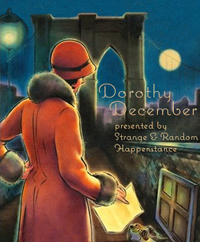

Book Review - Dorothy Parker's The Portable Dorothy Parker

Published by: Penguin Books
Publication Date: 1944
Format: Paperback, 626 Pages
Rating: ★★★★★
To Buy
Hazel is a beautiful busty blonde, always putting on a show for one lover or another. Marriage allows her to finally be herself, which doesn't please her husband one bit. He misses the good-time girl he married. She takes to drinking and hanging out with her neighbor who always seems to have a plethora of men at her place. One particular man takes a shine to her and her husband is out of the picture and she's a kept woman. Until one day she isn't. She moves from one man to another, being the good-time girl, a fate she's destined for as even suicide didn't take. Suicide is a theme returned to again and again, "Razors pain you;
Rivers are damp;
Acids stain you;
And drugs cause cramp.
Guns aren't lawful;
Nooses give;
Gas smells awful;
You might as well live." All these people living desperate lives, barely scraping by. Yet the Crugers are well off. They have staff to take care of their every whim. Miss Wilmarth is a nurse that works for them. She is neither above nor below stairs. She is in her own world. But her employers let her little by little into their world. Of course to the Crugers she is a joke. They believe she is unattractive and like showing off their "Horsie." Because if one thing is true, those with money will make sport of their lessers. So the truth of "society" is revealed, it is there to be the punching bag, a position they aren't used to. But the truth is, behind the veil even those who are well off, those with jewels and pearls, they too suffer from melancholia. The world makes everyone suffer in the end. Though one lady out on a date might just adopt "Horsie," it's something she's prone to do after "just a little one." But as she gets drunker and drunker, her companion Fred has to hear her slur the reputation of their mutual acquaintance, Edith. Because the alcohol makes her maudlin and apt to say what she shouldn't even be thinking. But it will all be alright if they adopt just a little horse... Alcohol, class, loneliness, depression, this is the world as it is, but also with the cut and thrust of someone who has been there.
Everyone knows Dorothy Parker even if they don't know they know her. She is remembered primarily for her pithy one-liners. If you've ever heard someone say that men "seldom make passes at girls who wear glasses" that's one of hers. As is "what fresh hell can this be?" And "I hate writing, I love having written." Timeless snark that people use to this day, even if it's been slightly bastardized and altered. Despite her dislike of writing her output was prodigious, a poet, a reviewer, and short story writer, she did it all. What's more she even followed the writers inevitable journey west to Hollywood and garnered two Academy Award nominations. One of which might surprise you. She just happened to write the first version of A Star is Born. Though personally I'm more impressed with her doing Saboteur for Hitchcock. Her stories became wildly popular due to her and Alexander Woollcott producing an anthology of her work for servicemen stationed overseas during World War II. It was finally published for the masses in 1944 as The Portable Dorothy Parker. Since then it's been revised twice to add in more material and make it the behemoth that it is today, a paperback clocking in at 626 pages that could clock anyone if wielded properly. One would think that reading this vast conglomeration of work from her scatching review of The House at Pooh Corner to letters about staying with friends in a tuberculosis sanitarium in Europe to poetry and prose might give you a little whiplash. That you might just be overwhelmed by the sheer disparate quality of her work. But for me, this wasn't the case. Instead I felt like I got a glimpse of this fully rounded character, and boy was she a character. Her poetry showed her depth of feeling along with her astounding use of language. Her letters showed her inner life and her social conscience and how she was always fighting for the underdog, even if it did get her on the Hollywood blacklist. Her reviews showed that even if you were her friend she'd come at you both barrels blazing. And her short stories showed her wicked wit. While many people point to "Big Blonde" as her best story, might I counter with "The Game." Written for Cosmopolitan in 1948 it's about a newlywed couple hosting a few of their friends at their apartment. The game they play becomes more and more vicious with secrets revealed, especially about the husband's first wife... With this story alone you can see why she worked with Hitchcock. It's a marital version of Rope. You NEED this story in your life so you might as well buy the book. You wouldn't want her ghost showing up and decimating you with the perfect pithy put-down now would you?
 Dorothy Parker is easily the most quoted American author known for her caustic wit and sharp tongue. An American Oscar Wilde, if you will. She had the brains and the bite. Dorothy Rothschild, not those Rothschilds, was born in New Jersey but quickly whisked back to New York, so as she could be a true New Yorker. Once her mother died her relationship with her father was contentious until his death when she was twenty. A year later she sold her first poem to Vanity Fair, a magazine she would eventually work at after a two year stint at Vogue. In fact she'd bounce around the various New York publications, from The New Yorker to Esquire and all those in between, for many years, though it was her work as the theatre critic for Vanity Fair, where she was filling in for P.G. Wodehouse when he was on vacation, that made her career take off. This time in her life was centered around her lunches at the Algonquin Round Table. She held her own as one of the few women at a table of (almost) equally smart and wisecracking male colleagues.
 "It occurs to me that there are other towns. It occurs to me so
violently that I say, at intervals, "Very well, if New York is going to
be like this, I'm going to live somewhere else." And I do — that's the
funny part of it. But then one day there comes to me the sharp picture
of New York at its best, on a shiny blue-and-white Autumn day with its
buildings cut diagonally in halves of light and shadow, with its
straight neat avenues colored with quick throngs, like confetti in a
breeze. Some one, and I wish it had been I, has said that "Autumn is the
Springtime of big cities." I see New York at holiday time, always in
the late afternoon, under a Maxfield Parish sky, with the crowds even
more quick and nervous but even more good-natured, the dark groups
splashed with the white of Christmas packages, the lighted holly-strung
shops urging them in to buy more and more. I see it on a Spring morning,
with the clothes of the women as soft and as hopeful as the pretty new
leaves on a few, brave trees. I see it at night, with the low skies red
with the black-flung lights of Broadway, those lights of which
Chesterton — or they told me it was Chesterton — said, "What a marvelous
sight for those who cannot read!" I see it in the rain, I smell the
enchanting odor of wet asphalt, with the empty streets black and shining
as ripe olives. I see it — by this time, I become maudlin with
nostalgia — even with its gray mounds of crusted snow, its little
Appalachians of ice along the pavements. So I go back. And it is always
better than I thought it would be."
"It occurs to me that there are other towns. It occurs to me so
violently that I say, at intervals, "Very well, if New York is going to
be like this, I'm going to live somewhere else." And I do — that's the
funny part of it. But then one day there comes to me the sharp picture
of New York at its best, on a shiny blue-and-white Autumn day with its
buildings cut diagonally in halves of light and shadow, with its
straight neat avenues colored with quick throngs, like confetti in a
breeze. Some one, and I wish it had been I, has said that "Autumn is the
Springtime of big cities." I see New York at holiday time, always in
the late afternoon, under a Maxfield Parish sky, with the crowds even
more quick and nervous but even more good-natured, the dark groups
splashed with the white of Christmas packages, the lighted holly-strung
shops urging them in to buy more and more. I see it on a Spring morning,
with the clothes of the women as soft and as hopeful as the pretty new
leaves on a few, brave trees. I see it at night, with the low skies red
with the black-flung lights of Broadway, those lights of which
Chesterton — or they told me it was Chesterton — said, "What a marvelous
sight for those who cannot read!" I see it in the rain, I smell the
enchanting odor of wet asphalt, with the empty streets black and shining
as ripe olives. I see it — by this time, I become maudlin with
nostalgia — even with its gray mounds of crusted snow, its little
Appalachians of ice along the pavements. So I go back. And it is always
better than I thought it would be."  And when you're talking landmarks of Literary New York, there's one place that you have to visit, and that's The Algonquin. The Algonquin is at 59 West 44th Street, between 5th and 6th Avenue, or if you're being pedantic, 5th Avenue and the Avenue of the Americas. The hotel's first desk clerk, and eventual owner, Frank Case, fostered the arts and in particular struggling writers creating an environment in which the Round Table, that most vicious of circles, was able to bloom. From 1919 to 1929
  The group first gathered in the Algonquin's Pergola Room (now called The Oak Room) at a long rectangular table. As they increased in number, Algonquin manager Frank Case moved them to the Rose Room and a round table. Initially the group called itself "The Board" and the luncheons "Board meetings." After being assigned a waiter named Luigi, the group re-christened itself "Luigi Board." Finally they became "The Vicious Circle" although "The Round Table" gained wide currency after cartoonist Edmund Duffy of the Brooklyn Eagle caricatured the group sitting at a round table and wearing armor. To join this hallowed group "the price of admission [was] a serpent's tongue and a half-concealed stiletto."
  Despite all the famous writers and celebrities who have lived at The Algonquin over the years I can't help but smile at the hotel's most famous current resident, Matilda the Cat! The tradition of having a cat in the hotel was started by Frank Case after he took in a stray. Though Frank didn't realize what he was starting with that first cat, Hamlet, who was named after that famous Dane by John Barrymore. Since then many a Hamlet and a Matilda have lived there. So go for the cat, stay for the literature!
  As a final note I find it vastly entertaining that the offices of The New Yorker were actually located right across the street from The Algonquin, making Vicious Circle meetings easy to slip out to, but that location must wait for another day. Parker and her cronies where in at the beginning, and instead of starting out on West 44th street, the original offices where in the house of it's founder, Harold Ross and Jane Grant. Located in Hell's Kitchen, at 412 West 47th Street between 9th and 10th Avenue, the little white four story house is still standing, if you care to pay homage to a magazine that has fostered the arts for almost a century. The past and the present merge in New York, to create living history and an experience you won't easily forget if you are lucky enough to visit.


