


Showing posts with label Somewhere in Time. Show all posts

Friday, March 17, 2017

Book Review - Cat Winters's The Uninvited

The Uninvited by Cat Winters
Published by: William Morrow
Publication Date: August 11th, 2015
Format: Kindle, 368 Pages
Rating: ★★
To Buy

Ivy Rowan has been abed with the flu for days. The last night she is to spend at home she awakes to see the ghost of her grandmother. She instantly knows something is wrong. She has only ever seen these uninvited guests, these ghosts, as harbingers of death; someone close to her will die. Her grandmother came to warn Ivy, her father and brother have killed a man. They have murdered the owner of the furniture store, who was a German immigrant. Ivy's brother Billy died the week previously in the Great War and there are rumors that the Germans are responsible for this plague that has descended on Ivy's small Midwestern town. Her brother and father committed this horrible act of vengeance on an innocent man. Though the papers will ascribed the death to patriotic vagrants, Ivy knows the truth. Ivy's mind and body rebels, she packs her belongings and flees into the night. Out in the world, Ivy, the virtual recluse, starts to live life and form friendships amongst all the death. She helps two red cross nurses ferry the ill, she lodges with the widow of a former classmate, but most importantly she tries to make amends to the grieving brother of the man her family killed, Daniel Schendel. She is drawn to Daniel as much as she is drawn to the jazz music playing every night across the road from his store. As their relationship grows more intense Ivy starts to realize that not everything is at it seems. There are secrets too horrific to face so one should just face the music and dance.

One of my friends said that I should have been forewarned that I wouldn't like this book because the blurb declaimed that it was "perfect for those who loved The Thirteenth Tale by Diane Setterfield." To say I loved The Thirteenth Tale would be grossly untrue, even saying I liked it would be a lie... so I should have had an inkling that The Uninvited wasn't for me. But it was the deal of the day on Kindle and that cover... well, that cover has more atmosphere than the whole book and I seriously need to stop being tricked by a pretty cover. The main problem I had was that I was looking for a good Gothic read and while this does have all the elements of Gothic literature it has all these elements without them ever coming together into a cohesive whole and being Gothic. Ghosts, check, virginal heroine, check, olden days, check, laws flouted, check, add to that a horrid plague and well, I am just baffled. I think the reason it failed is twofold. The ghosts aren't scary, they're just a part of the virginal heroine's life during the Great War. On top of that while a world destroying plague is terrifying and does have the Gothic element in spades, the problem is us modern readers aren't scared of this plague. We know what the cause is. You have to take this truth and spin it or distort it in order to keep the horror relevant to modern readers.

But everything about this book was like Gothic Literature turned upside down. You think it will work and it doesn't. I had this feeling from the first pages as Ivy raised herself from her sickbed that this felt like the conclusion of a story. That we missed Ivy's story, we missed her imprisonment and illness, we missed her journey and here we are at the end and she gets her happily ever after. She is no longer in seclusion but enjoying life and getting a chance at love. Oddly enough it turns out I was somewhat astute in this observation. Because the irony is, and this is a big spoiler folks, Ivy is dead. So this whole story happens after her death. Therefore her journey has happened, her day is done, what we read here is some imagined ghostly happily ever after that Christopher Reeve was so desperately searching and then dying for in Somewhere in Time. It's most likely Winters did this setup on purpose, but that doesn't satisfy me. It makes me feel like I was manipulated from page one. I went in expecting a certain kind of book and I basically got The Others, the disappointing Nicole Kidman movie. So if you're looking for a slightly otherworldly World War I book set in the Midwest that will give your tear ducts a workout, go for it.

Your tear ducts won't be the only thing getting a workout, because this book is determined to pull out your heartstrings and beat you to death with them. One of the reasons I like Gothic literature is that it preys on other emotions, fear being the primary one. I don't like chick flicks, I don't long for a good cry, I'm not pining for something new from Nicholas Sparks. I don't want my emotions manipulated. If in the telling of a good story my emotions suffer, well, that's fine, it's the sign of good storytelling. On the other hand, if a story is written just to play merry havoc on my emotions, well, it starts to piss me off. The repeated reveals of just how many of Ivy's friends are actually ghosts besides herself was unnecessarily cruel. Yes, Winters wanted to show that these people were more than just statistics, that each and every life claimed by the Spanish Flu was a life someone missed, a life that mattered, but there's a point when you just can't take anymore. This drain on my emotions was too much to handle. The first time Ivy returns home to talk to her mother, what with everything that's been going on in my own life at the moment I just couldn't deal with it. I wanted this book to be banished from my sight. I wanted it to stop hurting me. At one point I thought, I'll hurt it by giving it one star! But then I thought, no. While this book isn't for me, while it's not what I expected, Winters is still too competent a writer to punish, like she did to me.

What with everyone being dead you can't help to start drawing conclusions to the aforementioned The Others, or to The Sixth Sense, or more importantly to the television show Life on Mars and it's sequel Ashes to Ashes. In particular the television shows spent seasons building your rapport with these characters only to have the finale of Ashes to Ashes reveal that they are in a way station after their deaths awaiting the next phase of their journey, through a pub, The Railway Arms, which leads to heaven. Now let's look at The Uninvited Guests, ghosts, stuck continuing their lives until they go to the Jazz Club and ascend... so basically exactly what happens in Ashes to Ashes without the time slip... this similarity, even if the author has never seen or heard of these shows made me feel like there was nothing truly original in this book. It felt like it was never trying to be it's own thing, just a combination of other things that worked more successfully. With Ashes to Ashes when the reveal was made with the character of Shazzer I lost my shit. This wasn't a narrative that had ever made me cry, but I was so connected to the characters that this undid me. Whereas, as I've mentioned previously, here Winters just repeatedly pulls the rug out from under you. It's not a real connection, it's not real emotion, she never works to get you to feel, it's a false feeling. Whereas Shazzer's death will always stay with me, I don't think this book will stay with me after a few more weeks.

Though there is one thing that might stick. The jazz of it all. Once you realize the characters are dead and it's basically a siren song it makes a little more sense how much the music is driving Ivy. The thing is, while I love certain artists, play piano and even saxophone at one time, I'm not one of those people with music in my veins. If you cut me I will likely bleed ink from being such a word person. Therefore I have a hard time connecting to people like Ivy who hear music and just can't stop their toes tapping. Who can't stop the call of the music as it pumps through their veins. If music is pumping through my veins I'm usually the person wondering if we can turn the music down a bit cause it's loud. Also if there's one kind of music I detest it's jazz. Seriously. Can. Not. Stand. It. Therefore this jazz that runs through the book was annoying but also was antithesis to trying to get any Gothic vibe going. So it alienated me as it blithely made the book more and more the opposite of what I was hoping for. Can we also talk about how depressing it is that these ghosts are drawn to jazz? While it was popular at this time it wasn't until the roaring twenties when this genre took hold, a decade none of these characters are going to live to see. The music and the characters are full of false life. Their story is done, thankfully for me, and it was a bleak one.

Friday, January 23, 2015

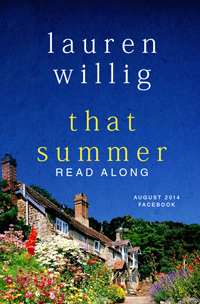
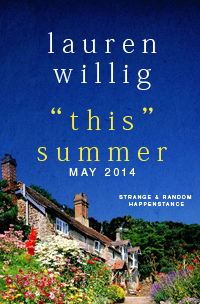
Book Review 2014 #3 - Lauren Willig's That Summer

That Summer by Lauren Willig
ARC Provided by the Publisher
Published by: St. Martin's Press
Publication Date: June 3rd, 2014
Format: Hardcover, 352 Pages
Rating: ★★★★★
To Buy

Julia Conley has inherited a house in England. A house on Herne Hill has been left to her by an unknown great-aunt. Julia and her father left England when she was six and her mother was killed in a car crash. Since her life in New York hasn't been going that well lately as one of the many unemployed, she decides to go to England and spend a few months sorting out the house and hopefully sorting out her life. For Julia who has viewed her family as just her and her father she finds it hard to come to gripes with the fact that this was where her mother came from and she still has family here with a few cousins, who of course feel slighted with great-aunt Regina's will. The more time Julia spends in the house the more she wishes she had been given the chance to know her great-aunt.

For Regina might have held the key to a lovely Pre-Raphaelite painting in one of the rooms of the house, which has a matching painting hidden deep at the back of one of the cupboards. Why was the one painting displayed and the other hidden? Who is this artist Gavin Thorne? Going back to 1849 we learn about the painter Gavin Thorne and his muse, Imogen Grantham, who happened to be the mistress of the house on Herne Hill and married to a wealthy and significantly older collector who was occasionally visited by the Pre-Raphaelite Brotherhood who doted on his historical relics. Yet why hide the painting? What connection does this painter and this wife have to Julia? More importantly, after 160 years can Julia find out?

Sometimes life is staggering in it's synchronicity. The very day that I received That Summer in the mail my Great-Aunt Vicki died. My family got the call that she had passed in her sleep and that the rest of the family was to descend on Madison to take care of her estate. My Great-Aunt was the last of the older generation, being preceded in death by all my Grandparents and even an Uncle. While sadly I have never been bequeathed a mysterious house, because she was the last of that generation I have gotten quite used to clearing out ancestral homes, my Grandparents farm having accumulated over a hundred years worth of ephemera, with sadly not a rare painting or a secret stash of cash in sight, but a random piano being used as a tool bench and much mouse effluvia. As I spent the following weeks sifting through the rooms of her house, picking what to keep and what to give away, I couldn't help but think of all the things I don't know about my family and where I come from. There is a strong ancestry bug that my family has, but I have not yet been bitten, and there's a part of me that keeps thinking, better now before it's too late.

The detritus is all we have left of our family's history. Random paintings around the house, Aunt so and so painted this, Cousin so and so did that one; just what if the painting was something more? What if the painting was a closely guarded secret that would unlock some mystery about yourself? The search for your own identity is caught up in the past, in where you come from. While Julia's search for what happened in her own past with her mother as well as to her ancestor's is something that might be uncommon, the search is something we can all identify with. Lauren has tapped into something deep within everyone, a longing to know where they're from in order to find out where they belong. This gives us a strong connection to the characters, we are on their journey with them and I wouldn't want it any other way.

While the time slip genre is nothing new, Lauren is able to create a more accessible story then some authors who mire their books in overly flowery details and descriptions that go on for so many pages you lose the thread of the story. This isn't to say the writing is sparse, it's exactly what it needs to be to conjure this world, no more and no less. Though there is a part of me that wishes at some time in the future Lauren would go all out and write a doorstop of a novel. Yet in Lauren's time slip she is able to capture the best of all worlds, with a little Kate Morton, a little Somewhere in Time, a nod to Du Maurier's Rebecca, a Keats Bridget Jones call out with a wink to Nancy Mitford's silly season. There are also echoes of Victorian literature, from Imogen's marriage mirroring Dorthea's in Middlemarch, to Gavin bringing a little of the John Thornton vibe from North and South. Yet these homages aren't derivative, they give us a touchstone for the time period but then become so distinctly their own story that while you remember the connections at the back of your mind they are inconsequential as the story takes on a life of it's own.

As for the Pre-Raphaelite Brotherhood, I will admit that this subject matter is what made me swoon when I heard over a year ago about Lauren's next planned stand alone. I think that I have adequately covered my love of them in previous posts and writings, but I will say that even in the BBC production of Desperate Romantics, they have always been a band apart. Outsiders who verged on Gods in their ways of self aggrandising each other and mythologizing their lives and works. They were Romantics in every sense of the word, demanding the capital letter "R". Yet Lauren brought them down off their pedestals. Packed into the snug sitting room on Herne Hill we see a human Rossetti with his schemes and ideas and his future spiraling out before him. The ways the Brotherhood sought out collectors of antiquities to give an authenticity to their paintings adds a realism to them and their works.

These men aren't Gods, no matter how many posters in English classrooms and dorm rooms might say otherwise, they are men. They have loved and lost and with Gavin we have a true romantic hero that is swoonworthy. And like all good writing, this one aspect of the book, the Brotherhood, it doesn't overpower the story, it compliments it, it strengthens and adds to it. You will fall into this book and even if you are just a fraction of a romantic the Pre-Raphaelite's were you will find yourself falling in love with both couples in the different time periods. I hope you enjoy this book as much as I did, and if you're coming into this book from Lauren's Pink Carnation series, there are a few gems hidden in the book, but like these painters who would hide the Brotherhood's initials in their paintings, you might have to have a keen eye to spot them.

Friday, May 30, 2014

Book Review - Lauren Willig's That Summer

That Summer by Lauren Willig
ARC Provided by the Publisher
Published by: St. Martin's Press
Publication Date: June 3rd, 2014
Format: Hardcover, 352 Pages
Rating: ★★★★★
To Buy

Julia Conley has inherited a house in England. A house on Herne Hill has been left to her by an unknown great-aunt. Julia and her father left England when she was six and her mother was killed in a car crash. Since her life in New York hasn't been going that well lately as one of the many unemployed, she decides to go to England and spend a few months sorting out the house and hopefully sorting out her life. For Julia who has viewed her family as just her and her father she finds it hard to come to gripes with the fact that this was where her mother came from and she still has family here with a few cousins, who of course feel slighted with great-aunt Regina's will. The more time Julia spends in the house the more she wishes she had been given the chance to know her great-aunt.

For Regina might have held the key to a lovely Pre-Raphaelite painting in one of the rooms of the house, which has a matching painting hidden deep at the back of one of the cupboards. Why was the one painting displayed and the other hidden? Who is this artist Gavin Thorne? Going back to 1849 we learn about the painter Gavin Thorne and his muse, Imogen Grantham, who happened to be the mistress of the house on Herne Hill and married to a wealthy and significantly older collector who was occasionally visited by the Pre-Raphaelite Brotherhood who doted on his historical relics. Yet why hide the painting? What connection does this painter and this wife have to Julia? More importantly, after 160 years can Julia find out?

Sometimes life is staggering in it's synchronicity. The very day that I received That Summer in the mail my Great-Aunt Vicki died. My family got the call that she had passed in her sleep and that the rest of the family was to descend on Madison to take care of her estate. My Great-Aunt was the last of the older generation, being preceded in death by all my Grandparents and even an Uncle. While sadly I have never been bequeathed a mysterious house, because she was the last of that generation I have gotten quite used to clearing out ancestral homes, my Grandparents farm having accumulated over a hundred years worth of ephemera, with sadly not a rare painting or a secret stash of cash in sight, but a random piano being used as a tool bench and much mouse effluvia. As I spent the following weeks sifting through the rooms of her house, picking what to keep and what to give away, I couldn't help but think of all the things I don't know about my family and where I come from. There is a strong ancestry bug that my family has, but I have not yet been bitten, and there's a part of me that keeps thinking, better now before it's too late.

The detritus is all we have left of our family's history. Random paintings around the house, Aunt so and so painted this, Cousin so and so did that one; just what if the painting was something more? What if the painting was a closely guarded secret that would unlock some mystery about yourself? The search for your own identity is caught up in the past, in where you come from. While Julia's search for what happened in her own past with her mother as well as to her ancestor's is something that might be uncommon, the search is something we can all identify with. Lauren has tapped into something deep within everyone, a longing to know where they're from in order to find out where they belong. This gives us a strong connection to the characters, we are on their journey with them and I wouldn't want it any other way.

While the time slip genre is nothing new, Lauren is able to create a more accessible story then some authors who mire their books in overly flowery details and descriptions that go on for so many pages you lose the thread of the story. This isn't to say the writing is sparse, it's exactly what it needs to be to conjure this world, no more and no less. Though there is a part of me that wishes at some time in the future Lauren would go all out and write a doorstop of a novel. Yet in Lauren's time slip she is able to capture the best of all worlds, with a little Kate Morton, a little Somewhere in Time, a nod to Du Maurier's Rebecca, a Keats Bridget Jones call out with a wink to Nancy Mitford's silly season. There are also echoes of Victorian literature, from Imogen's marriage mirroring Dorthea's in Middlemarch, to Gavin bringing a little of the John Thornton vibe from North and South. Yet these homages aren't derivative, they give us a touchstone for the time period but then become so distinctly their own story that while you remember the connections at the back of your mind they are inconsequential as the story takes on a life of it's own.

As for the Pre-Raphaelite Brotherhood, I will admit that this subject matter is what made me swoon when I heard over a year ago about Lauren's next planned stand alone. I think that I have adequately covered my love of them in previous posts and writings, but I will say that even in the BBC production of Desperate Romantics, they have always been a band apart. Outsiders who verged on Gods in their ways of self aggrandising each other and mythologizing their lives and works. They were Romantics in every sense of the word, demanding the capital letter "R". Yet Lauren brought them down off their pedestals. Packed into the snug sitting room on Herne Hill we see a human Rossetti with his schemes and ideas and his future spiraling out before him. The ways the Brotherhood sought out collectors of antiquities to give an authenticity to their paintings adds a realism to them and their works.

These men aren't Gods, no matter how many posters in English classrooms and dorm rooms might say otherwise, they are men. They have loved and lost and with Gavin we have a true romantic hero that is swoonworthy. And like all good writing, this one aspect of the book, the Brotherhood, it doesn't overpower the story, it compliments it, it strengthens and adds to it. You will fall into this book and even if you are just a fraction of a romantic the Pre-Raphaelite's were you will find yourself falling in love with both couples in the different time periods. I hope you enjoy this book as much as I did, and if you're coming into this book from Lauren's Pink Carnation series, there are a few gems hidden in the book, but like these painters who would hide the Brotherhood's initials in their paintings, you might have to have a keen eye to spot them.

Wednesday, August 10, 2011

Christopher Golden

I met Christopher Golden at a Buffy convention back in 2003. Now, this was to be my first big convention far from home, and yes, the Catskills are far from home and I think technically trapped in a different area, like a seedier version of Somewhere in Time. It was a graduation present to myself (though as it turned out I didn't graduate till a year later, long story...) Since this time I have now gotten quite good at navigating cons to meet my favorite authors. I've also found it a great place to find and meet new authors. Of course, this being a Buffy con, I was going for the Buffy people; Giles, Warren, Tara, Clem and Spike. Christopher Golden is part of the extended Buffyverse, having written for the comics, tie-in novels and video games. I didn't know all this at the time. I had a Buffy book sitting on my shelf that he wrote that I threw into my suitcase and called it a day. I should have researched! If I had I would have realized he was the writer to my favorite video game EVER. The EA Buffy game, besides being full of awesome and win, got me through a tough time. I had taken a year off from school due to many deaths in the family, as well as a close friend. When school started back up I was completely overwhelmed. I had not only the current semesters classes, but all the classes I took an incomplete in the year before. The only escape I had was my Buffy game. I played it whenever I could and shoving a stake through a little electronic vamp was pure joy. In other words, this is a roundabout way of saying I wish I had got him to sign my game... even if the second game has my favorite line ever: "Zander Harris doesn't need doors. Zander Harris makes his own." Followed by an explosion.

Back to meeting Chris. So, the signing! I don't know which day of the con it was, but there was one time where everyone got to get in a long line trailing through the resort and wait to get their stuff signed. By this point I had realized how funny Chris is through his panels and his co-hosting the auction with "Clem." I had also made the video game connection by this point and was looking forward to getting a few seconds to say hi and how much I love his work. Anyway, they set Chris up next to Amber "Tara" Benson because they where doing this little awesome side project called Ghosts of Albion. No one seemed to want to talk to Chris seeing as he was being eclipsed by Amber. I wanted to talk to Chris, and because of the "Tara" backup, I got to talk to him more than I would have normally. We where talking about the video game and he mentioned that there was actually a glitch in the game in which the vampires overly repeated a certain phrase, to which we said in unison "there's only one of you and an endless supply of us." My friend Sara looked at me askance and to this day that memory brings a smile to my face. I'm sad the Chris didn't come to the next years con, he would have made it better. But still, he wished me monsters and it made my day.

Older Posts Home