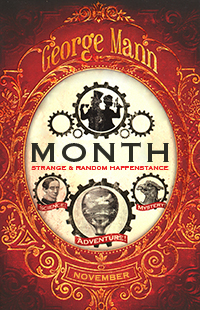
 So, instead of inflicting more of my dream casting on you I thought perhaps you might want to hear a little from the author himself to whom the month of November has been dedicated. So without further ado, I bring you George Mann!
 Question: The first memorable book from you childhood often extends its influence throughout your life. What is your favorite book that you re-read a million times from when you were little?
Answer: I was a very lucky child, in that I was read to extensively from an early age. I had the Hobbit, the complete Chronicles of Narania and all sorts, all before the age of 6. So I think I absorbed a lot of that, and it’s all still in here, somewhere.
A formative book for me, though, was The War of the Worlds by HG Wells. That was a real revelation. I’ve always considered it one of the first great science fiction novels, and I adore how the aliens are defeated at the end by the common cold, rather than the Victorians themselves.
Question: You have created your own vigilante superhero with The Ghost. What was your favorite superhero growing up?
Answer: It’s always been Spider-Man, and, to be honest, is still is. There’s something about the web-crawler that’s always appealed to me. I think it might be because, at heart, he’s just a normal, geeky guy, who saves the day because he has to, and because no one else is going to do it. In many ways he’s similar to the Doctor in that (see below) – he finds himself in these perilous, fantastical situations, and although he’s handy with his fists, it’s usually through intellectual endeavour that he saves the day. At least, in my favourite stories.
Of course, I’ve always been a huge fan of Batman, too. I prefer him in his ‘dark detective’ mode, stalking the streets of Gotham to solve crimes in a way the police aren’t able.
Question: Growing up what was the television show that you most anticipated every week and why?
Answer: I think you know the answer to this one…it was definitely Doctor Who. It was just so different from everything else at the time. Weird, wonderful fantasy that had a huge and lasting impact on my psyche. I loved how the Doctor would just stumble into these amazing, colourful adventures, and always win the day through cleverness, charm, or wit. It was real fuel for the imagination.
 Question: Victoriana and sensational supernatural stories are really making a comeback with shows like Ripper Street and Penny Dreadful. Why do you think people are continually drawn to these subjects?
Answer: I think it’s because the Victorian period is now distant enough to seem unknowable and strange (and therefore fertile ground for sensationalising), but at the same time close enough that it still feels half-familiar. I also think there’s something about the fact that the Victorian era feels like the borderlands between the modern world and the past, science vs superstition. There was a clear preoccupation with ‘occult science’ and superstition in that age, and a view that anything was possible, if only we could find the means to achieve it. Science would prove the existence of the spirit world, that sort of thing. So again, it’s great material for a writer to get their teeth into.
Question: You've written 34 books this year, or at least it seems that what with a new book on the shelves every few weeks. Seriously, when do you not write?
Answer: Ha! I’m always writing. At the same time, though, some of that is to do with scheduling and just a coincidence of when the books are published.
I do have trouble stopping, though. Some would say it’s an affliction. I’m not happy unless I’m working on a story of some kind, in one medium or other.
Question: With the future of traditional publishing avenues in limbo many writers are turning to self-publishing. What do you make of this trend, the advantages and the pitfalls, and how will it affect traditional publishing?
Answer: Well, first and foremost I’m a big believer in the adage ‘everyone needs an editor’. I think that editor can take many different forms, but you need someone who can cast an impartial eye over your work, who knows story and structure, and who will be honest with you about the quality of what you’ve written. That’s very important, I think. So I’d never want to dispense with that.
I think digital self-publishing has a place, though. I love the idea of serializing a Newbury and Hobbes story at some point, for example, over a number of parts, like an old story paper. And clearly people are making a great success of it. Personally, though, I find the interactions I have with my publishers very, very helpful. And it helps to have a team of salespeople and publicists working on your books – if I had to do that stuff myself it would never happen, and I wouldn’t sell any books!
Really, for me, it comes down to the fact that I’d rather be writing new stories than worrying about formatting an ebook, promoting and selling it, etc etc. But I know it’s a great tool for other people, and I’d never rule it out.
 Question: When you started writing the Newbury and Hobbes series did you intentionally write them as Steampunk or did you just write what you felt and it fit perfectly in the Steampunk Genre?
Answer: I’m not even sure they are steampunk! (Shock! Horror!). I definitely didn’t set out to write in any genre. In fact, The Affinity Bridge was quite the opposite. I’d spent years trying to write a big, sprawling space opera, because I thought that was the genre I should have been writing in, and it was so depressing. I just wasn’t getting anywhere with it. I wrote The Affinity Bridge for me, and just threw in everything I was interested in or loved. They’re Victorian fantasias, really, rather than steampunk. There’s not very much punk about them. They were the aesthetics of steampunk, sometimes, but they’re at least as concerned with the supernatural.
Question: With your books being interconnected we have had glimpses of the future of many of your beloved characters. As for the Newbury and Hobbes Series specifically, do you have an end in sight or is your plan to just keep writing? And when will we see The Revenant Express?
Answer: I tend to work in story arcs, rather than planning to the end of the series. So the first big N and H story arc will end in book 6, but I have no intention of retiring them. They may have a little break, but I have lots more stories to tell, if people want to keep reading them. I might also go back and write some more stories with Newbury and Templeton Black, as I enjoyed writing ‘The Dark Path’ very much.
There’s a whole bunch of N and H stuff happening next year. I’m really excited about it. New stories in three different mediums! The Revenant Express is one of them. The others, I can’t quite reveal yet. But soon!
 Question: Many authors don’t think of their characters in terms of actors, but I’ve been having a little fun doing the dream casting for the hopefully one day forthcoming miniseries (fingers crossed) and I was wondering if you’ve ever thought of who could bring your characters to life?
Answer: Ha! Yes, I’ve been watching your casting with interest. I don’t feel I can say too much about casting at the moment, for reasons that will become clear later (and it’s not a TV series, alas – at least not yet), but I will say that I originally had Tom Ward in mind when I first wrote about Newbury.
 Question: With the hugely successful Engines of War you are the first writer to tackle The War Doctor. How did it feel to be basically given a Doctor with a blank slate (well, minus that stuff in “The Day of the Doctor”)?
Answer: Oh, it was amazing! A dream come true, in fact. A little daunting, but so exciting, and so inspiring. I still can’t believe what they allowed me to get away with in that book. To this day, I still can’t quite actually believe it happened.
Question: In my opinion it’s unfair to ask people who their favorite Doctor is (how can I ask someone to choose when I can’t choose between Tom Baker and Matt Smith myself), so I’ll give you a twist, who is your favorite Doctor to write for? It can be one you haven’t written for yet.
Answer: I enjoyed writing for the Eleventh Doctor a lot, but really, it has to be the War Doctor. I had SO MUCH fun with Engines of War. I’ve always wanted to write for the Eighth Doctor too. Hopefully I’ll have the opportunity at some point.
Question: You are now showrunner for Doctor Who, we won’t go into details as to how you secured the job, there may have been a cage match to the death with Moffat and Gatiss, that is unclear, but what are the top three changes you would make?
Answer: That’s a tough question. I really don’t know! Bring in more new writers, perhaps. Introduce a new male companion, maybe someone who isn’t a love interest of one of the leads. Try to persuade the BBC to do additional Easter and Halloween specials. More two-parters. I don’t think there are any silver bullets and I think it must be one of the hardest jobs in TV.
Question: What’s next for George Mann?
Answer: The Revenant Express! Finally! And a bunch of other exciting N and H projects, as mentioned earlier. A new Ghost novel, Ghosts of Karnak, some more Doctor Who, and maybe some new things that I’m toying with at the moment…
 Question: Favorite movie you’ve seen this year?
Answer: Guardians of the Galaxy. Without a doubt.
 Question: Point Break or Bad Boys 2?
Answer: Point Break. I’m not sure I’m even aware of Bad Boys 2!














 My Batman fatigue set in in 2008. If Christopher Nolan couldn't be bothered to take down outdoor signage for the Lyric Opera of Chicago I don't know why I should be bothered to care about The Dark Knight. Also, controversial opinion, Heath Ledger didn't deserve the Oscar that year, but he did deserve it more than Robert Downey Junior. Since then we've gone through quite a few Batmen and my top picks might be a bit controversial, but with George Clooney being back maybe not as much as they once were. And wherever there is Batman there's his trusty butler. In fact for the who's who among actors I think Alfred has drawn the bigger names; Andy Serkis, Michael Caine, Jeremy Irons, Michael Gough, Sean Pertwee, Tom Hollander, Efrem Zimbalist Junior, and on and on. But one interesting development over the years is that Alfred has slowly become less and less posh, Michael Caine and Sean Pertwee really upping the ante. Sean Pertwee's rougher Alfred created by Bruno Heller for Gotham. But I just couldn't get into Gotham despite my Pertwee love. My problem was Gotham was still too rooted in the Batman mythology, seeing all these characters as younger versions of themselves and what they were to become. Which is why I was drawn to Pennyworth. Also created by Bruno Heller he seems to have realized the limitations of his previous series and limited his characters here. Here we have Alfred, and Batman's parents, Thomas and Martha. And that's it. Set in London during the swinging sixties the world created is a fascinating mashup of Last Night in Soho and V for Vendetta with a giant helping of Michael Caine's oeuvre. Our Alfie as played by Jack Bannon couldn't exist without Caine's Alfie. He exudes that cockney coolness and surety while also bringing a bit of Fred Thursday to the role, an inevitability as he played his son Sam on Endeavour for it's entire run. But the show isn't just a standout performance by Bannon, every actor is perfectly chosen to bring to life this vibrant alternative universe that mimics our Cold War but at the same time is wholly unique. Sadly season two leaned too far into mimicking World War II saved only by Peg and Bet. But then again Peg and Bet could save anyone and anything if they had a mind to. So how did they decide to fix the season two mistakes? By making sure everyone knew this show was about Batman's Butler by adding an absurdly ludicrous subtitle. I mean, surly people aren't so dumb they didn't connect the two. Please tell me I'm right because otherwise humanity is doomed. Much like London. Because while we're moving on from diamond geezers to the swinging sixties with hippies we're getting a darker side with the CIA experimenting with "MKUltra" and Patty Hearst and the Manson Family and an artist that looks like a stretched out Brian Eno. Trust me, he's up to no good. So while the aesthetic is very reminiscent of Adam West's Batman 66; brighter colors, dafter plots, and People With Enhancements, AKA PWEs, as pro superheroes and villains, there is a distinct underlying malevolence. Perhaps because they've fully embraced V for Vendetta in what I though was a lovely meta moment but according to the creators of the show is where they were heading all along because they view Pennyworth as a prequel to V for Vendetta as well as Gotham. Say what!?! Does James Purefoy know because I think he'd have something to say. Also you're still not getting me to watch Gotham. No matter how much I want closure and answers.
 Ghosts of Manhattan by George Mann


